

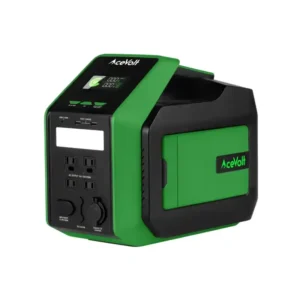
The Acevolt Campower 700 runs at 46dB, the quietest reading we have measured, and returns 89% through both AC and DC. Mains power arrives at 200W from a separate brick, with neither a handover function nor connectivity.
★★★★★
More details +
The Quietest Machine We Have Measured
Across every machine tested for this site, at every capacity and from every brand, none runs quieter under load than this one. Forty-six decibels is roughly a quiet refrigerator heard across a room, and in a tent (where canvas absorbs nothing, and the unit sits an arm's length from your head) that is the specification that decides whether you sleep. It backs the quiet with an unusually consistent 89% conversion through both the AC sockets and the 12-volt output, so the choice of socket costs nothing, plus 2,500-cycle cells and a 100-watt USB-C port that charges a laptop at full speed. The costs are concentrated in how energy gets in and what the machine knows about itself: 200 watts through an external charging brick at one fixed rate, around three and a half hours from empty; a 175-watt solar ceiling capped at 28 volts that excludes nearly every rigid panel; no app of any kind; and no transfer function. The awkward comparison is the VigorPool Captain 700, one decibel louder and better in almost every other way. PROS:
- Forty-six decibels under load, the quietest fan reading in our entire database.
- Returns 89% through both AC and DC, so the choice of socket costs nothing.
- Cells rated to 2,500 cycles, more than either rival at this capacity.
- A 100W USB-C port that charges a laptop at full rate.
- No measurable standby loss on the DC path, and a 145W twelve-volt socket.
- Output inside the accepted voltage band, unlike several rivals at this size.
CONS:
- Wall charging of 200W through an external brick, three and a half hours from empty.
- No UPS mode fitted, so equipment loses power during a blackout.
- No app of any kind, no monitoring, no rate control, no firmware updates.
- A 175W solar ceiling capped at 28 volts, excluding most rigid panels.
- Standby drain of 2.4% an hour with the inverter armed.
- An audible whine from the inverter, and no expansion path.