

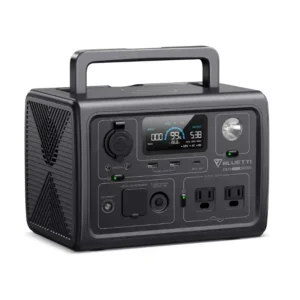
The Bluetti EB3A packs a 20ms transfer, a 600W inverter, and 430W internal charging into a 268Wh unit, with a Bluetooth app and 49dB operation. It sheds 5% of its charge every hour the inverter is armed.
★★★★★
More details +
Remarkable Specification, Worst Standby Drain Measured
Power stations at 268Wh normally charge devices quietly and do nothing else. This one carries a 600-watt inverter (more output than several units holding twice as much), a 20-millisecond transfer function that makes it the smallest machine in our database to offer one at all, 430 watts of internal charging that fills the pack in around thirty-seven minutes, adjustable charge rates, dual charging, a Bluetooth app that works off-grid, a correct 120-volt output and 49 decibels. For 10.1 pounds,s that is an extraordinary specification sheet. Then the standby figure: 5% of the charge disappears every hour the inverter sits armed (the worst idle loss recorded on any machine we have tested at any capacity), and it empties a full pack in roughly 20 hours of doing nothing. That cancels most of what the transfer function exists for, since waiting for a power cut is precisely what drains it. Charge it, use it, switch it off, and it is genuinely clever. PROS:
- A 20ms transfer, the smallest machine in our database to offer one at all.
- Internal charging at 430W with adjustable speed, filling the pack in under forty minutes.
- A 600W inverter on 268Wh, more output than several machines holding twice as much.
- A correct 120V output with no audible whine from the inverter, and 49dB fans.
- A Bluetooth app that works off-grid, plus dual charging and pass-through support.
- Ten point one pounds, a genuine one-handed carry, with solar that refills within the window.
CONS:
- Standby drain of 5% an hour, the worst figure recorded on any machine we have tested.
- Only 78% through AC, seven points below the class line.
- A 28-volt solar ceiling that excludes most rigid panels.
- Priced among the higher figures per watt-hour in our database.
- A 136W twelve-volt socket that falls just under the 150-watt threshold.
- Two thousand cycles under two years of cover, modest for the class.
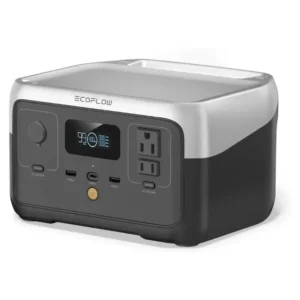
The EcoFlow River 2 weighs 7.4 pounds, the lightest in our database, and charges internally at 360W. It delivers just 190 Wh of its 256 Wh rating via AC but 228 Wh via DC, and includes Wi-Fi and Bluetooth app support.
★★★★★
More details +
At 7.4 pounds, this is the lightest machine we have put on a scale across 81 units spanning 240Wh to 6,144Wh, and for something carried rather than installed,d that counts for more than almost any other figure. EcoFlow pairs it with specifications that nothing else this small offers: 360 watts of internal charging that fills the pack in around forty-three minutes, adjustable rates, both Wi-Fi and Bluetooth, 3,000-cycle cells, and a five-year warranty—the longest coverage at this capacity. Then the conversion. Seventy-four percent reaches the AC sockets, compared with 89% through the twelve-volt path, a fifteen-point gap worth 38 watt-hours on a battery that was small to begin with. The inverter also sheds 4.4% of the charge every hour it sits armed, emptying the pack in roughly a day, and its 30-millisecond transfer ties for the slowest we have measured. Route everything onto DC and USB, switch the inverter off between sessions, and it is an excellent thing to carry.
PROS:
- Seven point four pounds; the lightest machine in our entire database.
- Internal charging at 360W with adjustable speed, filling in around forty-three minutes.
- Returns 89% through DC, fifteen points better than the AC path.
- Both Wi-Fi and Bluetooth connectivity, which nothing else at this capacity offers.
- Cells rated to 3,000 cycles under five years of cover, the longest at this size.
- Quiet at 45 decibels, correctly wired at 120 volts, and panels that finish a charge in the standard window.
CONS:
- Only 74% through the AC sockets, so a quarter of a small pack never reaches you.
- Standby drain of 4.4% an hour, which empties the pack in about a day while armed.
- A 30ms transfer, tied for the slowest reading in our database.
- A 30-volt solar ceiling that excludes most rigid panels.
- Electrical noise above 2,000mv with an audible whine from the inverter.
- A 60W USB-C port and a 100W twelve-volt socket, both modest.
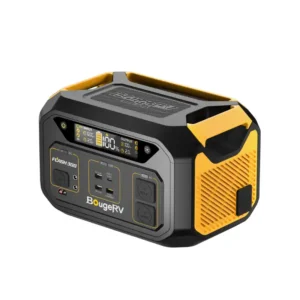
The BougeRV Flash 300 accepts 600W of solar on a 286Wh pack and charges from the wall at 600W, filling in under half an hour. Behind it sit NMC cells rated for 700 cycles, and with a shutoff, there is no way to switch them off.
★★★★★
More details +
Twice the Solar Input of Its Own Battery, at the Highest Price Per Watt-Hour
Solar input is normally sized to the pack behind it, and a 286Wh machine typically accepts 60 to 160 watts. This one accepts 600 across a 12- to 45-volt window at 25 amps, a panel input more than twice the size of its own battery, and a ratio that nothing else in our database approaches. Wall charging matches it at 600 watts through an internal charger, filling the machine in around twenty-nine minutes. That is the case for it, and it is real. Everything about living with it points the other way: NMC cells rated for 700 cycles, roughly two years at daily use where LiFePO4 rivals offer 2,000; an automatic shutoff the grading data records as impossible to disable, which stops low-draw loads unattended; 58 decibels plus an audible inverter whine; an output measuring 110 volts; an eighteen-month warranty; and the highest price per watt-hour of any machine in our entire database, by a clear margin over second place. PROS:
- Six hundred watts of solar on a 286Wh pack, a ratio unmatched anywhere in our database.
- Internal wall charging at 600W, filling the pack in under half an hour.
- Twenty-five amps of solar current, matching machines ten times its capacity.
- A 600W inverter and a 100W bi-directional USB-C port.
- A 45-volt solar ceiling, allowing a small series pair where most compact machines cannot.
- An internal charger rather than an external brick, unusual at this size.
CONS:
- The most expensive machine per watt-hour we have tested, by a clear margin.
- NMC cells rated for 700 cycles, roughly two years at daily use.
- An auto shutoff that cannot be disabled, which stops low-draw loads unattended.
- Fifty-eight decibels with an audible inverter whine, too loud for a tent.
- Output measured 110 volts, below the accepted band and hard on motors.
- An eighteen-month warranty, no app, and no dual charging.
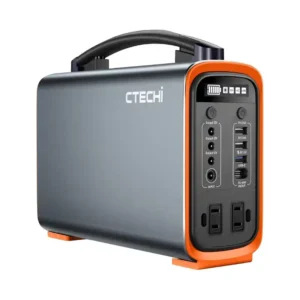
The CTECHi GT200 240Wh portable power station is the smallest machine we have tested, weighing 7.9 pounds and delivering 190Wh at the correct 120 volts. Its 200W inverter is the smallest in our database.
★★★★★
More details +
The Smallest and Cheapest Machine We Have Tested
Two hundred and forty watt-hours behind a 200-watt inverter makes this the smallest machine in our database on both counts, and at 7.9 pounds it is the second lightest we have weighed. There is a real argument for something this modest: if your loads are a laptop, a camera, some lighting and a phone, anything larger is weight and money carried for nothing. It also gets one thing right: four compact machines four times its size do not. Output measures a correct 120 volts, so the small things you run are treated properly. It returns 87% through the twelve-volt path, supports dual charging at 120 watts combined, and costs less per watt-hour than anything else at this capacity. The limits are plain and mostly definitional. The 200-watt inverter rules out everything beyond devices and lighting. Wall charging is 60 watts via an external brick, taking 4 hours from empty, and the solar ceiling of roughly 60 watts is among the lowest we have recorded. Cover runs for a single year. PROS:
- The smallest and cheapest machine in our database, at an entry price tier.
- Seven point nine pounds, the second lightest machine we have weighed.
- A correct 120V output, which four compact machines in our database fail to deliver.
- Returns 87% through DC, clearing the class line on the twelve-volt path.
- Dual charging at 120W combined, which halves the wait in decent sun.
- LiFePO4 cells rated to 2,000 cycles with the array permanently connectable.
CONS:
- A 200W inverter, the smallest continuous output we have recorded.
- Wall charging at 60W with an external brick, around 4 hours from empty.
- Solar of about 60W, among the lowest ceilings in our data.
- Only 79% through AC, six points below where machines this size should land.
- No app, no transfer function, and no expansion path.
- No fan noise or electrical noise is present in our data, and the cover runs for one year.
Show next