
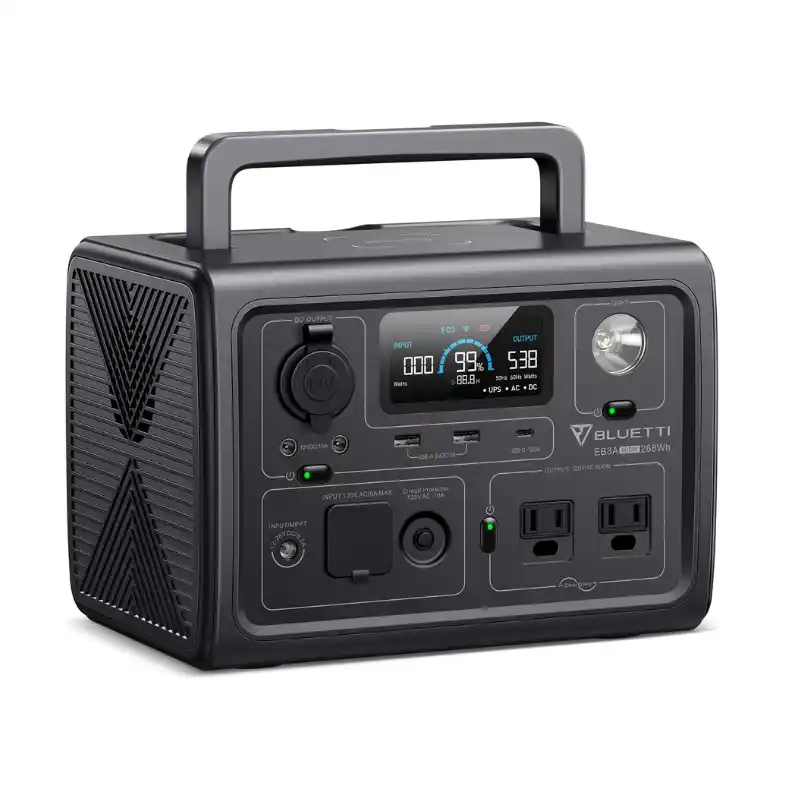
Bluetti EB3A Review

The Bluetti EB3A packs a 20ms transfer, a 600W inverter, and 430W internal charging into a 268Wh unit, with a Bluetooth app and 49dB operation. It sheds 5% of its charge every hour the inverter is armed.
My Quick Verdict
This is the smallest power station we have tested and reviewed with a working transfer function. At 268Wh, almost nothing else even attempts one.
It also charges at 430 watts internally, which fills the pack in under forty minutes, faster relative to capacity than most machines several times its size.
Add a 600-watt inverter, a Bluetooth app, adjustable charging, and 49 decibels; the specification sheet is remarkable for a unit this small.
What undoes it is standby drain of 5% an hour, the worst figure in our entire database. Left armed for a day, this machine empties itself.
Best for: Short trips and day use where the machine is charged, used and switched off in a single session.
Not for: leaving charged between uses, overnight backup, or anything stored ready.
Key Stats
Introduction
Power stations at 268Wh normally do one job: charge devices, quietly, for as little money as possible. Transfer functions, apps and fast charging belong to units four times the size.
The EB3A ignores that. It carries a 600-watt inverter, a 20-millisecond transfer time, 430 watts of internal charging, adjustable charge rates, a Bluetooth app, and dual charging, in a pack smaller than most laptops’ combined battery life.
It is the smallest machine in our database with a working transfer function.
Its pack claims 2,000 lithium iron phosphate cycles against two years of cover.
What It Can Actually Run
Six hundred watts sustained with 1,200 in a burst. That is extraordinary for 268Wh, more inverter than several machines holding twice as much.
From a 268Wh label, the outlets yielded 210Wh, an unimpressive 78% that trails the class bar by seven. Everything below uses 210Wh.
- Television at 150W: about an hour and twenty-five minutes.
- CPAP at 40W with the humidifier off: 5 1/4 hours.
- Starlink dish at 50W: 4.25 hours.
- Laptop at 70W: three charges at full rate through the 100-watt port.
The line held exactly 120 volts, the inverter stayed silent, and the noise measured 1,904 mV.
Charging and Smart Features
Wall input reaches 430 watts through an internal charger with adjustable speed. From empty, that is around thirty-seven minutes.
The panel side accepts 160 watts across 12 to 28 volts at 8.5 amps, and the sheet confirms that sunshine alone completes a charge within the standard window.
Dual charging is supported, and the transfer was measured at 20 milliseconds.
Upper mid-range price tier, luxury value tier.
Charging Speed Benchmarks
Where the Bluetti EB3A lands on charging within the Under 300Wh capacity class, based on all 24 units in our charging database. Mean wall input there is 131W and mean solar input is 97W. Because the bands are so tightly spaced at this size, a 40W difference can move a machine a whole rating, which is why the figures matter more than the labels.
Wall charging of 430W is more than three times the 131W class average, a clear High rating, and it is internal rather than routed through a brick. A 268Wh pack refills in around 0.6 hours. That speed does more work on this machine than on most: the EB3A sheds 5 percent of its charge every hour the inverter is armed, so a pack left ready for a week will need topping up, and being able to do that inside forty minutes is what keeps that drain from becoming a real problem.
Panels accept 160W, which clears the 97W class average comfortably and rates High, though the 600W class ceiling is nearly four times that. A full solar refill takes roughly 1.7 hours in strong light, close to three times the wall socket. A single 200W folding panel saturates the input on its own, so there is nothing to gain from a second one, and the array should be sized to that ceiling rather than to the pack.
Want the array to fill it as fast as the wall does? The BougeRV Flash 300 accepts 600W of solar, nearly four times the EB3A and the highest panel ceiling in the class, filling a 286Wh pack in about 0.5 hours on either channel. It runs 700-cycle NMC cells with no shutoff against the EB3A's lithium iron phosphate, so this is a charging upgrade bought with cell life rather than a straight improvement.
Real Capacity: What You Actually Get
Conversion is weak on AC and acceptable on DC, and the standby figure overshadows both.
A meter on the sockets recorded 210 Wh, compared with a claimed 268 Wh. Seven points adrift of the standard this class is meant to meet.
Twelve volts returned 228 Wh (85%) over the bar. Route what you can that way.
Standby is where the machine fails outright. With the inverter armed, it sheds 5% of its charge every hour, the worst figure recorded on any machine in our database, at any capacity.
In practice,e that means a full pack is empty in about twenty hours of doing nothing. On DC, the figure drops to 0.5%, which is normal.
My takeaway: 210Wh through the sockets, and switch the inverter off the moment you stop using it. At 5% an hour, this machine drains itself in under a day while armed.
Power Output and Surge: What It Can Turn On
Six hundred watts continuous is the standout specification, and it changes what a 268Wh machine can attempt.
Screens, lamps, a networking kit, a laptop, and chargers all fit well inside it, and 1,200 watts of burst power handles small motors. The constraint is capacity rather than output; at 600 watts, the pack lasts about 20 minutes.
Output quality is good: a correct 120 volts and no audible whine from the inverter, which several larger machines cannot claim.
USB-C supplies a laptop’s full 100 watts, while the 12-volt outlet caps at 136 watts, just shy of the 150-watt mark.
Electrical noise measured 1 at 1,904 mV, which is mid-field.
Real Appliance Runtimes
Main figures are based on 210 Wh; the DC line uses the higher 228 Wh.
None of these lines survives being left armed overnight. At a 5% hourly drain rate, a machine charged in the evening is substantially emptier by morning, even with nothing plugged in.
Recharging: Wall and Solar
From a Wall Outlet
Four hundred and thirty watts through an internal charger is exceptional for this capacity, filling the pack in around thirty-seven minutes.
For comparison, most machines of this size charge at 60 to 120 watts via an external brick and take 2 to 5 hours.
Charging speed is adjustable, so a gentler rate is available, and dual charging is supported, both of which are rare for a 268Wh battery.
The fast charging is also what makes the standby drain survivable. If the machine is empty when you reach for it, you are less than forty minutes from full.
From Solar Panels
The panel input draws 160 watts at 12-28 volts and 8.5 amps.
For a 268Wh pack, that is a generous ratio, and the grading data confirm that panels alone can refill the machine within the usual window, something many larger units cannot manage.
Engaging at 12 volts, one folding panel registers straight off, making it suitable for casual camp charging.
Twenty-eight volts at the ceiling excludes most rigid panels, so foldables in parallel are the practical route.
Panels may remain attached indefinitely, with output continuing during charging.
Blackout Backup: The Part I Care About Most
This is the specification that makes the machine unusual, and it comes with a caveat that undoes much of it.
Twenty milliseconds is the line, not a cushion beneath it, and at that pace, survival depends on the connected device’s own supply.
But it is a working transfer function on a 268Wh machine, and almost nothing else at this size has one.
The problem is that a transfer function requires the inverter to be armed, and arming this machine costs 5% an hour. A unit left ready for a power cut will be empty within a day of waiting.
Why this matters to me: the smallest machine in our database with a transfer function also has the worst standby drain, and those two facts cancel each other out. It can catch an outage, but not one you were waiting for.
Noise and Living With It
Forty-nine decibels under load, which is quiet and comfortably below the threshold for a room where someone sleeps.
The inverter is logged as making no sound of its own, leaving airflow as the only cause.
Ten point one pounds, 4.5 kilograms, light enough to carry in one hand as far as you like.
The app runs over Bluetooth, which is unusual at this capacity and works off-grid where Wi-Fi would not. The cover extends two years with a same-day response pledge.
Where It Falls Short
Three limitations, the first of which is the worst figure in our database.
1. Five per cent Standby Drain Per Hour
The highest idle loss recorded on any machine we have tested, at any capacity.
A full pack empties itself in roughly 20 hours when the inverter is armed, and nothing is plugged in. Charged on Friday evening, it is largely gone by Saturday afternoon.
That makes the transfer function nearly unusable for its intended purpose, since waiting for a power cut is exactly what drains it.
2. Seventy-Eight Per cent Through AC
Seven points below the class line, so 58 watt-hours of an already small pack never reach the sockets.
The 85% DC path is better, but on 268Wh every point matters more than it would on a larger machine.
3. A 28-Volt Solar Ceiling and Luxury Value Tier
Most rigid panels operate above 28 volts and will not engage, leaving foldables as the only route.
And per watt-hour,r this sits among the more expensive machines in our database, which is a lot to pay for 210 usable watt-hours.
How It Compares
Two comparisons at a similar capacity, neither of which has a transfer function.
Against the Energiser 320Wh, this machine doubles the inverter, charges nearly 7 times faster, and adds a transfer function and an app. It loses by three points on conversion, by six decibels on quiet, and badly on standby.
The BougeRV Flash 300 matches the inverter and charges faster still, but uses NMC cells rated for 700 cycles and outputs 110 volts.
So the EB3A is the most capable of the three by a clear margin, and the least suited to sitting on a shelf waiting to be needed.
Who Should Buy It, and Who Should Skip It
Buy It If
- You charge it, use it and switch it off in a single session.
- You want a 600-watt inverter in something you can carry one-handed.
- Fast recharging matters, with 37 minutes being exceptional at this size.
- An app on a compact machine is worth something to you.
Skip It If
- The machine will sit charged and armed between uses.
- You are buying it to wait for a power cut. The standby drain defeats that entirely.
- Your array is rigid panels, shut out by the 28-volt limit.
- Cost per watt-hour matters at this capacity.
The Bottom Line
The EB3A packs a 600-watt inverter, a 20-millisecond transfer, 430-watt charging, and a Bluetooth app into 268Wh, which nothing else this small offers.
It then loses 5% of its charge every hour the inverter is armed (the worst standby figure in our entire database), which largely negates the purpose of the transfer function.
Charge it, use it, switch it off. Treated that way, it is a genuinely clever little machine. Stored ready for an emergency, it will have emptied itself before one arrives.


There are no reviews yet.