
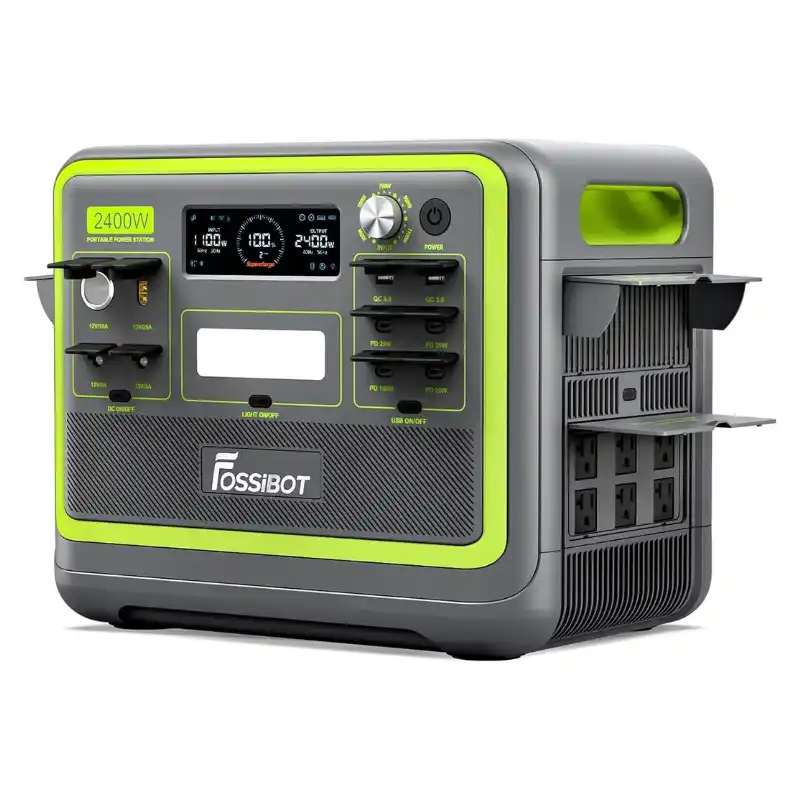
FOSSiBOT F2400 Review

The FOSSiBOT F2400 delivers 1,650Wh of its 2,048Wh rating, backed by a 2,400W inverter with 4,800W of surge power. Cells are rated at 3,500 cycles, and it hands over in 12.4ms, though the output measures 110 volts and there is no app.
My Quick Verdict
Three machines we have reviewed and tested weigh exactly 48 pounds, hand over in exactly 12.4 milliseconds, output exactly 110 volts, and accept exactly 500 watts of solar across the same 20-amp input. They carry three different brand names.
The FOSSiBOT F2400 is the strongest of the three. It gets a larger inverter, 1,500 more charge cycles, adjustable charging speed, and the highest usable capacity of the group.
That still leaves it with the problems all three share: an output voltage below the safe band, no app, no expansion, and a solar input that cannot be left connected.
Being the best version of a compromised design is a real, narrow distinction.
Best for: Resistive loads and workshop storage where the machine is battery-powered and nothing motor-driven depends on it.
Not for: refrigerators, pumps, remote monitoring, or future system expansion.
Key Stats
Introduction
Rebadging is common in this category and rarely worth writing about. What makes this case worth a paragraph is how complete the overlap is.
Three machines in our database share the same weight, switchover time, output voltage, solar specification, charging ceiling, and chassis. Only the badge, the inverter rating,g and the cell specification differ.
The F2400 is the version that got the better parts. Its inverter is 400 watts larger, its cells are rated for 3,500 cycles compared to 2,000 for its siblings, and it is the only one of the three with adjustable charging speed.
It is also the only one that returned above 80% of its rated capacity.
What It Can Actually Run
Two thousand four hundred watts sustained, with 4,800 in a burst, which is a genuine step up from the 2,000W its siblings carry and enough for a heating appliance with a second load beside it.
Rated at 2,048Wh, the sockets returned 1,650Wh, 80%. Every figure below rests on 1,650Wh.
- Refrigerator at 150W: eleven hours.
- CPAP at 40W without humidification: forty-one hours.
- Starlink dish at 50W: thirty-three hours.
- Laptop at 70W: about twenty-three charges.
Output measured 110 volts, below the accepted operating range, and the grading entry records audible noise from the inverter with electrical noise above 2,000 mV.
Charging and Smart Features
Wall input is 1,100 watts with adjustable speed, the only machine of the three to offer rate control.
Together, both inputs reach 1,600 watts, a useful improvement over the socket alone.
Solar takes 500 watts between 11.5 and 50 volts at 20 amps. The current allowance is generous; the wattage and the 50-volt ceiling are both low.
The switchover measured 12.4 milliseconds. Upper mid-range price tier, premium value tier.
Charging Speed Benchmarks
How the FOSSiBOT F2400 compares on charging with the rest of the 2,000Wh to 3,000Wh capacity class, measured across all 26 machines in our database rather than only those already reviewed. The group returns a 1,641W mean on the wall and 1,123W on panels, with bands set inside the class.
Mains charging of 1,100W falls well under the 1,641W class average and takes a Low rating, needing roughly 1.9 hours to fill 2,048Wh, with 1,600W available from both inputs at once. What separates it from the two machines built on the same chassis is that the rate is adjustable here, so an overnight charge can be run gently rather than at full current. Recorded inputs in the bracket cover 470W to 5,000W, so this sits low without being the slowest.
Panels cap at 500W over a 20-amp input, less than half the 1,123W class mean and a Low rating where the class high stands at 2,400W. Filling 2,048Wh that way takes about 4.1 hours in perfect conditions, which will not fit inside a realistic daylight window once cloud and panel angle take their 20 to 30 percent. The harder limitation is that the array cannot stay connected between sessions, so a permanently wired installation is off the table regardless of wattage.
Need a machine that can live beside an array? The Bluetti AC300 + B300K accepts 2,400W of solar to a 150-volt ceiling, nearly five times the F2400, and leaves panels wired around the clock. Mains charging rises to 3,000W, so 2,764Wh comes back in around 0.9 hours rather than the best part of two. The modular design also lets capacity grow without buying a second inverter.
Real Capacity: What You Actually Get
Conversion is weak in absolute terms and the best of the three siblings.
Metered at the outlets, 1,650 Wh was measured against a 2,048 Wh rating. 80% sits below the 85% line that machines at this capacity normally clear.
The twelve-volt route returned 1,615Wh, or 78%, two points behind. Neither path is efficient, so choose whichever suits the load.
Standby costs about 1.5% an hour with the inverter awake and 0.6% on DC, the weakest retention of the three, though still inside the 2% line.
For context, a machine at this capacity, converting at 91%, would return roughly 220 watt-hours more. That is an hour and a half of additional refrigerator time.
My takeaway: 1,650 Wh from a 2,048 Wh pack. Better than either sibling and still well short of what current machines at this capacity return.
Power Output and Surge: What It Can Turn On
The inverter is where the F2400 earns its place among the three. 2,400 watts of sustained power runs a heating appliance with a refrigerator beside it, and 4,800 watts of surge power covers any household compressor start.
Its siblings manage 2,000 and 4,000 respectively, so this is a genuine hardware difference rather than a specification-sheet variation.
The 330-watt DC output is also the largest of the three, enough to run a compressor fridge and a heater when the inverter is bypassed.
What all three share is the voltage. One hundred and ten volts falls below the accepted operating range, and motors compensate by drawing extra current, running hotter and wearing out faster. Resistive loads and switching supplies are unaffected.
Real Appliance Runtimes
What does 1,650 Wh deliver in running time given the appliance loads applied to every machine here?
These are the strongest runtimes of the three siblings and the weakest in this capacity class. Both statements are true at once, which is the whole character of the machine.
Recharging: Wall and Solar
From a Wall Outlet
At 1,100 watts, a 2,048 Wh pack takes close to two hours to charge from empty. That is slow by current standards, where 1,800 watts is common at this capacity.
What the F2400 has that its siblings do not is adjustable charging speed, so an unhurried overnight rate is available when time is not the constraint.
Running mains and solar together lifts the ceiling to 1,600 watts, which meaningfully shortens the wait on a bright day.
From Solar Panels
Panel input draws 500 watts at 11.5 to 50 volts and 20 amps.
Twenty amps is a genuinely generous current allowance, and the best thing about this solar arrangement is that a parallel bank of low-voltage panels will deliver its output rather than be clipped.
The ceilings are the problem. 500 watts is low for a 2-kilowatt-hour pack, and 50 volts rules out any meaningful series string.
The grading data also indicates that the array cannot remain connected around the clock, so panels must be disconnected between charging sessions. Nearly every current machine at this capacity permits a permanent connection.
Blackout Backup: The Part I Care About Most
Twelve point four milliseconds is the one specification these three machines share that is genuinely competent.
That figure sits comfortably within the 20-millisecond safety threshold with a reasonable margin, so a desktop or a router should handle the transfer.
It is not among the fastest at this capacity (several machines manage under nine), but it is a real transfer function, which is more than three older machines in this database offer.
Whether the inverter arm itself is recorded in our data. Given how often that turns out to be the deciding question, confirm it with FOSSiBOT before relying on the machine unattended.
Why this matters to me: a working 12.4-millisecond transfer puts this ahead of several better-known machines that have no transfer function whatsoever. It is the strongest argument on the page.
Noise and Living With It
Fifty-nine decibels under load, the loudest of the three siblings and beyond what any occupied indoor room will tolerate.
The grading entry also records audible noise from the inverter itself, so there are two sources rather than one.
Weight is 48 pounds 21.7 kilograms, identical to both siblings, and reasonable for two kilowatt-hours.
There is no app of any kind, no expansion port, and the warranty lasts 2 years, backed by a 24-hour customer service response commitment.
Where It Falls Short
Four limitations, three of which it shares with its siblings.
1. Output Measured at 110 Volts
Below the accepted working band on both our current and previous grading standards, and shared with both sibling machines.
Motors draw extra current at low voltage, run hotter, and fail earlier. A refrigerator cycled on this repeatedly has a harder life than one fed by a rival.
Heaters, lighting,g and anything on a switching supply are unaffected, which is what keeps the machine usable at all.
2. 80% Conversion
Below the 85% line that machines at this capacity normally clear, so a 2,048Wh pack behaves like a 1,650Wh one.
It is the best of the three siblings, yet still leaves roughly 220 watt-hours on the table compared to a strong performer at this size.
3. No App, No Expansion, and Panels Cannot Stay Connected
No Bluetooth or Wi-Fi, so no remote monitoring, no rate control from a phone,ne and no firmware updates.
No expansion battery support, so 2,048Wh is a permanent ceiling.
And the array has to be disconnected between charging sessions, which almost every current machine at this capacity allows you to leave in place.
4. Fifty-Nine Decibels and a Two-Year Warranty
The loudest of the three siblings, with audible inverter noise recorded separately from the fans.
Two years of coverage is the minimum at this capacity, while five is the class standard.
How It Compares
The only comparison that matters first is against its own siblings, followed by what a current machine at this capacity offers.
Compared to the Oukitel P2001 (the same machine with a different badge), the FOSSiBOT offers 400 watts of inverter power, 1,500 charge cycles, adjustable charging, 60 more usable watt-hours, and a higher DC output. It gives up five decibels of quiet.
If you are choosing between these three, the FOSSiBOT is the one to take, provided the price difference is modest.
The AFERIY P280 shows what a current machine at this capacity delivers: 230 more usable watt-hours, correct output voltage, a working app, five-stage charging, and a seven-year warranty. It is not a close comparison.
Who Should Buy It, and Who Should Skip It
Buy It If
- You are choosing among these three badges and want the strongest one.
- Your loads are resistive or electronic, with no motor, depending on the machine.
- It will live in a workshop or garage where the noise doesn’t reach anyone.
- You want a working transfer function on a budget machine.
Skip It If
- A refrigerator, freezer,r or pump will run on it regularly.
- You want an app, an expansion path, or a permanently wired solar array.
- Usable energy per pound spent is your test.
- A current machine at this capacity is within reach, as usual.
The Bottom Line
The F2400 is the best of three machines that are, in every measurable respect that matters to a chassis designer, the same machine. It got the larger inverter, the longer-lived cells, and the adjustable charger.
None of that changes what all three share: a 110-volt output that is hard on motors, 80% conversion, no app, no expansion, and an array that has to be unplugged between sessions.
Buy it if these three are on your shortlist. Widen the shortlist, and it stops being competitive quickly.


There are no reviews yet.