
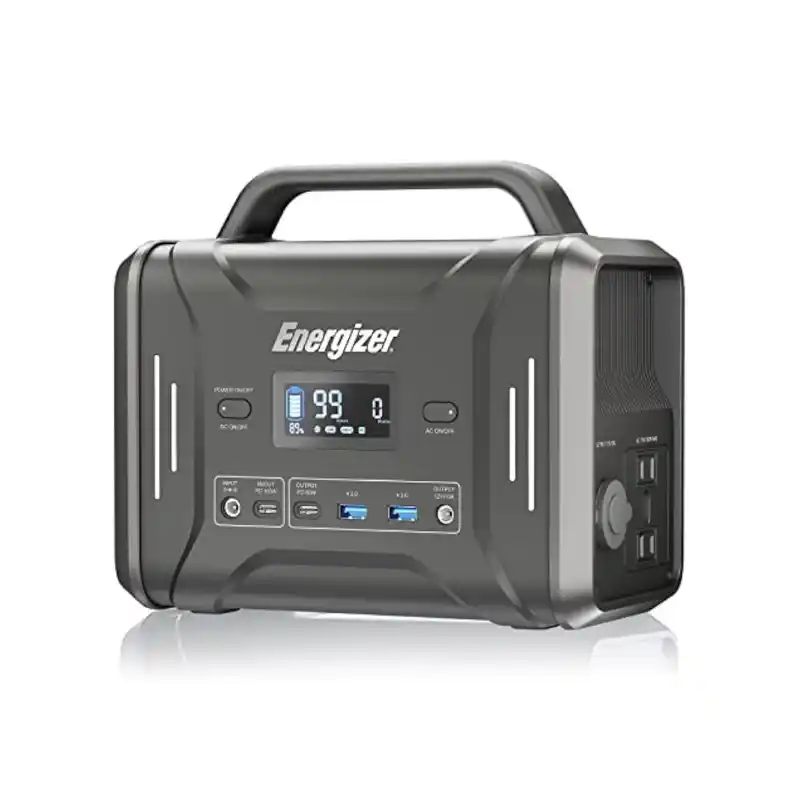
Energizer 320Wh Review

The Energiser 320Wh weighs nine pounds, the lightest machine in our database, and runs at 43dB. From a 320Wh label, it hands back 260Wh at a proper 120 volts, though refilling runs at 63W from a brick in the cable.
My Quick Verdict
At nine pounds, this is the lightest power station we have reviewed, and at 43 decibels, it is among the quietest.
It also returns 89% through its twelve-volt output and delivers a correct 120 volts, both of which several rivals at this size fail to manage.
Then the charging. Sixty-three watts through an external brick means more than five hours from empty, and its 65-watt solar ceiling is the lowest we have recorded.
A 300-watt inverter is also the smallest here, which rules out most appliances beyond devices and lighting.
Best for: Backpacking and charging light devices, where weight and quiet matter more than anything else.
Not for: appliances, fast charging, solar-led use, or anything with a motor.
Key Stats
Introduction
Two specifications make this machine worth considering, and both concern carrying it and living alongside it.
Nine pounds is the lightest figure in our entire database; across power stations we have reviewed, we have seen models from 240Wh to 6,144Wh. Forty-three decibels is the third quietest we have measured.
For a backpacking trip or a small tent, that pairing matters more than almost anything else on a specification sheet.
Cells are lithium iron phosphate rated at 2,000 cycles under a two-year warranty, which is standard for the class.
What It Can Actually Run
Three hundred watts sustained with 600 in a burst. That is the smallest inverter in our database,e and it constrains the machine sharply.
From a 320Wh label, the outlets yielded 260Wh, an 81% return, four points under the bar. Everything below uses 260Wh.
- Television at 150W: an hour and three-quarters.
- CPAP without humidification at 40W: six and a half hours.
- Starlink dish at 50W: 5.25 hours.
- A 45W twelve-volt camp fridge on DC: past six hours, drawing on the strong 286Wh route.
The output measured a correct 120 volts; the inverter itself was recorded as silent, and the electrical noise was 1,316 mV, among the cleaner readings for this size.
Charging and Smart Features
Wall input is 63 W via an external charging brick at a single, fixed rate. From empty, that is more than five hours.
Panels contribute just 65 watts, from 10.8 to 23 volts at 3 amps. No unit in this data accepts less.
No dual charging is fitted, so wall and sun never work in concert.
There is no UPS mode and no app. Mid-range price tier, premium value tier.
Charging Speed Benchmarks
Charging throughput on the Energizer 320Wh, set against the 300Wh to 999Wh capacity class, drawn from all 28 machines in our charging database. Mean wall input across the bracket is 279W and mean solar is 192W, and each rating is scored inside that group alone.
This machine sets the floor of the class on both channels. 63W is the slowest mains input recorded in the bracket, under a quarter of the 279W class average, and it arrives through a brick built into the cable rather than an internal charger. Filling 320Wh at that rate takes roughly 5.1 hours. The pack is the smallest here, so the absolute wait is not the worst on the page, but the ratio is: fifteen times less input than the class leader.
Panels sit at 65W, again the class minimum and about a third of the 192W class average, refilling the pack in about 4.9 hours of unbroken sun. That is marginally quicker than the socket and still most of a usable daylight window. At nine pounds this is the lightest machine in our database, and the charging hardware is clearly part of how that weight was achieved, so the slow refill is the cost of carrying it easily.
Want portability without the five-hour wait? The VigorPool Captain 700 charges internally at 600W with 240W of solar and dual charging, filling a 672Wh pack, more than double the Energizer's, in around 1.1 hours. It is considerably heavier, so this is a genuine trade rather than a straight upgrade if weight is why you are looking at the 320Wh in the first place.
Real Capacity: What You Actually Get
The twelve-volt path is s8points longer than the other by meter on the sockets, recording 260 Wh against a claimed 320 Wh. Four points adrift of what this class is held to.
Twelve volts gave back 286 Wh (89%), well over the bar and impressive for something this size.
Standby loss went unmeasured on both paths, so shelf behaviour is unknown.
Given the 155-watt, twelve-volt socket, routing loads to DC is both practical and worth the eight-point efficiency.
My takeaway: Plan on 260 Wh at the outlets, 286 Wh at 12 volts. Use the twelve-volt output where you can; it is eight points more efficient, and the socket is well specified.
Power Output and Surge: What It Can Turn On
Three hundred watts continuous is the smallest inverter in our database, and it is the specification that most limits the machine.
A television, lighting, a router, a laptop, and devices are all running. Anything that draws more than 300 watts does not work, including most small appliances.
Six hundred watts of surge is enough for the modest loads the inverter can sustain and nothing more.
What it does well is deliver clean power. A correct 120 volts, a silent inverter, and 1,316 mV of electrical noise put its output quality ahead of several larger machines.
That bi-directional USB-C outlet delivers a full 100 watts to a laptop and can power the machine from a compatible supply, while the 155-watt twelve-volt socket passes the test that makes such ports worth having.
Real Appliance Runtimes
Main figures are based on 260 Wh; the DC line uses the higher 286 Wh.
For a nine-pound machine, these are reasonable figures, and the clean 120-volt output means what you do run is being treated properly.
Recharging: Wall and Solar
From a Wall Outlet, charging a 3320Wh pack at 6 takes more than 5hours from empty, which is among the slowest charging arrangements in our database.
Power comes from a brick in the cable (another item to pack and renew), and its loss ends mains charging.
Neither rate control nor dual charging exists, so sunshine offers no help.
Both routes are slow, and neither helps the other. This is a machine you fill overnight and carry out in the morning.
From Solar Panels
The solar input holds a record at the wrong end.
No machine anywhere in this data accepts less from panels, and its 3-amp limit is likewise the smallest on record here.
The 10.8 to 23.5-volt window is among the narrowest measured, essentially excluding all rigid panels and leaving small foldables as the only option.
Sixty-five watts against 320 Wh explains the sheet’s note that sunshine alone falls short of the standard window.
The array can stay permanently connected and pass-through charging is supported, though at this input rate solar is a trickle rather than a route.
Blackout Backup: The Part I Care About Most
There is no automatic transfer function on this machine, which is entirely standard at 320Wh.
Its grading row indicates that UPS mode is not applicable, meaning the sockets are dead when the mains are off.
Nothing at this capacity offers a transfer function except the Bluetti EB3A, and it drains itself while waiting.
Treat this as device-charging equipment for trips rather than as a backup, as its nine-pound weight already implies.
Why this matters to me: with 320Wh behind a 300-watt inverter, catching a mains failure was never on the table. It is a battery you carry, and it does that better than anything else we have weighed.
Noise and Living With It
Forty-three decibels under load, which is the third quietest reading in our entire database and comfortably below the threshold for a room where someone sleeps.
The grading sheet also records no audible noise from the inverter itself, so the fans are the sole source of noise.
Weight is the headline: nine pounds, 4 kilograms. No machine here weighs less, and it travels comfortably in one hand, no matter how far you go.
Nothing connects to a phone, and the cover runs for two years with a same-day response promise.
Where It Falls Short
Three limitations, and the first two are both database records at the wrong end.
1. Sixty-Five Watts of Solar
Nothing in this data takes less from panels, and nothing allows less current either.
Stopping at 23.5 volts rules out practically all rigid panels, and 65 watts will not fill the pack inside the standard window.
2. Sixty-Three Watts of Wall Charging
Five hours and more from flat, unchangeable, via a part that can go astray.
Absent dual charging, each input crawls, and neither assists the other.
3. A 300-Watt Inverter and 81% Conversion
The smallest continuous output in our database, which rules out most appliances beyond devices and lighting.
And 81% through the sockets is four points below the class line, though the 89% DC path more than compensates.
How It Compares
Two comparisons at a similar capacity, both heavier and both louder.
This machine wins the two categories a backpacker cares about: it is a pound lighter than the EB3A and five lighter than the BougeRV, and six to fifteen decibels quieter than either.
It also holds the most capacity of the three and returns the most through DC.
It loses badly on everything to do with getting energy back in. The EB3A charges nearly seven times as fast, and the BougeRV nearly ten times as fast, and both take more solar. Neither, though, matches this one for weight or quiet.
Who Should Buy It, and Who Should Skip It
Buy It If
- Weight is your deciding factor. Nothing in our database is lighter.
- Quiet matters and the machine shares a tent with you.
- Your loads are devices, lighting, and a twelve-volt kit rather than appliances.
- You charge it overnight before each trip and never between uses.
Skip It If
- Anything on your list draws more than 300 watts.
- Solar is part of your plan. Sixty-five watts is the lowest we have measured.
- You need it full in under five hours.
- You want an app, dual charging or any transfer function.
The Bottom Line
This is the machine to carry. Nine pounds is the lightest figure in our database, and 43 decibels is the third-quietest, and it delivers clean 120-volt power with a strong 89% DC path.
What it cannot do is refill quickly by any route, or run anything much beyond devices and lighting.
Charge it the night before, carry it a long way, run small things quietly. Within those limits, nothing else we have tested does the job as well.


There are no reviews yet.