
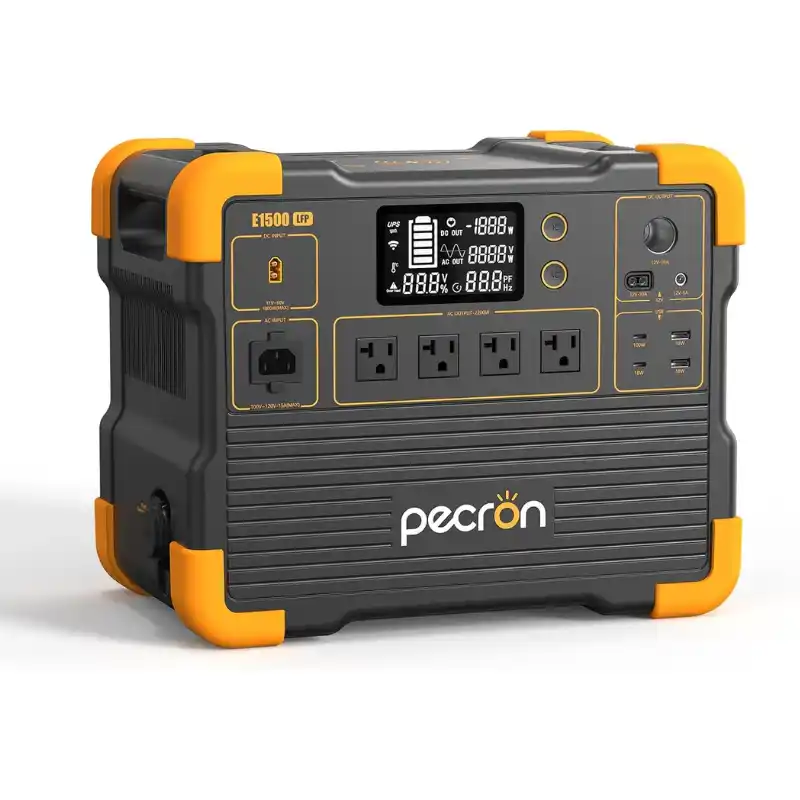
Pecron E1500LFP Review

The Pecron E1500LFP stores 1,536Wh behind a 2,200W inverter and returns 94.1% of rated capacity through its DC side, the highest figure measured in this class. A 400W XT60 output, 800W of solar input to 95 volts, and expansion support put it in the entry-price tier at exceptional value.
My Quick Verdict
Through its 12-volt side, this unit delivers 94.1% of its rated capacity. That is the highest DC yield in the entire list of power stations we have tested (across all brands and sizes), and it is by a significant margin.
It is also the cheapest watt-hour on this page by a comfortable margin, in the entry-price tier, with 11,536 Wh behind a 2,200 W inverter.
The engineering budget clearly went into the pack and the power path, because everything around them is unrefined. One wall-charging speed instead of adjustable stages. An 18-millisecond crossover. Distortion above the 2% line.
And an app that runs on Wi-Fi only, with no Bluetooth, which means it stops working precisely where a power station is most useful.
Best for: Overland and dry camping where twelve-volt loads dominate, and Emergency Home Resilience for buyers who want maximum stored energy per dollar.
Not for: off-grid app control, sensitive electronics, or protecting anything with a processor.
Key Stats
| Badge | Stat |
| Battery Chemistry and Longevity | LiFePO4 | 3,500 Cycles |
| Continuous AC Power Output | 2,200W AC | 4,000W Peak |
| Energy Storage Capacity | 1,536Wh | 1,310Wh Usable |
| Rapid AC Wall Recharge | 1,400W Input | Single Speed |
| Uninterrupted Emergency Backup | 18ms UPS | Manual Arm |
| Maximum Solar Input and MPPT | 800W Solar | 12–95V MPPT |
| Ultra-fast USB-C Power Delivery | 100W USB-C PD |
| Low-noise Operational Level | 53dB | Moderate Under Load |
| Modular Capacity Expansion | Expandable | Extra Battery Port |
| High-output DC | 400W XT60 | 94% DC Yield |
Introduction
Conversion loss is the tax that every power station pays, and most pay it at roughly the same rate. Eighty-five per cent through the sockets, somewhere between 85 and 90 through DC, and no real reason to think about which port you use.
The E1500LFP breaks that pattern harder than anything else measured here. Its DC side returns 94.1% of rated capacity, which is not only the best figure in this class but also the best in the entire dataset.
Its cells are lithium iron phosphate, with 3,500 cycles claimed and 5 years covered. Cycle it every day, and you are looking at ten years before capacity eases to 80%.
What It Can Actually Run
Sustained output is 2,200W with a 4,000W peak. That is generous for the class and enough to hold a space heater without shedding everything else.
Nominal capacity reads 1,536Wh. Metered AC output was 1,310 Wh (85.2%). The DC path produced 1,446Wh. AC figures below use 1,310Wh.
- Full-size refrigerator at 150W: close to nine hours.
- CPAP at 40W without humidifier: nearly 33 hours, so three nights.
- Starlink dish at 50W: about 26 hours.
- Twelve-volt camp fridge at 45W on DC: over 32 hours, calculated from the 1,446Wh DC yield.
The output measured 120 volts. Harmonic distortion came in at 2.1%, just over the 2% threshold I use for sensitive equipment.
Charging and Smart Features
Wall input reaches 1,400W, which is quick, but it runs at a single fixed rate with no adjustable stages. You get fast or nothing.
Solar accepts 800W, split between a 700W main input and a separate 100W barrel port, and operates from 12 to 95 V. That upper-voltage figure is well above the class norm and allows for a genuine series array.
Crossover measured 18 milliseconds, close to the safety limit, with no self-arming mode. Panels remained permanently attached; loads run while charging; and both inputs together draw 1,400W, with solar prioritised.
Entry-price tier, exceptional-value tier. On stored energy per dollar, nothing else on this page comes near it.
Charging Speed Benchmarks
How the Pecron E1500LFP compares on charging with the rest of the 1,000Wh to 1,999Wh capacity class, using the 30 machines we hold input figures for. Wall charging in that group runs to a 1,085W mean and solar to 641W. All bands are set inside the class, so a High rating describes this unit among comparable capacities.
Both channels rate High here, which only a handful of machines in this bracket manage. Mains charging of 1,400W clears the 1,085W class average and the 1,300W threshold, filling 1,536Wh in around 1.1 hours. Four-stage rate control sits behind it, finer than the two-speed switch typical at this price. The bracket does reach 2,400W at the top, so this is quick without being the quickest, and it is quick for a pack half again larger than most of its rivals.
Panels accept 800W to a 95-volt ceiling, above the 641W class average and past the 750W mark for a High rating, refilling the pack in about 1.9 hours. Ninety-five volts is the specification that changes the installation: where most machines at this capacity stop at 60 and limit you to two rigid panels in series, this takes three or four, which means less current, thinner cable and smaller losses on a long run.
Need the fastest grid recharge in this class? The Bluetti AC240 takes 2,400W from a socket against 1,400W here, on an identical 1,536Wh pack, which cuts empty to full from 1.1 hours to roughly 0.6 hours. Solar rises marginally to 900W but the window narrows to 60 volts, so you gain grid speed and lose the series-string flexibility that makes the Pecron worth wiring to an array.
Real Capacity: What You Actually Get
The split between this unit’s two output paths is the widest recorded anywhere in the dataset, and it is worth understanding before you plug anything in.
AC delivered 1,310 Wh out of a claimed 1,536 Wh. At 85.2%, that is unremarkable and entirely acceptable.
The twelve-volt side returned 19Wh. That is 94.1%, a full 9 points above the 136 Wh of the AC path, and roughly 136 Wh of extra energy for choosing a different port.
Standby loss on AC runs at about 2.3% per hour with the inverter awake, which is above the 2% line I consider acceptable. On DC, it drops to a much better 0.3%.
My takeaway: the nine-point gap between AC and DC here is the largest measured anywhere, and 136Wh is most of a fridge-hour. If a load can run on twelve volts, running it through the inverter wastes energy.
Power Output and Surge: What It Can Turn On
Sustained output determines what the unit holds; peak output determines whether a motor starts. On this unit, both figures are generous for the price when run
Twenty-two hundred watts, when run continuously, keeps heating appliances well within capacity and leaves enough spare capacity for something else to run alongside them.
The 4,000W peak swallows compressor startups with a wide margin. Nothing in an ordinary household will trip this inverter.
The output that stands out, though, is on the DC side: a 400W XT60, the highest DC output figure on this page and roughly three times that of a typical car socket in this class.
Real Appliance Runtimes
Below: 1,310 Wh converted to hours, plus one DC line calculated from the higher 1,446 Wh figure.
| Appliance | Power Draw | Runtime | What That Means |
| Full-size refrigerator | 150W | About 8.7 hours | A full night covered, and well beyond once the compressor rests. |
| CPAP machine (no humidifier) | 40W | About 32.8 hours | Three consecutive nights before refilling. |
| Starlink dish | 50W | About 26.2 hours | Better than twenty-four hours of uptime away from mains. |
| 12V camp fridge, runs on DC | 45W | About 32 hours | Worked from the 1,446Wh DC path, which is why it runs so far. |
| Laptop (70W) | 70W | About 18.7 recharges | Off USB-C, no mains brick involved. |
The camp fridge line is doing the most work on this table. Nine points of extra yieldovers on a multi-day trip compound into almost an additional day of cooling.
Recharging: Wall and Solar
From a Wall Outlet
Fourteen hundred watts is genuinely quick, filling an empty pack in a little over an hour despite its size.
What is missing is control. This unit charges at one rate, with no stages to step down to. Rivals at the same price offer four selectable speeds, letting you trickle overnight when time is irrelevant.
Charging lithium iron phosphate hard every time isn’t damaging in any dramatic sense, but the option to be gentler is real, and its absence here is a cost-saving you can feel.
From Solar Panels
Solar power arrives through two ports: a 700W main input and a separate 100W barrel connector, for a total of 800W.
The voltage range is 12 to 95 volts, which places it among the more capable units here. At 95 volts, you can wire a series array of rigid panels rather than being limited to the pair that a 60-volt ceiling permits.
Under good sun, it recovers from flat in around two and a half hours, which, for a pack this size, is genuinely quick.
Panels may stay permanently wired, and the unit powers loads while charging. Running mains and sun together, it accepts 1,400W with the panels served first.
Blackout Backup: The Part I Care About Most
This is where the E1500LFP is weakest, and the shortfall is not marginal.
The bench measurement was 18 milliseconds. Twenty is the usual pass mark, so on paper it clears. In practice, it is the slowest figure on this page, and the margin is almost nil.
At that speed, whether a device survives the gap depends on the device. At that speed,d the outcome belongs to the device, not the power station. Certain PC supplies cope, and others drop, and the test happens for real or not at all.
There is no self-arming mode either, so the inverter must be switched on and left running, at a cost of 2.3% an hour.
Why this matters to me: eighteen milliseconds with no auto-on is a specification I would not build a home backup plan around. This unit is a large, cheap, efficient battery. It is not a UPS, and treating it as one invites the failure you bought it to prevent.
Noise and Living With It
Under load, the fans reach 53dB, which is a fraction over the line I draw for rooms where people sleep and unremarkable in every other setting.
Weight is 40 pounds (18 kilograms). That is heavy in absolute terms and reasonable for 1,536Wh, but it is firmly a two-handed carry and not something to move often.
The app is the problem. It connects via Wi-Fi only, with no Bluetooth support.
That is a genuine design failure for this category. Wi-Fi needs a network, and a power station’s most valuable moments are a blackout, when the router is down, or a campsite, where there was never a network to begin with. The app works in exactly the conditions you least need it.
Where It Falls Short
Four rough edges. One of them is a design decision I struggle to defend.
1. The App Has No Bluetooth
Wi-Fi is the only connection option. During a blackout, your router is dead, so the app cannot reach the unit. If there is no network at all, the app cannot reach the unit.
Every other unit on this page supports Bluetooth precisely because it works when nothing else does. This is the single strangest omission in this review set.
2. The Slowest Crossover Here
Eighteen milliseconds scrapes inside the 20-millisecond line with almost nothing to spare, and it is the slowest figure among the units compared on this page.
When combined with a manually armed inverter and a 2.3% hourly standby drain, the unit should not be relied upon to automatically protect anything with a processor.
3. One Charging Speed
Wall charging is fixed at a single rate. There are no selectable stages, whereas rivals at the same price offer four.
It charges quickly, so this rarely causes a problem. But the option to charge gently overnight has been genuinely useful for over a decade of ownership, and here it does not exist.
4. Distortion Over the Line
Harmonic distortion measured 2.1%, just past the 2% threshold. Tools, lighting, and laptops will not care.
A CPAP motor or sensitive audio equipment might, and there are units on this page delivering less than half that figure. If medical equipment is the reason you are buying, look elsewhere.
How It Compares
Its natural rivals are its own smaller sibling, the Pecron E1000LFP, and the Bluetti AC240, the other high-capacity unit in this size class.
| Feature | Pecron E1500LFP | Pecron E1000LFP | Bluetti AC240 |
| Price Tier | Entry | Entry | Upper mid-range |
| Value Tier | Exceptional | Exceptional | Premium |
| Rated Capacity | 1,536Wh | 1,024Wh | 1,536Wh |
| Usable Through AC | 1,310Wh (85.2%) | 880Wh (85%) | 1,310Wh (87%) |
| Usable Through DC | 1,446Wh (94.1%) | 923Wh (90%) | 1,306Wh (85%) |
| High-output DC | 400W XT60 | 300W XT60 | 400W XT60 |
| Sustained Output | 2,200W | 1,800W | 2,400W |
| UPS Switchover | 18ms | 13.5ms | 19.2ms |
| Solar Voltage Ceiling | 95V | 60V | 60V |
| App Connectivity | Wi-Fi Only | Wi-Fi + Bluetooth | Wi-Fi + Bluetooth |
Compared to its smaller sibling, the E1500LFP offers 50% more capacity, 4 points more DC yield, a higher solar ceiling, and a larger inverter, all at the same price tier. What it gives up is the four-stage charging, the Bluetooth app, and three years of the warranty gap, which closes in the smaller unit’s favour.
For a vehicle build where the app matters, the E1000LFP remains the better-finished machine. For raw stored energy, this one wins comfortably.
The Bluetti AC240 has the same rated capacity but sits two price tiers higher. It buys you quieter fans, faster wall charging, and a proper app, and it delivers noticeably less through DC. If your loads are 12-volt, the Pecron is the better and cheaper battery.
Who Should Buy It, and Who Should Skip It
Buy It If
- Your loads are mostly twelve-volt. Nothing else measured here returns 94% through DC.
- You want the most stored energy per dollar available at this size.
- You are wiring a series solar array and need headroom above 60 volts.
- App control is not part of your plan for using the unit.
Skip It If
- You want to monitor or control it from a phone off-grid or during an outage.
- You are protecting a computer or NAS. Eighteen milliseconds is too close to the line.
- A CPAP machine or sensitive audio gear is on your list, given 2.1% distortion.
- You want adjustable charging speeds over a decade of ownership.
The Bottom Line
The E1500LFP is a superb battery wrapped in mediocre electronics, and both halves of that sentence are true at once.
A 94.1% DC yield, a 400W XT60, 1,536Wh at the entry-price tier, and a 95-volt solar ceiling make it the best raw energy value on this page by a clear margin.
But an 18-millisecond crossover, a single fixed charging speed, distortion over the line, and a Wi-Fi-only app add up to a unit that does the hard part brilliantly and the easy parts carelessly. Buy it for the pack, not for the features, and it is very hard to beat.


There are no reviews yet.