
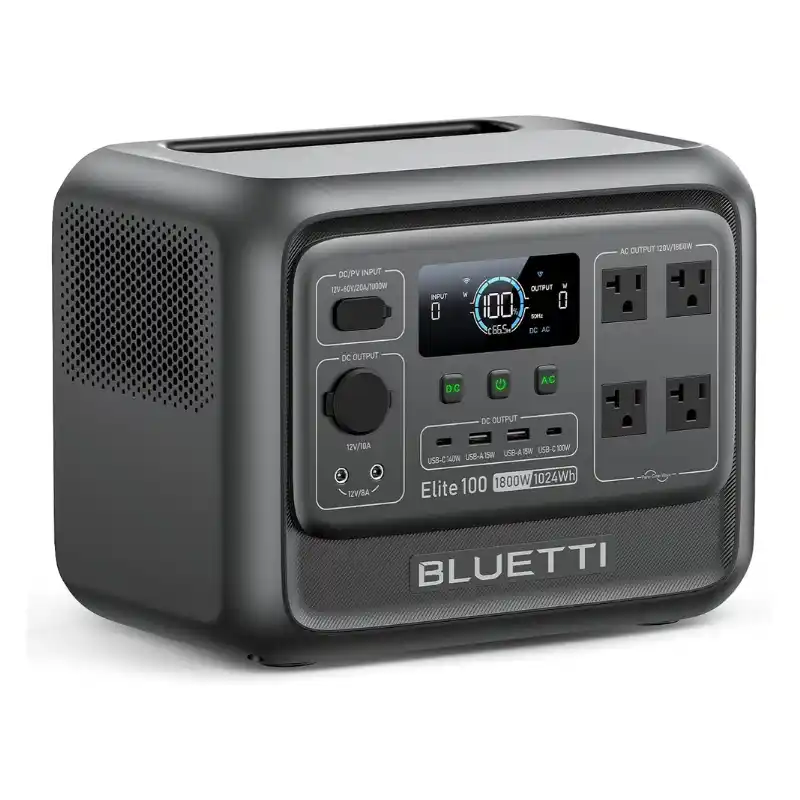
Bluetti Elite 100 V2 Review

The Bluetti Elite 100 V2 pairs 1,024Wh of 4,000-cycle lithium iron phosphate with an 1,800W inverter that spikes to 3,600W for motor startups. Its 8.7ms failover is among the quickest at this capacity, and it lands in the entry price tier while delivering exceptional value.
My Quick Verdict
The Bluetti Elite 100 V2 is a mid-size, all-in-one mobile power station in the High-Demand Utility Class, the 1,000W to 1,800W band, which I consider the baseline for real home blackout protection.
It is the unit I point people to when they ask what to buy on a budget. It sits in both the entry-price and exceptional-value tiers simultaneously, which almost never happens in this class.
It also has the fastest switchover I have seen at this size. Under 9 milliseconds. Nothing plugged into it will notice the grid dropping.
There is one catch, and it is a big one for some buyers. This unit will never take an expansion battery. What you buy is what you have, forever.
Best for: Emergency Home Resilience and Medical and CPAP Backup, especially for a first power station.
Not for anyone who plans to grow the system later. There is no expansion path at all.
Key Stats
| BadgeStat | Stats |
| Battery Chemistry and Longevity | LiFePO4 | 4,000+ Cycles |
| Continuous AC Power Output | 1,800W AC | 3,600W Peak |
| Energy Storage Capacity | 1,024Wh | 890Wh Usable |
| Rapid AC Wall Recharge | 1,200W Input | Adjustable Speed |
| Uninterrupted Emergency Backup | 8.7ms UPS | Auto-failover |
| Maximum Solar Input and MPPT | 1,000W Solar | Built-in MPPT |
| Ultra-fast USB-C Power Delivery | 140W USB-C PD |
| Low Noise Operational Level | 51dB | Quiet Under Load |
| Modular Capacity Expansion | Not Supported |
| Smart App Remote Control | Wi-Fi + Bluetooth App |
Introduction
Most people buy their first power station after an outage rather than before one. That timing shapes the question: what does a first unit actually have to do?
Keep the food cold. Keep the router alive. Do it without fumes, without noise, and without a fuel can to remember. The Elite 100 V2 answers all four in the entry-price tier.
The pack is lithium iron phosphate, good for 4,000 charge cycles. Drain and refill it every single day, and it would still hold 80% of its capacity a decade from now.
What It Can Actually Run
Two ratings matter, and they are easy to confuse. The inverter can sustain 1,800W indefinitely and spike to 3,600W for an instant, which is exactly what a fridge compressor demands the moment it engages.
The case reads 1,024Wh. Bench testing recovered 890Wh at the outlets, an 86% return. Everything below is calculated from 890Wh.
- Full-size refrigerator drawing 150W: close to six hours.
- CPAP without the humidifier, 40W: around 22 hours, which covers two nights.
- Starlink dish at 50W: just under 18 hours.
- Laptop at 70W: about a dozen refills off the 140W USB-C port.
Output measured 119 volts with 1.7% distortion on a pure sine wave. Sensitive gear will not notice the difference between this and a wall socket.
Charging and Smart Features
Mains charging tops out at 1,200W and steps up or down rather than locking you into a single rate.
Panels feed in at 1,000W across a 12-60 V window at 20 A, wide enough that generic third-party panels work straight off the shelf. Under a clear sky, reckon on a complete refill in roughly two and a half hours.
Failover took 8.7 milliseconds, and the inverter arms itself, so the unit requires no one to be present. The app pairs over Wi-Fi at home and Bluetooth in the field.
It occupies the entry-price tier while landing in the exceptional-value tier, a pairing you almost never see in the High-Demand Utility Class. That combination is the reason to buy it.
Charging Speed Benchmarks
Wall and panel recharge speeds for the Bluetti Elite 100 V2, set against the 1,000Wh to 1,999Wh capacity class, where 30 machines average 1,085W of mains input and 641W of solar. Because the bands are calculated within each capacity bracket, a High figure in this class would read as ordinary on a 3kWh machine and as exceptional on a 500Wh one.
Mains charging sits at 1,200W, a little over the 1,085W bracket average and squarely mid-table in the Average band, with the High threshold starting at 1,300W. Filling 1,024Wh at that rate takes around 0.9 hours, and the input is adjustable rather than fixed, so a slower overnight profile is available. Set against a class running from 200W to 2,400W, this is a competent charger rather than a quick one, and it is the clearest gap between this unit and the more expensive machines in its bracket.
Solar is the better channel. 1,000W is well past the 641W bracket average and a clear High rating, filling the pack in roughly 1.0 hour of proper sun, which is faster than its own wall socket. The catch is the 60-volt input ceiling. That caps how many rigid panels can go in a single series string, so reaching the full 1,000W means wiring more of the array in parallel, with the heavier cable and higher current losses that come with it over a long run.
Want quicker mains recharging at the same capacity? The EcoFlow Delta 3 Plus carries the same 1,024Wh but accepts 1,500W from a socket, a quarter more, which brings a full recharge down to about 0.7 hours. Solar matches at 1,000W. If the Elite 100 V2 appeals and the charging speed is the only reservation, that is the direct swap, though it sits a price tier above it.
Real Capacity: What You Actually Get
The figure stamped on the case describes the battery. What reaches your outlets is a smaller number because conversion costs energy.
Here, the gap is narrow. Bench testing recovered 890 Wh of the rated 1,024 Wh at the AC outlets, an 86% return.
DC came back at 879Wh, or 85%. On most units,s DC comfortably beats AC, so this parity is unusual. In practice,ce it means running a 12V fridge off the car socket buys you nothing.
Standby behaviour is the hidden strength. Inverter live, nothing connected, it sheds roughly 1% an hour. Plenty of units in this class shed more than double that.
My takeaway: 890Wh is your working number. And because standby losses are so small, this is a unit you can genuinely leave charged in a closet for months and still trust.
Power Output and Surge: What It Can Turn On
Watts and watt-hours answer different questions, and conflating them is how buyers end up disappointed.
The 1,800W rating governs what runs continuously. The 3,600W rating governs the instant a motor engages.
That instant is the one that trips lesser units. A fridge settles at around 150W once it is running, but draws around 1,200W for a heartbeat when the compressor starts. There is ample margin here.
Voltage read 119 with 1.7% distortion, both comfortably inside safe territory.
Real Appliance Runtimes
Below is 890Wh translated into hours. The appliance draw values are fixed across all reviews on this site, so you can compare them with any other unit.
| Appliance | Power Draw | Runtime | What That Means |
| Full-size refrigerator | 150W | About 5.9 hours | Enough for an evening outage, and further still if the door stays shut. |
| CPAP machine (no humidifier) | 40W | About 22 hours | Two nights of sleep without touching a charger. |
| Starlink dish | 50W | About 17.8 hours | Work all day and stream after dinner. |
| Pellet grill or smoker | 100W | About 8.9 hours | A whole brisket, start to finish. |
| Laptop (70W) | 70W | About 12 recharges | Straight off USB-C at 140W, leaving the brick at home. |
Bear in mind that a fridge is not a constant load. The compressor rests between cycles, so six hours on paper tends to behave like eight or nine in a genuine outage.
Recharging: Wall and Solar
From a Wall Outlet
Plugged into a household socket, the Elite 100 V2 draws up to 1,200W. Mid-pack for this class, and enough to go from flat to full in roughly ninety minutes.
What I rate more highly is the stepped charge control. Rather than a slow setting and a fast one, you choose a rate. Days of warning mean an easy trickle that is kind to the cells. An hour of warning means everything it will take.
From Solar Panels
Panels feed up to 1,000W over a 12-60 V range at 20 A. Generic third-party panels work without an adapter, so you are not tied to brand-name gear.
A complete refill under a clear sky takes roughly two and a half hours.
Panels can remain permanently attached, and the unit will run a load while it charges. That single capability is what separates an off-grid system from a battery you have to babysit.
Combine mains and sun, and it draws a total of 1,200W, with the panels served first.
Blackout Backup: The Part I Care About Most
A backup unit earns its name in the milliseconds after the grid fails. Too slow, and the devices you were protecting rebooted anyway.
This one crossed over in 8.7 milliseconds, among the quickest figures I have on record at this capacity. Twenty milliseconds is the usual safety line; anything beneath eleven counts as excellent.
The inverter also arms itself, so the unit does not sit through an outage waiting for a human to notice.
Why this matters to me: blackouts rarely wait until you are standing beside the unit. Self-arming is what separates insurance from an expensive paperweight.
Noise and Living With It
Under load, the fans read 51dB, sitting exactly on the line I draw for anything running where people sleep. It is a soft hum rather than a whine, but a silent room will bring it to the surface.
Think of a conversation happening two rooms away. A garage swallows that. A small bedroom will not suit a light sleeper.
Weight is 25 pounds (1.3 kilograms), unusually light for a full kilowatt-hour. One hand and a short walk are realistic here, unlike most units at this capacity.
App connectivity covers Wi-Fi at home and Bluetooth in the field, where there is no signal to lean on.
Where It Falls Short
Three things would give me pause, and one of them cannot be fixed later.
1. There Is No Expansion Path
This is the real limitation. The Elite 100 V2 does not accept an expansion battery, and it never will.
If your plan is to start at 1kWh and grow to 2kWh or 3kWh as your needs change, this unit rules itself out. You would be buying a second complete power station instead of a battery pack.
2. Fan Noise Sits at the Limit
At 51 dB, it is not loud, but it is at the edge of what I would want running next to a bed. Several units in this class run ten decibels quieter.
For a garage or a living room, it is not an issue. For a small bedroom with a light sleeper, it is worth considering.
3. The 12V Socket Falls Just Short
The car socket delivers 146W. That is close to the 150W mark I look for, and most 12V gear will run fine. But a larger 12V cooler or a high-draw DC accessory will hit the ceiling.
How It Compares
The two units I would set beside it are below. All three are Mid-Size All-in-One designs sitting in the High-Demand Utility Class, aimed squarely at Emergency Home Resilience.
| Feature | Bluetti Elite 100 V2 | EcoFlow Delta 3 Plus | Anker SOLIX C1000 |
| Price Tier | Entry | Mid-range | Entry |
| Value Tier | Exceptional | Premium | Exceptional |
| Rated Capacity | 1,024Wh | 1,024Wh | 1,056Wh |
| Usable (Tested) | 890Wh (86%) | 880Wh (85%) | 910Wh (86%) |
| Continuous Output | 1,800W | 1,800W | 1,800W |
| UPS Switchover | 8.7ms | 10.2ms | 16.1ms |
| Fan Noise | 51dB | 41dB | 59dB |
| USB-C Port | 140W | 140W | 100W |
| Battery Cycles | 4,000 | 4,000 | 3,000 |
| Expansion Battery | No | Yes | Yes |
Against the EcoFlow Delta 3 Plus, this is a straight trade. The Elite 100 V2 switches over faster and costs a full price tier less. The Delta 3 Plus runs ten decibels quieter and takes an expansion battery.
If the unit is going in a bedroom or you want a system you can grow into, pay the premium for the Delta 3 Plus. If it is going in a hall closet and 1kWh is all you will ever need, this is the better buy, and it is not close.
The Anker SOLIX C1000 sits in the same entry tier and accepts an expansion battery, making it an interesting middle-ground option. But its switchover is nearly twice as slow, it is louder, and its USB-C port is weaker.
Who Should Buy It, and Who Should Skip It
Buy It If
- This is your first power station, and you want the most capable unit at the entry tier.
- You need genuine blackout backup for a PC, router, or NAS drive that hates dirty shutdowns.
- You run a CPAP machine and want two nights of runtime.
- You want something light enough to move with one hand.
Skip It If
- Growing the system later is part of your plan. This unit cannot be grown at all.
- It will live in a bedroom with a light sleeper. Look at the EcoFlow Delta 3 Plus instead.
- Your 12V gear draws over 146 W.
The Bottom Line
The Bluetti Elite 100 V2 is the strongest value in the High-Demand Utility Class right now. Entry-price tier, exceptional-value tier, and the fastest switchover I have measured at this size.
The catch is permanent. No expansion battery, ever. That single limitation is what keeps it from being the obvious pick for everyone.
If you know 1kWh is enough, buy this one and stop shopping. If you are not sure, spend the extra tier on something that can grow with you.


There are no reviews yet.