

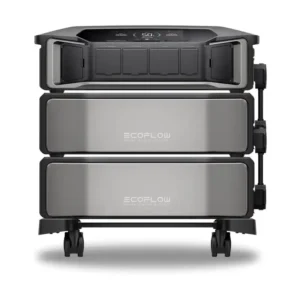
The EcoFlow Delta Pro Ultra holds 6,144Wh behind a 7,200W split-phase inverter, delivers 5,620Wh at the outlets, and transfers to battery with no measurable gap while arming itself. Solar accepts 5,600W across a path reaching 450 volts.
★★★★★
More details +
A genuine home backup needs two things: a takeover with no gap and no requirement for anyone to be present when it happens. Across forty machines measured for this site, this is the only one that does both—others transfer instantaneously but wait to be armed, and plenty arm themselves but take ten or fifteen milliseconds to hand over. Around that sit the largest figures in the dataset: 7,200 watts continuous on split phase, 7,200 watts of mains charging and 8,800 combined, and a solar input reaching 450 volts, roughly triple anything else here and the range a rooftop array actually operates at when wired to a string inverter. It converts 91% of a 6,144Wh pack, holds 42 decibels behind that inverter, and loses 0.58% an hour on standby. The costs are all physical and financial rather than functional: 188 pounds, the heaviest machine measured here; premium-tier energy at a flagship price; only 80% returned through DC; and 3,500 cycles where larger rivals offer more. For a property wired to a transfer switch, nothing else in this data does the job. Anything short of that, and the cheque covers hardware that sits idle.
PROS:
- Zero measurable transfer time with a self-arming inverter, the only machine here to do both.
- A 7,200W split-phase inverter with 10,000W of surge, the largest output reviewed here.
- Solar to 450 volts across a 5,600W input, roughly triple the ceiling of anything else here.
- A 91% return at the sockets — strong wherever it appears, and rare on a pack this large.
- Main charging of 7,200W and 8,800W combined, both the highest recorded on this site.
- Forty-two decibels behind a 7,200W inverter, and standby drain of 0.58% an hour.
CONS:
- One hundred and eighty-eight pounds, the heaviest measured for this site.
- Premium value tier at a flagship price, well above the best-value machines in this size class.
- Only 80% delivered through DC, eleven points behind its own AC path.
- Cells rated to 3,500 cycles, the shortest among the largest machines in this data.
- A single 100W USB-C port is thin on a machine at this price.
- Electrical noise of 1,830mv is mid-field rather than clean.
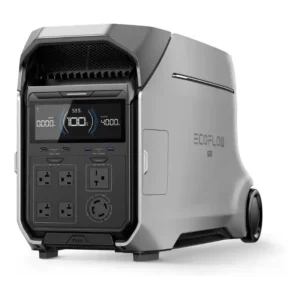
The EcoFlow Delta Pro 3 delivers 3,810Wh of its 4,096Wh rating through a 4,000W split-phase inverter that produces both 120V and 240V. It arms itself, hands over in 9.7ms, accepts 2,600W of solar power, and recharges at 7,000W from both inputs combined.
★★★★★
More details +
Everything reviewed on this site until now has been a machine you plug things into. This one is wired into a panel, and the specification that moves it across that line is split-phase output: 120 and 240 volts, which brings well pumps, electric ranges, and anything else on a two-pole breaker into scope for the first time. Behind that sit 4,000 watts held continuously and 8,000 available in a burst, a 93% return that puts 3,810Wh of a 4,096Wh pack at your disposal (a figure exactly one machine in this data betters) and a mains input of 4,000 watts that empties-to-full in under sixty minutes. It also arms its own inverter and hands over in 9.7 milliseconds, which, for something tied to a transfer switch,h is not a luxury but the entire point. The costs are real and mostly physical: 113 pounds for permanently settled portability, the single 100-watt USB-C port is meager for a premium-tier machine, and per watt-hour it lands in the good-value tier while cheaper units reach the exceptional tier. Most households do not need this. The ones that do have nothing else in the range to consider.
PROS:
- Split-phase 120V and 240V output: the first unit reviewed here can serve two-pole circuits.
- Conversion of 93%, beaten by a single machine anywhere in this dataset.
- A self-arming inverter with a 9.7ms handover is essential for anything wired into a transfer switch.
- Mains charging at 4,000W and 7,000W from both inputs, filling the pack inside an hour.
- Solar of 2,600W across two independently tracked paths, one reaching 150 volts.
- Cells rated to 4,000 cycles with standby loss of 0.91% per hour and expansion support.
CONS:
- One hundred and thirteen pounds, which makes installation the only realistic option.
- A single 100W USB-C port on a premium-tier machine, where cheaper units fit two at 140W.
- Good value tier rather than exceptional, so the cost per watt-hour is beaten lower down the range.
- Fifty-three decibels, where several smaller machines run in the low forties.
- A distortion of 1.60% is within limits but well behind the cleanest units reviewed here.
- At four kilowatt-hours, recharging rather than capacity becomes the planning constraint.
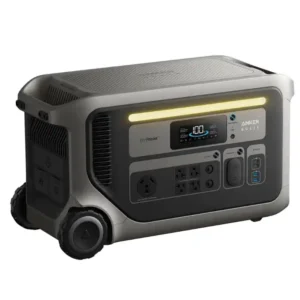
The Anker SOLIX F3000 holds 3,072Wh behind a 3,600W inverter and accepts 2,400W of solar, including a path reaching 165 volts that permits a real series string. It returns 91% through DC, charges at 3,840W from the wall, and sits in the upper mid-range price tier at exceptional value.
★★★★★
More details +
The reason to buy this machine is a number most buyers never look at: its upper solar input accepts 165 volts, where the majority of this field stops at 60. That is the difference between wiring two rigid panels in series and wiring five or six in series: lower current for the same power, thinner cable over a long run from a roof, and less energy lost warming the copper. Around it sits a genuinely strong package: 3,600 watts sustained, 2,760Wh delivered from a 3,072Wh pack, 91% through a 440-watt DC port, 4,000-cycle cells, and mains charging at 3,840 watts that refills the whole thing in under an hour; all at an exceptional value tier. What holds it back is the failure that has recurred through this entire dataset: it hands over in 9.8 milliseconds and then needs somebody to have switched the inverter on first. Its 0.66% hourly standby drain is low enough that leaving it armed costs almost nothing, which makes this the most forgivable version of that flaw I have reviewed. It is still a habit rather than a guarantee, and at 91 pounds,s this is a machine you install once and leave.
PROS:
- A solar path reaching 165 volts, high enough for a five- or six-panel series string.
- Mains charging at 3,840W, among the fastest recorded, refilling three kilowatt-hours in under an hour.
- Delivers 91% through DC via a 440W app-controlled port, enough for real twelve-volt loads.
- Standby loss of 0.66% an hour, low enough that leaving it armed costs almost nothing.
- A 3,600W sustained inverter at the top of its class, with 7,200W of surge.
- Cells rated to 4,000 cycles under five years of cover, at an exceptional value tier.
CONS:
- The inverter cannot wake itself, so protection depends on somebody having armed it.
- Ninety-one pounds, a two-person lift, and twenty-eight heavier than its direct rival.
- A single 100W USB-C port where cheaper machines now fit two at 140W.
- Electrical noise above 2,000 mV is at the high end of this field.
- Fifty-three decibels, where quieter machines exist at lower output.
- Both solar paths are capped at 17 amps, so the design favors voltage over current.
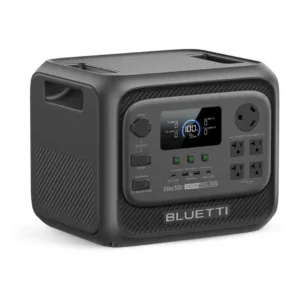
The Bluetti Elite 300 delivers 2,760Wh of its 3,014Wh rating, a 91% conversion efficiency, and an 8.1ms handover for its inverter. Cells are rated for 4,000 cycles; a 140W USB-C port and a 400W XT90 output are available; and it weighs 57 pounds. Upper mid-range price tier, exceptional value.
★★★★★
More details +
Most of the machines reviewed on this site fail at some point, which is a deciding factor for those who should not buy them. This one has a single such failure, and it is stated on the box: there is no expansion battery, and 3,014 Whis has a permanent ceiling. Everything else is unusually good. It returns 2,760 Wh at the outlets, a 91% conversion rate, among the strongest recorded here, and 93% through DC. It arms its own inverter with an 8.1-millisecond handover and sheds 0.5% per hour, a combination that actually makes automatic backup work and that most of its price tier cannot manage. It weighs 57 pounds for three kilowatt-hours, lighter than several two-kilowatt-hour units in this data, and it lands in the exceptional value tier; the cheapest three kilowatt-hours measured anywhere here. Sixty-nine hours of CPAP runtime from a sealed unit, one person can shift, is a genuinely different proposition for anyone dependent on overnight medical equipment. Just be certain about the ceiling before you buy, because buyers reaching this capacity are usually building toward more rather than settling.
PROS:
- Conversion of 91% through AC and 93% through DC, among the best figures recorded here.
- A self-arming inverter with an 8.1ms handover at an exceptional value tier.
- Fifty-seven pounds for three kilowatt-hours, lighter than several 2kWh units reviewed here.
- Sixty-nine hours of CPAP runtime, the longest recorded on this site.
- Cells rated to 4,000 cycles with standby loss of just 0.5% an hour.
- A 140W USB-C port, a 400W XT90 output, and 0.70% distortion.
CONS:
- No expansion battery support, so 3,014Wh is a permanent ceiling.
- A 2,400W inverter, the same rating as several two-kilowatt-hour units carry.
- Electrical noise above 2,000mv, at the high end of this field.
- The 60-volt solar ceiling rules out long series strings.
- Combined charging at 2,400W is adequate, rather than generous, for a pack this size.
- Fifty-two decibels sit just above what a bedroom can comfortably absorb.
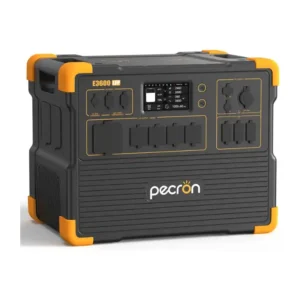
The Pecron E3600LFP delivers 2,760Wh of its 3,072Wh rating, powered by a 3,600W inverter with 7,200W of surge capacity. It draws 3,600W from a wall socket and 2,400W from solar across two channels, reaching 150 volts, at an exceptional value tier.
★★★★★
More details +
Pecron sells two machines that use three kilowatt-hours, with identical cells and conversion, and setting them side by side is the most useful thing about either. The cheaper one takes 1,800 watts from a socket, 1,600 from panels, and cannot see any array producing under 25 volts. This one takes 3,600 from the socket, 2,400 from panels across two channels, and adds a dedicated 12-volt low-voltage input, so a single foldable works alongside a 150-volt series string. Everything else holds up: 2,760 Wh delivered from a 3,072 Wh pack, a 3,600-watt inverter with 7,200 W of surge, a 400-watt XT60, four charging stages, a 9-millisecond handover, and 52 decibels. What it costs is sixteen pounds over the cheaper unit, taking it to seventy-nine and firmly into two-person territory, and it still will not arm its own inverter. Install it beside an array, and the faster charging is the entire reason to be here. Carry it anywhere,e and you have paid for hardware you cannot use.
PROS:
- Main charging of 3,600W, twice what the cheaper machine at this capacity accepts.
- A dedicated low-voltage solar channel from 12 volts, so small foldable panels work.
- A 150-volt main solar path allowing four or five rigid panels in series.
- An inverter rated at 3,600W, with 7,200W in reserve, topping out its power class.
- Conversion of 89% at the sockets and 88% through DC, so port choice barely matters.
- A 400W XT60 output, four-stage charging and expansion support, at an exceptional value tier.
CONS:
- Seventy-nine pounds, sixteen more than its own cheaper sibling and a two-person lift.
- The inverter will not arm itself, leaving an empty house unprotected.
- Cells rated tfor3,500 cycles, while both rivals at this capacity offer 4,000.
- A single 100W USB-C port on a machine at this price.
- A standby drain of 1.16% an hour is affordable rather than negligible.
- Distortion of 1.20% and noise of 1,750 mV are decent, though they don't approach the cleanest here.
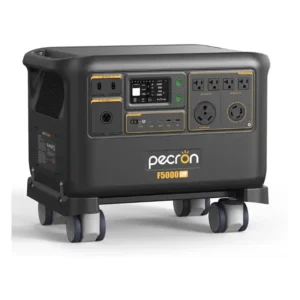
The Pecron F5000LFP delivers 4,440Wh of its 5,120Wh rating behind a 7,200W split-phase inverter that transfers instantaneously and arms itself. Solar reaches 6,400 W at 180 V; the DC output is rated at 1,000 W, and it sits in an exceptional value tier.
★★★★★
More details +
The specification list here belongs to a machine costing twice as much: 7,200 watts on split phase, transfer with no measurable gap and an inverter that raises itself, 6,400 watts of solar at 180 volts with 25 amps per channel, a 1,000-watt XT60 that is by a wide margin the largest DC output measured on this site, and five kilowatt-hours of storage; all at an exceptional value tier and 124 pounds, which is light for the class. Then there is the waveform. Harmonic distortion measures 3.50% against a 2% working limit, the highest figure across all machines tested at this site and well clear of the next-worst at 2.1%. Heaters and lighting will not notice. Motors run hotter on a distorted supply, and sensitive electronics were never designed for one, which rules out CPAP machines and medical equipment on the AC side entirely. Notably, three of the four worst distortion readings in this dataset come from Pecron machines, suggesting this is a design characteristic rather than a single bad sample. Feed it general household and resistive loads, or route twelve-volt equipment through that enormous DC port and skip the inverter altogether, and very little competes.
PROS:
- A 7,200W split-phase inverter matching the largest output in this dataset.
- Instantaneous transfer with a self-arming inverter, which few machines here manage.
- Solar of 6,400W at 180 volts and 25 amps per channel, high voltage and high current together.
- A 1,000W XT60 DC output is, by a wide margin, the highest DC figure measured here.
- Delivers 90% through DC, four points better than AC, bypassing the inverter entirely.
- One hundred and twenty-four pounds for five kilowatt-hours, light for the class, at an exceptional value tier.
CONS:
- Harmonic distortion of 3.50%, the highest recorded here and well above the 2% limit.
- Fifty-eight decibels, beyond what any occupied indoor room will tolerate.
- Main charging at 3,600W is adequate, rather than fast, for five kilowatt-hours.
- A 9,000W surge is a narrow headroom above a 7,200W continuous rating.
- Three of the four worst distortion figures in this dataset are Pecron machines.
- Conversion of 86% at the sockets trails the best machines at this size.
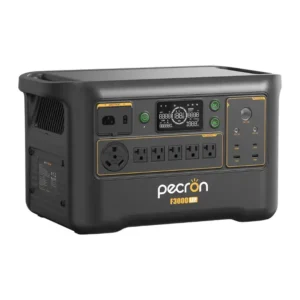
The Pecron F3000 holds 3,072 Wh behind a 3,000W inverter and delivers 2,750 Wh at the outlets, 89% of its rating. At 63 pounds, it is far lighter than rivals of this capacity and offers the lowest cost per watt-hour among units measured at this site.
★★★★★
More details +
Strip away capacity, brand, and features, and one question remains: how much energy does each pound buy? Across every machine measured at this site, the answer has ranged from about twenty-six cents per watt-hour to well over a dollar, and this unit sits at the very bottom of that range, with nothing else within about fifteen percent of it. What makes that remarkable rather than merely cheap is that the delivery figures hold up — 2,750Wh out of a 3,072Wh pack at the outlets, 91% through DC, an 8.6-millisecond handover, and a 182-watt car socket that clears a threshold most machines here miss. It also weighs sixty-three pounds, while its direct rival at the same capacity weighs ninety-one. The savings came from the charging: the mains input is 1,800 watts, less than half of what that rival accepts, and the solar path will not engage at all below 25 volts, so a single small foldable panel is simply invisible to it. Factor in 56 decibels and an inverter that stays down until switched on, and where this machine belongs becomes self-evident. This belongs in a workshop or an outbuilding with a properly wired array, and on those terms, nothing here gives you more for the money.
PROS:
- The lowest cost per watt-hour of any machine measured for this site, by a clear margin.
- Sixty-three pounds for three kilowatt-hours, twenty-eight pounds lighter than the closest equivalent.
- Conversion of 89% through AC and 91% through DC, matching machines costing considerably more.
- A handover of 8.6ms, among the quicker figures recorded here.
- A 182W car socket is above the 150-watt threshold that most sockets in this data miss.
- Solar current of 25 amps and four-stage wall charging; both generous for the price.
CONS:
- The main charging of 1,800W is less than half of what its direct rival accepts.
- The solar input will not engage below 25 volts, so small foldables are unusable.
- Fifty-six decibels rule out bedrooms, tents, and quiet offices.
- The inverter cannot arm itself, and a 1.25% hourly drain makes leaving it armed costly.
- Cells rated to 3,500 cycles, whereas both rivals at this capacity offer 4,000.
- Electrical noise above 2,000mv sits at the noisy end of this field.
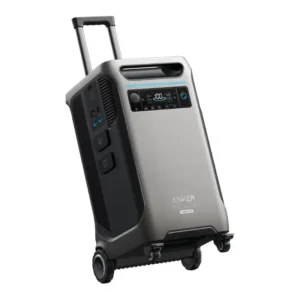
The Anker SOLIX F3800 Plus runs a 6,000W split-phase inverter producing 120V and 240V, delivers 3,270Wh of its 3,840Wh rating, and draws 6,000W from a wall socket. Solar reaches 3,200W across a 165-volt path, and the inverter arms itself.
★★★★★
More details +
Anker sells two machines four pounds apart with the same 3,840Wh pack and the same 6,000-watt split-phase inverter, and every difference between them sits on the input side. This one takes 6,000 watts from a wall socket, whereas the standard version takes 1,800; it accepts 3,200 watts of solar at up to 165 volts, compared with 2,400 at 60; it supports pass-through charging, raises its own inverter when the grid drops, and returns five extra points through the DC path at 91%. Behind a 6,000-watt inverter, an 1,800-watt charger is a real bottleneck, so for anything wired into a transfer switch, these specifications determine whether the system keeps up during a storm week. The costs are blunt: 136 pounds in one sealed body that does not come apart, a premium value tier that puts it above its own standard version, 85% conversion and 3,000 cycles that are both the weakest at this capacity, and a 100-watt USB-C port that would look thin on a machine a fifth of the price. Buy this for the installation. The battery inside it is the least impressive thing about it.
PROS:
- A 6,000W split-phase inverter on 120 and 240 volts, with 12,000W of surge.
- Main charging of 6,000W, refilling a 3,840Wh pack in around forty minutes.
- A self-arming inverter and pass-through charging, both absent on the standard F3800.
- Solar of 3,200W across two independently tracked 165-volt channels.
- Delivers 91% through DC, six points better than through the outlets.
- Waveform distortion of 1.10%, expansion support, and a phone line behind the cover.
CONS:
- One hundred and thirty-six pounds in a single sealed body that does not separate.
- Premium value tier, a full tier above its own standard version.
- Conversion of 85% at the sockets, the weakest among machines at this capacity.
- Cells rated for 3,000 cycles, while rivals here offer 4,000 or 6,000.
- A handover of 14.3ms is the slowest reading among machines of this size.
- A 100W USB-C port and a 141W car socket, both ordinary at this price.
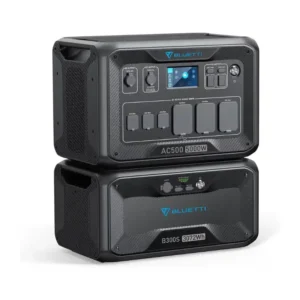
The Bluetti AC500 pairs a 5,000W inverter head, which holds no cells, with a B300S module, delivering 2,520Wh. Wall charging reaches 5,000W, and the combined input is 8,000W, both among the highest recorded, with 3,000W from solar across two 150-volt channels.
★★★★★
More details +
Five thousand watts from a wall socket is the highest mains input recorded for any machine on this site, eight thousand with panels alongside is near the top too, and a 5,000-watt continuous inverter is the largest single-phase output reviewed here; a system that empties under heavy load and recovers within half an hour, which is exactly what fails on slower rivals across a storm week. The waveform is excellent as well, with 0.70% distortion and 985 mV. Then you meter the outlets and find 2,520 Wh from a 3,072 Wh rating, 82%, the weakest conversion at this capacity, with the DC path worse again at 77%, among the lowest figures in the whole dataset. From the same rating, a 91% machine hands back roughly 280 watt-hours more. Paying the highest price per watt-hour at this size and receiving the smallest share of it is a hard combination to defend, and the 16-millisecond handover on an inverter that will not arm itself does not help. If you need 5,000 watts continuously, nothing else here delivers it. If 3,000 would do, Bluetti's own AC300 beats this on conversion, cycles, noise, weight, and value.
PROS:
- Wall charging of 5,000W, the highest mains input recorded on this site, refilling a module in under half an hour.
- Combined charging of 8,000W with solar is prioritized, among the highest figures measured here.
- A 5,000W continuous inverter with 10,000W of surge, the largest single-phase output reviewed here.
- Distortion of 0.70% and 985mv of electrical noise, among the cleanest at this capacity.
- Solar of 3,000W across two independently tracked 150-volt channels with a 12-volt floor.
- Modular architecture, so capacity grows without replacing the electronics.
CONS:
- Conversion of 82% through AC, the weakest at this capacity.
- Only 77% through DC, among the lowest figures in the entire dataset.
- A 16ms handover on an inverter that will not arm itself.
- Premium value tier, roughly double the cost per watt-hour of the best value machines at this size.
- One hundred and forty-nine pounds for a head and one module, before expansion.
- Cells are rated for 3,500 cycles, whereas the smaller AC300 in the same family offers 6,000.
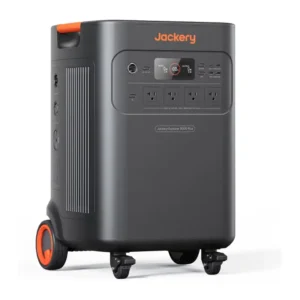
The Jackery Explorer 5000 Plus delivers 4,380Wh of its 5,040Wh rating, backed by a 7,200W split-phase inverter with 14,400W of surge, the largest peak rating measured here. Solar accepts 4,000W across a path reaching 450 volts.
★★★★★
More details +
Fourteen thousand four hundred watts of peak output is the largest surge figure across all machines measured at this site, and it means the question of whether lesser inverters (whether a well pump or a big compressor) will actually start never arises here. Behind it sit 7,200 watts continuous on split-phase, 1.10% distortion, 700 mV of electrical noise, and 49 decibels, which, for an inverter this size, is genuinely good engineering. The solar side matches that ambition with a 135- to 450-volt channel that takes 4,000 watts, the range a rooftop string array actually produces. Then the input side falls apart. Main charging stops at 1,800 watts into a 5,040Wh pack, close to three hours from empty and the worst ratio at this size; pass-through is absent, so those three hours are also downtime; and the inverter will not arm itself, so an empty house is uncovered regardless of whether the 0ms or the 15.5ms switchover figure applies. Fill it from a large array, and it is formidable. Ask it to ride out a storm for a week on a wall socket, and it cannot keep up.
PROS:
- A 14,400W peak rating, the largest surge figure measured anywhere in this dataset.
- A 7,200W split-phase inverter matching the largest sustained output here.
- Solar to 450 volts, the range a rooftop string array actually produces.
- Distortion of 1.10% and 700 mV of electrical noise, both clean at this scale.
- Forty-nine decibels behind a 7,200W inverter, quieter than several smaller machines.
- Cells rated to 4,000 cycles, and a 172W car socket that clears the 150-watt mark.
CONS:
- Wall charging at 1,800W into a 5,040 Wh pack is the worst ratio at this size.
- No pass-through charging, so refilling and using the machine are mutually exclusive.
- The inverter will not arm itself, so an empty house is unprotected.
- Switchover data records two different figures, 0ms and 15.5ms, without explanation.
- One hundred and thirty-two pounds in a single body, and a premium value tier.
- Two charging speeds only, with no gentle overnight rate available.
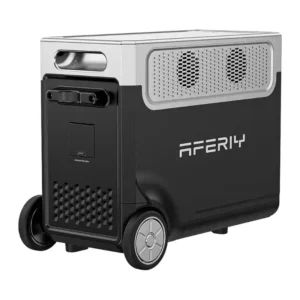
The AFERIY P310 delivers 3,630Wh of its 3,840Wh rating, a 94% conversion, beaten by only one machine we have measured. Behind it is a 3,600W inverter, 2,000W of solar accepted up to 160 volts, and seven years of coverage on 4,000-cycle cells.
★★★★★
More details +
Two numbers make a strong case for this machine, and two more take it apart. It converts 94% of its rated capacity into usable energy, beaten by exactly one unit across this entire dataset, and it carries a seven-year warranty, while five is the class standard and several units offer three; both at an exceptional value tier, for nearly four kilowatt-hours. Then the fans, at 63 decibels (nothing else measured at this site runs louder), eliminate every indoor space people actually occupy. And the wall input stops at 1,500 watts, the poorest charging-to-capacity ratio here, meaning close to three hours from empty and a machine that genuinely depends on its panels rather than merely benefiting from them. The solar side is well judged for that: 2,000 watts to 160 volts at 20 amps, with a low enough floor that foldables work too. Put it in an outbuilding beside a large array where nobody has to hear it, and it delivers more energy per pound spent than anything at this size. Bring it indoors,s and it is unusable.
PROS:
- Conversion of 94%, beaten by only one machine across this entire dataset.
- A seven-year warranty, longer than anything else measured for this site.
- Solar to 160 volts at 20 amps, with an 11-volt floor so foldables work without a separate channel.
- Cells rated to 4,000 cycles and 3,630Wh of usable energy at an exceptional value tier.
- Five-stage charge control is the finest rate adjustment offered by any machine here.
- A 350W XT60 output and a 3,600W inverter at the top of its class.
CONS:
- Sixty-three decibels is the loudest fan reading recorded anywhere in this data.
- Wall charging at 1,500W into a 3,840Wh pack takes close to three hours to fully charge from empty.
- AFERIY operates no telephone support behind that seven-year cover.
- Dual charging exceeds 2,500W only below 70% state of charge, so the last third refills slowly.
- The inverter will not arm itself, so an empty house is unprotected.
- A surge of 5,500W is below the 7,200W most machines at this capacity provide.
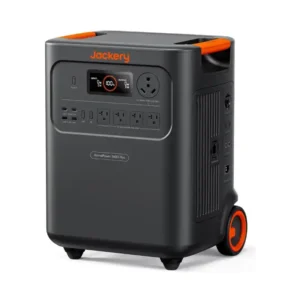
The Jackery HomePower 3600 Plus delivers 3,210Wh of its 3,584Wh rating, is powered by a 3,600W inverter, and weighs 77 pounds, while rivals at this capacity weigh over 130 pounds. Cells are rated for 6,000 cycles, and standby drain is less than 1% per hour.
★★★★★
More details +
Machines holding three and a half kilowatt-hours are typically installed and left in place; the two closest rivals here weigh 132 and 136 pounds. This one weighs 77, the same as a mid-range two-kilowatt-hour unit that carries nearly twice the energy, and that alone makes it a different proposition. The battery specifications back this up: 6,000 cycles, jointly highest in this dataset; 89% conversion, better than either heavier rival; 0.83% hourly standby drain, so it holds a charge through months of storage; 51 decibels; and a 9-millisecond handover. Then you look at the ports and find no high-output DC socket at all (not undersized, not unmeasured, simply absent), whereas every rival has at least a car socket, and most have an XT60 between 300 and 440 watts. On a machine light enough to be carried into a vehicle or a campsite, where twelve-volt loads actually live, that is a genuinely strange omission. Solar caps at 1,000 watts, too low to refill the pack in the window its rivals manage. Buy it as a portable household battery, and it is the best at this size. Ask it to feed anything on twelve volts,s and it cannot.
PROS:
- Seventy-seven pounds, holding 3,584 Wh, lighter than anything else reviewed above three and a half kilowatt-hours.
- Cells rated at 6,000 cycles, the joint highest figure recorded in this dataset.
- Standby drain of 0.83% an hour, so it holds a charge through months of storage.
- Conversion of 89% at the sockets, better than either heavier rival at this capacity.
- A 9ms handover, among the quicker figures at this capacity.
- Fifty-one decibels and dual independently tracked solar ports.
CONS:
- No high-output DC socket at all, so every load must run through the inverter.
- Solar capped at 1,000W, too low to complete a recharge in the window rivals meet.
- Main charging at 1,700 W means over two hours from empty.
- The inverter will not arm itself, so an empty house is unprotected.
- Output is 120 volts only, with no split-phase option for two-pole circuits.
- Electrical noise above 2,000mv sits at the noisier end of this field.
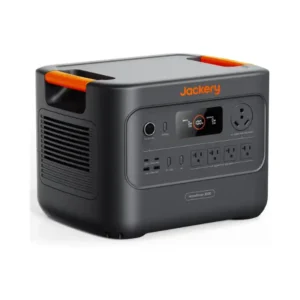
The Jackery SG HomePower 3000 delivers 2,820 Wh of its 3,072 Wh rating, with a 91% conversion efficiency, powered by a 3,600W inverter. At 59 pounds, it is among the lightest machines in this capacity, with 4,000-cycle cells and a standby drain of less than 1 percent per hour.
★★★★★
More details +
Past about eighty pounds, a power station stops being something you reposition and becomes something you install, which is why fifty-nine pounds holding 3,072Wh is the specification that defines this machine; roughly what a good two-kilowatt-hour unit weighs, with half again the energy. It backs that with a 91% conversion, among the stronger figures in this data, so it gives you more usable energy than several rivals with larger packs on paper, and 0.83% hourly standby means it is still nearly full whenever you get to it. A 3,600-watt inverter, a 169-watt car socket that clears a threshold most machines here miss, and 52 decibels round out a genuinely good battery. The system around it is closed and slow. There is no expansion support at all; wall charging stops at 1,800 watts, solar stops at 1,000, and cannot refill the pack in the window rivals manage, and running both together does not lift the ceiling. Buy it because you need to carry three kilowatt-hours. For a machine that stays put, both rivals at this capacity do more for a lower price tier.
PROS:
- Fifty-nine pounds holding 3,072Wh, among the lightest machines at this capacity.
- A 91% conversion rate at the sockets is one of the strongest figures in this data.
- Standby drain of 0.83% an hour, so it holds a charge through months of storage.
- A 3,600W inverter with 7,200W of surge, at the top of its class.
- A 169W car socket, exceeding the 150-watt limit, is missing from most of the sockets in this data.
- Fifty-two decibels and a 24-amp solar current allowance, both better than several rivals.
CONS:
- No expansion battery support, so the capacity is permanently fixed.
- Wall charging at 1,800 W, close to two hours from empty.
- Running solar alongside mains does not raise the charging ceiling above 1,800W.
- Solar caps at 1,000W and cannot complete a recharge in the window rivals meet.
- The inverter will not arm itself, leaving an empty house unprotected.
- Electrical noise above 2,000mv sits at the higher end of this field.
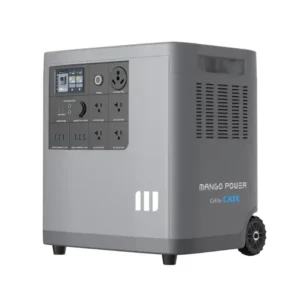
The Mango Power E has a 33,532 Wh battery and delivers 33,010 Wh to the outlets via a 3,000W inverter. Cells are rated at 4,000 cycles, the handover measures 8.5ms, and solar accepts 2,000W, but only from 60 volts upward.
★★★★★
More details +
Buyers read solar specifications from top to bottom (the wattage, then the upper voltage), and the lower figure is normally so low it never registers. On this machine,e it is the number that matters most: the input accepts 60 to 150 volts, and since foldable panels typically produce between 18 and 40, none of them will work at all. Reaching the floor takes two rigid panels in series, and operating comfortably above it through a cloudy afternoon takes three or four. Nothing about the headline 2,000-watt figure warns you. There is a sound machine underneath: 4,000-cycle cells, an 8.5-millisecond handover among the quicker at this size, 0.7% hourly standby, so leaving it armed costs little, and 3,010Wh delivered from a 3,532Wh pack. But it weighs 100 pounds, runs at 60 decibels, charges at one fixed rate, and combines mains and solar to a lower ceiling than the wall socket manages alone, which is unlike anything else recorded here. Wired to a permanent rigid array in an outbuilding,g it is fine. Bought expecting to unfold a panel next to it, it is the wrong machine entirely.
PROS:
- A handover of 8.5ms, among the quicker figures at this capacity.
- Standby drain of 0.7% an hour, so leaving the inverter armed costs little.
- Cells rated to 4,000 cycles under five years of cover, at an exceptional value tier.
- Mains charging at 3,000 W refills the pack in a little over an hour.
- Solar to 150 volts at 20 amps, suited to a properly wired rigid array.
- Expansion is supported, with phone assistance behind the warranty.
CONS:
- The solar input recognizes nothing below 60 volts, so foldable panels will not work at all.
- Combined mains and solar charging caps below what the wall input manages alone.
- Sixty decibels rule out every indoor space where people spend time.
- One hundred pounds in a single body, and a fixed single charging rate.
- A 4,800W surge is narrower than the 7,200W offered by several rivals in this size class.
- A 133W car socket and 2,000mv of electrical noise, both unremarkable.
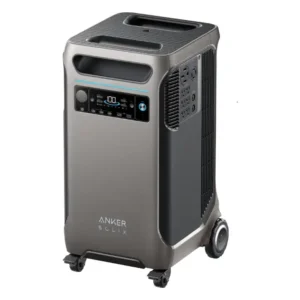
The Anker SOLIX F3800 runs a 6,000W split-phase inverter producing 120V and 240V and delivers 3,310Wh of its 3,840Wh rating. Solar accepts 2,400W with an unusually generous 27-amp channel, though wall charging is limited to 1,800W.
★★★★★
More details +
At full output, this machine empties its pack in about 33 minutes and takes over 2 hours to refill it, the worst balance between output and input in this dataset. The 6,000-watt split-phase inverter is genuinely excellent (120 and 240 volts, 12,000 watts of surge, 1.20% distortion, 1,500 mV of noise) and the solar side is well judged too, with a 27-amp channel among the most generous current allowances measured here. Everything governing recovery lets it down. Main charging stops at 1,800 watts; the inverter will not arm itself; standby costs 1.9% per hour; and it is the only machine reviewed on this site with no pass-through charging at all, so refilling and using are mutually exclusive. Fed by a large array in an outbuilding where daylight does the work, it is honest value,e and the current headroom earns its keep. Wired to a transfer switch and expected to ride out a storm week, it will not keep up, and Anker's own Plus version (four pounds heavier, one value tier up) is the one that does.
PROS:
- A 6,000W split-phase inverter on 120 and 240 volts, with 12,000W of surge.
- A 27-amp solar channel is among the most generous current allowances measured here.
- Conversion of 86% on both AC and DC, so the choice of port costs nothing.
- Electrical noise of 1,500mv and 1.20% distortion, both on the cleaner side of this field.
- Good value tier, a full tier below the Plus version for the same inverter.
- Expansion support with phone assistance behind a five-year warranty.
CONS:
- The main 1,800W charge behind that inverter has the least balanced ratio in this data.
- No pass-through charging at all, so the machine cannot supply loads while refilling.
- The inverter will not arm itself, leaving an empty house unprotected.
- Standby drain of 1.9% an hour, near the threshold and slow to replace.
- A 60-volt solar ceiling rules out long series strings despite the strong current allowance.
- Cells rated to 3,000 cycles, the shortest at this capacity, in a 132-pound sealed body.
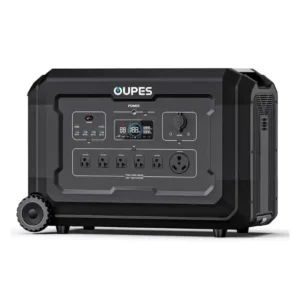
The Oupes Mega 3 holds 3,072Wh behind a 3,600W inverter, delivers 2,620Wh at the outlets, and accepts 2,100W of solar to 150 volts. A six-year warranty backs 3,500-cycle cells, and it sits in the upper mid-range price tier at exceptional value.
★★★★★
More details +
Most specifications in this category are matters of degree; a slower charger costs you time; a louder fan costs you a room. Switchover speed has a practical threshold of 20 milliseconds: below it, connected equipment generally rides through a grid failure; above it, it depends on your particular power supply. Across forty machines measured for this site, this is the only one to land on the wrong side of it, at 20.1 milliseconds, and it cannot arm its own inverter either. Two further limitations compound it: the array cannot stay permanently connected, which almost everything else here allows, and the machine cannot receive firmware updates at all across six years of warranty coverage. That warranty is genuinely a year better than the class standard, the value tier is honest, the 2,100-watt solar range is flexible, and the standby drain under 1% is good. But two direct rivals at identical capacity and the same price convert four points better, switch over in less than half the time, take a permanent array,y and get firmware support. There is no configuration in which this is the one to buy.
PROS:
- A six-year warranty, a year beyond the class standard.
- Solar of 2,100W across a wide 12 to 150 volt range, suiting foldables and rigid strings alike.
- Combined charging of 3,900W, more than double the mains input alone.
- Standby drain of 0.9% an hour, so it holds a charge through long storage.
- A 400W app-controlled DC port and expansion support at an exceptional value tier.
- A 3,600W inverter with 6,000W of surge, properly sized for the capacity.
CONS:
- A 20.1ms switchover, the only reading above the twenty-millisecond threshold in this dataset.
- Panels cannot remain connected around the clock, so the array must be disconnected between sessions.
- No firmware update capability across six years of warranty coverage.
- Sixty-one decibels, beyond what any occupied indoor room will tolerate.
- No harmonic distortion figure exists in the bench data
- Eighty-one pounds and 1,800W mains charging, both behind the better machines at this size.
Show next