
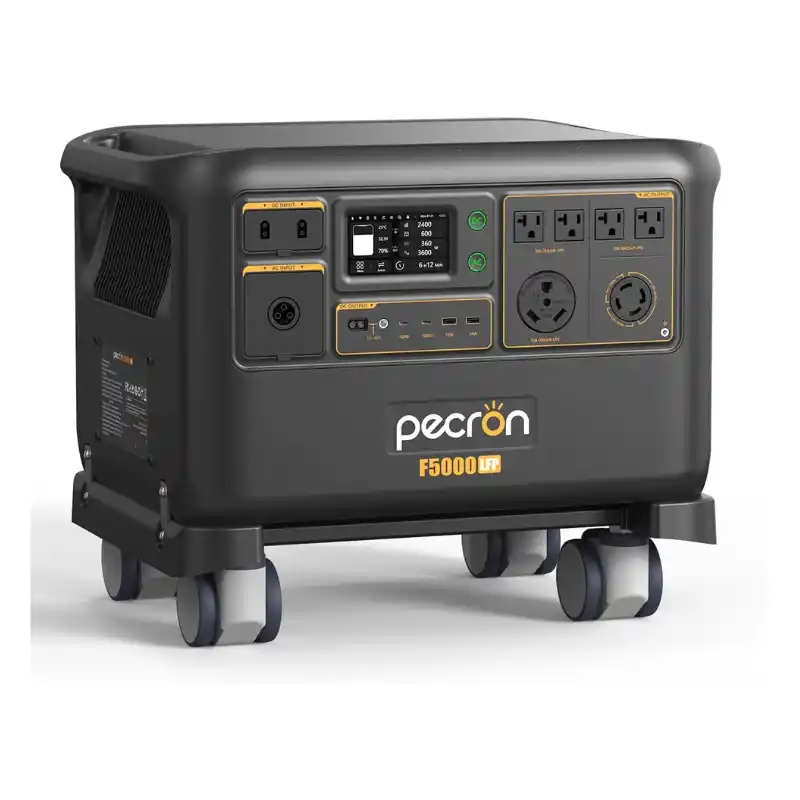
Pecron F5000LFP Review

The Pecron F5000LFP delivers 4,440Wh of its 5,120Wh rating behind a 7,200W split-phase inverter that transfers instantaneously and arms itself. Solar reaches 6,400 W at 180 V; the DC output is rated at 1,000 W, and it sits in an exceptional value tier.
My Quick Verdict
On paper, this reads like a machine costing twice as much. A 7,200-watt split-phase inverter, instantaneous transfer with a self-arming inverter, 6,400 watts of solar at 180 volts, a 1,000-watt DC output and 5,120Wh of storage; all at an exceptional value tier.
Then you look at the waveform. Harmonic distortion measures 3.50%, which is not merely above the 2% threshold but also the highest figure recorded across all machines measured at this site, and well clear of second place.
For resistive loads, that is irrelevant. For a motor, a compressor, or a sensitive supply, the specification determines whether this machine belongs anywhere near them.
Everything else about it is genuinely impressive, which makes the distortion reading all the more frustrating.
Best for: Large-array off-grid setups and property-wide backup covering resistive and everyday household loads.
Not for: medical equipment, sensitive electronics, or anywhere quiet.
Key Stats
| Badge | Stat |
|---|---|
| Battery chemistry and longevity | LiFePO4 | 4,000 cycles |
| Continuous AC power output | 7,200W AC | 9,000W peak |
| Split-phase output | 120V and 240V |
| Energy storage capacity | 5,120Wh | 4,440Wh usable |
| Rapid AC wall recharge | 3,600W input | 4,500W+ combined |
| Uninterrupted emergency backup | 0ms transfer | Self-arming |
| Maximum solar input and MPPT | 6,400W solar | 180V, 25A |
| High-output DC | 1,000W XT60 | Highest measured |
| Inverter waveform quality | 3.50% THD | Above the limit |
| Low-noise operational level | 58dB | Loud under load |
Introduction
There is a version of this review that lists the specifications and stops because they are the most capable set at this price point. Seven thousand two hundred watts on split phase, transfer with no measurable gap, an inverter that raises itself, 6,400 watts of solar, and a thousand-watt DC output.
The reason it is not that review is that it is a single measurement. Harmonic distortion of 3.50%, where the working limit is 2%, and the next worst machine in this dataset manages 2.1%.
Distortion describes how closely the waveform leaving the inverter resembles that delivered by a wall socket. Heaters and lighting do not care. Motors run hotter on a distorted supply, and sensitive electronics are simply not designed for it.
Its cells are lithium iron phosphate, rated for 4,000 cycles and backed by a 5-year warranty.
What It Can Actually Run
Seven thousand two hundred watts held continuously with 9,000 in a burst, across 120 and 240 volts. That matches the largest sustained output in this data.
Rated at 5,120 Wh, the sockets returned 4,440 Wh. 86%, which is a fair figure at this scale. Everything below is based on 4,440 Wh.
- Refrigerator at 150W: nearly thirty hours.
- CPAP at 40W without humidification: 111 hours, subject to the waveform warning below.
- Starlink dish at 50W: eighty-eight hours.
- A 45W twelve-volt camp fridge fed on DC: past 103 hours, using the better 4,653Wh path.
Electrical noise measured 750mv, which is among the cleanest readings in this dataset; an odd pairing with the distortion figure, and worth understanding as two separate measurements rather than one.
Charging and Smart Features
Mains charging reaches 3,600 watts, and the combined input power exceeds 4,500 watts. Solid rather than exceptional at this capacity.
Solar is where the machine is extraordinary: 6,400 watts across two channels, each delivering 3,200 watts at 30-180 volts and 25 amps.
That combination of high voltage and generous current is rare. Most machines here trade one for the other.
The transfer to battery is instantaneous, and the inverter arms itself. Premium price tier, exceptional value tier.
Charging Speed Benchmarks
Charging figures for the Pecron F5000LFP set against the Over 3,000Wh capacity class, the 16 largest machines in our charging database. Mains input averages 2,802W in that bracket and solar averages 2,681W. As everywhere on the site, Low, Average and High are calculated within the class rather than across it.
Mains charging of 3,600W is above the 2,802W class average yet lands right on the High threshold and records as Average. Across 5,120Wh of storage that comes to roughly 1.4 hours from flat, adequate rather than quick for a pack this size, and it is the one input figure on this machine that does not lead its class. The bracket reaches 6,000W at the top, so there is a machine here that fills a smaller pack in less than half the time.
Panels are the reason this unit exists. 6,400W is the highest solar input recorded anywhere in our database, well over double the 2,681W class average, and it arrives at 180 volts with 25 amps on each channel, so voltage headroom and current allowance are generous together rather than one at the expense of the other. A full 5,120Wh pack comes back from the array in roughly 0.8 hours, faster than from a wall socket. Almost nothing else in this category can say that.
Need the grid side to match the array? The Anker SOLIX F3800 Plus draws 6,000W from mains, two thirds more than the F5000LFP, and refills 3,840Wh in around 0.6 hours with pass-through supported throughout. Solar falls to 3,200W, so the choice is which channel you need to be fast. Its 1.10% waveform distortion also keeps sensitive equipment on the table, which this machine does not.
Real Capacity: What You Actually Get
Both paths deliver well, and unusually, the twelve-volt side is the stronger.
The outlets produced 4,440 Wh from a 5,120 Wh label. 86% is a fair showing on a pack this size.
The DC route returned 4,653Wh, or 90%, four points ahead and worth 213 watt-hours. With a 1,000-watt XT60 output available, routing real loads that way is practical rather than theoretical.
Retention holds up well: 0.83% per hour while armed, 0.08% at twelve volts, so keeping it ready indefinitely is barely a cost at all.
My takeaway: The socket delivers 4,440 Wh Wat 12lve vo, theylts retu4,653 Wh3 Wh. With a 1,000-watt DC port on board, the twelve-volt path here is a genuine option rather than a footnote, and it bypasses the inverter’s distortion entirely.
Power Output and Surge: What It Can Turn On
The inverter matches the largest in this dataset at 7,200 watts continuous, across both 120 and 240 volts. A well pump, an electric range, heating, and refrigeration, with room to spare.
Nine thousand watts of surge is narrower headroom than some rivals offer above their continuous rating, though still far beyond any domestic motor start.
The DC output is the standout port. One thousand watts down an XT60 dwarfs every other DC rating measured here, and it carries serious twelve-volt equipment while leaving the inverter out of the picture.
That last point matters more here than on any other machine, because bypassing the inverter also bypasses the distortion.
Real Appliance Runtimes
Four thousand four hundred and forty watt-hours at the sockets, with one line worked from the better 4,653Wh DC path, against the usual appliance set.
| Appliance | Power Draw | Runtime | What That Means |
|---|---|---|---|
| Full-size refrigerator | 150W | About 29.6 hours | Nearly thirty hours, though a compressor on 3.50% distortion is not ideal. |
| CPAP machine (no humidifier) | 40W | About 111 hours | Four and a half nights, but consider the waveform first. |
| Starlink dish | 50W | About 88.8 hours | Nearly four days of connection off the grid. |
| 12V camp fridge, runs on DC | 45W | About 103 hours | Drawn on twelve volts, so the waveform never enters it. |
| Laptop (70W) | 70W | About 63 recharges | Sixty-three, through a single 100W port. |
The DC line is doing more work here than on any other machine reviewed. It is both the more efficient path and the one that sidesteps the distortion, which makes twelve-volt loads unusually attractive on this unit.
Recharging: Wall and Solar
From a Wall Outlet
Three thousand six hundred watts refills a five-kilowatt-hour pack in roughly ninety minutes, which is reasonable for its capacity but not class-leading.
Combined mains and solar charging exceed 4,500 watts, with panels prioritised.
Given how strong the solar side is, the main figure is arguably the right balance: this is a machine designed to be filled by daylight, with the socket as backup rather than the primary route.
From Solar Panels
This is the most capable solar arrangement at this price point, and it is worth spelling out.
Two channels each draw 3,200 watts at 30-180 volts and 25 amps, for a total of 6,400 watts.
One hundred and eighty volts allows a series string of five or six rigid panels. Twenty-five amps per channel is a generous current allowance, which is unusual; most machines that permit high voltage restrict current to compensate, or vice versa.
The practical effect is that both a high-voltage series string and a wide parallel bank work properly, and 6,400 watts is enough input to refill the entire pack inside a couple of hours of good sun.
Both channels track independently; panels may remain permanently wired; and the machine runs loads throughout a charge.
Blackout Backup: The Part I Care About Most
Backup behaviour here is as good as anything in this dataset, which is why the overall score stays high despite the waveform.
The bench data records both 0-millisecond and 9.5-millisecond transfers, suggesting different behaviour across circuits or modes. Either reading is excellent.
More importantly, the inverter arms itself. Only a handful of machines here manage that, and without it, a fast transfer protects only an occupied house.
Losing 0.83% an hour keeps permanent readiness a sensible arrangement.
Why this matters to me: instantaneous transfer, sub-one-per-cent inverter, and sub-one-per-cent standby are the complete set for automatic backup. Very few machines here have all three, and none of the others reaches an exceptional value tier while having all three.
Noise and Living With It
Fifty-eight decibels under load, among the louder readings recorded on this site and beyond what any occupied indoor room will tolerate.
For a 7,200-watt inverter, that is not unreasonable, but the largest machine in this dataset manages 42 decibels behind the same output rating, so it is clearly achievable.
The weight is 124 pounds (56 kilograms), which is genuinely light for a five-kilowatt-hour, split-phase inverter of this size. Comparable machines run to 188.
It pairs via Wi-Fi and Bluetooth, and Pecron provides a phone line under the warranty.
Where It Falls Short
Three limitations: the first defines who should not buy this machine.
1. Harmonic Distortion of 3.50%
The highest figure recorded across all machines measured at this site was well clear of the next-worst 2.1%. The working threshold is 2%.
Distortion describes how far the waveform departs from what a wall socket produces. Resistive loads such as heating and lighting are unaffected. Motors draw extra current and run hotter on a distorted supply, and sensitive electronics are not designed for it.
On the hardware side, this is a grave shortcoming, though I would keep a CPAP machine or any medical device off the AC side entirely.
Worth noting: three of the four worst distortion figures in this dataset are from Pecron machines, suggesting a design characteristic rather than a single bad sample.
2. Fifty-Eight Decibels
Too loud for any room somebody occupies. Its place is a plant room, a garage, or an outbuilding.
The comparison that hurts is that the largest machine in this data runs at the same 7,200-watt output at 42 decibels.
3. Mains Charging and Surge Headroom Are Merely Adequate
Three thousand six hundred watts is fine for the capacity but well behind the fastest machines at this size, and 9,000 watts of surge is narrow relative to the 7,200-watt continuous rating.
Neither is a problem in practice. Both are places where the value pricing shows.
How It Compares
The natural comparisons are the EcoFlow Delta Pro Ultra and the EcoFlow Delta Pro 3, the two closest models in terms of capability.
| Feature | Pecron F5000LFP | EcoFlow Delta Pro Ultra | EcoFlow Delta Pro 3 |
|---|---|---|---|
| Price tier | Premium | Flagship | Premium |
| Value tier | Exceptional | Premium | Good |
| Rated capacity | 5,120Wh | 6,144Wh | 4,096Wh |
| Usable through AC | 4,440Wh (86%) | 5,620Wh (91%) | 3,810Wh (93%) |
| Usable through DC | 4,653Wh (90%) | 4,936Wh (80%) | 3,660Wh (89%) |
| Sustained output | 7,200W split phase | 7,200W split phase | 4,000W split phase |
| Transfer time | 0ms, self-arming | 0ms, self-arming | 9.7ms, self-arming |
| Distortion (THD) | 3.50% | 0.90% | 1.60% |
| High-output DC | 1,000W XT60 | 400W | 400W |
| Solar input | 6,400W to 180V | 5,600W to 450V | 2,600W to 150V |
| Fan noise | 58dB | 42dB | 53dB |
| Weight | 124 lbs | 188 lbs | 113 lbs |
Compared to the Delta Pro Ultra, this machine matches its inverter output and transfer behaviour, exceeds it in solar wattage and DC output, weighs 64 pounds less, and sits two value tiers higher.
What the EcoFlow offers is 1,000 Wh more capacity, 5 points higher AC conversion, 16 dB less noise, a 450-volt solar path, and 0.90% distortion versus 3.50%. On waveform quality, it is not a contest.
The Delta Pro 3 is the middle option: cleaner than the Pecron, cheaper than the Ultra, and limited to 4,000 watts. For a household running mostly general loads, it remains the most balanced of the three.
Who Should Buy It, and Who Should Skip It
Buy It If
- You need whole-property output and automatic operation without paying a flagship price.
- Your array is large, and 6,400 watts at 180 volts with 25 amps per channel is appropriate for it.
- Twelve-volt loads are central, where the 1,000-watt DC port bypasses the inverter entirely.
- The installation is in an outbuilding or plant room where the noise does not carry.
Skip It If
- A CPAP machine, medical equipment, or sensitive electronics will run on the AC side.
- The machine has to be anywhere within earshot of people.
- You want the cleanest available power, where two rivals are dramatically better.
- You need faster mains charging than 3,600 watts.
The Bottom Line
This machine delivers flagship capability at a value price, and the list is not a short one: 7,200 watts on split-phase, instantaneous self-arming transfer, 6,400 watts of solar, a 1,000-watt DC output, and 5 kilowatt-hours of storage.
One measurement undermines it. A distortion of 3.50% is the highest recorded on this site and well beyond the working limit, putting every motor and every sensitive supply on the wrong side of a design decision.
Run resistive and general household loads on it, or push twelve-volt equipment through that enormous DC port and bypass the inverter, and it is an outstanding value. Ask it to power anything that cares about waveform quality, and it is the wrong machine at any price.


There are no reviews yet.