
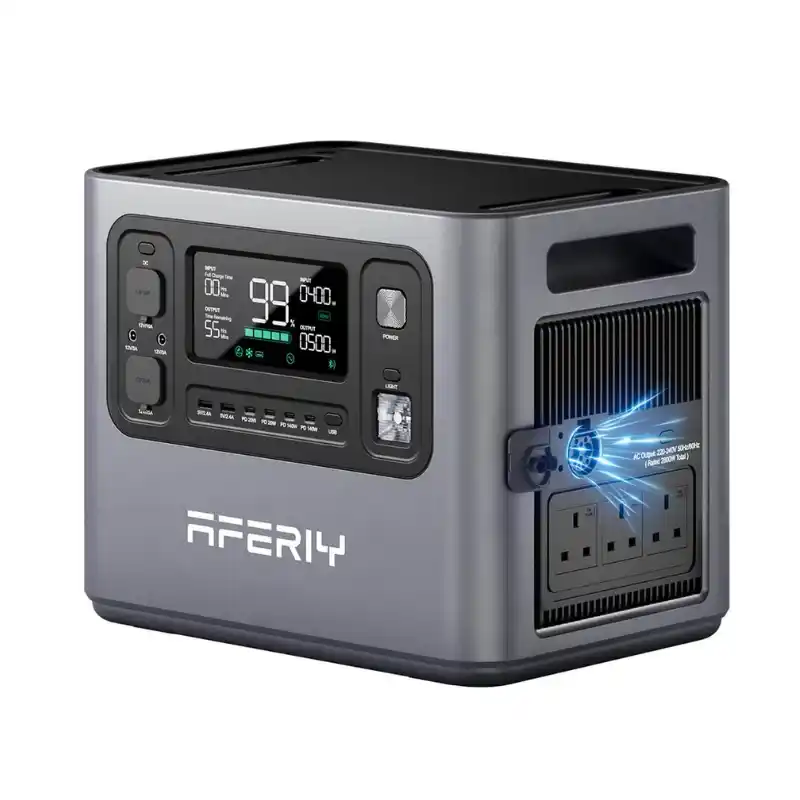
AFERIY P280 Review

The AFERIY P280 delivers 1,880 Wh of its 2,048 Wh rated capacity to the sockets, a 91% conversion rate that is the best at this size. It runs a 2,800 W inverter with a 6,000 W surge, accepts 1,200 W of solar power across dual ports, and carries a seven-year warranty on 4,000-cycle cells.
My Quick Verdict
Two figures in this unit are unmatched anywhere in the dataset. It converts 91% of its rated capacity into usable energy at the sockets, the best result at this size. And it carries a seven-year warranty, two years longer than anything else reviewed here.
Those are the two numbers that describe how much you get and how long you keep it, and no rival leads on both.
It also costs less than the units it outperforms. At the mid-range and exceptional value tiers, this is the cheapest usable energy at two kilowatt-hours anywhere on this site.
The catch is a familiar one. It cannot arm its own inverter, and at 57 decibels, the fans are loud enough to rule out an entire category of use.
Best for: Overland and RV work, and Emergency Home Resilience, where the unit sits somewhere noise does not carry, and somebody is home.
Not for: unattended backup, bedrooms, or anyone who wants a support line to call.
Key Stats
| Badge | Stat |
|---|---|
| Battery chemistry and longevity | LiFePO4 | 4,000 cycles |
| Continuous AC power output | 2,800W AC | 6,000W peak |
| Energy storage capacity | 2,048Wh | 1,880Wh usable |
| Rapid AC wall recharge | 1,800W input | Five-stage |
| Uninterrupted emergency backup | 8ms UPS | Manual arm |
| Maximum solar input and MPPT | 1,200W solar | Dual 600W ports |
| Ultra-fast USB-C power delivery | Dual 140W USB-C PD |
| Low-noise operational level | 57dB | Loud under load |
| Warranty coverage | 7 years | Longest measured |
| High-output DC | 340W XT60 output |
Introduction
Conversion loss is the quietest expense in this category. A pack rated at 2 kWh typically delivers around 1,740 Wh at the sockets, and the missing 300 Wh is lost as heat and never appears on a specification sheet.
The P280 loses less of it than anything else at this size. Metering the outlets produced 1,880 Wh, a 91% return, which is 120-140 Wh more usable energy than its closest rivals deliver at the same nominal capacity.
The cells are lithium iron phosphate, rated for 4,000 cycles, and the cover is rated for 7 years. Five years is the class standard, and several units offer three. Nobody else here offers seven.
What It Can Actually Run
The inverter sustains 2,800W with a 6,000W peak, which is genuinely large and sufficient for heating appliances running alongside other loads.
The rated capacity is 2,048 Wh, and the sockets returned 1,880 Wh. The twelve-volt route returned 1,831 Wh, or 89%. Calculations below use 1,880Wh.
- Refrigerator at 150W: 12.5 hours.
- CPAP at 40W without humidifier: around forty-seven hours, four nights and part of a fifth.
- Starlink dish at 50W: better than thirty-seven hours.
- Laptop at 70W: about twenty-seven refills, across two 140W ports.
Output measured 117 volts with 1.60% distortion. Both are inside safe limits, though 117 sits at the bottom edge of the acceptable band rather than the middle.
Charging and Smart Features
Maximum charging reaches 1,800W across five selectable stages, the finest rate control of any unit reviewed here.
Panels contribute up to 1,200W, arranged as two 600W inputs running 11 to 55 volts at 20 amps each. That total is the joint highest at this capacity.
Crossover was timed at 8 milliseconds, which is genuinely fast, but the inverter will not arm itself. Panels can stay wired permanently, and both inputs together take 2,100W.
Mid-range price tier, exceptional value tier. Nothing at two kilowatt-hours delivers more usable energy for less.
Charging Speed Benchmarks
The AFERIY P280 measured against the charging figures of every machine in the 2,000Wh to 3,000Wh capacity class. Twenty-six units make up that comparison, with a mean wall input of 1,641W and a mean solar input of 1,123W. Because the bands are drawn within each class, a rating here says nothing about how the unit would score in a bigger bracket.
Five-stage wall charging peaks at 1,800W, which clears the 1,641W typical for the bracket and carries the P280 to the upper limit of the Average band. Filling 2,048Wh at that rate is about 1.1 hours, inside a field spanning 470W to 5,000W. The stage control is the part worth using: five selectable rates is finer than anything else we have reviewed, and dropping to a slow profile overnight costs nothing when the pack is not needed until morning, while keeping cell temperatures down.
Solar reaches 1,200W across two independent 600W ports at 20 amps each, over the 1,123W class mean and sitting exactly on the boundary where a High rating begins, so it records as Average by a single watt. A full refill needs about 1.7 hours of good sun. The practical limit is not the wattage but the 55-volt ceiling, which is slightly below the 60 volts most rivals allow and caps how many rigid panels you can wire in a single series string before the array becomes invisible to the controller.
Need to push more panel wattage in? The DJI Power 2000 accepts 1,800W of solar at the same 2kWh capacity, half again what the P280 takes, and does it over a 43-amp low-voltage path rather than a narrow voltage window. Time to a full pack on panels drops from 1.7 hours to about 1.1 hours. Wall charging is identical at 1,800W, so this is purely a solar upgrade for anyone running a large array.
Real Capacity: What You Actually Get
This is the section where the P280 earns its place, and the margin is larger than it first appears.
The sockets returned 1,880 Wh out of a claimed 2,048 Wh. At 91%, that is six or seven points above what units at this capacity normally return, and it is the highest AC conversion figure recorded at this size.
The12-volt path produced 1,831 Wh, or 89%. Note the reversal: unlike almost every other unit reviewed here, the AC side outperforms the DC side, so there is no advantage to reorganising loads onto twelve volts.
Idling with the inverter live costs roughly 0.66% an hour, falling to 0.25% through the DC path. Both sit among the stronger retention figures recorded here.
My takeaway: 1,880 Wh is the working number, and it is 120 Wh more than its nearest rival delivers at the same rated capacity. That difference is roughly an extra hour of refrigerator time, bought purely by better conversion.
Power Output and Surge: What It Can Turn On
The inverter is one of the larger ones at this capacity, and the ratings reflect that.
Twenty-eight hundred watts, held continuously, can power a space heater and a refrigerator together, or a microwave alongside lighting and networking. Only one unit at this size offers more.
Six thousand watts of peak leave nothing domestic that could trouble it.
The one output figure worth pausing on is voltage. At 117 volts, the unit sits at the lower boundary of the acceptable 117-123 band rather than in the middle. Nothing will malfunction, but it is the narrowest margin at this size and worth knowing if you run equipment that is fussy about supply voltage.
Real Appliance Runtimes
What 1,880Wh buys in hours, measured against the same set of appliances applied to every unit here.
| Appliance | Power Draw | Runtime | What That Means |
|---|---|---|---|
| Full-size refrigerator | 150W | About 12.5 hours | Half a day outright, and well beyond with compressor cycling. |
| CPAP machine (no humidifier) | 40W | About 47 hours | Four nights and into a fifth. |
| Starlink dish | 50W | About 37.6 hours | Coming up on thirty-eight hours of dish time. |
| Pellet grill or smoker | 100W | About 18.8 hours | Two long sessions on a single charge. |
| Laptop (70W) | 70W | About 27 recharges | Two 140W ports running together. |
Every figure here is roughly an hour longer than those of rivals with identical rated capacity, and the reason is conversion, not a larger pack. That is 91% of the time spent doing visible work.
Recharging: Wall and Solar
From a Wall Outlet
The main input takes 1,800W across five selectable stages, offering finer control than anything else reviewed here
The practical value is real over a decade of ownership. Charge gently overnight when time is irrelevant, or take everything the socket will give when a warning arrives, and choose three positions in between.
Mains and solar together accept 2,100W.
From Solar Panels
Solar is one of this unit’s strongest areas, and it is arranged sensibly.
Twelve hundred watts of capacity is provided through a pair of separate 600W sockets, each rated for 11 to 55 volts and 20 amps. That total ties for the highest at this capacity.
Having two independent inputs means an east-facing bank and a west-facing bank can both deliver, each tracked separately rather than averaged together.
The 55-volt ceiling is slightly lower than the 60 volts most rivals allow, which marginally restricts series wiring, though 20 amps per port is generous compensation.
Panels may stay connected around the clock, and loads run while charging.
Blackout Backup: The Part I Care About Most
The hardware here is good, and the firmware wastes it, which is the most frustrating combination in this category.
The crossover measured 8 milliseconds, which is genuinely fast and among the better figures recorded on this site. Nothing with a processor would notice a gap that brief.
But the inverter does not arm itself. It has to be switched on in advance and left running for that 8-millisecond figure to protect anything at all.
At least the drain while armed is small enough that keeping it switched on is a realistic habit, unlike with every unit sharing this fault.
Why this matters to me: an 8-millisecond crossover that only works when somebody remembers to arm it is a specification, not a safeguard. The gap between this unit and the self-arming ones is a firmware decision, and it costs the P280 the top of its class.
Noise and Living With It
Fifty-seven decibels under load. That is among the louder readings in this dataset and comfortably past the threshold for any room where someone sleeps.
It is a working noise rather than a whine, and a garage, basement, or vehicle absorbs it without complaint. A bedroom, a tent, or a small home office does not.
The weight is 47 pounds, but the source data is inconsistent, listing both 47 pounds and 26.5 kilograms, which do not correspond. Treat the imperial figure as indicative and confirm before planning around it.
Connectivity covers Wi-Fi and Bluetooth. AFERIY, however, offers no telephone support, which sits oddly against a seven-year warranty. Claims and faults are submitted via email or a web form.
Where It Falls Short
Three limitations, and the first two decide who should not buy this.
1. The Inverter Will Not Arm Itself
An 8-millisecond crossover is wasted unless the inverter was already running when the grid failed.
This is the single thing separating the P280 from the best units at this capacity, and it is not a hardware limitation. Rivals with slower crossovers protect a house better simply because they wake up on their own.
2. Fifty-Seven Decibels
Loud enough to rule out bedrooms, tents, RVs, and quiet offices entirely. Not marginally, and not only for light sleepers.
For a unit otherwise this capable, the fans are the specification most likely to cause regret, because they are invisible when comparing spec sheets and unmissable the first night it runs.
3. No Telephone Support, and a Weight Discrepancy
A seven-year warranty is the longest here, and there is no phone line behind it. Claims go through email or a form, which is a meaningful difference over that timescale.
Separately, the published weight figures do not agree between the imperial and metric systems. Confirm the actual mass before planning around it.
How It Compares
The natural comparisons are the Anker SOLIX C2000 Gen 2 and the EcoFlow Delta 3 Max Plus, the two strongest units at this capacity.
| Feature | AFERIY P280 | Anker SOLIX C2000 Gen 2 | EcoFlow Delta 3 Max Plus |
|---|---|---|---|
| Price tier | Mid-range | Upper mid-range | Upper mid-range |
| Value tier | Exceptional | Exceptional | Good |
| Usable through AC | 1,880Wh (91%) | 1,760Wh (85%) | 1,740Wh (84%) |
| UPS switchover | 8ms | 7.2ms | 7.9ms |
| Self-arming inverter | No | Yes | Yes |
| Sustained output | 2,800W | 2,400W | 3,000W |
| Solar input | 1,200W (dual port) | 800W | 1,000W (dual port) |
| Warranty | 7 years | 5 years | 5 years |
| Battery cycles | 4,000 | 4,000 | 3,500 |
| Fan noise | 57dB | 44dB | 42dB |
| Phone support | No | Yes | Yes |
On raw delivery,y the P280 wins clearly. It delivers 120 Wh more than the Anker and 140 Wh more than the EcoFlow at the same nominal capacity, accepts more solar than either, runs a larger inverter than the Anker, and comes with two extra years of warranty. It also costs a price tier less.
On behaviour, it loses just as clearly. Neither rival needs anyone to arm it, and both run thirteen to fifteen decibels quieter, which is the difference between a unit that can live in a hallway and one that cannot.
So the split is unusually clean. If the unit sits in a garage or in a vehicle and someone is around to switch it on, the P280 delivers more energy for less money than any other unit at this size. If it needs to protect a house on its own, or live where people sleep, both rivals are worth their premium.
Who Should Buy It, and Who Should Skip It
Buy It If
- You want the most usable energy per pound spent at two kilowatt-hours.
- Warranty length matters, where seven years is unmatched here.
- You are running two solar arrays and want 1,200W across independent ports.
- Its permanent home is somewhere the fan noise does not reach anyone.
Skip It If
- It must protect the house while nobody is home. This unit will not arm itself.
- It will run anywhere quietly. Fifty-seven decibels rules that out.
- You want a telephone number to call over a seven-year ownership period.
- Your equipment is sensitive to supply voltage at the low end of the range.
The Bottom Line
On the two questions that matter most over a decade of ownership (how much energy you get and how long the manufacturer stands behind it), the AFERIY P280 leads everything else. 91% conversion and a seven-year warranty, at a lower price tier than the units it beats.
What it will not do is look after itself. The inverter needs to be armed by hand, so it protects a house only when someone is in it, and the fans are loud enough that where it lives is decided for you.
That makes it an outstanding buy for a garage, a workshop, or a vehicle, and the wrong buy for a hallway cupboard. Very few units in this dataset draw that line so clearly.


There are no reviews yet.