
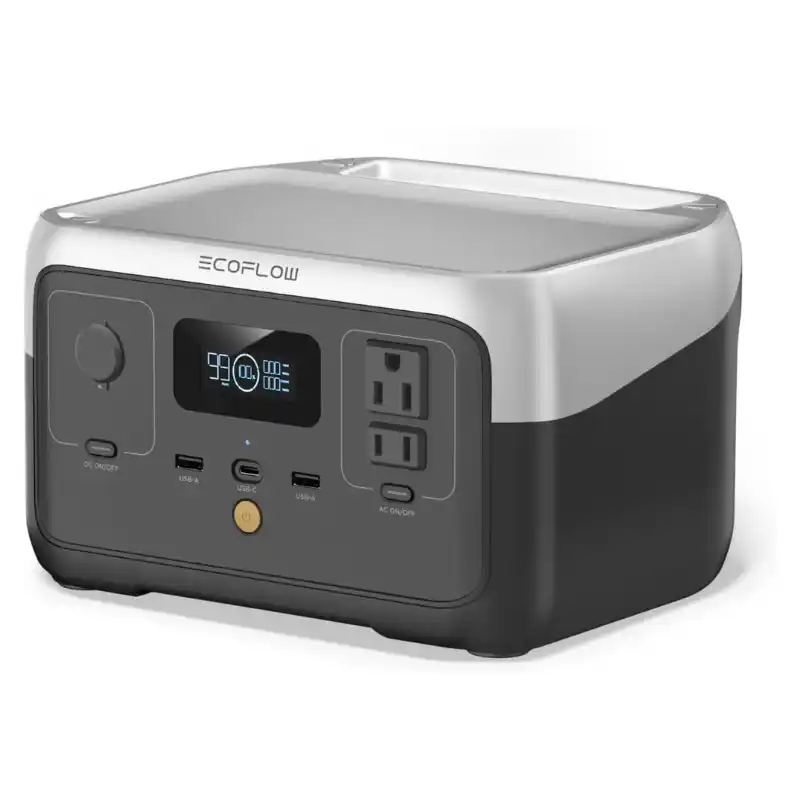
EcoFlow River 2 Review

The EcoFlow River 2 weighs 7.4 pounds, the lightest in our database, and charges internally at 360W. It delivers just 190 Wh of its 256 Wh rating via AC but 228 Wh via DC, and includes Wi-Fi and Bluetooth app support.
My Quick Verdict
Seven point four pounds makes this the lightest machine in our entire database, narrowly ahead of the Energizer 320Wh at nine.
It charges internally at 360 watts, filling the pack in around forty minutes, and carries both Wi-Fi and Bluetooth apps; neither of which anything else this small offers.
Then the conversion. The outlets return 74%, while the twelve-volt outlets return 89%, a 15-point difference, and are worth 38 watt-hours, depending on where you plug in.
Its inverter also sheds 4.4% of the charge every hour it sits armed, which, on a 256 Wh pack, empties it in about a day.
Best for: Backpacking and day trips where the machine is charged, carried, used on DC, and switched off.
Not for: AC-heavy loads, leaving charged between uses, or anything needing more than 300 watts.
Key Stats
| Badge | Stat |
|---|---|
| Battery chemistry and longevity | LiFePO4 | 3,000 cycles |
| Continuous AC power output | 300W AC | 600W peak |
| Energy storage capacity | 256Wh | 190Wh usable via AC |
| Weight | 7.4 lbs | Lightest measured |
| Rapid AC wall recharge | 360W internal | Under 45 minutes |
| DC conversion efficiency | 89% | 15 points above AC |
| Emergency backup switchover | 30ms | Above the threshold |
| Maximum solar input and MPPT | 110W solar | 11–30V, 8A |
| Smart app control | Wi-Fi + Bluetooth |
| Low-noise operational level | 45dB | Quiet under load |
Introduction
At 7.4 pounds, this is the lightest machine we have weighed among the power stations we have tested, which range from 240Wh to 6,144Wh.
For a machine that gets carried rather than installed, that figure matters more than almost anything else, and EcoFlow pairs it with specifications no rival in this size class offers: 360 watts of internal charging, adjustable charge rates, and both Wi-Fi and Bluetooth connectivity.
Its pack claims 3,000 lithium iron phosphate cycles and is warranted for five years, which is more coverage than anything else this size offers.
The trouble lies in the journey from cell to socket.
What It Can Actually Run
Three hundred watts sustained with 600 in a burst. That covers a laptop, lighting, a router, and devices, and nothing beyond them.
Rated at 256 Wh, the sockets returned only 190 Wh, a 74% loss. The main calculations below are based on 190 Whh; the twelve-volt ones are based on the much better 228 Wh Whh.
- Television at 150W: an hour and fifteen minutes.
- CPAP without humidification at 40W: four and three-quarter hours.
- Starlink dish at 50W: nearly four hours.
- A 45 W, twelve-volt camp fridge on DC: past five hours, drawing 228 Wh.
The line held 120 volts correctly, though noise exceeded 2,000 mV, and the sheet logged a hum from the inverter.
Charging and Smart Features
Wall input reaches 360 watts via an internal charger with adjustable speed, filling the pack in about 43 minutes.
The panel side accepts 110 watts across 11 to 30 volts at 8 amps, and the sheet confirms sunshine alone completes a charge inside the standard window.
No dual charging is fitted, so wall and sun never work in concert.
The transfer measured 30 milliseconds. Upper mid-range price tier, luxury value tier.
Charging Speed Benchmarks
Charging figures for the EcoFlow River 2, benchmarked against every machine in the Under 300Wh capacity class our database covers. Twenty-four units make up that group, averaging 131W from the wall and 97W from panels. Ratings are scored inside the class alone, so they compare this unit only with machines of similar size.
Internal charging at 360W is close to triple the 131W class average and takes a High rating, returning a 256Wh pack to full in roughly 0.7 hours. The practical figure is smaller than that suggests, because this machine delivers 190Wh of its rating through AC, so what you actually replace after a working session is less than the nameplate implies and the real turnaround is shorter again. On a 7.4-pound unit meant to be carried, a sub-hour refill is the specification that makes it repeatable.
Solar accepts 110W, which clears the 97W class average and just passes the 100W mark for a High rating, but sits a long way under the 600W class ceiling. Panels fill the pack in about 2.3 hours of good sun, more than three times the wall socket. This is where the tight banding at this size is worth reading carefully: a High rating on 110W and a High rating on 600W describe very different machines.
Need a quicker turnaround between sessions? The Bluetti EB3A charges internally at 430W and takes 160W of solar, so a slightly larger 268Wh pack comes back in around 0.6 hours on AC or 1.7 hours on panels. It weighs 10.1 pounds against 7.4 here, which is the cost, and it drains 5 percent an hour with the inverter armed, so the faster charging is partly compensating for that.
Real Capacity: What You Actually Get
The gap between the two output paths is the widest at this capacity and among the widest in our database.
A meter on the sockets recorded 190 Wh, compared with a claimed 256 Wh. At 74%, some 66 watt-hours of a modest battery stay locked inside.
Twelve volts yielded 228 Wh (89%), a properly good result. That fifteen-point spread is worth 38 watt-hours; a fifth of what the AC side delivers.
Standby follows the same split. Armed, it sheds 4.4% each hour and clears the pack in about twenty-three hours of idleness; twelve volts loses a tenth of that.
The lesson is plain enough: work through twelve volts and USB, and keep the inverter shut down.
My takeaway: Plan on 1190, or 2228 Wh at 12 volts. On a pack this small, that 38Wh gap is a fifth of what the AC side provides, so route as much as you can to twelve volts.
Power Output and Surge: What It Can Turn On
300 W continuous is modest and appropriate for 256 Wh. A laptop, lighting, a router,r and devices all run; anything with a heating element or a motor does not.
Six hundred watts of surge covers the small loads the inverter can sustain.
Its bi-directional USB-C runs both ways at 60 watts: full speed for handhelds, sluggish for a laptop, and capable of feeding the machine from a compatible supply.
The output voltage is a correct 120, which is good. Set against it: noise past 2,000mv and a humming inverter, both toward the messier end of this data.
Its 12-volt outlet is limited to 100 watts, under the 150-watt bar, though on a pack this size, that constraint is less limiting than it would be elsewhere.
Real Appliance Runtimes
Main figures rest on 1190 Wh; the DC line uses the far better 2228 Wh
| Appliance | Power Draw | Runtime | What That Means |
|---|---|---|---|
| Television | 150W | About 1.3 hours | Through the inverter, only 74% arrives. |
| CPAP machine (no humidifier) | 40W | About 4.8 hours | Under five hours - not a full night. |
| Starlink dish | 50W | About 3.8 hours | An afternoon of connection. |
| 12V camp fridge, runs on DC | 45W | About 5.1 hours | Five hours on the markedly better route. |
| Laptop (70W) | 70W | About 2.7 recharges | Under three charges, none of them quick. |
Compare the television line against the camp fridge line. Similar draws, and the DC path delivers nearly four extra hours from the same pack—the clearest illustration in our data of why the socket matters.
Recharging: Wall and Solar
From a Wall Outlet
Three hundred and sixty watts through an internal charger is exceptional at this capacity, filling the pack in around forty-three minutes.
The usual arrangement at this size is 60 to 120 watts from a brick, with a two- to five-hour wait. Neither applies here.
The rate steps down as you wish, so an unhurried fill is available.
The fast charging also partly offsets the standby drain: if the machine has drained while waiting, you are three-quarters of an hour from full again.
From Solar Panels
Panel input draws 110 watts at 11-30 volts and 8 amps.
Against 256 Wh, that ratio is sound, and the sheet confirms that sunshine alone finishes the job within the standard window, something plenty of bigger machines cannot.
Engaging from 11 volts, one compact folding panel registers at once, which fits the outings this is made for.
Stopping at 30 volts rules out most rigid panels, leaving parallel foldables.
Panels may remain attached indefinitely, with output continuing as long as they are charged.
Blackout Backup: The Part I Care About Most
The transfer measured 30 milliseconds, which ties for the slowest reading in our entire database.
The conventional safety threshold is 20 milliseconds, so this sits half again beyond it. Work on the basis that whatever is plugged in reboots.
At 256 Wh, that matters less than it would on a larger machine, since nobody is protecting a household with this.
What compounds the 4.4% hourly standby drain? A machine left armed to catch a power cut empties itself in about a day, so the transfer function is very nearly self-defeating here.
Why this matters to me: a 30-millisecond transfer on a pack that drains itself in a day is not backed up by any useful definition. Treat this as a carry-and-use machine and switch the inverter off between sessions.
Noise and Living With It
Forty-five decibels under load, which is quiet and comfortably below the threshold for a room where someone sleeps.
One qualification: the inverter hums on its own, so airflow is not the only culprit, and quiet operation does not follow from a light draw.
Weight is the headline,e and it is a database record: 7.4 pounds, 3.4 kilograms. Nothing else we have weighed is lighter.
The app runs over both Wi-Fi and Bluetooth, which nothing else at this capacity offers, and the warranty lasts 5 years, the longest at this size.
Where It Falls Short
There are three limitations, and the first two compound each other.
1. Seventy-Four Percent Through AC
Of a 2256 Wh pack, 66 Wh stays inside; a quarter of a battery that had little to spare.
The 89% DC path is fifteen points better, but the 60-watt USB-C port and 100-watt twelve-volt socket limit how much you can route that way.
2. A 4.4% Hourly Standby Drain and a 30ms Transfer
Armed and idle, the machine empties itself in roughly twenty-three hours. That is the second-worst standby figure in our database.
And 30 milliseconds ties for the slowest transfer we have measured, more than twice the safety threshold. Together, they make the backup function nearly pointless.
3. A 30-Volt Solar Ceiling and Luxury Value Tier
Most rigid panels operate above 30 volts and will not engage, leaving small foldables as the only option.
Its cost per watt-hour falls into the luxury band, which is steep for 190 spendable watt-hours at the outlets.
How It Compares
Two comparisons at a similar capacity, both heavier and both cheaper per watt-hour.
| Feature | EcoFlow River 2 | Bluetti EB3A | CTechi 240Wh |
|---|---|---|---|
| Rated capacity | 256Wh | 268Wh | 240Wh |
| Usable through AC | 190Wh (74%) | 210Wh (78%) | 190Wh (79%) |
| Usable through DC | 228Wh (89%) | 228Wh (85%) | 209Wh (87%) |
| Weight | 7.4 lbs | 10.1 lbs | 7.9 lbs |
| Continuous output | 300W | 600W | 200W |
| Wall charging | 360W internal | 430W internal | 60W via brick |
| Idle drain (AC armed) | 4.4% per hour | 5% per hour | Not recorded |
| UPS switchover | 30ms | 20ms | None fitted |
| Battery cycles | 3,000 | 2,000 | 2,000 |
| Warranty | 5 years | 2 years | 1 year |
| App connectivity | Wi-Fi + Bluetooth | Bluetooth | None |
| Fan noise | 45dB | 49dB | Not recorded |
Compared to the Bluetti EB3A, this machine is 2.7 pounds lighter, quieter, better connected, has longer-lasting cells and a longer warranty, and draws slightly less power. It gives up half the inverter, 70 watts of charging, and four points of AC conversion.
The CTechi 240Wh is the value alternative: half a pound heavier, five points better through AC, and considerably cheaper, but it charges at 60 watts through a brick and has no app at all.
If weight and connectivity are your priorities, this is the machine for you. If output or AC efficiency matters more, the EB3A is the one.
Who Should Buy It, and Who Should Skip It
Buy It If
- Weight decides it. Nothing in our database is lighter.
- Your loads run on 12 volts and USB, not through the inverter.
- You want fast internal charging and a real app on a machine you can carry all day.
- Long cell life and warranty matter at 3,000 cycles and five years.
Skip It If
- Your loads plug into the AC sockets, but only 74% of the power reaches them
- The machine will sit charged and armed between uses.
- You need more than 300 watts of output.
- Cost per watt-hour matters at this capacity.
The Bottom Line
This is the machine to carry, and by a small but real margin, nothing else we have weighed is lighter. It charges fast, connects properly, and its cells and warranty outlast everything at this size.
What it does badly is deliver AC power. 74% at the sockets and 4.4% hourly drain while armed are both near the bottom of our data.
Use it as a DC and USB machine with an inverter; it is excellent. Use the inverter as the main path, and use a quarter of the battery.


There are no reviews yet.