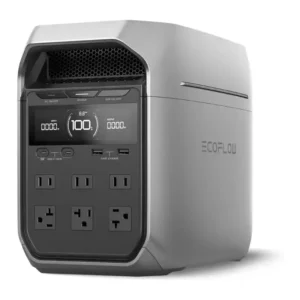
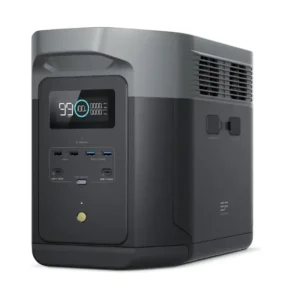
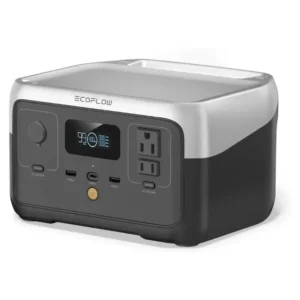
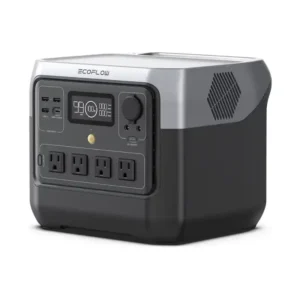
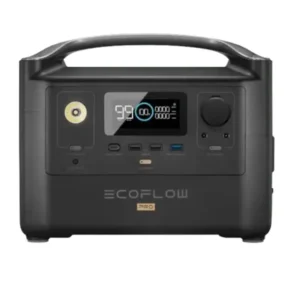
The EcoFlow Delta 3 Max Plus holds 2,048Wh behind a 3,000W inverter with 6,000W of surge, crossing over in 7.9ms with a self-arming inverter. Distortion measures 0.30% “the cleanest recorded” fans stay at 42dB, and dual charging reaches 2,600W. Upper mid-range price tier, good value.
On almost all power stations we have reviewed, nearly every one has carried a defect that decides who should not buy it: fans too loud for a bedroom, an inverter that will not arm itself, a solar window too narrow for real panels, a pack that drains while it waits. This is the first one in which the shortcomings are matters of degree rather than exclusion. It crosses over in 7.9 milliseconds and arms itself, which only three of the previous thirteen could do, and it loses just 0.9% an hour, so leaving it armed costs nothing. Distortion measured 0.30%, around a fifth of the field average,e and the cleanest waveform recorded anywhere here, and the fans hold 42 decibels despite a 3,000-watt inverter behind them. Dual charging reaches 2,600 watts across two independent solar ports. What it does not do is deliver cheap energy: 84% conversion is the only ordinary figure on the sheet; it weighs 48 pounds and sits in the good value tier, while rivals at this capacity reach exceptional. You are paying a price tier for finished engineering rather than for watt-hours, which is rare enough in this category to be worth saying plainly.
Battery safety and chemistry (LiFePO4, 3,500 cycles)
Built on 4,000-cycle LiFePO4 cells, EcoFlow Delta 3 Plus 1,024Wh power station delivers 1,800W of continuous output and a 3,600W surge, enough to start a full-size refrigerator. Whisper-quiet 41dB fans and a 10.2ms blackout switchover make it a mid-range pick for indoor emergency backup.
I judge every unit in the High-Demand Utility Class by one question: would I trust it to sit in a closet for a year and then work perfectly on the worst night of the winter? The Delta 3 Plus is one of the few I answer yes to. It delivered 880Wh of the rated 1,024Wh, switches over in 10.2 milliseconds, and runs at 41dB, the quietest in this class by a wide margin. The idle drain and the underpowered 12V socket are real flaws, and the Bluetti Elite 100 V2 sits a full tier below it on value. But if you are buying this to protect a refrigerator, a CPAP machine, and a router through a multi-day outage, the quiet fans, the fast switchover, and the auto-on inverter earn the premium.
Battery safety and chemistry (LiFePO4, 4,000 cycles)
10
Real-world inverter efficiency (85%)
7.5
UPS failover speed (10.2ms, auto-on)
9.5
Port selection and power distribution
7.5
Solar charging and MPPT performance (1,000W)
9.5
AC wall recharge speed (1,500W, adjustable)
10
Noise and thermal management (41dB)
10
Portability and build quality (27 lbs)
8
Expandability and ecosystem
8
Smart app and interface
8.5
PROS:
Whisper-quiet 41dB fans. The quietest in its class by a wide margin so it can sit in a bedroom.
10.2ms switchover with an auto-on inverter. Your PC and router stay up, even when nobody is home.
4,000-cycle LiFePO4 cells. Over ten years of daily use before it drops to 80% capacity.
Takes an expansion battery, so you can start at 1kWh and grow later.
1,500W wall charging with step-by-step speed control, plus 1,000W of solar input.
140W USB-C port charges a laptop with no wall brick.
CONS:
Sits in the premium value tier, while same-capacity units in this class sit in the exceptional tier.
Loses about 2.5% of its charge per hour when the AC inverter idles. Remember to switch it off.
The 12V car socket caps at 139W, which is short of the 150W I look for.
At 27 pounds, it is a two-hand carry. Fine for the house, less fun on a long walk.
Expansion batteries are proprietary, so you are locked into EcoFlow's ecosystem.
Inverter electrical noise measured high, which may matter for sensitive radio gear.
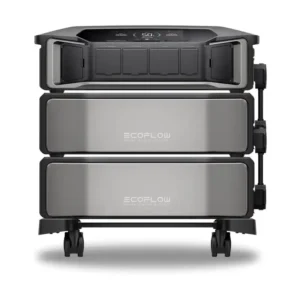
The EcoFlow Delta Pro Ultra holds 6,144Wh behind a 7,200W split-phase inverter, delivers 5,620Wh at the outlets, and transfers to battery with no measurable gap while arming itself. Solar accepts 5,600W across a path reaching 450 volts.
A genuine home backup needs two things: a takeover with no gap and no requirement for anyone to be present when it happens. Across forty machines measured for this site, this is the only one that does both—others transfer instantaneously but wait to be armed, and plenty arm themselves but take ten or fifteen milliseconds to hand over. Around that sit the largest figures in the dataset: 7,200 watts continuous on split phase, 7,200 watts of mains charging and 8,800 combined, and a solar input reaching 450 volts, roughly triple anything else here and the range a rooftop array actually operates at when wired to a string inverter. It converts 91% of a 6,144Wh pack, holds 42 decibels behind that inverter, and loses 0.58% an hour on standby. The costs are all physical and financial rather than functional: 188 pounds, the heaviest machine measured here; premium-tier energy at a flagship price; only 80% returned through DC; and 3,500 cycles where larger rivals offer more. For a property wired to a transfer switch, nothing else in this data does the job. Anything short of that, and the cheque covers hardware that sits idle.
Battery safety and chemistry (LiFePO4, 3,500 cycles)
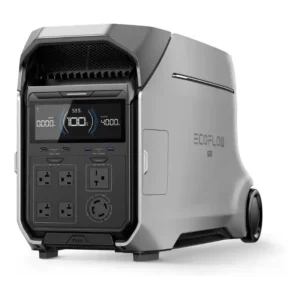
The EcoFlow Delta Pro 3 delivers 3,810Wh of its 4,096Wh rating through a 4,000W split-phase inverter that produces both 120V and 240V. It arms itself, hands over in 9.7ms, accepts 2,600W of solar power, and recharges at 7,000W from both inputs combined.
Everything reviewed on this site until now has been a machine you plug things into. This one is wired into a panel, and the specification that moves it across that line is split-phase output: 120 and 240 volts, which brings well pumps, electric ranges, and anything else on a two-pole breaker into scope for the first time. Behind that sit 4,000 watts held continuously and 8,000 available in a burst, a 93% return that puts 3,810Wh of a 4,096Wh pack at your disposal (a figure exactly one machine in this data betters) and a mains input of 4,000 watts that empties-to-full in under sixty minutes. It also arms its own inverter and hands over in 9.7 milliseconds, which, for something tied to a transfer switch,h is not a luxury but the entire point. The costs are real and mostly physical: 113 pounds for permanently settled portability, the single 100-watt USB-C port is meager for a premium-tier machine, and per watt-hour it lands in the good-value tier while cheaper units reach the exceptional tier. Most households do not need this. The ones that do have nothing else in the range to consider.
Battery safety and chemistry (LiFePO4, 4,000 cycles)
9.5
Real-world efficiency and output (93% AC, 89% DC, 0.91% idle)
9.5
UPS and EPS switchover (9.7ms, self-arming)
10
Port selection and distribution (100W USB-C, 400W DC)
7
Solar charging and MPPT (2,600W across dual paths, 150V ceiling)
10
AC recharge speed (4,000W mains, 7,000W dual)
10
Noise and thermal management (53dB)
7
Portability and build quality (113 lbs)
3.5
Expandability and ecosystem (expansion and split-phase pairing)
10
Smart app and interface (Wi-Fi and Bluetooth)
8.5
PROS:
Split-phase 120V and 240V output: the first unit reviewed here can serve two-pole circuits.
Conversion of 93%, beaten by a single machine anywhere in this dataset.
A self-arming inverter with a 9.7ms handover is essential for anything wired into a transfer switch.
Mains charging at 4,000W and 7,000W from both inputs, filling the pack inside an hour.
Solar of 2,600W across two independently tracked paths, one reaching 150 volts.
Cells rated to 4,000 cycles with standby loss of 0.91% per hour and expansion support.
CONS:
One hundred and thirteen pounds, which makes installation the only realistic option.
A single 100W USB-C port on a premium-tier machine, where cheaper units fit two at 140W.
Good value tier rather than exceptional, so the cost per watt-hour is beaten lower down the range.
Fifty-three decibels, where several smaller machines run in the low forties.
A distortion of 1.60% is within limits but well behind the cleanest units reviewed here.
At four kilowatt-hours, recharging rather than capacity becomes the planning constraint.
The EcoFlow Delta 2 Max carries 2,048Wh behind a 2,400W inverter, runs at 46dB, and sheds only 0.8% of its charge per hour on standby. Distortion measures 0.90%, dual charging reaches 2,600W, and it weighs 51 pounds. Upper mid-range price tier, good value.
Placed beside its own smaller sibling, this unit is a study in what a manufacturer chose to fix. The kilowatt-hour Delta 2 is the loudest machine in this entire dataset at 62 decibels; scaled up to two kilowatt-hours behind a larger inverter, it runs at 46, which is a transformation rather than an improvement and makes it genuinely usable in a room where someone sleeps. Conversion improved to 87%, distortion dropped to 0.90%, dual charging reached 2,600 watts (the smaller unit supports none at all), and a standby drain of 0.8% per hour means it holds its charge through months of storage. What EcoFlow left alone is the handover, at 17.5 milliseconds; the second slowest at this capacity, clearing the safety line by very little, on an inverter that still will not wake by itself. That combination keeps it out of the job most buyers want a power station for. Buy it as a quiet, efficient battery for a house where someone lives. For automatic protection, EcoFlow's Delta 3 Max Plus fixed this precisely at the same price tier.
Battery safety and chemistry (LiFePO4, 3,000 cycles)
8
Real-world efficiency and output (87% AC, 81% DC, 0.90% THD)
8.5
UPS and EPS switchover (17.5ms, no self-arming)
5
Port selection and distribution (two 100W USB-C, 139W 12V)
7
Solar charging and MPPT (1,000W across dual-tracked ports)
9
AC recharge speed (1,800W mains, 2,600W dual)
10
Noise and thermal management (46dB)
9.5
Portability and build quality (51 lbs)
7
Expandability and ecosystem (expansion support)
9
Smart app and interface (Wi-Fi and Bluetooth)
8.5
PROS:
Forty-six decibels under load, sixteen decibels quieter than the smaller unit in the same family.
Standby drain of 0.8% an hour, near the top of this dataset, so leaving it armed is practical.
Distortion of 0.90%, under half the class average, and well suited to sensitive equipment.
Conversion of 87% at the sockets, four points better than the kilowatt-hour Delta 2.
Combined charging to 2,600W, among the highest ceilings at this size.
Two independently tracked 500W solar ports, so shaded and unshaded arrays do not average out.
CONS:
A handover of 17.5ms is the second slowest at this capacity and clears the safety line by a small margin.
The inverter will not wake on its own, so automatic protection is not available.
The DC path returns 81% against 87% on AC, reversing the usual efficiency advantage.
Cells rated to 3,000 cycles,s where the best units at this capacity reach 4,000.
The 139W car socket is ordinary and falls short of the 150-watt mark.
Fifty-one pounds is mid-field, heavier than the lightest units at this capacity.
The EcoFlow Delta 2 carries 1,024Wh behind an 1,800W inverter with X-Boost, weighs 27 pounds, and loses just 0.8% of its charge per hour on standby. Cells are rated for 3,000 cycles over five years of coverage, and they sit in the mid-range price tier at good value.
This was the default recommendation in its category for a long time, and reviewing it now means separating that reputation from what you can actually buy today. Two things still stand out: standby loss of 0.8% per hour is among the lowest figures I have recorded, meaning it holds a charge through months of storage better than almost anything, and at 27 pounds, it is the lightest kilowatt-hour unit on this site. Everything else has been overtaken, much of it by EcoFlow's own successors. It returned 850Wh of the rated 1,024Wh, crossed over in 19.2 milliseconds, clearing the safety line by under a millisecond, will not arm its own inverter, accepts only 500W of solar, and carries 3,000 cycles, while rivals now offer 4,000. Then there are the fans, at 62 decibels, the loudest reading from any unit of any size in this entire review set, which rules out bedrooms, tents, and offices outright. The Delta 3 Plus costs the same tier and beats it on nearly every line. Buy this one only if long-term storage is the whole job and it lives somewhere nobody has to hear it.
Battery safety and chemistry (LiFePO4, 3,500 cycles)
The EcoFlow Delta Max delivers 1,830Wh of its 2,016Wh rating, a 90% return, and is backed by a 2,400W inverter. At 48 pounds, it is light for its capacity and charges at 1,800W from the wall, though its NMC cells are rated for only 800 cycles.
Of the power stations tested for this site, three still use NMC cells rather than lithium iron phosphate, and this is one of them. The rating is 800 charge cycles, compared to the 3,000 to 4,000 its rivals carry; at one cycle a day, that's a little over two years to the 80% mark, whereas competitors reach 11. That single line governs everything else, because the rest of the machine is genuinely competent: 1,830Wh returned from a 2,016Wh pack at 90%, which beats most of this capacity class; 48 pounds, light for two kilowatt-hours; 1,800 watts of adjustable wall charging and 2,600 combined, far better than the 470-watt bricks on the older Bluettis it competes with; and 0.5% hourly standby. Two things compound the chemistry problem. The switchover measured 30 milliseconds, the slowest reading on this site and half again past the twenty-millisecond threshold, so assume equipment restarts rather than rides through. And it runs at 60 decibels with audible inverter noise recorded separately. Buy it only if heavily discounted; for lightweight, rarely cycled. EcoFlow's own Delta 2 Max fixes the chemistry, the noise, and the switchover at a lower price tier.
Battery safety and chemistry (NMC, 800 cycles)
3
Real-world efficiency and output (90% AC, 81% DC, 0.5% idle)
8.5
UPS and EPS switchover (30ms, above the threshold)
3
Port selection and distribution (two 100W USB-C, 135W 12V)
7
Solar charging and MPPT (800W to 100 volts)
7.5
AC recharge speed (1,800W adjustable, 2,600W combined)
9.5
Noise and thermal management (60dB)
4.5
Portability and build quality (48 lbs at 2,016Wh)
7
Expandability and ecosystem (expansion support)
8.5
Smart app and interface (Wi-Fi and Bluetooth)
8.5
PROS:
Conversion of 90% at the sockets, beaten by only a handful of machines at any capacity.
Forty-eight pounds for two kilowatt-hours, light for the class.
Wall charging: 1,800W with adjustable rate; 2,600W combined.
Two 100W USB-C ports rather than the single port most of this cohort provides.
Standby drain of 0.5% an hour, so it holds a charge well between uses.
Solar to 100 volts with an 11-volt floor and expansion support.
CONS:
NMC cells are rated for 800 cycles, compared to 3,000 to 4,000 for LiFePO4 rivals.
A 30ms switchover, the slowest recorded on this site and past the safety threshold.
Sixty decibels under load, with audible inverter noise recorded separately.
Luxury value tier, the most expensive energy at two kilowatt-hours in our data.
The 135W car socket falls short of the 150-watt threshold.
The DC path returns 81% against 90% on AC, a nine-point gap.
The EcoFlow River 2 weighs 7.4 pounds, the lightest in our database, and charges internally at 360W. It delivers just 190 Wh of its 256 Wh rating via AC but 228 Wh via DC, and includes Wi-Fi and Bluetooth app support.
At 7.4 pounds, this is the lightest machine we have put on a scale across 81 units spanning 240Wh to 6,144Wh, and for something carried rather than installed,d that counts for more than almost any other figure. EcoFlow pairs it with specifications that nothing else this small offers: 360 watts of internal charging that fills the pack in around forty-three minutes, adjustable rates, both Wi-Fi and Bluetooth, 3,000-cycle cells, and a five-year warranty—the longest coverage at this capacity. Then the conversion. Seventy-four percent reaches the AC sockets, compared with 89% through the twelve-volt path, a fifteen-point gap worth 38 watt-hours on a battery that was small to begin with. The inverter also sheds 4.4% of the charge every hour it sits armed, emptying the pack in roughly a day, and its 30-millisecond transfer ties for the slowest we have measured. Route everything onto DC and USB, switch the inverter off between sessions, and it is an excellent thing to carry.
Battery safety and chemistry (LiFePO4, 3,000 cycles)
The EcoFlow River 2 Pro charges from a wall socket at 940W and refills in under an hour, weighs 17 pounds for 768Wh, and has Wi-Fi and Bluetooth apps. Its fans read 60 dB, and the switchover measures 30ms.
Fastest Charging Under a Kilowatt-Hour, and Among the Loudest
Most power stations of this size normally charge via an external brick at 90 to 200 watts and take four to six hours to recharge. This one takes 940 watts through an internal charger and is full in under an hour, which is a generational rather than an incremental difference, and it does so in 17 pounds, returning 45.2 watt-hours per pound, the best energy density of any machine under a kilowatt-hour we have weighed. It also features a bidirectional 100-watt USB-C port, a Wi-Fi and Bluetooth app, 3,000-cycle cells, and a five-year warranty. The costs are concentrated and severe. Sixty decibels, with an audible whine from the inverter on top, on a machine sold for camping, where a tent offers no sound insulation. A 30-millisecond switchover, tied for the slowest reading anywhere in our database. 80% conversion through the outlets vs. 88% through DC. And 2.4% hourly standby drain while armed, which costs roughly 40% of the pack over a week of waiting. Charge it fast, use the DC side, and keep it outside the tent.
Battery safety and chemistry (LiFePO4, 3,000 cycles)
8.5
Real-world efficiency and output (80% AC, 88% DC, 2.4% idle)
6
UPS and EPS switchover (30ms, above the threshold)
3
Port selection and distribution (100W bi-directional USB-C, 140W DC)
7
Solar charging and MPPT (220W, cannot refill in window)
4.5
AC recharge speed (940W internal, adjustable)
9.5
Noise and thermal management (60dB plus inverter whine)
3.5
Portability and build quality (17 lbs, 45.2 Wh per pound)
9
Expandability and ecosystem (no expansion support)
4
Smart app and interface (Wi-Fi and Bluetooth)
8.5
PROS:
Wall charging of 940W through an internal charger, refilling in under an hour.
Seventeen pounds for 768Wh, 45.2 Wh per pound, the best density under a kilowatt-hour.
Returns 88% through DC, a genuinely strong figure with only 0.13% hourly loss on that path.
A bi-directional 100W USB-C port that charges a laptop at full rate.
Cells rated to 3,000 cycles under five years of warranty, with a Wi-Fi and Bluetooth app.
Adjustable charging speed and a correct 120V output.
CONS:
Sixty decibels with an audible inverter whine, unusually loud for this size.
A 30ms switchover, the joint slowest recorded anywhere in our database.
Only 80% through AC, five points below the class line.
Standby drain of 2.4% an hour with the inverter armed.
No dual charging, and 220W of solar that cannot refill the pack in the usual window.
An 800W inverter that rules out every heating appliance.
The EcoFlow River Pro returns just 530 Wh of its 720 Wh rating via AC, but 665 Wh via DC, the widest gap we have measured. It charges internally at 660W, weighs 16.8 pounds, and uses NMC cells rated for 800 cycles.
Most machines differ by three to five points between their AC and DC output paths. This one differs by nineteen “73% through the mains sockets versus 92% through the twelve-volt output,” the widest spread in our database, meaning the socket you choose changes what you receive by 135 watt-hours. That 73% is also the joint second-worst AC conversion we have measured, so more than a quarter of what you charge never reaches the outlets. Used on DC through its 158-watt socket, it becomes a decent camp battery: 665 Wh delivered, 16.8 pounds, internal charging at 660 watts with adjustable speed, expansion support, and a proper app. Three things limit it badly. The cells are NMC-rated for 800 cycles, the shortest life of any machine we have tested, and roughly two years of daily use. The solar input stops at 25 volts, the narrowest window in our database, which excludes nearly every rigid panel. And 58 decibels rules out the tent; this machine's weight otherwise suits.
Battery safety and chemistry (NMC, 800 cycles)
3
Real-world efficiency and output (73% AC, 92% DC)
6
UPS and EPS switchover (no UPS mode fitted)
2.5
Port selection and distribution (100W USB-C, 158W DC)
7.5
Solar charging and MPPT (197W, 25V ceiling)
2.5
AC recharge speed (660W internal, adjustable)
8
Noise and thermal management (58dB, silent inverter)
5
Portability and build quality (16.8 lbs)
8.5
Expandability and ecosystem (expansion supported)
7.5
Smart app and interface (Wi-Fi and Bluetooth)
8.5
PROS:
Returns 92% through DC, a genuinely strong figure paired with a 158W twelve-volt output.
Internal wall charging at 660W with adjustable speed, refilling in about an hour and a quarter.
Sixteen point eight pounds for 720Wh, a comfortable one-handed carry.
Expansion battery support and a Wi-Fi and Bluetooth app with a five-year warranty.
A correct 120V output with no audible whine from the inverter itself.
Priced in the premium value tier rather than luxury.
CONS:
Only 73% through AC, the joint second-worst conversion in our database.
NMC cells rated for 800 cycles, the shortest life of any machine we have tested.
A 25-volt solar ceiling, the narrowest in our database, excluding nearly all rigid panels.
Fifty-eight decibels, too loud for a tent or a bedroom.
No UPS mode fitted, and no dual charging.
A 600W inverter with 1,200W of surge, the lowest at this capacity.
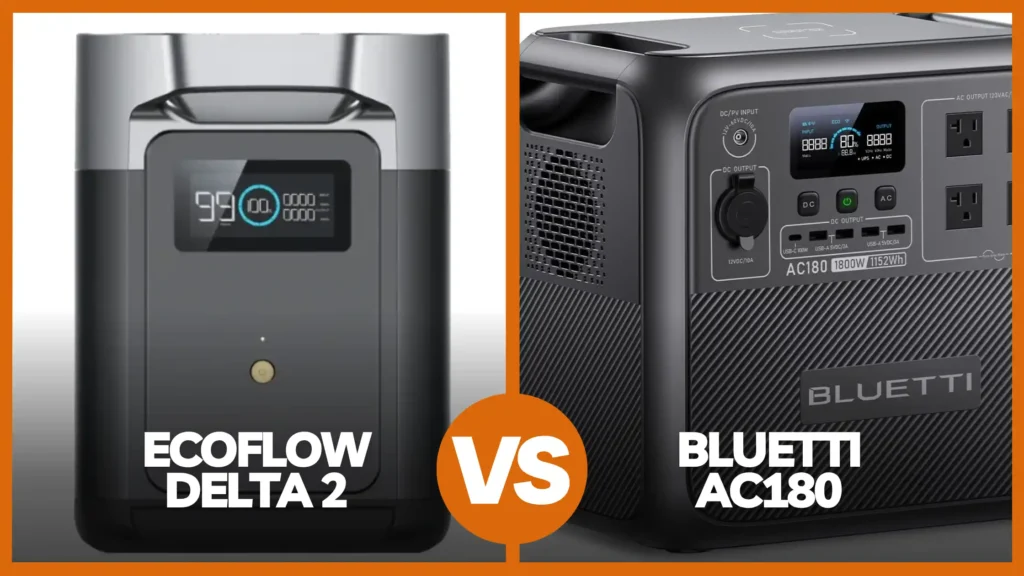
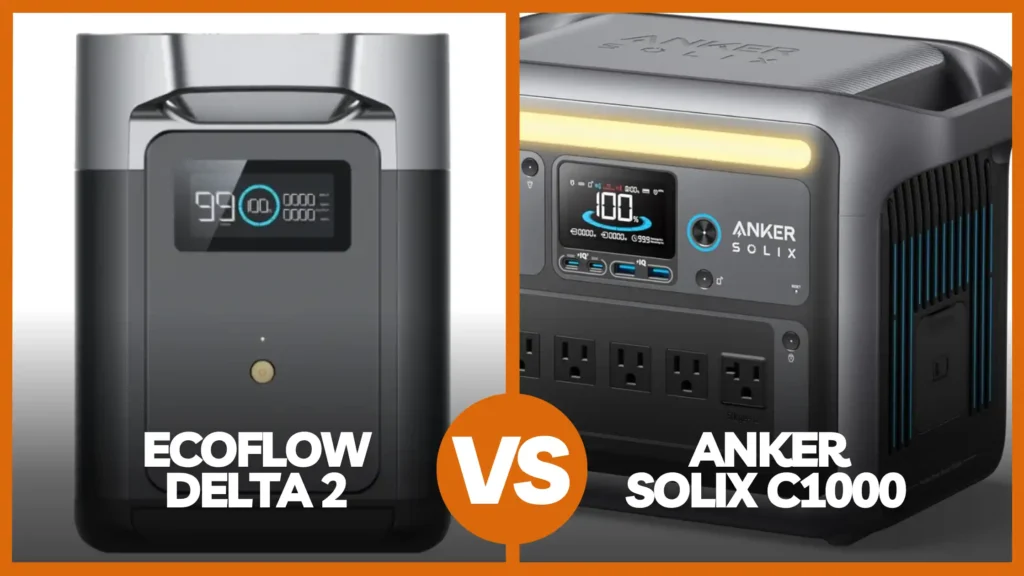
EcoFlow Power Station Comparisons
Compare EcoFlow power stations against competing models from other brands with in-depth editor comparisons covering specifications, editor reviews, ratings, performance tests, capacity, output, charging, and real-world differences.