
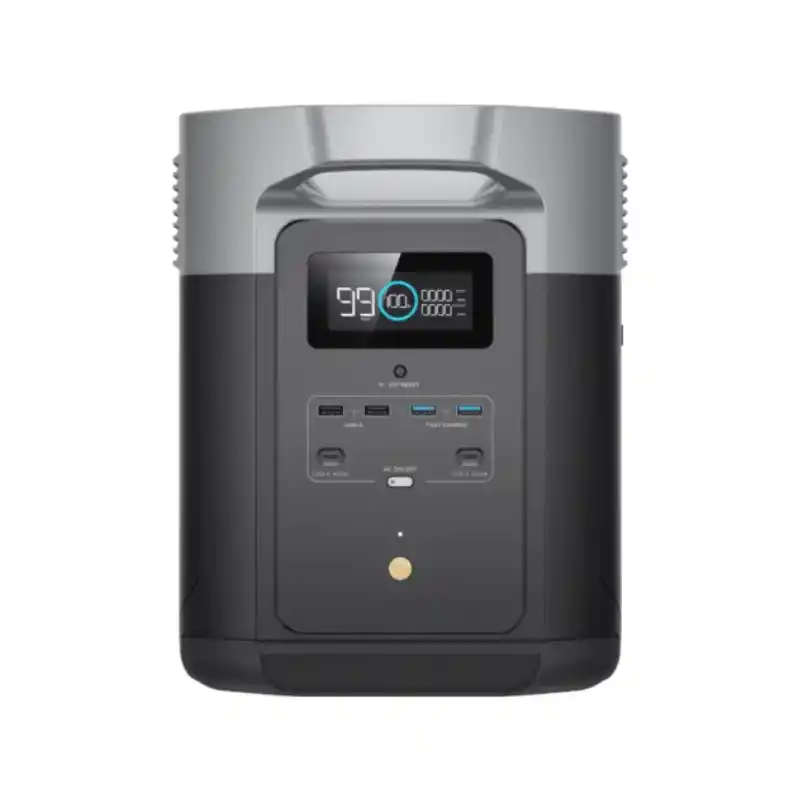
EcoFlow Delta Max Review

The EcoFlow Delta Max delivers 1,830Wh of its 2,016Wh rating, a 90% return, and is backed by a 2,400W inverter. At 48 pounds, it is light for its capacity and charges at 1,800W from the wall, though its NMC cells are rated for only 800 cycles.
My Quick Verdict
Almost everything in this category has moved to lithium iron phosphate. Of the power stations tested for this site, a few still use older NMC chemistry, and this is one of them.
The difference is not subtle. These cells are rated for 800 charge cycles. The LiFePO4 power stations it competes with are rated for 3,000-4,000.
Cycled daily, that works out to a little over two years, while rivals reach eleven, on the machine with the highest cost per watt-hour at this size.
Which is a shame, because the rest of it is good: 90% conversion, 48 pounds, 1,800 watts of wall charging, and 0.5% standby drain.
Best for: Buyers who need lightweight above all and will not cycle the machine often.
Not for: anyone planning to own it for more than a few years or to protect equipment during outages.
Key Stats
Introduction
Battery chemistry is the specification that determines how long a machine remains useful, and it is the one buyers most often overlook.
Lithium iron phosphate cells typically have a rated life of 3,000 to 4,000 charge cycles. NMC cells, the older technology, typically carry 500 to 800.
This machine has 800. Cycled daily, it reaches the end of its rated life in a little over two years, whereas the LiFePO4 units beside it on the shelf are rated for eleven.
Everything else about it is competent to good, which makes the chemistry the whole conversation.
What It Can Actually Run
2,400 watts held continuously, with 4,400 in a burst. That covers a heating appliance with a second load beside it.
Rated at 2,016 Wh, the sockets returned 1,830 Wh (90%), which is among the stronger conversion figures for this capacity. Everything below uses 1,830Wh.
- Refrigerator at 150W: better than twelve hours.
- CPAP at 40W without humidification: forty-five hours.
- Starlink dish at 50W: nearly thirty-seven hours.
- Laptop at 70W: around twenty-six charges across two ports.
Output measured 120 volts. The sheet notes that the inverter is audible in its own right, and electrical noise measured at 1,503 mV, unremarkable either way.
Charging and Smart Features
Wall input reaches 1,800 watts with adjustable speed, and mains plus panels together take 2,600 watts. Both figures are genuinely good and among the better charging arrangements in this cohort.
Panel input runs up to 800 watts and accepts 11 to 100 volts at 13 amps. The 100-volt ceiling is above the class norm but doesn’t match the best.
The switchover took 30 milliseconds, well past the 20-millisecond threshold.
Premium price tier, luxury value tier; this is the most expensive energy at two kilowatt-hours in our data.
Charging Speed Benchmarks
Where the EcoFlow DELTA Max sits on recharging within the 2,000Wh to 3,000Wh capacity class, based on all 26 machines in our charging database. Across those machines the mean is 1,641W from a socket and 1,123W from panels. Low, Average and High are worked out inside the class, so they rank this unit against similar capacities only.
Mains charging is the part of this machine that has aged well. 1,800W is adjustable, beats the 1,641W class average and finishes the Average band, with 2,600W available from both inputs together. That refills 2,016Wh in about 1.1 hours, and it is a real advantage over the 470W brick-charged machines it shares a shelf with. Worth remembering, though, that fast charging is harder on NMC cells than on lithium iron phosphate, so the slower profile is the sensible default here rather than an optional courtesy.
Panel input caps at 800W to a 100-volt ceiling, well under the 1,123W class mean which rates Low where the class high is 2,400W. Expect roughly 2.5 hours of unbroken sun to fill the pack, and longer once cloud and panel angle take their usual share. The 11-volt floor is generous and keeps foldables usable, but anyone planning an array beyond 800W is buying panel capacity this machine will simply ignore.
Planning a larger array at this capacity? The Jackery Explorer 2000 Plus accepts 1,400W of solar at 24 amps, three quarters more than the DELTA Max and unusually generous on current, which is what normally stops a wide array delivering its rating. A full panel refill drops to around 1.5 hours. It also runs lithium iron phosphate cells rated for 4,000 cycles against 800 here, so repeated fast charging costs far less over time.
Real Capacity: What You Actually Get
Delivery is a genuine strength here, and the AC side in particular is excellent.
The sockets returned 1,830 Wh on a 2,016 Wh label. At 90%, only a small number of machines across this dataset perform better.
The twelve-volt route returned 1,636Wh, or 81%, nine points behind. That is a wide gap, and it means loads should stay on the AC side.
Retention holds up too: half a percent an hour armed, and nothing detectable on the twelve-volt side.
The catch is that these figures describe a new machine. With 800 rated cycles, the capacity behind them declines faster than on anything else at this capacity.
My takeaway: 1,830Wh from the sockets today, and a pack rated to reach 80% of that after 800 cycles. Both halves of that sentence matter equally.
Power Output and Surge: What It Can Turn On
The inverter is well-sized for the capacity. At 2,400 watts, a heater and a fridge can share the load, and 4,400 watts of burst absorbs any domestic compressor waking up.
Two 100-watt USB-C ports are better than the single port most machines in this cohort provide, allowing two laptops to charge at full speed simultaneously.
The 135-watt car socket falls short of the 150-watt threshold that makes a twelve-volt outlet genuinely useful.
The grading entry also records audible noise on the inverter itself, separate from the fans. On a machine already measuring 60 decibels under load, that is worth knowing.
Real Appliance Runtimes
What 1,830 Wh buys in hours, based on the unchanging appliance list used throughout.
These figures are strong in terms of capacity, but they will not remain so as long as their rival does. A pack rated for 800 cycles reaches 80% of these numbers years before a 4,000-cycle pack does.
Recharging: Wall and Solar
From a Wall Outlet
Eighteen hundred watts from a socket refills the pack in a little over an hour, and the rate is adjustable in steps.
That is a genuine strength in this cohort. Two of the machines it competes with directly charge at 470 watts through an external brick and take more than four hours.
Feed it from the socket and the sun together, and the total reaches 2,600 watts, near the top of what this capacity class manages.
Charging is the one area where this machine clearly outperforms the older Bluetti units at the same capacity.
From Solar Panels:
The panel input draws 800 watts at1-100 volts and 13 amps.
Topping out at 100 volts clears the 60-volt caps common here, putting a three-panel series string within range.
It is not, however, near the best available. Two machines at this capacity accept 145 volts, and the wattage ceiling here is the lowest of the group.
The wide 11-volt floor does keep foldable panels usable, so casual solar charging works out of the box.
Panels can remain connected around the clock while the machine supplies loads.
Blackout Backup: The Part I Care About Most
The switchover measured 30 milliseconds, which is the slowest figure recorded for any machine reviewed on this site.
The accepted safety mark is twenty milliseconds; below it, connected gear usually survives a grid failure intact. This sits half as far again past that.
At that speed, a desktop, a network drive, or a router should be assumed to restart rather than survive. This is not a marginal case.
A standby drain of 0.5% per hour is genuinely good and does not rescue the switchover figure.
Why this matters to me: thirty milliseconds is far enough past the threshold that I would not describe this machine as a blackout backup at all. It is a battery that can be switched over manually, which is a different product.
Noise and Living With It
Sixty decibels under load, among the louder readings recorded on this site and beyond what any occupied indoor room will tolerate.
The grading entry separately records audible noise from the inverter itself, so there are two sources rather than one.
Weight is the compensation, and it is real: 48 pounds, 21.7 kilograms, which is light for two kilowatt-hours, where several rivals run to sixty.
That lightness is partly a consequence of the NMC chemistry, which is denser by weight than lithium iron phosphate, the one genuine advantage the older cells retain.
Connectivity covers Wi-Fi and Bluetooth alike, with five years of coverage and a phone line standing behind it.
Where It Falls Short
Three limitations, and the first governs how long the other two matter for.
1. Eight Hundred Charge Cycles
NMC chemistry is rated for 800 cycles, compared with 3,000 to 4,000 for the LiFePO4 machines it competes with.
At one cycle a day, that is a little over two years, by which point capacity has dropped to 80%.
Even at a gentler two or three cycles a week, this machine ages out years before its rivals do. At this price, the specification determines value.
2. A Thirty-Millisecond Switchover
The slowest figure recorded on this site has fallen below the twenty-millisecond safety threshold again.
Assume connected equipment restarts rather than rides through. This machine should not be relied on to protect anything with a processor.
3. Sixty Decibels and Luxury Value Tier
Loud enough to exclude every occupied indoor room, with audible inverter noise recorded separately from the fans.
Per watt-hour, nothing at this size costs more, and spending the most on the shortest-lived chemistry is hard to defend.
How It Compares
The clearest comparison is EcoFlow’s own LiFePO4 successor at this capacity, alongside the strongest value machine here.
EcoFlow’s own Delta 2 Max is the direct replacement,t and the comparison is decisive. Same charging speed, three points less conversion, and nearly four times the cycle life on lithium iron phosphate cells. It also runs fourteen decibels quieter and switches over almost twice as fast, at a better value tier.
There is no scenario where the older machine is the better buy unless it is heavily discounted and you plan to use it rarely.
The AFERIY P280 makes the point even more starkly: better conversion, five times the cycle life, seven years of warranty, and a pound lighter, at two value tiers below.
Who Should Buy It, and Who Should Skip It
Buy It If
- Weight is genuinely your top priority, and you have compared it against lighter LiFePO4 units.
- The machine will be cycled rarely, a few times a year rather than weekly.
- You are buying it at a heavy discount as older stock.
- Fast wall charging matters, and the alternatives in this cohort charge at 470 watts.
Skip It If
- You expect to own it for more than a few s.
- Blackout protection is any part of the plan, given the 30-millisecond switchover.
- It will run anywhere within earshot of people.
- EcoFlow’s own Delta 2 Max is available.
The Bottom Line
There is a good machine here that arrived a generation too early. 90% conversion, 48 pounds, 1,800 watts of adjustable wall charging, and half a percent of standby drain would all be competitive today.
The chemistry is not. Eight hundred cycles against three or four thousand is not a specification you work around, and it means this machine ages out while its rivals are still in early middle age.
Add a 30-millisecond switchover and 60 decibels, and the only case left is weight at a heavy discount. EcoFlow’s own Delta 2 Max fixes all three problems for less.


There are no reviews yet.