
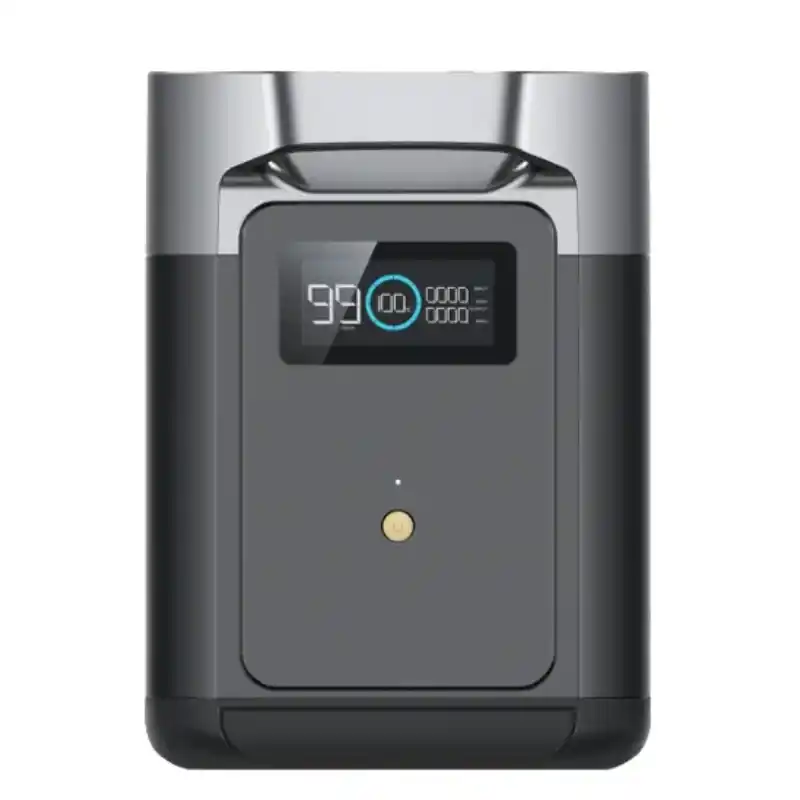
EcoFlow Delta 2 Review

The EcoFlow Delta 2 carries 1,024Wh behind an 1,800W inverter with X-Boost, weighs 27 pounds, and loses just 0.8% of its charge per hour on standby. Cells are rated for 3,000 cycles over five years of coverage, and they sit in the mid-range price tier at good value.
My Quick Verdict
For a long stretch, this was the answer to the question. Someone would ask what power station to buy, and the Delta 2 was what they were told, more or less, regardless of the details.
The category moved. What was competitive when this launched now sits behind newer units on most of the specifications that drive a purchase decision, including EcoFlow’s own successors.
Two things still hold up well. Standby loss of 0.8% per hour is among the lowest in this dataset, and at 27 pounds, it is the lightest kilowatt-hour unit reviewed on this site.
Against that, the fans reach 62 decibels, the loudest measurement I have recorded from any unit, regardless of size.
Best for: Emergency Home Resilience for buyers who want a proven, widely supported unit and can put it somewhere noise does not carry.
Not for: bedrooms, tents, or anyone comparing it against what has arrived since.
Key Stats
| Badge | Stat |
| Battery Chemistry and Longevity | LiFePO4 | 3,000 Cycles |
| Continuous AC Power Output | 1,800W AC | 2,700W Peak |
| Energy Storage Capacity | 1,024Wh | 850Wh Usable |
| Rapid AC Wall Recharge | 1,200W Input | Adjustable Speed |
| Uninterrupted Emergency Backup | 19.2ms UPS | Manual Arm |
| Maximum Solar Input and MPPT | 500W Solar | 11–60V MPPT |
| Ultra-fast USB-C Power Delivery | 100W USB-C PD |
| Low-noise Operational Level | 62dB | Loudest Measured |
| Modular Capacity Expansion | Expandable | Extra Battery Port |
| Smart App Remote Control | Wi-Fi + Bluetooth App |
Introduction
There is a particular difficulty in reviewing a product that was once the obvious choice. The instinct is to grade it against its reputation rather than against what you can buy today.
Judged on reputation, the Delta 2 is excellent. Judged against the current field, it is a competent unit with one outstanding virtue, one serious flaw, and a set of numbers that its own replacements have surpassed.
The pack is lithium iron phosphate, with a claimed 3,000 cycles under a five-year warranty. Cycled daily, that is roughly eight years before capacity settles at 80%, which is now the shortest life among the units it competes with.
What It Can Actually Run
The inverter sustains 1,800W, with a 2,700W peak, plus EcoFlow’s X-Boost mode to drive resistive loads beyond the nominal ceiling.
Rated storage is 1,024Wh. The AC outlets returned 850 Wh during testing, an 83% result. Figures below use 850Wh.
- Household refrigerator drawing 150W: about five and three-quarter hours.
- CPAP without humidifier at 40W: roughly twenty-one hours.
- Starlink dish at 50W: seventeen hours, give or take.
- Laptop at 70W: a dozen refills through the USB-C port.
Voltage sat at 120 with 1.7% distortion, both within safe bounds for sensitive electronics.
Charging and Smart Features
Wall input peaks at 1,200W with stepped rate control, a headline feature at launch that is now merely competent.
Panels contribute up to 500W between 11 and 60 volts at 15 amps. The voltage band is workable; the wattage ceiling is at the low end of the current field.
Crossover was measured at 19.2 milliseconds, barely inside the safety line, and there is no self-arming mode. Solar can remain wired in permanently, and the unit powers things as it charges. What it will not do is accept both inputs at once.
Mid-range price tier, good value tier. It is no longer the bargain it once was, and several newer units undercut it while outperforming it.
Charging Speed Benchmarks
Recharge speeds for the EcoFlow Delta 2 compared with the full 1,000Wh to 1,999Wh capacity class, which holds 30 machines in our charging database at an average of 1,085W on AC and 641W on solar. Ratings are relative to this bracket alone rather than to every machine on the site.
Mains input of 1,200W is slightly ahead of the 1,085W class average and sits inside the Average band, bringing 1,024Wh back in about 0.9 hours at full rate with X-Stream adjustment available below that. The limitation is not the figure but the architecture: this machine supports no dual charging at all, so mains and panels cannot stack the way they do on the larger Delta 2 Max, and 1,200W is genuinely the ceiling rather than a starting point.
Solar accepts 500W, below the 641W class average and holding Average where the class high sits at 1,400W, filling the pack in roughly 2.0 hours of clear sun. Combined with the absence of dual charging, that makes the two inputs genuine alternatives rather than partners: you pick one each time, and the socket is more than twice as fast. For a machine at the older end of EcoFlow's range, this is the specification that shows its age most clearly.
Looking at the machine that replaced it? The EcoFlow Delta 3 Plus holds the same 1,024Wh but charges at 1,500W from mains and 1,000W from panels, and supports both together. Both channels then finish inside an hour, which is the quickest pairing anywhere in this bracket. It also runs 4,000-cycle cells against 3,000 here, at a comparable price tier.
Real Capacity: What You Actually Get
The gap between the label and the meter is unremarkable here, which,h after several units with wide splits,ts is almost a relief.
Eight hundred and fifty watt-hours came back through the AC outlets, against a claimed 1,024 Wh, or 83%.
The twelve-volt route returned 870 Wh (85%), a modest two-point advantage rather than the large gaps seen elsewhere. There is little reason to reorganise your loads around it.
Standby is the standout. With the inverter awake and nothing drawing, losses run about 0.8% an hour, and on DC the meter found nothing measurable at all. Only one unit reviewed here does better.
My takeaway: 850Wh is your working figure. The 0.8% standby loss is the reason this unit still deserves consideration: charge it, store it, and it will still be there months later.
Power Output and Surge: What It Can Turn On
Continuous and peak solve separate problems, and the Delta 2’s approach to the gap between them is unusual.
The nominal figures are 1,800W sustained and 2,700W peak. On paper, the peak is modest by current standards, where 3,600W is now common at this capacity.
X-Boost is EcoFlow’s answer. It reduces voltage to resistive loads, so appliances rated above the inverter’s ceiling still run, up to around 2,200W. It works well for heating elements and poorly for anything with a motor or sensitive electronics, so treat it as a bonus rather than a specification.
For an ordinary compressor that draws roughly 1,200W, the 2,700W provides headroom.
Real Appliance Runtimes
850 watt-hours, translated into hours against this site’s fixed appliance loads.
| Appliance | Power Draw | Runtime | What That Means |
| Full-size refrigerator | 150W | About 5.7 hours | An evening, and longer once the compressor takes its rest periods. |
| CPAP machine (no humidifier) | 40W | About 21.3 hours | One night easily, a second with care. |
| Starlink dish | 50W | About 17 hours | A day's remote work, ending sometime in the evening. |
| Pellet grill or smoker | 100W | About 8.5 hours | Long enough for most cooks. |
| Laptop (70W) | 70W | About 12 recharges | Standard 100W USB-C, no faster than average. |
Nothing here is bad, and nothing is notable. These are middle-of-the-field runtimes from a middle-of-the-field conversion figure, which is a fair summary of where this unit now sits.
Recharging: Wall and Solar
From a Wall Outlet
The main input takes 1,200W with rate control in steps, refilling an empty pack in around an hour.
When this launched, that speed was genuinely remarkable, and much of the unit’s reputation was built on it. It is now ordinary, and several rivals at lower price tiers charge faster.
Dual charging is not supported, so you cannot combine mains and panels to shorten the wait.
From Solar Panels
Panels feed in up to 500W across a -1-60 V band at 15 A.
That voltage window is perfectly usable and covers most foldable panels, as well as a pair of rigid ones in series. It is the wattage ceiling that dates the unit, since 500W is now the low end for this class, and several rivals accept twice as much.
Under a clear sky, a full recharge takes around two and a half hours, aided more by the modest pack size than by input speed.
Panels can remain permanently attached, and loads can run during charging.
Blackout Backup: The Part I Care About Most
This is where the Delta 2 shows its age most plainly.
The crossover measured 19.2 milliseconds. Twenty is the conventional safety threshold, so it clears by less than a millisecond, and it is among the slowest figures on this site.
At that speed, whether connected equipment survives depends entirely on the equipment. Some computer supplies bridge the gap; others restart.
There is no auto-on setting either, so the inverter has to be armed manually. The low 0.8% standby loss at least makes leaving it armed genuinely practical, which is more than can be said for several rivals.
Why this matters to me: the whole appeal of a slow crossover paired with excellent standby is that you can afford to leave it running. That combination almost works here. Nineteen milliseconds is what stops it from working.
Noise and Living With It
Sixty-two decibels under load. That is the highest figure recorded from any unit reviewed on this site, at any capacity.
In practical terms, it is comparable to a conversation happening beside you, and it is impossible to ignore in a quiet room. Bedrooms, tents, home offices,s and RVs are all effectively excluded.
The counterweight is the weight itself. Twenty-seven pounds (12.2 kilograms) makes this the lightest kilowatt-hour unit reviewed here, and one hand and a flight of stairs are entirely realistic.
App support covers Wi-Fi and Bluetooth, with EcoFlow’s software among the more mature in the category, and phone support is included with the warranty.
Where It Falls Short
Three things hold it back, and one of them is louder than anything else here.
1. The Loudest Unit Measured
Sixty-two decibels rule out every quiet application at once. Not marginally, and not only for light sleepers.
This is the specification that decides the purchase for most people, and it is invisible on a spec sheet until the unit is running in your house at night.
2. Crossover of 19.2 Milliseconds
It scrapes inside the safety threshold with almost nothing to spare, and pairs that with the lack of a self-arming mode.
For a refrigerator or lighting, it is fine. For a desktop or a network drive, it is a gamble on the particular power supply you happen to own.
3. Outpaced by Its Own Successors
Five hundred watts of solar, 3,000 cycles, and no dual charging were all competitive figures when this unit launched. Every one of them now trails the current state of the field, including EcoFlow’s newer models.
The unit has not gotten worse. The comparison set has improved, and it is a mid-range-priced product being measured against entry-tier rivals that beat it.
How It Compares
Two comparisons matter here: the EcoFlow Delta 3 Plus that replaced it in the range, and the Bluetti Elite 100 V2, the strongest all-round unit at this capacity.
| Feature | EcoFlow Delta 2 | EcoFlow Delta 3 Plus | Bluetti Elite 100 V2 |
| Price Tier | Mid-range | Mid-range | Entry |
| Value Tier | Good | Premium | Exceptional |
| Usable Through AC | 850Wh (83%) | 880Wh (85%) | 890Wh (86%) |
| Idle Drain Per Hour | 0.8% | 2.5% | 1.0% |
| UPS Switchover | 19.2ms | 10.2ms | 8.7ms |
| Auto-on Inverter | No | Yes | Yes |
| Solar Input | 500W | 1,000W | 1,000W |
| USB-C Port | 100W | 140W | 140W |
| Battery Cycles | 3,000 | 4,000 | 4,000 |
| Fan Noise | 62dB | 41dB | 51dB |
| Weight | 27 lbs | 27 lbs | 25 lbs |
The Delta 3 Plus is the same weight, the same price tier, and better on nearly every line: twice the crossover speed, a self-arming inverter, double the solar input, a thousand more cycles, and twenty-one fewer decibels. The one place the Delta 2 wins is standby, where 0.8% an hour comfortably beats its successor’s 2.5%.
That is a narrow win on a single specification, and it only matters for a unit that sits in storage for years between uses.
The Elite 100 V2 makes the case even harder, sitting an entire price tier lower while beating the Delta 2 on conversion, crossover, cycles, solar, and noise. Its only shortfall is the lack of an expansion port, which the Delta 2 provides.
Here’s a list of the most popular specific comparisons
EcoFlow Delta 2 vs Anker SOLIX C1000
EcoFlow Delta 2 vs Bluetti AC180
Who Should Buy It, and Who Should Skip It
Buy It If
- The unit will sit charged for long periods. Standby behaviour here is close to the best available.
- You want the lightest kilowatt-hour unit reviewed on this site.
- You value mature app software and an established support operation.
- It will live somewhere the noise genuinely does not reach anyone.
Skip It If
- It has to run anywhere quiet. At 62 dB, this is the loudest unit measured here.
- You are protecting a computer or a network drive.
- Solar is central to your plan, given the 500W ceiling.
- You are buying today and can compare it against what has launched since.
The Bottom Line
The Delta 2 earned its reputation honestly. Fast charging, a solid app, sensible weight, and a well-supported brand made it the default answer for a long time, and none of that was wrong.
What has changed is everything around it. Newer units at lower price tiers now cross over twice as fast, arm themselves, accept double the solar, carry more cycles,s and run twenty decibels quieter.
Its remaining edge is standby loss, and that is a real one for a unit destined to sit in a cupboard for years. But 62 decibels will decide this purchase long before anyone gets to that argument.


There are no reviews yet.