
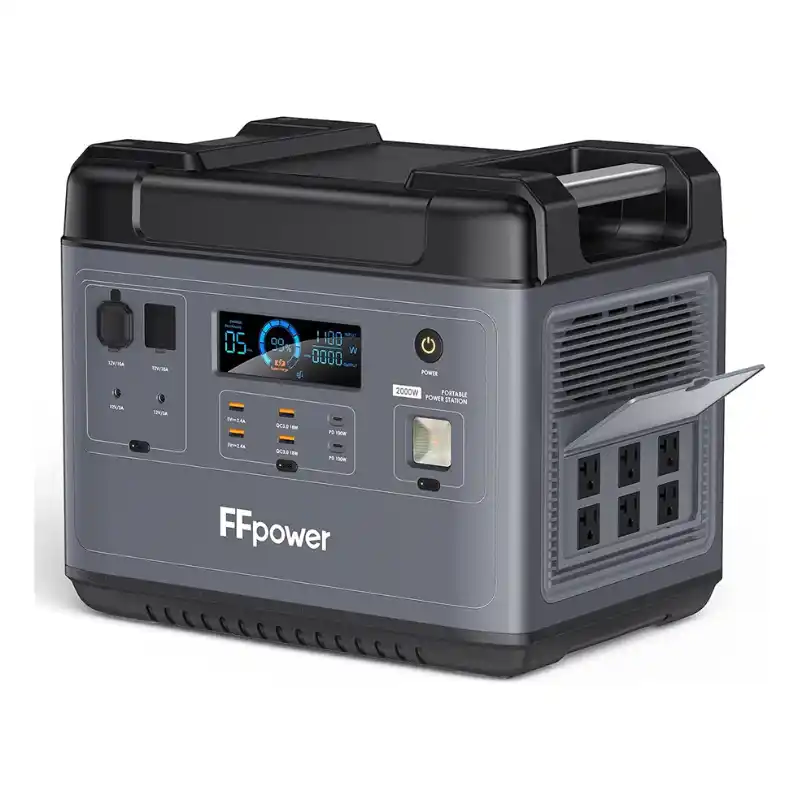
FFpower P2001 Review

The FFpower P2001 delivers 1,570Wh of its 2,048Wh rating, backed by a 2,000W inverter with 4,000W of surge power. It hands over in 12.4ms with a 225W DC output, though the output measures 110 volts, and there is no app or expansion path.
My Quick Verdict
This is the third badge on a chassis we have now measured three times. Same 48 pounds, same 12.4-millisecond transfer, same 110-volt output, same 500 watts of solar, same 1,100-watt charger.
It is also the cheapest of the three, which is the only argument it needs and the only one it has.
It returns 78% of its rated capacity through the outlets and 74% through DC, the weakest figures of the three siblings and among the poorest at this capacity.
There is a working transfer function here, which several better-known machines cannot claim. Beyond that, this is a large battery with an outdated design
Best for: Buyers who have settled on this chassis and want it for the least money.
Not for: motors, monitoring, expansion, or anyone comparing it against a current machine.
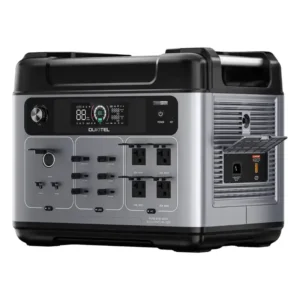
The Same Machine as the Oukitel P2001.
Key Stats
Introduction
There is not much to add about this machine that has not been said about the two before it, and pretending otherwise would waste your time.
The FFpower P2001, the Oukitel P200,1 and the FOSSiBOT F2400 are one design wearing three badges. Every physical measurement we take comes back the same: weight, transfer time, output voltage, solar window, current limit, charging ceiling, dual-charging figure.
They differ in cell count, inverter size, and price, and this one is the cheapest.
The pack claims 2,000 lithium iron phosphate cycles and comes with a 2-year warranty; a daily cycle would exhaust that in about 5.5 years.
What It Can Actually Run
Two thousand watts sustained, with 4,000 in a burst, which is enough for a heating appliance alone or a refrigerator with lighting.
Rated at 2,048 Wh, the sockets returned 1,570 Wh (78%), the weakest of the three siblings. Every figure below rests on 1,570Wh.
- Refrigerator at 150W: 10.5 hours.
- CPAP at 40W without humidification: over thirty-nine hours.
- Starlink dish at 50W: about thirty-one hours.
- Laptop at 70W: roughly twenty-two charges across two ports.
Output measured 110 volts, below the accepted band, with audible inverter noise and electrical noise above 2,000mv.
Charging and Smart Features
Wall input is 1,100 watts at one fixed rate, with no adjustment available on this badge.
Together, the mains and panels reach 1,600 watts, at which point the machine recovers fastest.
Solar delivers 500 watts at 12-48 volts and 20 amps, and the array cannot remain connected between sessions.
The transfer measured 12.4 milliseconds. Upper mid-range price tier; good-value tier; the best-value position of the three siblings.
Charging Speed Benchmarks
Input figures for the FFpower P2001 against the 2,000Wh to 3,000Wh capacity class, taken from the complete 26-machine set in our charging database. Wall input across the class comes to a 1,641W mean, solar to 1,123W. Because bands are internal to each bracket, a Low rating here still describes an input most smaller machines could not accept.
Wall charging runs at 1,100W on a single fixed rate, roughly two thirds of the 1,641W class average and a Low rating, which puts 2,048Wh at around 1.9 hours from empty. Dual input raises the combined ceiling to 1,600W. There is no rate control at all, so there is no gentle overnight profile, though at this input level the cells are not being pushed hard in the first place. The quickest machine in the bracket accepts 5,000W.
Solar is capped at 500W across a 12 to 48 volt window at 20 amps, a shade over a third of the 1,123W class mean and a clear Low rating against a 2,400W ceiling. That is roughly 4.1 hours of ideal sun to refill the pack. The 48-volt ceiling is the tighter constraint of the two: it allows only a short series string, so reaching the full 500W means wiring in parallel, and the array has to come off between sessions rather than staying connected.
Want serious solar at a similar price position? The AFERIY P280 takes 1,200W of solar across two independent 600W ports at 20 amps each, well over double the P2001, and charges from mains at 1,800W across five selectable stages. Full from flat drops to about 1.1 hours on AC or 1.7 hours on panels, and it carries a seven-year warranty in the mid-range price tier.
Real Capacity: What You Actually Get
This is the weakest conversion of the three siblings and among the poorest at this capacity.
The sockets delivered 1,570 Wh out of a claimed 2,048 Wh. That 78% leaves 478 watt-hours stranded inside the machine.
Twelve volts fared worse still: 1,490Wh, a 74% return that ranks near the bottom of everything recorded here.
Retention rescues it somewhat. 1% an hour armed, and half that on DC, is a solid showing, ahead of machines that cost several times as much.
To put the shortfall in perspective, a strong performer in this capacity returns 1,880 Wh from a similar pack. That is 310 watt-hours more, or roughly two extra hours of refrigerator run time.
My takeaway: 1,570Wh is what you can spend. The remaining 478 Wh of the rated capacity is lost during conversion, which is close to the entire capacity of a small camping unit.
Power Output and Surge: What It Can Turn On
The inverter is adequate rather than generous. Two kilowatts of steady power run a single household appliance, while the 4,000-watt burst rating handles compressor startup.
The FOSSiBOT, built on the same chassis, has 2,400 watts, so the extra headroom exists in the design and is simply not fitted here.
A pair of 100-watt USB-C outlets beats what several rivals this size manage, and the 225-watt twelve-volt socket sits above the 150-watt line where such ports become genuinely usable.
The shared weakness is the 110-volt output. Motors draw extra current at low voltage and run hotter as a result, which is cumulative damage rather than an immediate fault. Heaters, lighting, and switching supplies are unaffected.
Real Appliance Runtimes
1,570 Wh-ish is set as the appliance’s runtime, with this site held constant.
These are the shortest runtimes among the three siblings, and the difference is entirely due to conversion. All three have the same 2,048Wh; this one returns the least of it.
Recharging: Wall and Solar
From a Wall Outlet
Eleven hundred watts into a 2,048Wh pack takes close to two hours from flat, at a single fixed rate with no adjustment.
The FOSSiBOT version of this chassis does offer adjustable charging, so the omission here is a badge decision rather than a hardware limit.
Running mains and solar together lifts the ceiling to 1,600 watts, which meaningfully cuts the wait on a bright day and is the fastest this machine can recover.
From Solar Panels
Panel input draws 500 watts at 12-48 volts and 20 amps, matching the Oukitel badge.
The current allowance is the strong part. With 20 amps on offer, a bank of low-voltage panels wired in parallel delivers its full output rather than hitting a ceiling.
Both ceilings are weak. Five hundred watts is low for a two-kilowatt-hour pack, and 48 volts rules out a series string of more than two panels.
According to the grading sheet, the panels cannot remain attached indefinitely; they come off once charging is complete. Contemporary machines this size almost universally let you leave them wired.
Blackout Backup: The Part I Care About Most
The transfer is the one specification on this machine that competes with anything.
The 12.4-millisecond figure leaves genuine room under the twenty-millisecond limit, so a workstation, router,r or network drive should not notice the mains going.
Several far better-known machines in this database have no transfer function at all, which puts this budget unit ahead of them on the specification that decides whether a power station is backup or merely storage.
Whether the inverter arm itself is not recorded in our data is the same open question that applies to its siblings, and one worth posing directly to FFpower.
At 1% an hour, leaving it armed is affordable.
Why this matters to me: the cheapest of three identical machines still hands over faster than several premium-tier units that cannot hand over at all. That is worth saying plainly, because it is the one place this machine genuinely earns attention.
Noise and Living With It
Fifty-three decibels under load, the quietest of the three siblings, and still past what a room with a sleeper will tolerate.
The sheet marks the inverter as audible in its own right, meaning the fans have company.
Weight is 48 pounds (21.7 kilograms), matching both siblings exactly.
No app, no port to add capacity through, and two years of cover with a same-day response promise attached.
Where It Falls Short
Four limitations, all of them shared with at least one sibling.
1. The Weakest Conversion of the Three
78% through AC and 74% through DC, which puts 478 watt-hours of the rated pack permanently out of reach.
Both figures are the lowest of the three siblings, and among the poorer results at this capacity anywhere in our data.
2. Output Measured 110 Volts
Below the accepted working band, and identical across all three badges.
Motors draw more current to compensate and run hotter as a result, which shortens their life. A refrigerator cycled on this repeatedly fares worse than one fed by a rival.
3. No App, No Expansion, No Rate Control
No Bluetooth or Wi-Fi, so nothing can be monitored, adjusted remotely, or updated.
No expansion battery support, and no adjustable charging speed either, though the same chassis offers it under a different badge.
4. Two Thousand Cycles, and Panels That Cannot Stay Connected
Roughly five and a half years if cycled every day. Machines built now manage double.
And the array has to be disconnected between charging sessions, whereas nearly every current rival lets you leave it in place.
How It Compares
The comparison that matters is with its own siblings, since all three are the same machine.
Compared to the Oukitel P2001, this machine delivers 20 usable watt-hours via AC and 45 via DC, is 1 decibel quieter, and costs less. In terms of value, it is the better of the two.
Of the three, the FOSSiBOT leads comfortably, with an extra 80 usable watt-hours, 400 more inverter watts, 1,500 additional cycles, rate control, and a bigger DC socket. The cost is six decibels and slightly poorer retention.
So the order is straightforward. Take the FOSSiBOT if the price gap is small, the FFpower if it is not, and the Oukitel only if it is discounted below both.
Who Should Buy It, and Who Should Skip It
Buy It If
- You have decided on this chassis and want to get the lowest price.
- A working transfer function matters more than efficiency or monitoring.
- Your loads are resistive or electronic, with no motor, depending on the machine.
- It will live somewhere where the fan noise doesn’t reach anyone.
Skip It If
- The FOSSiBOT F2400 is priced similarly, making it the better machine.
- A refrigerator, freezer, or pump will run on it regularly.
- You want an app, an expansion path, or a permanently wired array.
- Usable energy per pound spent is your deciding metric.
The Bottom Line
There is no meaningful sense in which this is a different machine from the two before it. Same chassis, same transfer, same voltage, same solar, same charger.
What it has is the lowest price of the three, and 78% conversion is the price you pay for that.
If this design is what you want, buy it here rather than under the Oukitel badge. If you have not settled on the design, the FOSSiBOT is better for a small premium, and a current machine at this capacity is better than all three by a wide margin.


There are no reviews yet.