
FFpower Power Station Reviews

FFpower power stations tested. The BP2000’s record 6.2ms switchover, and why the P2001 appears under three different brand names.

The FFpower BP2000 hands over in 6.2 milliseconds, the fastest measurable switchover of any machine in our entire database.

The P2001 is a different proposition: it is the same chassis sold by FOSSiBOT and Oukitel under their own badges, with identical weight, transfer time and 110-volt output.

Best for: the BP2000, where switchover speed is critical. Weakest for: noise, at 59dB on the BP2000.

Editor's Choice

Both models link to their full reviews, where you will find measured runtimes, the ten-category score breakdown, and complete specifications. This page is for choosing between them.

Add to compare
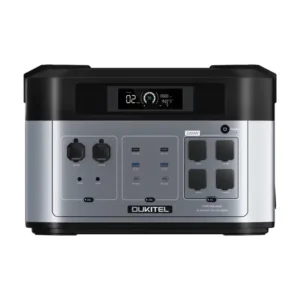
The FFpower BP2000 (marketed as Oukitel BP2000) transfers to battery in 6.2ms, the fastest measurable switchover we have recorded. It has a 2,048 Wh capacity, is powered by a 2,200W inverter, charges internally at 1,800W, and accepts an expansion battery.
★★★★★
More details +
Leaving aside the handful of machines that show no measurable gap at all, nothing tested for this site transfers faster than this one: 6.2 milliseconds, ahead of every branded rival, including several premium-tier systems from manufacturers with vastly larger marketing budgets. At that speed, no processor registers the changeover; a desktop keeps running; a network drive stays mounted. It backs that with internal charging at 1,800 watts, where three machines it competes with on price still use 470-watt external bricks and take over four hours; 2,500 watts from both inputs combined; a usefully wide 12- to 120-volt solar range; two 100-watt USB-C ports; and expansion support. The compromises sit on the periphery: no app of any kind, 77% returned through DC against 87% on AC, and 59-decibel fans that rule out quiet rooms. One question remains unanswered in our data, and worth settling before you buy: whether the inverter arms itself. A 6.2-millisecond transfer that still needs somebody to switch it on is only half a product.
Battery safety and chemistry (LiFePO4, 3,500 cycles)
7.5
Real-world efficiency and output (87% AC, 77% DC, 1.6% idle)
7
UPS and EPS switchover (6.2ms, self-arming unrecorded)
9
Port selection and distribution (two 100W USB-C, 191W DC)
8
Solar charging and MPPT (1,000W across 12 to 120 volts)
8.5
AC recharge speed (1,800W internal, 2,500W combined)
9.5
Noise and thermal management (59dB)
5
Portability and build quality (52 lbs)
6.5
Expandability and ecosystem (expansion support)
8.5
Smart app and interface
3
PROS:
  • A 6.2ms transfer, the fastest measurable switchover recorded anywhere in this database.
  • Internal wall charging at 1,800W and 2,500W combined, with no external brick to carry.
  • Two 100W USB-C ports, where several machines in this cohort fit one, or manage 60W.
  • Solar of 1,000W across a wide 12 to 120 volt range, covering foldables and rigid strings.
  • Conversion of 87% at the outlets, ahead of several better-known machines at this capacity.
  • Expansion battery support, a 191W DC socket and a 2,200W inverter.
CONS:
  • No app of any kind, no monitoring, no rate control, and no firmware updates.
  • Only 77% returned through DC, ten points behind its own AC path.
  • Fifty-nine decibels, beyond what any occupied indoor room will tolerate.
  • Whether the inverter arms itself is recorded in our data.
  • Standby drain of 1.6% an hour, middling rather than good.
  • Electrical noise above 2,000mv, with no distortion figure recorded, and a three-year warranty.
Add to compare
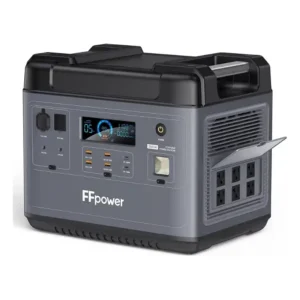
The FFpower P2001 delivers 1,570Wh of its 2,048Wh rating, backed by a 2,000W inverter with 4,000W of surge power. It hands over in 12.4ms with a 225W DC output, though the output measures 110 volts, and there is no app or expansion path.
★★★★★
More details +
This is the third badge on a design we have now measured three times, and there is little to add that was not true of the first two. Forty-eight pounds, a 12.4-millisecond transfer, a 110-volt output, 500 watts of solar across a 12 to 48 volt window at 20 amps, and a 1,100-watt charger, identical across all three. What separates them is the number of cells, inverter size, and price, and this is the cheapest. It is also the weakest converter of the three at 78% through the outlets and 74% through DC, so 478 watt-hours of the rated pack never reach you. Two things genuinely count in its favor: a working transfer function that several far better-known machines in this database lack entirely, and standby drain of 1% an hour that beats units costing considerably more. Against that: 110 volts is below the accepted range and hard on motors; the cells support 2,000 cycles; there is no app or expansion path; and the array cannot remain connected between sessions. If this chassis is what you want, this is the cheapest way to own it.
Battery safety and chemistry (LiFePO4, 2,000 cycles)
5.5
Real-world efficiency and output (78% AC, 74% DC, 110V output)
4
UPS and EPS switchover (12.4ms, self-arming unrecorded)
7.5
Port selection and distribution (two 100W USB-C, 225W DC)
7.5
Solar charging and MPPT (500W at 20A, 48V ceiling)
4.5
AC recharge speed (1,100W single rate, 1,600W combined)
5.5
Noise and thermal management (53dB plus inverter noise)
5.5
Portability and build quality (48 lbs)
6.5
Expandability and ecosystem (no expansion support)
4
Smart app and interface
3
PROS:
  • The cheapest of three identical machines, and the best value position of the group.
  • A working 12.4ms transfer, which several better-known machines cannot match at all.
  • Two 100W USB-C ports and a 225W DC output that clears the 150-watt threshold.
  • Standby drain of 1% per hour, better than several machines that cost far more.
  • Twenty amps of solar current, generous for a parallel bank of panels.
  • Fifty-three decibels, the quietest of the three siblings.
CONS:
  • Conversion of 78% through AC and 74% through DC, the weakest of the three siblings.
  • Output measured 110 volts, below the accepted band and hard on motors.
  • Cells rated to 2,000 cycles, about five and a half years of daily use.
  • No app, no expansion path, and no adjustable charging speed.
  • The array cannot stay connected between sessions, and the ceiling is 48 volts.
  • A two-year warranty against a five-year class standard.

Strengths and Weaknesses

Assessed across all our FFpower-reviewed power stations rather than on any single model.

What this brand does well Where it falls short
The BP2000's 6.2ms handover is the fastest measurable figure in our database, ahead of every major brand. Both machines are loud, at 59dB and 53dB, and the BP2000 is the noisier of the two.
The BP2000 converts at 87% and supports expansion, with a silent inverter behind the fans. The P2001 outputs 110 volts, below the accepted band, and returns only 78% at the outlets.
Both machines have telephone support, which several smaller brands lack. The P2001 is a rebadged chassis also sold as the FOSSiBOT F2400 and Oukitel P2001, so the badge tells you nothing about origin or support.
Value is reasonable at $0.49 and $0.54 per watt-hour. Warranty is three years on the BP2000 and two on the P2001, both short of the five-year market standard.
LiFePO4 on both machines, rated 2,000 to 3,500 cycles. Only two machines in the range, both at exactly 2,048Wh. No smaller or larger option.
The BP2000's transfer speed makes it genuinely suitable for protecting computers and network equipment. No expansion support on the P2001, and neither machine is split-phase.

Which Model Is Right for You?

Protecting Computers and Network Equipment

The BP2000 is the specialist recommendation here. At 6.2 milliseconds, it is the fastest measurable handover we have recorded, comfortably inside the band where a desktop or a network drive rides through without restarting. The 59dB fan noise means it belongs in a garage, basement, or utility room rather than beside a desk.

Add to compare
A front-facing studio photo of the FFpower BP2000 portable power station on a white background, featuring a silver and black two-tone chassis, central LCD display showing 99% battery capacity, four covered AC outlets, and multiple DC and USB outputs.
Deal
3 months ago

FFpower BP2000 Review

The FFpower BP2000 (marketed as Oukitel BP2000) transfers to battery in 6.2ms, the fastest measurable switchover we have recorded. It has a 2,048 Wh capacity, is powered by a 2,200W inverter, charges internally at 1,800W, and accepts an expansion battery.
★★★★★

If You Are Comparing the P2001 Against Other Models

The FFpower P2001, FOSSiBOT F2400, and Oukitel P2001 are the same chassis: identical 48-pound weight, identical 12.4ms transfer, identical 110-volt output. Compare them on price, warranty, and support rather than on specifications, because the specifications are the same.

Add to compare
A front and side studio photo of the FFpower P2001 portable power station on a white background, featuring a dark grey chassis, black top section with integrated handles, LCD display showing 99% battery capacity, multiple USB and DC outputs, and six covered AC outlets on the side panel.
Deal
3 months ago

FFpower P2001 Review

The FFpower P2001 delivers 1,570Wh of its 2,048Wh rating, backed by a 2,000W inverter with 4,000W of surge power. It hands over in 12.4ms with a 225W DC output, though the output measures 110 volts, and there is no app or expansion path.
★★★★★
Add to compare
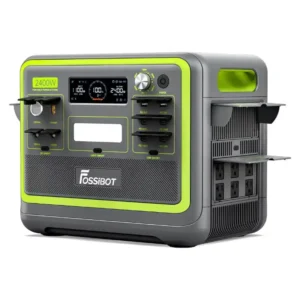
A front and side studio photo of the FOSSiBOT F2400 portable power station on a white background, featuring a dark grey and black chassis with neon lime green accents, a display showing 100% battery capacity, a central LED light bar, a rotary AC charging control dial, and multiple covered AC, DC, and USB ports.
Deal
3 months ago

FOSSiBOT F2400 Review

The FOSSiBOT F2400 delivers 1,650Wh of its 2,048Wh rating, backed by a 2,400W inverter with 4,800W of surge power. Cells are rated at 3,500 cycles, and it hands over in 12.4ms, though the output measures 110 volts and there is no app.
★★★★★
Add to compare
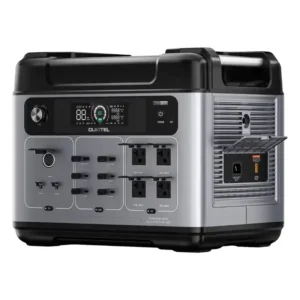
A symmetrical front-facing studio photo of the OUKITEL P2001 Pro portable power station on a white background, featuring a silver and black chassis, front LCD display, four covered AC outlets, multiple USB and DC ports, an adjustable AC charging dial, and a side panel with covered charging inputs.
Deal
3 months ago

Oukitel P2001 Review

The Oukitel P2001 delivers 1,590Wh of its 2,048Wh rating, backed by a 2,000W inverter with 4,000W of surge power. It hands over in 12.4ms and offers a 225W DC output, though the output measures 110 volts and there is no app or expansion path.
★★★★★

Emergency Home Backup

Both machines have working transfer functions, at 6.2ms and 12.4ms. The BP2000 is the clearly better choice, converting nine points higher and outputting a correct 120 volts.

Add to compare
A front-facing studio photo of the FFpower BP2000 portable power station on a white background, featuring a silver and black two-tone chassis, central LCD display showing 99% battery capacity, four covered AC outlets, and multiple DC and USB outputs.
Deal
3 months ago

FFpower BP2000 Review

The FFpower BP2000 (marketed as Oukitel BP2000) transfers to battery in 6.2ms, the fastest measurable switchover we have recorded. It has a 2,048 Wh capacity, is powered by a 2,200W inverter, charges internally at 1,800W, and accepts an expansion battery.
★★★★★

The P2001’s 110-volt output is worth noting if a refrigerator or pump will run on it regularly, since undervoltage makes motors work harder.

Add to compare
A front and side studio photo of the FFpower P2001 portable power station on a white background, featuring a dark grey chassis, black top section with integrated handles, LCD display showing 99% battery capacity, multiple USB and DC outputs, and six covered AC outlets on the side panel.
Deal
3 months ago

FFpower P2001 Review

The FFpower P2001 delivers 1,570Wh of its 2,048Wh rating, backed by a 2,000W inverter with 4,000W of surge power. It hands over in 12.4ms with a 225W DC output, though the output measures 110 volts, and there is no app or expansion path.
★★★★★

What Sets This Brand Apart

Switchover speed is what distinguishes the BP2000. At 6.2 milliseconds, it beats every branded machine in our database, including flagships from EcoFlow, Anker, and Bluetti costing considerably more. Only machines transferring with no measurable gap at all are faster.

The conventional threshold in this category is 20 milliseconds, and under 11 is where a transfer becomes genuinely reliable for equipment with a processor. The BP2000 clears that comfortably.

Editors Brand Comparisons Summary (How This Brand Compares to Rivals)

Against How they differ on our measurements Choose this brand when
FFpower vs Anker Anker is quieter, better supported, and more consistent across a far wider range. The BP2000 beats every Anker on raw transfer speed at 6.2ms against 7.2ms. Switchover speed is the single specification that matters most to you.
FFpower vs Pecron Pecron converts better on average, covers many more capacities, and costs less per watt-hour. FFpower's BP2000 transfers faster than any Pecron. You need the fastest measurable handover available in a 2kWh machine.

The Bottom Line

FFpower is worth knowing for one machine. The BP2000 holds the fastest measurable switchover in our database and beats far more expensive flagships on that specific measure.

The P2001 is the same chassis sold under three badges, so shop it on price and support rather than specifications. Neither machine is quiet, and both carry warranties shorter than the market standard.

Frequently Asked Questions

The BP2000 is a genuinely strong machine, holding the fastest measurable switchover in our database at 6.2ms with 87% conversion and expansion support. The P2001 is a rebadged chassis with 78% conversion and 110-volt output. The range is narrow, and warranties are short, at two to three years.

Five machines in our database transfer with no measurable gap at all. Among machines with a measurable figure, the FFpower BP2000 is the fastest at 6.2 milliseconds. For context, the conventional safety threshold is 20 milliseconds, and the reliable band is under 11.

Because they share the same chassis, the FFpower P2001, FOSSiBOT F2400, and Oukitel P2001 have identical weight, transfer time, output voltage, and specifications. Compare them on price, warranty, and support instead, since the hardware is the same.

Electrically, yes. A 6.2ms handover means a desktop or network drive should ride through a mains failure without restarting. Acoustically, no. At 59 dB, it is too loud to sit beside a desk, so plan on running an extension from another room.

Power Station Geek
Logo
Compare items
  • Total (0)
Compare
0