
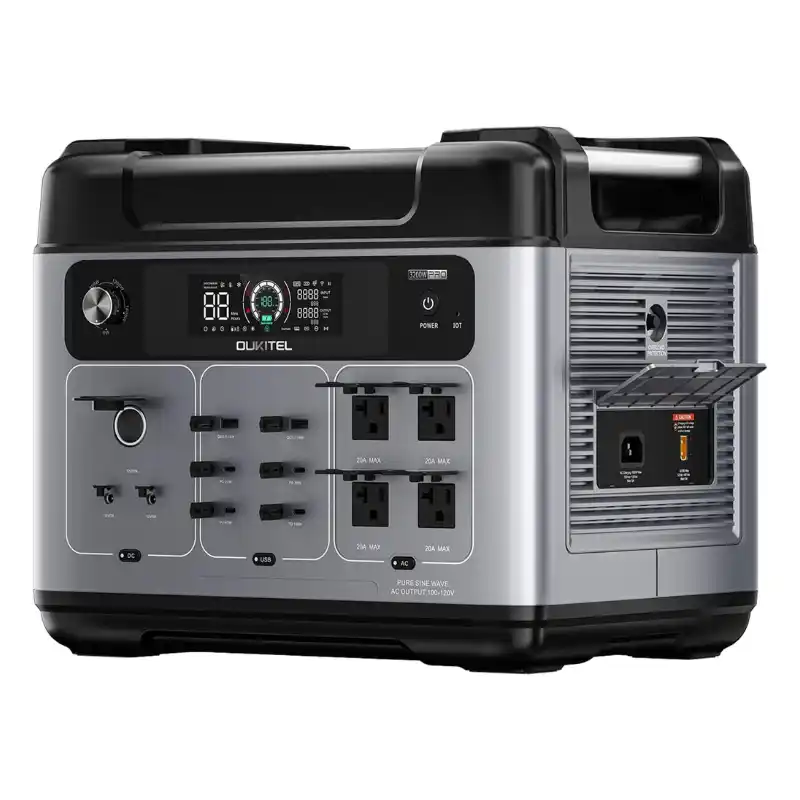
Oukitel P2001 Review

The Oukitel P2001 delivers 1,590Wh of its 2,048Wh rating, backed by a 2,000W inverter with 4,000W of surge power. It hands over in 12.4ms and offers a 225W DC output, though the output measures 110 volts and there is no app or expansion path.
My Quick Verdict
Two machines in this database carry the model number P2001, differ by one badge, and post figures within a rounding error of each other on every measurement we take.
The Oukitel is the more expensive of the pair, and what the extra money buys is 20 usable watt-hours and one decibel of quiet.
It shares everything else with its twin: 110 volts of output, 2,000 charge cycles, no app, no expansion, and a solar input that will not stay connected.
There is a working 12.4-millisecond transfer here, which several better-known machines lack entirely. That is the honest case for it.
Best for: Workshops and off-grid storage where a working transfer function matters and no motor is at stake.
Not for: refrigerators, monitoring, expansion, or paying a premium for a badge.
The Same Machine as the FFpower P2001, but at a higher price.
Key Stats
Introduction
Reviewing a rebadged machine raises an awkward question: is there anything to say that is not also true of its twin?
In this case, very little. The Oukitel P2001 and the FFpower P2001 share the same chassis, weight, transfer time, output voltage, solar specifications, charging ceiling, cell rating, and DC output. Our bench figures place them within 20 watt-hours of each other.
What differs is the price, and the Oukitel is the dearer of the two.
Lithium iron phosphate cells sit inside, with 2,000 cycles claimed against a two-year warranty. Both numbers are the smallest anything this size offers.
What It Can Actually Run
2,000 watts sustained, with 4,000 in a burst, enough to handle a heating appliance on its own or a refrigerator with lighting.
Rated at 2,048 Wh, the sockets returned 1,590 Wh (797)9%. Everything below is calculated from 1,590Wh.
- Refrigerator at 150W: 10.5 hours.
- CPAP at 40W without humidification: nearly forty hours.
- Starlink dish at 50W: close to thirty-two hours.
- Laptop at 70W: about twenty-two charges across two ports.
Output measured 110 volts, below the working band, with audible inverter noise recorded and electrical noise at 1,935mv.
Charging and Smart Features
Wall input is 1,100 watts at a single fixed rate. There is no speed adjustment on this badge, though the FOSSiBOT version of the same chassis has it.
Together, both inputs reach 1,600 watts, which is a real improvement over the socket alone.
The panel input handles 500 watts at 12 to 48 volts and 20 amps, and that 48-volt cap is the tightest of the three badges.
The switchover measured 12.4 milliseconds. Premium price tier, luxury value tier.
Charging Speed Benchmarks
Grid and array recharge times for the Oukitel P2001 within the 2,000Wh to 3,000Wh capacity class, benchmarked against all 26 machines our charging database holds for that bracket. The averages are 1,641W on mains and 1,123W on solar. All three bands are terciles inside the class, not site-wide scores.
At 1,100W on a fixed rate, mains charging is a Low rating and roughly a third under the 1,641W class average, filling 2,048Wh in about 1.9 hours. The figure worth noting is the combined one: mains and panels together reach 1,600W with pass-through supported, so loads keep running while the pack fills. Against a class that reaches 5,000W at the top, this is slow, though it is still a genuine internal charger rather than one of the 470W bricks lower down the bracket.
Panel input stops at 500W with a 48-volt ceiling and 20 amps of current, well under half the 1,123W class mean and a Low rating in a bracket topping out at 2,400W. A full solar refill needs roughly 4.1 hours of flawless light. Twenty amps is generous relative to the wattage, so a parallel bank of low-voltage panels is the arrangement that works here, but the array still has to be disconnected between charging sessions.
Want the array to fill the pack in one afternoon? The DJI Power 2000 accepts 1,800W of solar over a 43-amp low-voltage path, three and a half times the P2001 and the largest current allowance recorded anywhere in our data, which suits exactly the parallel foldable banks this chassis encourages. Panels fill 2kWh in about 1.1 hours, and mains charging rises to 1,800W alongside it.
Real Capacity: What You Actually Get
Conversion is weak on both paths and sits in the middle of the three siblings.
Put a meter on the sockets, and 1,590 Wh of the claimed 2,048 Wh comes back. Machines this size are expected to clear 85%; this returns 79.
DC came back at 1,535 Wh (76%). With both routes being lossyfavouringis nothing to gain by favoring either.
Idle losses run to a percent an hour armed, half that on twelve volts. Of the three, this badge holds its charge best, and the figure stands up to far pricier machines.
The scale of the shortfall is worth noting: a machine at this capacity, converting at 91%, hands back roughly 290 watt-hours more. That is close to two hours of extra time in the refrigerator.
My takeaway: 1,590 Wh from a 2,048 Wh pack. Nearly 460 watt-hours, never the station’s full capacity.
Power Output and Surge: What It Can Turn On
The inverter is modest for the capacity. Two thousand watts sustained is 400 short of what the FOSSiBOT version of this chassis carries, and enough for ordinary household loads one at a time.
A compressor waking up draws far less than the 4,000 watts available in a burst.
The 225-watt DC output is genuinely useful, clearing the 150-watt threshold that separates a working twelve-volt socket from a token one, and it is enough to run a compressor fridge alongside something else.
Two 100-watt USB-C ports are also better than what several machines at this capacity can manage.
The shared problem is voltage. Ten volts under nominal is enough to change how a compressor behaves. It takes more effort to do the same work, warms up doing it, and gets there sooner. Heaters and anything on a switching supply carry on unbothered.
Real Appliance Runtimes
1,590Wh converted into hours, on the appliance set applied to every machine on this site.
Every line here is roughly an hour and a half shorter than a strong performer at this capacity would give from the same rated pack. That gap is conversion, not battery size.
Recharging: Wall and Solar
From a Wall Outlet
Eleven hundred watts into a 2,048 Wh pack takes close to two hours to charge from empty.
There is no rate adjustment on this badge, so that is the only speed available. The FOSSiBOT, built on the same chassis,s does offer adjustable charging, which is one of the few genuine differences between them.
Feed it from the socket and panels at once, and the total reaches 1,600 watts, which, on a clear day, appreciably cuts the wait.
From Solar Panels
Panel input draws 500 watts at 12-48 volts and 20 amps.
The current headroom is what saves it. At 20 amps, a low-voltage parallel bank delivers its full output rather than being throttled by the controller.
Forty-eight volts is the lowest ceiling of the three siblings and low by any standard, so a series string of more than two panels is out of reach.
Half a kilowatt is thin for two kilowatt-hours of storage, and the grading sheet notes the array must come off between sessions rather than living permanently attached.
Blackout Backup: The Part I Care About Most
The transfer function is the strongest feature of this machine and all three of its siblings.
At 12.4 milliseconds, the handover occurs well within the twenty-millisecond limit, meaning a NAS or a router continues through a mains failure rather than rebooting.
That is not among the fastest figures at this capacity, where several machines manage under nine milliseconds, but it is a real, working transfer, which is more than three better-known machines in this database offer.
Whether the inverter arms itself is recorded in our data is worth confirming with Oukitel before relying on the machine to protect an empty house. A standby drain of 1% per hour makes leaving it armed genuinely affordable.
Why this matters to me: for a machine at this price, the transfer is the one specification that competes. If you are buying for backup rather than storage, that is the reason to consider it at all.
Noise and Living With It
Fifty-four decibels under load, which is the middle of the three siblings and past the point where a room with a sleeper is comfortable.
The grading entry also records audible noise from the inverter itself, separate from the fans.
The scale reads 48 pounds (21.7 kilograms), the same as the other two badges, and is fair for a pack this size.
There is no app and no expansion port. Cover lasts two years, backed by a promise to respond within a day.
Where It Falls Short
Five limitations: four shared with its twin and one purely about price.
1. You Are Paying More for the Same Machine
The FFpower P2001 shares this chassis, this transfer time, this output voltage, this solar input, this charging ceiling, and this cell rating, at a lower price.
What the Oukitel badge adds is 20 usable watt-hours and one decibel of quiet. Unless the price difference is negligible, that is not a trade worth making.
2. Output Measured 110 Volts
Below the accepted working band, and shared with both sibling machines.
Motors compensate by drawing more current and running hotter, which shortens their life. A refrigerator cycled on this repeatedly is worse off than one fed by a rival.
3. 79% Conversion and 2,000 Cycles
Nearly 460 watt-hours of the pack’s rated capacity never reach the outlets, and the cells have the shortest lifespan of the three siblings.
Cycle it daily and 2,000 runs out somewhere past year five. Machines built now reach twice that.
4. No App, No Expansion, No Rate Control
Neither wireless standard is fitted, which rules out watching it from another room, changing anything remotely, or ever receiving an update.
No expansion battery support and no adjustable charging speed either; the FOSSiBOT version of the same chassis has the latter.
5. Panels Cannot Stay Connected, and a 48-Volt Ceiling
Panels must be unhooked when you finish, as almost every current machine this size is happy to have them bolted on permanently.
And 48 volts is the lowest solar ceiling of the three siblings, ruling out any real series string.
How It Compares
The first comparison is its own twin. The second shows what a current machine at this capacity delivers
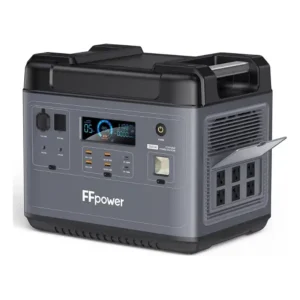
Compared to the FFpower P2001, the differences are almost invisible: 20 more usable watt-hours via AC, 45 via DC, and 1 decibel louder. Everything else is identical, and the Oukitel costs more.
The FOSSiBOT F2400, built on the same chassis, is the one to take if these three are your shortlist. You gain 400 watts on the inverter, 1,500 extra cycles, rate control, and a larger DC socket, in exchange for 5 dB.
Widen the shortlist, and all three fall away quickly. Current machines at this capacity return 91% compared to this one’s 79%, output the correct voltage, offer an app, and carry warranties of 5 years or more.
Who Should Buy It, and Who Should Skip It
Buy It If
- It is discounted below the FFpower version of the same machine.
- Your loads are resistive or electronic, and no motor depends on them.
- A working transfer function matters more to you than monitoring or efficiency.
- It will live in a workshop or outbuilding where the noise reaches nobody.
Skip It If
- The FFpower P2001 is available more cheaply, which it generally is.
- A refrigerator or pump will run on it regularly.
- You want an app, an expansion path, or adjustable charging.
- Usable energy per pound spent enters your decision at all.
The Bottom Line
The Oukitel P2001 has one genuine strength, and it shares it with two other machines: a working 12.4-millisecond transfer that several far better-known units cannot match.
Everything else is either shared with its twin or worse than the class. 79% conversion, 110 volts of output, 2,000 cycles, no app, no expansion, and an array that has to be unplugged.
If these three badges are your shortlist, take the FOSSiBOT. If price is the deciding factor, take the FFpower. There is no scenario where the Oukitel badge is worth paying extra for.


There are no reviews yet.