
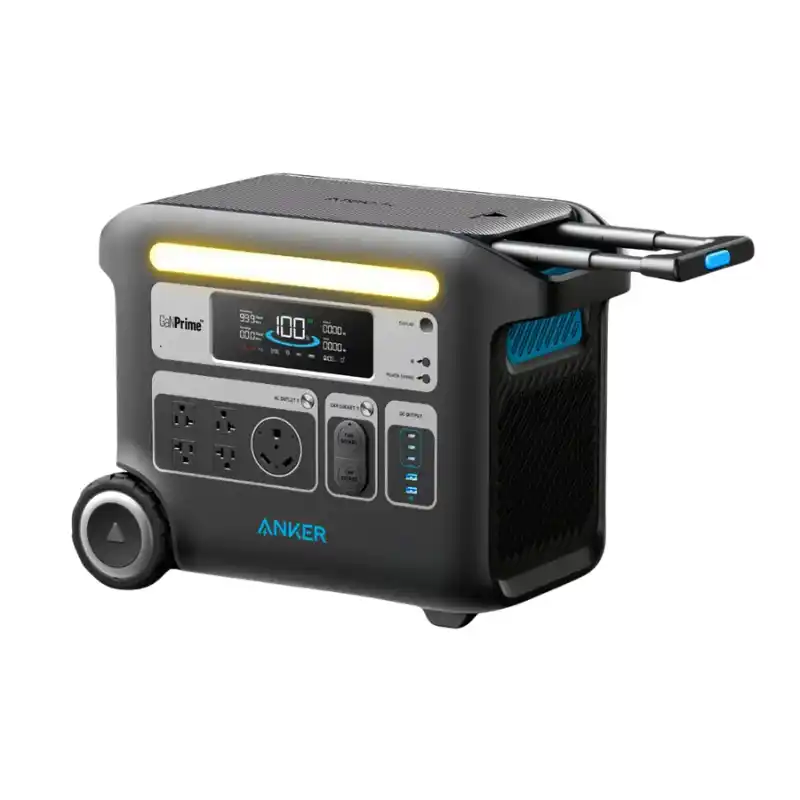
Anker SOLIX F2000 Review

The Anker SOLIX F2000 delivers 1,850 Wh (90% of its 2,048 Wh rating) and is powered by a 2,400W inverter. It’s 270W; the 12-volt socket is the highest-rated car outlet in this data, three USB-C ports deliver 100W each, and the fans operate at 45dB. Upper mid-range price tier, good value.
My Quick Verdict
The 12-volt car socket is the port nobody compares to. Manufacturers fit one, rate it somewhere between 120 and 145 watts, and nobody mentions it again.
The F2000 rates its socket at 270 watts. That is roughly double the class norm and the highest figure of its kind in this data, and it means a compressor fridge, a diesel heater, or a run of vehicle accessories can plug straight into the socket without an adapter or a breakout cable.
Conversion is strong, too, at 90% through the outlets, and the fans are at 45 decibels.
Against that, this is the heaviest unit at full capacity; its app supports Bluetooth only, and it cannot be charged simultaneously via mains and solar.
Best for: Overland and RV installations running twelve-volt accessories, and Emergency Home Resilience in a household that is rarely empty.
Not for: unattended backup, or any situation involving lifting it more than once.
Key Stats
| Badge | Stats |
|---|---|
| Battery chemistry and longevity | LiFePO4 | 3,000 cycles |
| Continuous AC power output | 2,400W AC | 4,800W peak |
| Energy storage capacity | 2,048Wh | 1,850Wh usable |
| Rapid AC wall recharge | 1,440W input | Adjustable speed |
| Uninterrupted emergency backup | 15.1ms UPS | Manual arm |
| Maximum solar input and MPPT | 1,000W solar | 20A MPPT |
| Ultra-fast USB-C power delivery | Three 100W USB-C ports |
| Low-noise operational level | 45dB | Whisper quiet |
| High-output car socket | 270W 12V | Highest measured |
| Modular capacity expansion | Expandable | Extra battery port |
Introduction
Anyone who has run a fridge from a power station in a vehicle knows the frustration. The battery is direct current, the fridge is direct current, and between them sits an inverter that converts it to household power, so the fridge’s own supply can convert it back.
The workaround is usually an XT60 or Anderson breakout, which most units provide but few make convenient. The car socket, the one port every twelve-volt accessory already plugs into, is typically rated too low to be useful for anything demanding.
The F2000 rates its socket at 270 watts, roughly double what the rest of the field offers and enough for real appliances. Lithium iron phosphate chemistry sits inside, rated for 3,000 cycles and covered for five years, which works out to around eight years of daily use.
What It Can Actually Run
The inverter has a 2,400W continuous rating and a 4,800W peak, enough to power a heating appliance while another device runs alongside it.
The pack is rated at 2,048 Wh; put a meter on the outlets, and 1,850 Wh comes back. 90%, which only two units this size beat. Everything below rests on that number.
- Refrigerator drawing 150W: better than twelve hours.
- CPAP without humidifier at 40W: over forty-six hours.
- Starlink dish at 50W: thirty-seven hours.
- Laptop at 70W: around twenty-six refills, spread across three ports.
The output measured 119 volts. No harmonic distortion figure appears in the available bench data, so verify it with Anker before running any medical tests.
Charging and Smart Features
Mains charging tops out at 1,440W with stepped rate control, which is mid-field for this capacity.
A kilowatt of panel capacity is accepted from 11 to 60 volts, and the 20-amp allowance is roomy enough that rigid panels present no trouble.
Handover to battery took 15.1 milliseconds, and the inverter requires manual arming. Solar may stay wired in, and loads keep running through a charge.
One notable gap: dual charging is unsupported, so mains and panels will not feed it together. Upper mid-range price tier; good value.
Charging Speed Benchmarks
The Anker SOLIX F2000 set against every unit in the 2,000Wh to 3,000Wh capacity class we hold charging figures for, 26 machines averaging 1,641W on the wall and 1,123W on solar. Ratings are calculated within the class, so they compare this unit to its own size bracket and not to the database at large.
The charger is this machine's weakest input figure. 1,440W from mains is the lowest rate that still avoids a Low rating in this bracket, and it trails the 1,641W typical here by a wide enough margin to show. Working through 2,048Wh at that rate is around 1.4 hours, roughly a third longer than the quickest machines at the same capacity. Dual charging is absent as well, so unlike most of this bracket the F2000 cannot lean on panel wattage to shorten a mains recharge.
Panels top out at 1,000W, a fraction below the 1,123W typical for the bracket, which is enough for an Average rating where the ceiling is 2,400W. Refilling the pack that way takes about 2.0 hours of proper sun. A 20-amp allowance is comfortable for rigid panels rather than foldables alone, and the array can stay permanently wired. Since mains and solar will not run together, though, that 1,000W is a genuine alternative to the wall socket rather than an addition to it, and choosing between them is a decision you make every time.
Want both inputs running at once? The Bluetti AC300 + B300K takes 3,000W from mains, 2,400W from solar, and 5,400W from both together, which is more than three times the F2000's single-channel ceiling. Its 2,764Wh of storage comes back from flat in a little over half an hour on mains, and further modules slot underneath without new charging hardware.
Real Capacity: What You Actually Get
The delivery figures here are among the better ones at this capacity, and the split between the two paths is wider than usual.
Against a claimed 2,048 Wh, the outlets delivered 1,850 Wh (a 90% return) with only two units at this size ahead of it.
Twelve-volt delivery came in at 1,738 Wh, or 84%, six points behind. That reversal is worth noting, given the strong car socket: the port is excellent, but the path behind it is less efficient than the other.
Left awake and unloaded, it loses roughly 1.5% per hour. Middling by the standards here, though the twelve-volt side registered no loss the meter could detect.
My takeaway: 1,850Wh is a generous working figure. Just be aware that the 270-watt socket is about convenience and capability rather than efficiency; on this unit, AC is the better-converting path.
Power Output and Surge: What It Can Turn On
Sustained and peak ratings are conventional for the capacity and need little discussion. 2,400W powers a heating appliance in the room beside it, and 4,800W of peak handles any compressor start.
The port array is why we need to look at this unit twice.
Three separate USB-C outputs, each rated at 100 watts, mean three devices can charge at full rate simultaneously; a feature no other unit reviewed here offers. Most fit one such port; a few fit two.
And the 270-watt car socket changes what plugs in without adaptation. A twelve-volt compressor fridge, a heater, a tyre inflator, and lighting can all run from the socket they were designed for, rather than through a breakout cable and an inverter.
Real Appliance Runtimes
What 1,850 Wh delivers in hours, against the appliance setting applied to every review on this site.
| Appliance | Power Draw | Runtime | What That Means |
|---|---|---|---|
| Full-size refrigerator | 150W | About 12.3 hours | Half a day held outright, and further as the compressor idles. |
| CPAP machine (no humidifier) | 40W | About 46.3 hours | Two nights, two days, and change. |
| Starlink dish | 50W | About 37 hours | Longer than a working weekend off-grid. |
| Pellet grill or smoker | 100W | About 18.5 hours | An overnight smoke with the morning left over. |
| Laptop (70W) | 70W | About 26 recharges | Across three ports, so a small team at once. |
That 90% conversion earns roughly an hour more refrigerator time than a unit returning 84% from the same nominal capacity. It is the quiet reason this machine outperforms its specification sheet.
Recharging: Wall and Solar
From a Wall Outlet
The mains socket delivers 1,440W into it, with the rate steppable rather than fixed.
From flat that is roughly ninety minutes, which sits behind the 1,800W and 2,400W units at this capacity without being slow in absolute terms.
What hurts more is the missing dual-charging support. On a dull morning, there is no way the wall can make up for what the panels fail to deliver, and most rivals at this price do exactly that.
From Solar Panels
A thousand-watt panel capacity, accepting between 11 and 60 volts at 20 amps.
Twenty amps is a comfortable current ceiling that keeps rigid panels in play rather than restricting you to foldables. Sixty volts at the top end is the usual arrangement, which puts lengthy series strings beyond it.
Under good conditions, an empty pack fills in about 2.5 hours.
The array can remain attached indefinitely, and the unit powers loads throughout a charge cycle. It simply will not accept mains at the same time.
Blackout Backup: The Part I Care About Most
Backup is this unit’s weakest area, and the shortfall is on both counts that matter.
Handover measured 15.1 milliseconds. That clears the 20-millisecond safety line with some room, and it is well adrift of the seven- and eight-millisecond figures the leaders at this capacity post. At fifteen milliseconds, the outcome depends on the equipment.
The inverter also will not wake up on its own, so it has to be switched on deliberately and left on.
With a 1.5% per hour standby drain, leaving it armed is workable but not free. A week untouched costs a quarter of the pack.
Why this matters to me: fifteen milliseconds and a manual switch make this a fine appliance backup and a poor computer backup. If you are protecting a desktop or a network drive, three units of this capacity will do it properly, and this is not one of them.
Noise and Living With It
Forty-five decibels under load, which is quiet for a 2,400-watt inverter and comfortably beneath what a room with a sleeper in it can tolerate.
Practically, it recedes into the background rather than announcing itself, and a utility room next to a bedroom would be untroubled.
Then the weight. Sixty-seven pounds, 30 kilograms, and that is the heaviest figure at this capacity in the whole dataset. Six pounds above the next heaviest and twenty-six above the lightest.
The app runs on Bluetooth alone. There is no Wi-Fi, so it cannot be checked from elsewhere in the house; though Bluetooth is the connection that keeps working off-grid, which softens the loss for vehicle use.
Where It Falls Short
Four things weigh against it, and the first two are permanent.
1. Sixty-Seven Pounds
The heaviest unit at this capacity anywhere in this data, and a genuine two-person lift rather than an awkward one-person one.
For a permanent installation or a vehicle, it stays put, and the weight is irrelevant. For anything you load and unload, it is decisive.
2. Fifteen Milliseconds and No Self-Arming
Sluggish for this size class. The strongest machines here manage the handover in half that time and come up unprompted.
Combined with a 1.5% hourly drain while armed, the unit is neither quick enough nor cheap enough to leave running for genuine unattended protection.
3. No Dual Charging
Mains and solar cannot feed it simultaneously. Most rivals at this price tier accept both, and the absence is felt on any overcast day when you want the wall to cover the shortfall.
4. Bluetooth Only, and No Distortion Figure
Without Wi-Fi, you have to be within Bluetooth range, so you can’t check the state of charge from upstairs or the office.
Separately, harmonic distortion never appears in the bench data. Immaterial for tools and appliances; worth confirming before running medical equipment.
How It Compares
Two comparisons frame it: the Bluetti AC200L, another heavy unit built around a specific strength, and the Anker SOLIX C2000 Gen 2, its own stablemate and the strongest all-rounder in this capacity.
| Feature | Anker SOLIX F2000 | Bluetti AC200L | Anker SOLIX C2000 Gen 2 |
|---|---|---|---|
| Price tier | Upper mid-range | Upper mid-range | Upper mid-range |
| Value tier | Good | Exceptional | Exceptional |
| Usable through AC | 1,850Wh (90%) | 1,830Wh (89%) | 1,760Wh (85%) |
| 12V car socket | 270W | 142W | 137W |
| USB-C ports | Three at 100W | One at 100W | Two at 140W |
| UPS switchover | 15.1ms | 13.8ms | 7.2ms |
| Self-arming inverter | No | No | Yes |
| Dual charging | No | Yes, 2,400W | Yes, 2,600W |
| Fan noise | 45dB | 48dB | 44dB |
| App connectivity | Bluetooth only | Wi-Fi + Bluetooth | Wi-Fi + Bluetooth |
| Weight | 67 lbs | 61 lbs | 41 lbs |
Anker’s own C2000 Gen 2 is the awkward comparison. It weighs twenty-six pounds less, crosses over in half the time, wakes itself, charges from both inputs at once, and sits a value tier better. What it cannot match is the car socket, which supplies 137 watts, compared to this unit’s 270.
That single port is the entire case for the F2000, and for a vehicle build, it is substantial. For a house, the C2000 is better in almost every respect.
The Bluetti AC200L is the closer match on character: heavy, efficient, quiet, manually armed. It offers dual charging and Wi-Fi where this does not, and a far higher solar voltage ceiling. The F2000 comes with the car socket and two extra USB-C ports.
Who Should Buy It, and Who Should Skip It
Buy It If
- You run 12-volt accessories and want to connect them to the car socket rather than through a breakout cable.
- Several people need to charge devices at full USB-C speed simultaneously.
- The unit goes into a vehicle or a fixed location and stays there.
- You want quiet operation and strong conversion at this capacity.
Skip It If
- You will move it. Sixty-seven pounds settles that question.
- The house needs protecting while empty.
- You want to charge from the mains and panels together.
- Remote monitoring over Wi-Fi matters to you.
The Bottom Line
The F2000 solves one problem that almost nothing else in this category addresses, and it does so properly. A 270-watt car socket means 12-volt equipment plugs into the port it was designed for, with power sufficient for real appliances.
Around that sit genuinely good numbers: 90% conversion, 45 decibels, three full-speed USB-C ports.
What it asks in exchange is that you never move it, never leave the house relying on it, and never expect to charge from two sources at once. For a vehicle build, that is an easy trade. For a household backup unit, Anker’s C2000 Gen 2 is the better option at the same price point.


There are no reviews yet.