
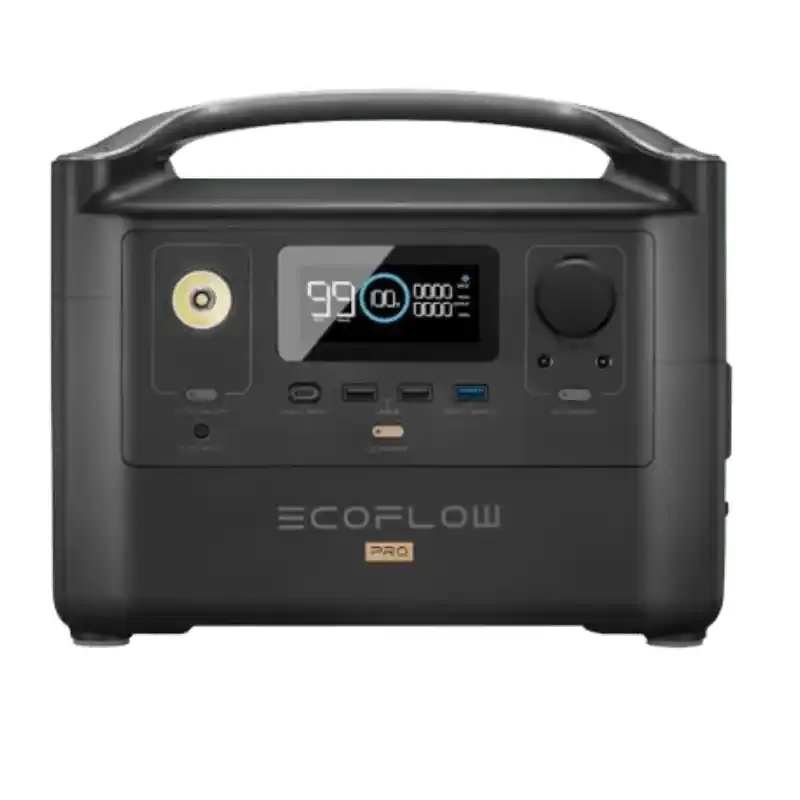
EcoFlow River Pro Review

The EcoFlow River Pro returns just 530 Wh of its 720 Wh rating via AC, but 665 Wh via DC, the widest gap we have measured. It charges internally at 660W, weighs 16.8 pounds, and uses NMC cells rated for 800 cycles.
My Quick Verdict
Run this machine through its AC outlets, and 73% of the rated pack reaches you. Run the same pack through its twelve-volt output, and 92% does.
That nineteen-point spread is the widest gap between output paths anywhere in our database, and it means the choice of socket changes what you get by 135 watt-hours.
The 73% figure is also the joint second-worst AC conversion we have measured. If you plug everything into the mains sockets, more than a quarter of what you charged never arrives.
It uses NMC cells rated for 800 cycles (roughly two years of daily use), the shortest life of any machine in our data.
Best for: Cheap-to-buy camp setups where everything runs off the twelve-volt socket.
Not for: AC-heavy use, long-term ownership, backup, or anywhere quiet.
Key Stats
| Badge | Stat |
|---|---|
| Battery chemistry and longevity | NMC | 800 cycles |
| Continuous AC power output | 600W AC | 1,200W peak |
| Energy storage capacity | 720Wh | 530Wh usable via AC |
| DC conversion efficiency | 92% | 19 points above AC |
| Rapid AC wall recharge | 660W internal | Adjustable |
| Emergency backup switchover | No UPS mode fitted |
| Maximum solar input and MPPT | 197W solar | 10–25V, 12A |
| High-output DC | 158W output |
| Low-noise operational level | 58dB | Loud under load |
| Modular capacity expansion | Expandable | Extra battery port |
Introduction
Every machine loses some energy when converting stored energy into usable energy, and the two output paths rarely differ by more than five or six points.
This one differs by nineteen. Ask the mains sockets, and 73% of the labels arrive; ask the twelve-volt outlet, and 92%dos.
No other machine in our database comes close to that spread, and it fundamentally changes how the unit should be used. Plug into the wrong socket, and you throw away 135 watt-hours.
It also uses NMC cells rated for 800 cycles under a five-year warranty; the shortest cell life of anything we have tested.
What It Can Actually Run
Six hundred watts sustained with 1,200 in a burst. That is modest, and it excludes refrigerator compressors with much confidence as well as every heating appliance.
Rated at 720 Wh, the sockets returned only 530 Wh, a 73% drop. The main calculations below are based on 530 Wh; the twelve-volt ones are based on the far better 665 Wh.
- Refrigerator at 150W through the inverter: 3.5 hours.
- CPAP at 40W with the humidifier off: thirteen hours.
- Starlink dish at 50W: 10.5 hours.
- A 45W, 12-volt DC camp fridge ran for close to 15 hours, drawing 665 Wh.
The line held 120 volts, and the inverter remained quiet, though electrical noise climbed past 2,000 mV.
Charging and Smart Features
Wall input reaches 660 watts through an internal charger with adjustable speed. From empty, that is around an hour and a quarter.
Panels contribute 197 watts, taken from 10 volts up to 25, at 12 amps. That 25-volt ceiling is the narrowest we have measured.
No dual charging is available, so the socket and panels never operate simultaneously.
There is no UPS mode. Upper mid-range price tier, premium value tier.
Charging Speed Benchmarks
Both input channels on the EcoFlow River Pro, measured against every machine in the 300Wh to 999Wh capacity class our charging database covers. Twenty-eight units make up that group, averaging 279W from the wall and 192W from panels. Banding is internal to the class, so these ratings describe the unit among comparable capacities.
Internal charging of 660W is well over double the 279W class average and takes a High rating, returning a 720Wh pack to full in roughly 1.1 hours. The caveat is the chemistry underneath. These are NMC cells rated for 800 cycles, and charging at 660W repeatedly works through that allowance faster than a gentler rate would, so the speed is best treated as a capability for when you need it rather than the default setting.
Panels reach 197W, which lands one watt under the 198W threshold and records as Average rather than High, marginally above the 192W class average and a long way beneath the 600W ceiling. A full solar refill runs to about 3.7 hours of unbroken sun. Combined with the delivery gap on this machine, which returns 530Wh of its 720Wh rating through AC, the realistic solar day is longer than the pack size alone suggests.
Want cells that survive being charged hard? The Pecron E600LFP runs 3,500-cycle lithium iron phosphate against 800-cycle NMC here, and takes 400W of solar, double the River Pro, filling a 614Wh pack from the array in around 1.5 hours instead of 3.7. Its wall charging is slower at 270W, so the trade is grid speed for panel speed and a pack that lasts four times as long.
Real Capacity: What You Actually Get
This section is the whole review.
A meter on the sockets recorded 530 Wh ,acompared toa claimed 720 Wh. 73% is the joint second-worst AC conversion in our database, meaning 190 watt-hours never reach the sockets.
The twelve-volt route returned 665Wh, or 92%, which is genuinely strong and would grace a much better machine.
That nineteen-point spread is the widest we have recorded. For comparison, most machines differ by three to five points between their two paths, and a handful reach nine.
Neither idle drain figure is recorded in our data, leaving storage behaviour an open question worth raising with EcoFlow.
My takeaway: 530 Wh through the sockets vs. 665 Wh through DC. On this machine, more than any other we have tested, the socket you choose decides what you actually get.
Power Output and Surge: What It Can Turn On
Six hundred watts continuous is the lowest AC rating among machines at this capacity, and it considerably limits what the machine can do
A television, lighting, a router,r and devices all run comfortably. A domestic refrigerator sits close to the 1,200-watt surge limit at startup, so it may or may not hold, depending on the appliance.
The DC side is where the design makes sense. At 158 watts, the twelve-volt outlet passes the 150-watt bar, and with 92% arriving, it runs camp fridges and a vehicle kit with very little waste.
Output quality is mixed: 20 volts is correct, and theinverter, is silent, but electrical noise exceeds 2,000 mV.
Real Appliance Runtimes
The main figures are based on 530 Wh; the DC line uses the much higher 665 Wh.
| Appliance | Power Draw | Runtime | What That Means |
|---|---|---|---|
| Full-size refrigerator | 150W | About 3.5 hours | Through the inverter, only 73% is returned. |
| CPAP machine (no humidifier) | 40W | About 13.3 hours | Thirteen hours, but not within earshot at 58dB. |
| Starlink dish | 50W | About 10.6 hours | A working day online. |
| 12V camp fridge, runs on DC | 45W | About 14.8 hours | Nineteen points more of the pack arrive this way. |
| Laptop (70W) | 70W | About 7.6 recharges | Over the 100W USB-C port. |
Compare the fridge line against the camp fridge line. With similar loads, the DC path delivers more than 4 extra hours from the same pack. No other machine we have tested rewards that choice so heavily.
Recharging: Wall and Solar
From a Wall Outlet
Six hundred and sixty watts through an internal charger fill the pack in about an hour and a quarter, which is quick for this size and generation.
The rate steps down, so an overnight trickle is on offer.
The charger also lives inside the machine rather than in the cable, unlike rivals of this size that deliver 200 watts over three and a half hours.
Dual charging is not supported, so panels cannot further shorten the wait.
From Solar Panels
The solar input is the most restrictive we have measured anywhere in the database.
Just 197 watts, over a 10 to 25 volt band, at 12 amps. That 25-volt ceiling is the narrowest of any machine we have tested.
Practically anything rigid runs past 25 volts and goes unrecognised, confining you to foldables in parallel; and even those cap out under 200 watts.
That ceiling explains the sheet’s note that panels alone will not finish a charge inside the standard window.
Panels may remain wired in indefinitely, and loads run throughout a charge.
Blackout Backup: The Part I Care About Most
There is no automatic transfer function on this machine.
Its grading row marks the UPS mode as not applicable, meaning the sockets die the moment the mains do.
Typical for the size, since few units under 800Wh have one, though it does mean the word backup has no place in your reasoning.
EcoFlow’s newer River 2 Pro does have a transfer function, though at 30 milliseconds it is the joint slowest we have measured, so the improvement is smaller than it sounds.
Why this matters to me: no one hardwires 720Wh into a property, so the absent handover matters less here than on something bigger. Saying so plainly matters, since the name of the category suggests the opposite.
Noise and Living With It
Fifty-eight decibels under load, which is loud for a machine this small and beyond what an occupied indoor room will tolerate.
No sound comes from the inverter, leaving the fans to take the blame; better than rivals, where both add to it.
In a tent, 58 decibels is a real problem, since canvas absorbs nothing and the machine sits close by.
What you get back is mass: 16.8 pounds (7.6 kilograms), easily managed with one arm. Both Wi-Fi and Bluetooth are supported, with five years of coverage behind them.
Where It Falls Short
Four limitations, and the first sets a ceiling on how long you will own it.
1. Eight Hundred NMC Cycles
The shortest cell life of any machine in our database. With daily cycling, capacity falls to 80% around the two-year mark.
Current machines at this capacity use lithium iron phosphate rated for 2,000 to 3,000 cycles, which is five to eight years for the same money.
The five-year warranty is generous by comparison, which is an odd pairing on cells rated to last two.
2. 73% Through AC
The joint second-worst AC conversion we have measured leaves 190 watt-hours of the rated pack unreachable through the sockets.
The 92% DC path is excellent by contrast, but it only helps loads you can route that way.
3. A 25-Volt Solar Ceiling
The narrowest solar voltage window in our entire database. Almost every rigid panel operates above 25 volts and will not work at all.
Nor will a 197-watt total fill the pack inside the standard window.
4. Fifty-Eight Decibels and a 600-Watt Inverter
Loud enough to exclude tents and bedrooms, on a machine whose portability suggests exactly those uses.
And 600 watts continuous is the lowest at this capacity, with a 1,200-watt surge, leaving little margin for a fridge compressor.
How It Compares
The clearest comparison is EcoFlow’s own replacement, which is also the quietest machine at this capacity.
| Feature | EcoFlow River Pro | EcoFlow River 2 Pro | VigorPool Captain 700 |
|---|---|---|---|
| Rated capacity | 720Wh | 768Wh | 672Wh |
| Usable through AC | 530Wh (73%) | 620Wh (80%) | 560Wh (84%) |
| Usable through DC | 665Wh (92%) | 683Wh (88%) | 625Wh (93%) |
| Cell chemistry | NMC, 800 cycles | LiFePO4, 3,000 cycles | LiFePO4, 2,000 cycles |
| Continuous output | 600W | 800W | 700W |
| Wall charging | 660W internal | 940W internal | 600W internal |
| UPS switchover | None fitted | 30ms | 20ms |
| Solar input | 197W, 10–25V | 220W, 11–50V | 240W, 12–30V |
| Fan noise | 58dB | 60dB | 47dB |
| Weight | 16.8 lbs | 17 lbs | 20 lbs |
EcoFlow’s River 2 Pro replaces this machine and improves nearly everything that matters: more AC conversion, LiFePO4 cells rated for nearly 4 times as many cycles, 280 watts more charging power and a solar window twice as wide.
It runs 2 dB louder, the only measure in which the older machine wins.
The VigorPool Captain 700 is the stronger machine outright: eleven points better through AC, a working 20-millisecond transfer, and 47 decibels against 58. If quiet matters at all, it is not close.
Who Should Buy It, and Who Should Skip It
Buy It If
- You will run 12-volt equipment from the DC output, which delivers 92% of the power here.
- It is heavily discounted as older stock, and you accept a short working life.
- Weight matters,s and 16.8 pounds is worth something to you.
- Your existing panels fold out beneath 25 volts.
Skip It If
- You expect to own it for more than a couple of years. The chemistry decides that.
- Your loads plug into the AC sockets, but only 73% of the power reaches them.
- You own or plan to buy rigid solar panels.
- EcoFlow’s River 2 Pro is available and improves nearly everything.
The Bottom Line
There are two machines inside this one. At 12 volts, it returns 92% of its pack’s energy through a 158-watt socket and handles camp and vehicle loads reasonably well.
On AC, it returns 73%, the joint-second-worst figure we have recorded, and that 19-point spread is the widest in the database.


There are no reviews yet.