
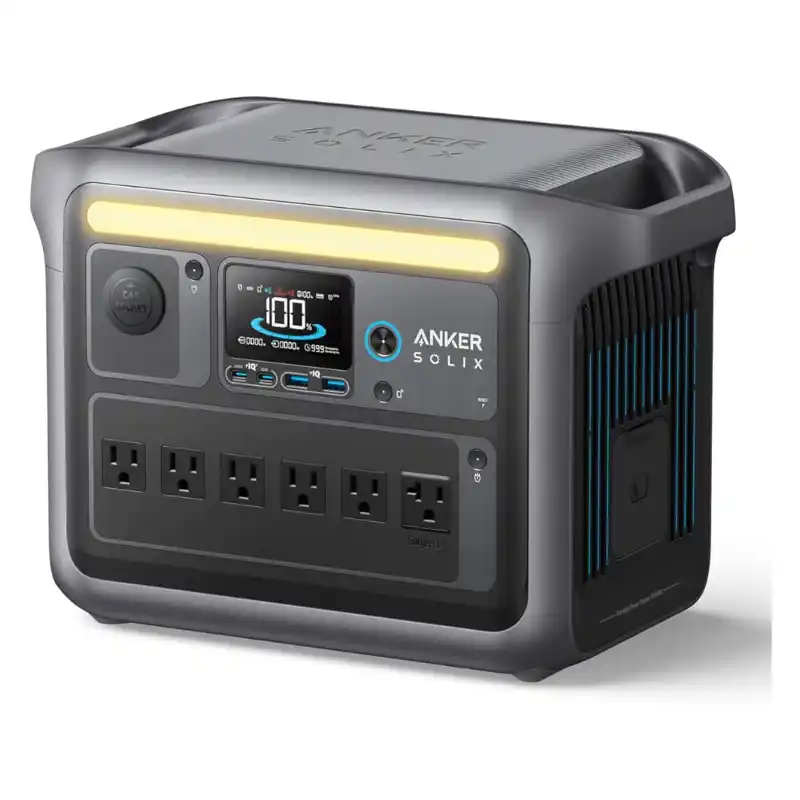
Anker SOLIX C1000 Review

The Anker SOLIX C1000 holds 1,056Wh behind an 1,800W inverter and loses just 0.7% of its charge per hour on standby, the lowest figure in its class. Inverter distortion measures 0.8%; it’s an expansion battery that sits in the entry-price tier with exceptional value.
My Quick Verdict
Most reviews of a unit this size open with capacity. With the SOLIX C1000, the number worth opening on is 0.7%, because that is how much charge it loses per hour sitting idle with its inverter awake.
That is the lowest standby loss I have on record in the High-Demand Utility Class, and it changes the unit’s purpose. This is a Mid-Size All-in-One you can charge, put in a cupboard, and still find useful months later.
It also has the cleanest inverter output measured here, at 0.8% distortion, and it accepts an expansion battery.
Then there are the fans. Fifty-nine decibels, the loudest reading in this class, and a crossover slow enough that it barely qualifies as backup at all.
Best for: Emergency Home Resilience for households that want a unit stored ready rather than running, and Remote Work or DIY where noise is irrelevant.
Not for: bedrooms, tents, or protecting anything that cannot survive a sixteen-millisecond gap.
Key Stats
| BadgeStat | Stats |
| Battery Chemistry and Longevity | LiFePO4 | 3,000 Cycles |
| Continuous AC Power Output | 1,800W AC | 2,600W Peak |
| Energy Storage Capacity | 1,056Wh | 910Wh Usable |
| Rapid AC Wall Recharge | 1,350W Input | Adjustable Speed |
| Uninterrupted Emergency Backup | 16.1ms UPS | Manual Arm |
| Maximum Solar Input and MPPT | 600W Solar | Built-in MPPT |
| Ultra-fast USB-C Power Delivery | 100W USB-C PD |
| Low-noise Operational Level | 59dB | Loud Under Load |
| Modular Capacity Expansion | Expandable | Extra Battery Port |
| Smart App Remote Control | Wi-Fi + Bluetooth App |
Introduction
A power station bought for emergencies spends almost all its life doing nothing. That is the job. It sits in a cupboard through months of ordinary weather, waiting for one bad night.
Which makes standby behaviour the specification nobody advertises and everybody should check. A unit that quietly loses two or three percent an hour is not full when you reach for it, however impressive its capacity looked in the shop.
The SOLIX C1000 loses 0.7% per hour. Its cells are lithium iron phosphate with a 3,000-cycle rating and five years of coverage. Used hard once a day, that is about 8 years before capacity settles at 80%.
What It Can Actually Run
The inverter sustains 1,800W and peaks at 2,600W. Sustained output covers what runs; the peak covers the fraction of a second when a motor engages.
Rated capacity reads 1,056 Wh, and metering the outlets returned 910 Wh, an 86.1% result. All figures below use 910Wh.
- Full-size refrigerator at 150W: around six hours.
- CPAP at 40W, humidifier switched off: a shade under 23 hours.
- Starlink dish at 50W: a little over 18 hours.
- Laptop at 70W: about thirteen complete refills.
Waveform quality is the standout. Distortion measured at 0.8%, less than half the class average, and voltage was held at 121. For medical equipment or sensitive electronics, this is as clean as this category gets.
Charging and Smart Features
Mains charging reaches 1,350 W, with the rate adjustable in steps.
Solar reaches 600W over an 11- 60 V range at 12.5 A, and with good sun, empty-to-full takes about 2.5 hours.
Crossover took 16.1 milliseconds, inside the safety line but not by much, and the inverter does not self-arm. Panels can stay connected indefinitely, and loads can run while charging, though this unit will not accept mains and solar power simultaneously.
Price tier entry, value tier exceptional. On cost per watt-hour, it argues well for itself.
Charging Speed Benchmarks
Recharge performance for the Anker SOLIX C1000 against the 1,000Wh to 1,999Wh capacity class, using the 30 machines in our charging database. The bracket averages 1,085W of mains input and 641W of solar. The three bands are set inside this class, ranking the unit against similar capacities and nothing beyond.
Wall charging is the stronger side. 1,350W clears both the 1,085W bracket average and the 1,300W threshold, so it takes a High rating, and it fills the 1,056Wh pack in around 0.8 hours with the rate adjustable below that. Inputs in this bracket run from 200W to 2,400W. For a machine whose whole design is about waiting in a cupboard and still being full, a quick grid recharge is the input that matters most, and this is a genuinely good figure.
Panels are where it gives ground. 600W sits just below the 641W bracket average, which holds an Average rating in a bracket whose ceiling is 1,400W, and needs roughly 1.8 hours of ideal sun to refill the pack. The larger problem is that mains and solar cannot run at the same time on this unit, so there is no combined rate to fall back on and no way to shorten a solar day with a partial grid top-up. Charging here is one channel or the other, chosen each time.
Planning to run mostly on panels? The Dabbsson 1000 Pro takes 1,200W of solar at 25 amps, double the C1000's ceiling and the most generous current allowance in this bracket, filling a 1,024Wh pack from panels in about 0.9 hours. Its own weakness is a 3.6% hourly standby drain, so treat it as a working solar machine rather than a standby unit.
Real Capacity: What You Actually Get
A rated capacity describes cells. What you can actually spend is smaller, and the difference is heat.
Metered at the outlet, the C100 delivered 910 Wh of its rated 1,056 Wh, or 86.1%. On the twelve-volt side, it did even better, at 946 Wh, an 89.5% return.
That DC figure is worth noticing. Nearly 4% more energy reaches a 12-volt fridge via the car socket than via an outlet, so if you are running DC gear, run it on DC.
Standby is where this unit truly excels. Inverter awake, nothing connected; it sheds around 0.7% per hour, and on the DC side, the meter registered no measurable loss.
My takeaway: 910 Wh is your working figure for AC, and 946 Wh for DC. But the number to remember is 0.7% an hour, because it means this unit is still nearly full after a month in a cupboard.
Power Output and Surge: What It Can Turn On
Sustained output and peak output solve different problems, and buyers who conflate them end up with a large battery that trips.
At 1,800W sustained, the C1000 sits in the middle of its class. At 2,600W peak, it has enough reserve to handle a refrigerator compressor drawing roughly 1,200W at startup, though it has less spare capacity than units offering 3,600W.
The most interesting output number is the distortion at 0.8%. Most units in this class land between 1.5% and 2%, and a few are not measured at all.
Low distortion means the waveform coming out of the inverter closely resembles that of a wall socket. For a CPAP motor, a laptop supply, or audio equipment, that is worth more than another few hundred watts of surge.
Real Appliance Runtimes
Here is 910 Wh converted to hours, using the appliance draws applied to every unit on this site.
| Appliance | Power Draw | Runtime | What That Means |
| Full-size refrigerator | 150W | About 6.1 hours | An evening covered, stretching further as the compressor rests. |
| CPAP machine (no humidifier) | 40W | About 22.8 hours | Two nights, and the cleanest waveform here to run it on. |
| Starlink dish | 50W | About 18.2 hours | A day of remote work with the evening spare. |
| Pellet grill or smoker | 100W | About 9.1 hours | A brisket from first light to dinner. |
| Laptop (70W) | 70W | About 13 recharges | Via the 100W USB-C port. |
Run twelve-volt gear off the car socket rather than through an inverter and adapter, and you gain nearly 4% more energy. On this unit, that difference is larger than on most.
Recharging: Wall and Solar
From a Wall Outlet
A household socket feeds the C1000 up to 1,350W, with the rate steppable rather than fixed.
That fills an empty pack in a little under an hour, which is quick enough for storm preparation. It is not the fastest figure in this class, but the gap only matters if you are routinely caught with less than an hour’s warning.
From Solar Panels
Panel input reaches 600W between 11 and 60 volts at 12.5 amps. Middling for the class, though the wide low-voltage entry point means small foldable panels work well.
A clear sky brings an empty pack back in roughly two and a half hours.
Solar may stay plugged in permanently, and the unit will power something while it charges.
One notable omission: dual charging is not supported. Mains and solar cannot feed it simultaneously, so you choose one or the other. Most units at this price accept both, and on a cloudy day when you want the wall to make up the shortfall, its absence is felt.
Blackout Backup: The Part I Care About Most
This is the weakest thing about the unit, and it is worth being blunt about.
Crossover measured 16.1 milliseconds. The conventional safety threshold is 20, so it passes, but the units I would call genuinely good sit below 11, and several are under 9.
There is no self-arming inverter either. Somebody has to have armed it beforehand and left it armed for that crossover figure to do any work.
At 0.7% per hour, the standby cost of leaving it armed is lower than that of almost any rival, which softens the problem. It does not remove it.
Why this matters to me: sixteen milliseconds is the range where results become equipment-dependent. Some desktops ride through it,t and some do not, and you find out during the outage rather than before it.
Noise and Living With It
Fifty-nine decibels under load. That is the loudest measurement in this class, and it is not marginal.
The practical translation is a unit you can hear through a closed door. Working in the same room is tiring, sleeping in it is not realistic, and taking it into a tent would be antisocial.
Against that, it is light. Twenty-eight pounds, 12.7 kilograms, comfortably one-handed for short distances and among the more portable units at this capacity.
The app runs on both Wi-Fi and Bluetooth, so it can be monitored from elsewhere in the house and still controlled off-grid where there is no network to lean on.
Where It Falls Short
Three real weaknesses, and one of them is loud enough to hear from another room.
1. The Fans Are the Loudest in the Class
Fifty-nine decibels rule out an entire category of use. Bedrooms, tents, RVs, home offices; anywhere quiet matters.
This is the specification most likely to make a buyer regret the purchase, because it is invisible on a spec sheet and unmissable the first time the unit runs under load at night.
2. Crossover Is Slow, and the Inverter Does Not Self-Arm
Sixteen milliseconds passes the safety threshold but leaves no margin, and results at that speed vary by equipment. Some desktops reboot,t and some do not.
Combined with the missing auto-on mode, this is not a unit I would put in front of a NAS drive or a home server. For a fridge, a router,er or lighting, it is entirely adequate.
3. No Dual Charging
Mains and solar cannot run simultaneously. On an overcast day, when you want the wall to cover what the panels aren’t delivering, you have to choose one.
Most units at this price accept both inputs simultaneously, making this a genuine feature gap rather than a rounding difference.
4. Fewest Cycles in the Comparison Set
Three thousand cycles against the 3,500 and 4,000 offered by close rivals. Still, roughly eight years of daily cycling, and most owners will never approach it.
Across a decade, though, the shortfall is real, and this is the single line on the spec sheet where the C1000 trails every rival on this page.
How It Compares
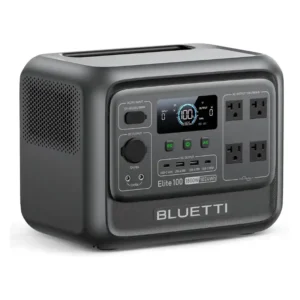
Two natural comparisons. The Bluetti Elite 100 V2 is the closest rival on price and capacity, and the Bluetti AC180 is the other capacity-per-dollar contender.
| Feature | Anker SOLIX C1000 | Bluetti Elite 100 V2 | Bluetti AC180 |
| Price Tier | Entry | Entry | Mid-range |
| Value Tier | Exceptional | Exceptional | Exceptional |
| Rated Capacity | 1,056Wh | 1,024Wh | 1,152Wh |
| Usable (Tested) | 910Wh (86%) | 890Wh (86%) | 990Wh (86%) |
| Idle Drain Per Hour | 0.7% | 1.0% | 1.2% |
| Inverter Distortion | 0.8% | 1.7% | 1.8% |
| UPS Switchover | 16.1ms | 8.7ms | 8.7ms |
| Auto-on Inverter | No | Yes | No |
| Fan Noise | 59dB | 51dB | 54dB |
| Expansion Battery | Yes | No | No |
The Elite 100 V2 beats the C1000 on the two things that define emergency backup: it crosses over in half the time, and its inverter arms itself. It is also eight decibels quieter, which is the difference between usable and unusable in a bedroom.
What the C1000 offers is lower standby loss, a cleaner waveform, and an expansion port the Elite will never have. If your unit spends its life stored and you expect to grow the system, those are the right things to win on.
The AC180 offers more usable capacity than either, but it shares the C1000’s manual-arm limitation and has a much weaker solar input. Between the two, the C1000’s expansion port and standby behaviour are worth more than the AC180’s extra eighty watt-hours.
Here’s a list of the most popular specific comparisons
Who Should Buy It, and Who Should Skip It
Buy It If
- The unit will be stored charged and used rarely. Nothing here holds a charge better.
- You run medical or sensitive electronics and want the cleanest waveform available at this price.
- You want to add an expansion battery later without paying a higher price tier now.
- It will live somewhere noise does not matter: a garage, a workshop, a truck.
Skip It If
- It needs to run where anyone is sleeping or working quietly.
- You are protecting a desktop, NAS, or server. Sixteen milliseconds is too close to the line.
- You want to charge from mains and solar simultaneously.
- Maximum cycle life is your priority. Rivals offer 3,500 or 4,000.
The Bottom Line
The SOLIX C1000 is built for a unit that waits. Standby loss of 0.7% an hour and the cleanest inverter output in this class are exactly the qualities that matter when a power station spends months doing nothing between emergencies.
It is not built for a unit that has to react. A 16-millisecond crossover on a manually-armed inverter is adequate for a fridge and marginal for anything with a processor.
And it is loud. Fifty-nine decibels is the specification that will decide this purchase for most people, long before anything else comes up.


There are no reviews yet.