

Measured capacity, weight, switchover speed, and expansion support for the Anker SOLIX C1000 and Bluetti AC180. See which 1kWh unit fits your setup.
Summary
-
- Overview
- Review
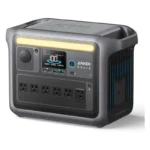
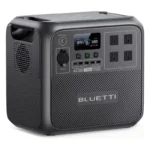
Portability Against Capacity
These two are cross-shopped by buyers weighing a lighter, expandable machine against a larger, quieter one, and the trade is unusually clean.
The Anker is nine pounds lighter and accepts an expansion battery. The Bluetti holds 80 more usable watt-hours, runs 5 dB quieter, and delivers power twice as fast when the grid fails.
Both use lithium iron phosphate cells, and the LiFePO4 solar generator lifecycle question favors the Bluetti slightly: 3,500 rated cycles against 3,000.
Tested Specifications Side by Side
| Measurement | Anker SOLIX C1000 | Bluetti AC180 |
| Rated Capacity | 1,056Wh | 1,152Wh |
| Usable Through AC (Tested) | 910Wh – 86.1% | 990Wh – 85.9% |
| Usable Through DC (Tested) | 946Wh – 89.5% | 981Wh – 85.2% |
| Continuous AC Output | 1,800W | 1,800W |
| Surge Output | 2,600W | 2,400W |
| Blackout Switchover | 16.1ms measured | 8.7ms measured |
| Self-arming Inverter | No | No |
| Pure Sine Wave Distortion (THD) | 0.80% | 1.80% |
| Standby Drain Per Hour | 0.7% | 1.2% |
| Max Wall Charging | 1,350W | 1,440W |
| Dual Charging (AC + Solar) | Not supported | 1,440W |
| Maximum Solar Input | 600W, 11–60V, 12.5A | 500W, 12–60V, 10A |
| USB-C Output | 100W | 100W |
| 12V Car Socket | 138W | 129W |
| Expansion Battery | Supported | Not supported |
| Cell Chemistry and Cycles | LiFePO4, 3,000 | LiFePO4, 3,500 |
| App Connectivity | Wi-Fi and Bluetooth | Bluetooth only |
| Fan Noise Under Load | 59dB | 54dB |
| Weight | 28 lbs | 37 lbs |
Weight and the Expansion Path
These two factors are linked, and together they make the strongest case for the Anker.
- The Anker weighs 28 pounds, while the Bluetti weighs 37. Nine pounds is the difference between a comfortable one-handed carry and a deliberate two-handed lift.
- The Anker accepts an expansion battery, so capacity can roughly double later without replacing the electronics.
- The Bluetti has no expansion support at all. Its 1,152Wh is a permanent ceiling, and growing the system means buying a second complete machine.
For a camper, an overlander, or anyone who might scale up, that combination is decisive. The Bluetti’s extra capacity today is smaller than what an expansion battery would add tomorrow.
Real Usable Capacity After Conversion Losses
Neither machine delivers its rated figure. Both lose roughly 14% to AC inverter conversion efficiency losses, which is normal for this class.
- Through the AC outlets:990 Whh from the Bluetti, 910 Whh from the Anker. An 80Wh advantage to the Bluetti.
- Through DC, the gap narrows to 35 Wh (981 Wh vs. 946 Wh) because Anker’s 89.5% DC return is one of the better figures at this capacity, while Bluetti’s is average.
- On a 150W refrigerator that is about six hours thirty-five from the Bluetti against six hours five from the Anker.
If your loads run on twelve volts, the difference between these two nearly disappears. If they run on AC, the Bluetti holds a real half-hour advantage.
Blackout Switchover and Waveform Quality
The two machines split these categories between them, and which matters more depends entirely on what you are protecting.
The Bluetti AC180 completes the handover in 8.7 milliseconds, comfortably within the sub-11ms band where a transfer is genuinely reliable. The Anker SOLIX C1000 takes 16.1 milliseconds, clearing the 20ms line but leaving little margin.
The Anker answers with waveform quality: 0.80% distortion versus Bluetti’s 1.80%, less than half. For a CPAP motor, audio equipment, or a workstation, that is the more relevant number.
Neither power station has its own inverter, so both protect only an occupied house.
Put simply: the Bluetti catches the outage faster; the Anker delivers cleaner power once it has. For a desktop, take the Bluetti. For sensitive medical equipment that runs continuously, use the Anker.
Charging and Solar Infrastructure
- Wall charging is close: 1,440W on the Bluetti against 1,350W on the Anker.
- Dual charging is not. The Bluetti runs mains and panels together at 1,440W; the Anker does not support it at all.
- Maximum solar input wattage favors the Anker at 600W over the Bluetti’s 500W, though the Bluetti’s 10-amp ceiling is the tighter current limit of the two.
- Both accept a 1-12 to 60-volt window, so VOC limits are effectively identical, and the same panels suit either. Neither will take a long series string.
- Both support pass-through charging capabilities, and both can leave an array connected around the clock.
Noise, Apps and Living With Them
- The Bluetti measures 54dB under load, compared to the Anker’s 59dB. Neither is quiet enough for a bedroom, but the Bluetti is noticeably more tolerable in a hallway or a living room.
- The Anker’s smart app energy management system runs over Wi-Fi and Bluetooth. The Bluetti offers Bluetooth only, so it cannot be checked from elsewhere in the house.
- Standby drain favors the Anker at 0.7% per hour against 1.2%, so for a machine stored charged for months, the Anker holds its state better.
- The Bluetti has a 3,500-cycle rating versus 3,000, and both come with five-year warranties and telephone support.
Which One Should You Buy?
The Anker SOLIX C1000 scores higher overall at 7.6 compared to the Bluetti AC180’s 7.2, driven by its stronger inverter efficiency, portability, expandability, and smart connectivity.
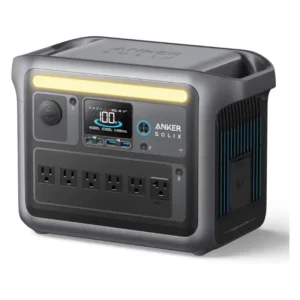
The AC180 counters with faster UPS switchover, lower noise, and a longer rated battery cycle life. If you value efficiency and a lighter, expandable system, the C1000 is the better choice.