
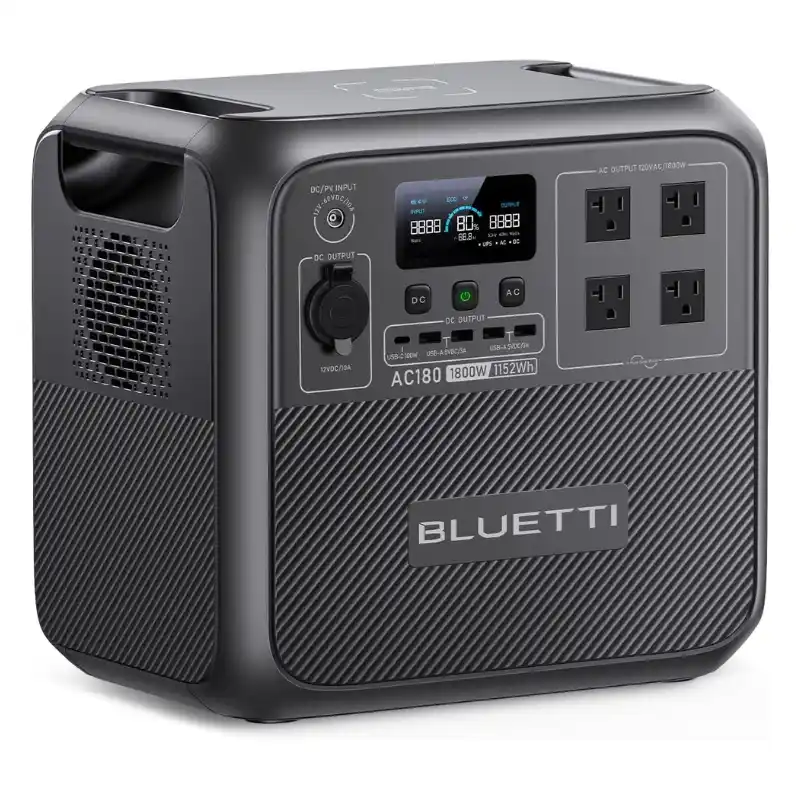
Bluetti AC180 Review

The Bluetti AC180 wraps 1,152 Wh of 3,500-cycle lithium iron phosphate around an 1,800 W inverter and crosses over in 8.7 milliseconds when the grid drops. Wall charging reaches 1,440W. It lands in the mid-range price tier while delivering exceptional value per watt-hour.
My Quick Verdict
The AC180 is a Mid-Size All-in-One unit in the High-Demand Utility Class, and it is the clearest example on this site of a manufacturer choosing where to spend and where to stop.
What it spends on is the part that keeps food cold. Capacity is generous for the money, wall charging is quick, and the crossover when the grid dies is among the fastest anywhere at this size.
What it stops short of is everything around that. No expansion port. No self-arming inverter. Bluetooth but no Wi-Fi. Solar input is less than half of what its rivals accept.
Whether that is a bargain or a false economy depends entirely on how long you plan to own it.
Best for: Emergency Home Resilience, where someone is home to switch the unit on and where capacity per dollar is the deciding factor.
Not for: unattended backup, serious solar, or anyone who expects the system to grow.
Key Stats
| BadgeStat | Stats |
| Battery Chemistry and Longevity | LiFePO4 | 3,500 Cycles |
| Continuous AC Power Output | 1,800W AC | 2,400W Peak |
| Energy Storage Capacity | 1,152Wh | 990Wh Usable |
| Rapid AC Wall Recharge | 1,440W Input | Adjustable Speed |
| Uninterrupted Emergency Backup | 8.7ms UPS | Manual Arm |
| Maximum Solar Input and MPPT | 500W Solar | Built-in MPPT |
| Ultra-fast USB-C Power Delivery | 100W USB-C PD |
| Low-noise Operational Level | 54dB | Audible Under Load |
| Modular Capacity Expansion | Not Supported |
| Smart App Remote Control | Bluetooth Only |
Introduction
There is a version of this purchase where you buy the most watt-hours your budget allows and accept whatever comes attached. The AC180 is built for exactly that buyer.
It offers more capacity than most units at its price and delivers a genuinely useful share of it. Everything else on the specification sheet was clearly negotiated down to reach that point.
Inside sit lithium iron phosphate cells, good for 3,500 charge cycles, backed by five years of coverage. At one cycle per day, that is, service into the mid-2030s before capacity drops to 80%.
What It Can Actually Run
The inverter has a continuous rating of 1,800W and peaks at 2,400W. Note the second figure. Most units at this size offer 3,600W of headroom, and the AC180 gives you a third less.
Capacity is quoted at 1,152Wh. Metered at the outlet, it returned 990 Wh, an 85.9% result. Everything below is worked from 990Wh.
- Full-size refrigerator at 150W: roughly 6.5 hours.
- CPAP running without its humidifier at 40W: close to 25 hours, two nights with room over.
- Starlink dish at 50W: about 20 hours.
- Laptop at 70W: about 14 complete refills.
The waveform measured 121 volts with 1.8% distortion, both of which are within safe limits for sensitive equipment.
Charging and Smart Features
Maximum charging reaches 1,440 W, and the rate steps up and down quickly for this price, which is one of the unit’s genuine strengths.
Solar is the opposite story. The ceiling is 500W across a 12- to 60-volt window at 10 amps, roughly half of what comparable units accept, and it caps how fast you can recover off-grid.
Crossover took 8.7 milliseconds, which is excellent, but the inverter will not arm itself. Someone has to switch it on beforehand, or nothing gets caught.
The price tier is mid-range; the value tier is exceptional. Capacity per dollar is the whole case for this unit, and the rest of this review is about what funding that cost elsewhere.
Charging Speed Benchmarks
Charging benchmarks for the Bluetti AC180 set against the 1,000Wh to 1,999Wh capacity class, drawn from all 30 machines in our database rather than only the reviewed subset. The class averages 1,085W on mains and 641W on panels, with each band a tercile inside that group.
Wall charging is genuinely quick. 1,440W is a third above the 1,085W class average and past the 1,300W threshold for a High rating, which against a 1,152Wh pack works out at roughly 0.8 hours from flat, one of the shortest full-recharge times at this capacity. The class spans 200W to 2,400W. For a machine bought to sit ready and take over in 8.7 milliseconds, being able to refill it inside a single hour before a storm lands is the input figure that matters most.
Panels are ordinary by comparison. 500W is under the 641W class average yet still records Average in a field whose ceiling is 1,400W, and it refills the pack in about 2.3 hours of strong sun, nearly three times the wall socket time. That is fine for topping up on a long weekend and thin for running the machine off-grid, so plan on the socket doing the heavy lifting and panels covering the gaps.
Want an array that can actually keep up? The Montek X1200 takes 1,200W of solar through a 150-volt window, more than double the AC180 and wide enough for a five or six panel series string of cheap third-party rigid panels. A 1,280Wh pack refills from the array in roughly 1.1 hours. Mains charging drops to 1,200W, so this is the swap when daylight rather than the grid is doing the work.
Real Capacity: What You Actually Get
The number printed on a power station is a battery measurement. The number that matters is the one that survives the trip to the socket.
On the AC180, that trip costs about 14%. Metered output came to 990 Wh of the rated 1,152 Wh, an 85.9% return that clears the line without any drama.
DC finished at 981 Wh, nearly the same at 85.2%. There is no advantage to running twelve-volt gear off the car socket here, which is unusual and worth knowing if that was your plan.
Left idling with the inverter awake and nothing plugged in, it drops about 1.2% an hour. Respectable, and better than several units that cost more.
My takeaway: 990 is the working figure and the reason to buy this unit. Very little at this price puts that much usable energy in your hands.
Power Output and Surge: What It Can Turn On
Continuous output tells you what the unit sustains. Surge tells you what it survives for a fraction of a second. On the AC180, the second number deserves attention.
At 2,400 W, the surge ceiling is noticeably tighter than the 3,600 W offered by most rivals. A refrigerator compressor demanding around 1,200W at startup still fits comfortably, so ordinary home backup is unaffected.
Where it bites is running two things at once. A fridge that kicks in while a microwave is already drawing power puts you closer to that ceiling than you would be on a unit with more reserve.
For a single appliance, this is not an issue. For a kitchen circuit during an outage, size the load list carefully.
Real Appliance Runtimes
Here is 990 Wh expressed in hours; against the fixed appliance draws, this site applies to every unit.
| Appliance | Power Draw | Runtime | What That Means |
| Full-size refrigerator | 150W | About 6.6 hours | An evening and then some, longer once the compressor starts resting. |
| CPAP machine (no humidifier) | 40W | About 24.8 hours | Two nights with a margin left over. |
| Starlink dish | 50W | About 19.8 hours | A working day and the evening after it. |
| Pellet grill or smoker | 100W | About 9.9 hours | A full cook without watching the gauge. |
| Laptop (70W) | 70W | About 14 recharges | Off the 100W USB-C port. |
That fridge figure is the strongest thing on this page. Half an hour to an hour longer than most kiduringwatt-hour units manage, and in a genuine outage, the comeven furthert cycles push it further still.
Recharging: Wall and Solar
From a Wall Outlet
Plugged into a household socket,t the AC180 draws up to 1,440W, filling an empty pack in well under an hour.
That is fast for this price bracket, and the stepped rate control means you can dial it back for an unhurried overnight charge that is easier on the cells. When a warning gives you an hour of notice, this is the specification that matters.
From Solar Panels
Here the compromises show. The panel in-topV range 0-60 volts at 10 amps.
Ten amps is the constraint worth understanding. It has a narrow current ceiling that limits both how many panels you can run and which ones will work, putting this unit behind rivals that accept twice the wattage at the same price.
Under a clear sky, a full refill still lands around two and a half hours because the pack is not enormous. But on an overcast day, or through a partially shaded morning, you recover far more slowly than a 1,000W input would.
Panels can stay wired permanently, and loads run while charging. Mains and sun together take 1,440W.
Blackout Backup: The Part I Care About Most
The AC180 gets half of this right and misses the other half, and the half it misses is the one that counts.
Crossover measured 8.7 milliseconds, genuinely fast and well inside the 11-millisecond mark that separates good from adequate. A computer or router will not notice the grid disappearing.
But the inverter has no self-arming mode. It has to be switched on and left running, bleeding that 1.2% an hour, or the outage passes it by entirely.
So you choose between a unit that bleeds charge while it waits and one that isn’t actually protecting anything.
Why this matters to me: a fast crossover on a manually armed inverter is a specification that reads well and protects nothing. If you are buying because of a NAS drive or a desktop, this is the wrong unit.
Noise and Living With It
The fans reach 54dB under load, which is above the level I would tolerate in a room where someone is sleeping.
In practice, that is a clear mechanical presence rather than a hum you stop noticing. Fine in a hallway, a garage,e or a basement. Not fine beside a bed.
Weight is 37 pounds (17 kilograms), which is heavy for 1,152 WhWh. Comparable power stations in the same capacity tier weigh around 10 pounds less, and you feel that difference on stairs.
The app connects over Bluetooth only. No Wi-Fi, so no checking the unit from another room or another building, though Bluetooth is the connection that actually works off-grid anyway.
Where It Falls Short
The savings on this unit came from somewhere. Four places, specifically.
1. The Inverter Will Not Arm Itself
There is no auto-on mode. That 8.7-millisecond figure only counts if the inverter was already awake when the grid went.
That forces a choice nobody should have to make: leave it powered and lose 1.2% an hour indefinitely, or leave it off and accept that it will not catch an outage. For unattended backup, this alone disqualifies it.
2. Solar Input Is Half the Class Standard
Five hundred watts at 10 amps, where rivals at the same price accept 1,000W or more.
For occasional foldable-panel use, that is adequate. For multi-day off-grid work, or anywhere you rely on the sun to keep pace with consumption, it is a hard ceiling that no accessory can lift.
3. No Expansion, Ever
The AC180 takes no expansion battery. The capacity you buy is permanent.
Given that it is otherwise a sensible home backup unit, this is the specification most likely to cause regret two years in, when the answer to needing more turns out to be buying a second complete power station.
4. Heavy, Loud, and Bluetooth Only
Thirty-seven pounds for 1,152 Wh is poor by class standards; 54dB rules out bedroom use; and Bluetooth-only connectivity means no remote monitoring from elsewhere in the house.
None of these is a dealbreaker on its own. Together, they describe a unit that is less pleasant to live with than its capacity figure suggests.
How It Compares
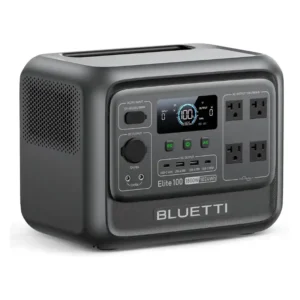
Two comparisons make the trade clear. The Bluetti Elite 100 V2 comes from the same maker at a lower price point, and the Anker SOLIX C1000 is the closest direct rival in terms of capacity and price.
| Feature | Bluetti AC180 | Bluetti Elite 100 V2 | Anker SOLIX C1000 |
| Price Tier | Mid-range | Entry | Entry |
| Value Tier | Exceptional | Exceptional | Exceptional |
| Rated Capacity | 1,152Wh | 1,024Wh | 1,056Wh |
| Usable (Tested) | 990Wh (86%) | 890Wh (86%) | 910Wh (86%) |
| Surge Output | 2,400W | 3,600W | 2,600W |
| UPS Switchover | 8.7ms | 8.7ms | 16.1ms |
| Auto-on Inverter | No | Yes | No |
| Solar Input | 500W | 1,000W | 600W |
| Fan Noise | 54dB | 51dB | 59dB |
| Expansion Battery | No | No | Yes |
The Elite 100 V2 is an uncomfortable comparison because it comes from the same manufacturer, sits a price tier lower, and beats the AC180 on surge headroom, solar input, fan noise, and the auto-on inverter. What the AC180 offers in return is roughly a hundred more usable watt-hours.
If you want a hundred extra watt-hours more than you want any of those four things, buy the AC180. That is a narrower case than it first appears.
Against the Anker SOLIX C1000, the AC180 wins in capacity, crossover speed, and quiet operation, but loses in expansion support and weight. Neither self-arms, so neither is a real unattended backup unit.
Here’s a list of the most popular specific comparisons
Who Should Buy It, and Who Should Skip It
Buy It If
- Usable watt-hours per dollar is the specification you are optimising for.
- Somebody is normally home, so a manually armed inverter is not a problem.
- Wall charging matters more to you than solar, because you are planning for storms rather than off-grid trips.
- The unit will be located in a hallway, basement, or garage rather than a bedroom.
Skip It If
- You need the unit to catch an outage while the house is empty.
- Solar is your main recharge route. The 500W ceiling cannot be lifted.
- You expect to add capacity later.
- You will be carrying it any distance, or running it where someone sleeps.
The Bottom Line
The AC180 is a capacity play, and on that measure, it delivers. Nearly a thousand usable watt-hours at this price is a genuinely strong offer, and the fast crossover and quick wall charging are real.
But the savings came from somewhere, and where they came from is what decides whether a power station is still the right tool in year three. No expansion. No self-arming. Half the solar input of its rivals.
Buy it knowing exactly what you are getting: a big, plain battery that charges fast and does very little else. On those terms,s it is honest value. On any other terms, its own stablemate,te the Elite 100 V2, is the better purchase.


There are no reviews yet.