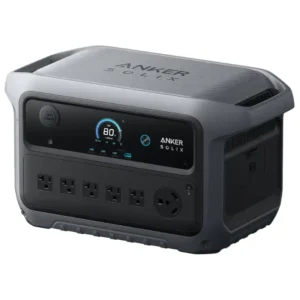
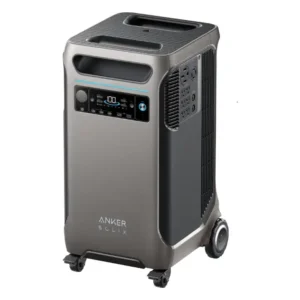
The Anker SOLIX C2000 Gen 2 stores 2,048Wh behind a 2,400W inverter, crosses over in 7.2ms with a self-arming inverter, and loses only 0.41% of its charge per hour idle, both the best figures in this dataset. Cells rate at 4,000 cycles and sit in the upper-mid-range price tier at exceptional value.
Backup power fails in two ways, and this unit posts the best figures in the dataset for both: 7.2 milliseconds to take the load, the quickest crossover recorded here, and 0.41% per hour on standby, the lowest idle drain I have measured anywhere. These are the numbers that determine whether a power station is actually protecting your equipment. A fast crossover is useless if the battery has drained itself in storage, and a full battery is useless if the handover takes too long.
It also arms itself automatically, which most units in this dataset cannot do, so there is no configuration to remember. Add 4,000 cycles, 0.60% distortion, 44 decibels, 41 pounds, and 1,760Wh delivered from a 2,048Wh battery, and the package earns an exceptional value rating. The flagship, which this unit outperforms on those measures, only reaches the good tier.
The one limitation is specific: the solar panels cannot remain connected continuously. That rules out a permanently wired solar array, but little else. If your solar setup is roof-mounted, look elsewhere. For everything else at this capacity, this is the power station I would buy.
Battery safety and chemistry (LiFePO4, 4,000 cycles)
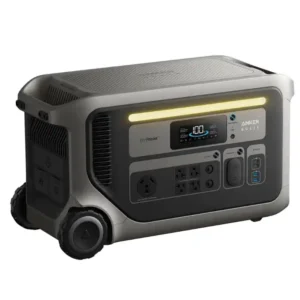
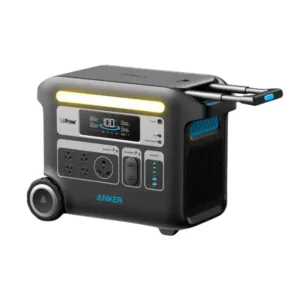
The Anker SOLIX F3000 holds 3,072Wh behind a 3,600W inverter and accepts 2,400W of solar, including a path reaching 165 volts that permits a real series string. It returns 91% through DC, charges at 3,840W from the wall, and sits in the upper mid-range price tier at exceptional value.
The reason to buy this machine is a number most buyers never look at: its upper solar input accepts 165 volts, where the majority of this field stops at 60. That is the difference between wiring two rigid panels in series and wiring five or six in series: lower current for the same power, thinner cable over a long run from a roof, and less energy lost warming the copper. Around it sits a genuinely strong package: 3,600 watts sustained, 2,760Wh delivered from a 3,072Wh pack, 91% through a 440-watt DC port, 4,000-cycle cells, and mains charging at 3,840 watts that refills the whole thing in under an hour; all at an exceptional value tier. What holds it back is the failure that has recurred through this entire dataset: it hands over in 9.8 milliseconds and then needs somebody to have switched the inverter on first. Its 0.66% hourly standby drain is low enough that leaving it armed costs almost nothing, which makes this the most forgivable version of that flaw I have reviewed. It is still a habit rather than a guarantee, and at 91 pounds,s this is a machine you install once and leave.
Battery safety and chemistry (LiFePO4, 4,000 cycles)
9.5
Real-world efficiency and output (89% AC, 91% DC, 0.66% idle)
9.5
UPS and EPS switchover (9.8ms, no self-arming)
7.5
Port selection and distribution (100W USB-C, 440W DC)
8.5
Solar charging and MPPT (2,400W across dual paths, 165V ceiling)
10
AC recharge speed (3,840W mains and dual)
9.5
Noise and thermal management (53dB)
7
Portability and build quality (91 lbs)
4
Expandability and ecosystem (expansion support)
9.5
Smart app and interface (Wi-Fi and Bluetooth)
8.5
PROS:
A solar path reaching 165 volts, high enough for a five- or six-panel series string.
Mains charging at 3,840W, among the fastest recorded, refilling three kilowatt-hours in under an hour.
Delivers 91% through DC via a 440W app-controlled port, enough for real twelve-volt loads.
Standby loss of 0.66% an hour, low enough that leaving it armed costs almost nothing.
A 3,600W sustained inverter at the top of its class, with 7,200W of surge.
Cells rated to 4,000 cycles under five years of cover, at an exceptional value tier.
CONS:
The inverter cannot wake itself, so protection depends on somebody having armed it.
Ninety-one pounds, a two-person lift, and twenty-eight heavier than its direct rival.
A single 100W USB-C port where cheaper machines now fit two at 140W.
Electrical noise above 2,000 mV is at the high end of this field.
Fifty-three decibels, where quieter machines exist at lower output.
Both solar paths are capped at 17 amps, so the design favors voltage over current.
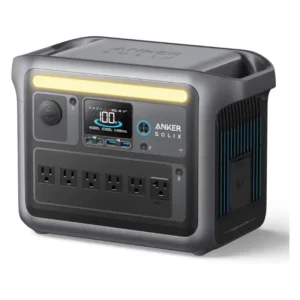
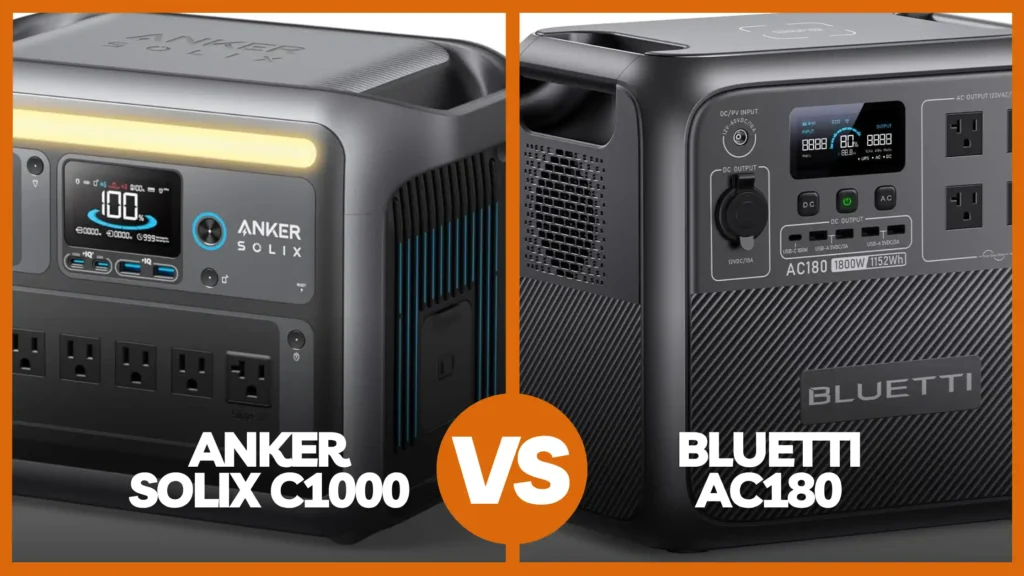
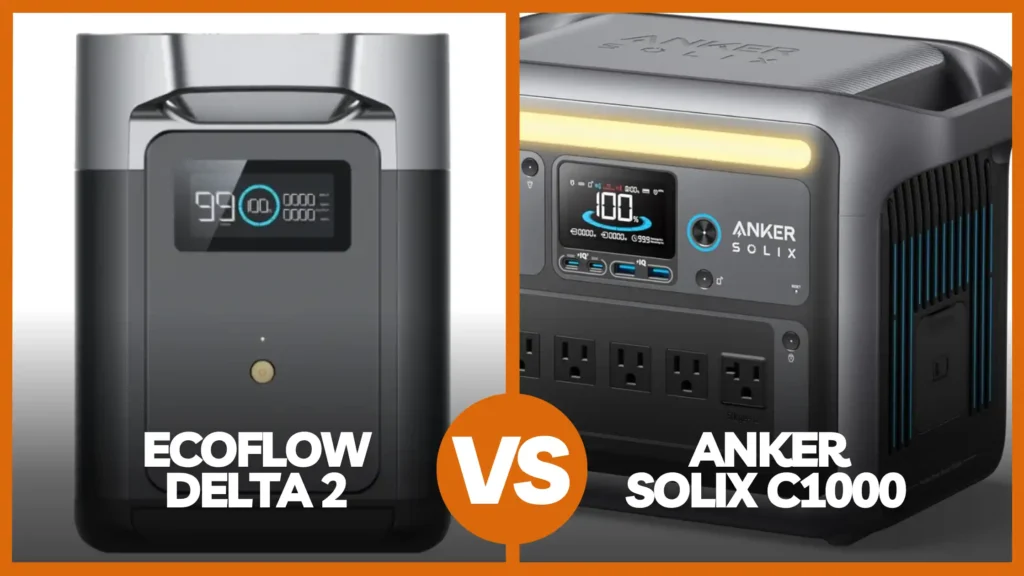
The Anker SOLIX C1000 holds 1,056Wh behind an 1,800W inverter and loses just 0.7% of its charge per hour on standby, the lowest figure in its class. Inverter distortion measures 0.8%; it's an expansion battery that sits in the entry-price tier with exceptional value.
This is a unit designed for the years it spends waiting rather than the hours it spends working, and on those terms it is excellent: 0.7% standby loss an hour is the lowest figure I have recorded in this class, meaning it is still close to full after a month in a cupboard, and 0.8% inverter distortion is less than half the class average and the cleanest power here for a CPAP motor or a laptop supply. The sockets gave back 910Wh from a 1,056Wh pack and 946Wh on the twelve-volt side, and it accepts an expansion battery that its closest rivals cannot. The problems are loud and slow. Fifty-nine decibels under load is the noisiest measurement in this class and rules out bedrooms, tents, and quiet offices entirely, and a 16.1-millisecond crossover on an inverter that will not arm itself is too close to the line for a desktop or a NAS. Put it somewhere nobody has to listen to it and where its real job is waiting: a utility room, a workshop, the back of a vehicle. On those terms, very little touches it.
Battery safety and chemistry (LiFePO4, 3,000 cycles)
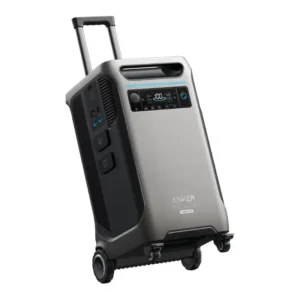
The Anker SOLIX F3800 Plus runs a 6,000W split-phase inverter producing 120V and 240V, delivers 3,270Wh of its 3,840Wh rating, and draws 6,000W from a wall socket. Solar reaches 3,200W across a 165-volt path, and the inverter arms itself.
Anker sells two machines four pounds apart with the same 3,840Wh pack and the same 6,000-watt split-phase inverter, and every difference between them sits on the input side. This one takes 6,000 watts from a wall socket, whereas the standard version takes 1,800; it accepts 3,200 watts of solar at up to 165 volts, compared with 2,400 at 60; it supports pass-through charging, raises its own inverter when the grid drops, and returns five extra points through the DC path at 91%. Behind a 6,000-watt inverter, an 1,800-watt charger is a real bottleneck, so for anything wired into a transfer switch, these specifications determine whether the system keeps up during a storm week. The costs are blunt: 136 pounds in one sealed body that does not come apart, a premium value tier that puts it above its own standard version, 85% conversion and 3,000 cycles that are both the weakest at this capacity, and a 100-watt USB-C port that would look thin on a machine a fifth of the price. Buy this for the installation. The battery inside it is the least impressive thing about it.
Battery safety and chemistry (LiFePO4, 3,000 cycles)
8
Real-world efficiency and output (85% AC, 91% DC, 1.6% idle)
8
UPS and EPS switchover (14.3ms, self-arming)
8.5
Port selection and distribution (100W USB-C, 141W 12V socket)
6.5
Solar charging and MPPT (3,200W across dual 165V channels)
10
AC recharge speed (6,000W mains, pass-through supported)
10
Noise and thermal management (54dB)
6.5
Portability and build quality (136 lbs, single body)
2.5
Expandability and ecosystem (expansion and split-phase pairing)
10
Smart app and interface (Wi-Fi and Bluetooth)
8.5
PROS:
A 6,000W split-phase inverter on 120 and 240 volts, with 12,000W of surge.
Main charging of 6,000W, refilling a 3,840Wh pack in around forty minutes.
A self-arming inverter and pass-through charging, both absent on the standard F3800.
Solar of 3,200W across two independently tracked 165-volt channels.
Delivers 91% through DC, six points better than through the outlets.
Waveform distortion of 1.10%, expansion support, and a phone line behind the cover.
CONS:
One hundred and thirty-six pounds in a single sealed body that does not separate.
Premium value tier, a full tier above its own standard version.
Conversion of 85% at the sockets, the weakest among machines at this capacity.
Cells rated for 3,000 cycles, while rivals here offer 4,000 or 6,000.
A handover of 14.3ms is the slowest reading among machines of this size.
A 100W USB-C port and a 141W car socket, both ordinary at this price.
The Anker SOLIX F2000 delivers 1,850 Wh (90% of its 2,048 Wh rating) and is powered by a 2,400W inverter. It's 270W; the 12-volt socket is the highest-rated car outlet in this data, three USB-C ports deliver 100W each, and the fans operate at 45dB. Upper mid-range price tier, good value.
Nobody compares car sockets, which is exactly why this one is worth pointing at: 270 watts, where the rest of this field sits between 120 and 145, high enough that a compressor fridge, a diesel heater, or a run of vehicle accessories goes straight into the port it was designed for instead of through a breakout cable and an inverter. Around that sits a genuinely capable machine: 1,850Wh delivered from a 2,048Wh pack at 90%, beaten by only two units at this size; three separate 100-watt USB-C ports, which nothing else here offers; and 45 decibels behind a 2,400-watt inverter. The costs are high and specific. Sixty-seven pounds is the largest figure at this capacity anywhere in this data, a 15.1-millisecond handover on a manually armed inverter rules out protecting an empty house, mains and solar refuse to charge it together, and the app speaks Bluetooth with no Wi-Fi behind it. Put it in a van, and it earns its place. Put it in a hallway,y and Anker's own C2000 Gen 2 does the job better for the same money.
Battery safety and chemistry (LiFePO4, 3,000 cycles)
8
Real-world efficiency and output (90% AC, 84% DC, 1.5% idle)
9
UPS and EPS switchover (15.1ms, no self-arming)
6
Port selection and distribution (three 100W USB-C, 270W 12V socket)
8.5
Solar charging and MPPT (1,000W at 20A, no dual charging)
8
AC recharge speed (1,440W, no dual charging)
7.5
Noise and thermal management (45dB)
9.5
Portability and build quality (67 lbs)
4.5
Expandability and ecosystem (expansion support)
9
Smart app and interface (Bluetooth)
6.5
PROS:
A 270W twelve-volt car socket, roughly double the class norm and the highest rating in this data.
Conversion of 90% at the sockets, beaten by only two units at this size.
Three separate 100W USB-C ports, so three devices charge at full rate together.
Fans at 45dB behind a 2,400W inverter, quiet enough for a room adjoining a bedroom.
Solar input of 1,000W at 20 amps, comfortable for rigid panels, with the array able to stay wired.
Expansion is supported, with phone assistance available for five years under warranty.
CONS:
Sixty-seven pounds, the heaviest unit at this capacity, and a two-person lift.
Handover of 15.1ms with no self-arming, which rules out reliable unattended protection.
Mains and solar cannot charge it simultaneously, unlike most rivals at this price.
The app runs on Bluetooth only, so there is no monitoring from elsewhere in the house.
An idle drain of 1.5% per hour is normal, and a week armed costs a quarter of the pack.
No harmonic distortion figure appears in the bench data at all.
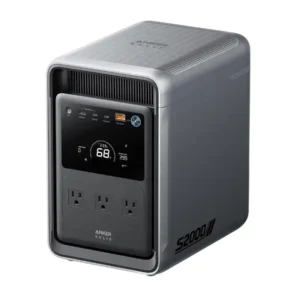
The Anker SOLIX S2000 delivers 1,920Wh of its 2,009Wh rating (a 95% conversion rate, unmatched in this data) and loses just 0.08% of its charge per hour while idle. It crosses over in 9.6ms with a self-arming inverter, weighs 35 pounds, and sits in the mid-range price tier at exceptional value.
Two numbers here are so far ahead of the field that they change how the unit should be judged. It converts 95% of its rated capacity into energy you can actually spend, whereas the next best result in this data is 92%, and the field average sits near 86%, meaning this 2,009Wh machine hands you more usable power than several 2,048Wh rivals. And it loses 0.08% of its charge per hour idle, compared with a previous best of 0.41%, which is so close to nothing that the usual trade-off between staying armed and staying charged simply vanishes. Add a self-arming inverter, a 9.6-millisecond crossover, 4,000 cycles, and 35 pounds (the lightest at this capacity by twelve), and, as a machine that waits for years and then works, it is close to ideal. Then the limits arrive hard. A 1,500-watt inverter is the smallest here, and a single space heater consumes all of it. 400 watts of solar is the lowest ceiling at this size and cannot refill the pack in a normal window, and there is no expansion path. Stay within those boundaries, and nothing in this dataset offers better value. Step outside them, and it fails at once.
Battery safety and chemistry (LiFePO4, 4,000 cycles)
9.5
Real-world efficiency and output (95% AC, 0.08% idle, 0.90% THD)
10
UPS and EPS switchover (9.6ms, self-arming)
10
Port selection and distribution (100W USB-C, no DC figure)
5
Solar charging and MPPT (400W, lowest at this capacity)
4.5
AC recharge speed (1,600W mains, 1,800W dual)
9
Noise and thermal management (53dB)
7
Portability and build quality (35 lbs)
9.5
Expandability and ecosystem (expansion support)
4
Smart app and interface (Wi-Fi and Bluetooth)
8.5
PROS:
Conversion of 95%, the best figure measured anywhere in this data, and three points clear of second place.
Standby loss of 0.08% an hour, five times better than the previous best recorded here.
A self-arming inverter with a 9.6ms crossover, so it protects an empty house without configuration.
Thirty-five pounds for two kilowatt-hours, the lightest at this capacity by twelve pounds.
Cells rated for 4,000 cycles under a five-year warranty, with phone support included.
Distortion of 0.90% and electrical noise of 1,350mv, both better than the class average.
CONS:
A 1,500W inverter, the smallest at this capacity, is consumed entirely by a single heating appliance.
The 400W solar input is the lowest for this size and cannot complete a recharge within the usual window.
No expansion battery support, making 2,009Wh a permanent ceiling.
One 100W USB-C port and no documented high-output DC socket.
No twelve-volt yield figure appears in the bench data at all.
Combined charging caps at 1,800W, modest for this capacity.
The Anker SOLIX F3800 runs a 6,000W split-phase inverter producing 120V and 240V and delivers 3,310Wh of its 3,840Wh rating. Solar accepts 2,400W with an unusually generous 27-amp channel, though wall charging is limited to 1,800W.
At full output, this machine empties its pack in about 33 minutes and takes over 2 hours to refill it, the worst balance between output and input in this dataset. The 6,000-watt split-phase inverter is genuinely excellent (120 and 240 volts, 12,000 watts of surge, 1.20% distortion, 1,500 mV of noise) and the solar side is well judged too, with a 27-amp channel among the most generous current allowances measured here. Everything governing recovery lets it down. Main charging stops at 1,800 watts; the inverter will not arm itself; standby costs 1.9% per hour; and it is the only machine reviewed on this site with no pass-through charging at all, so refilling and using are mutually exclusive. Fed by a large array in an outbuilding where daylight does the work, it is honest value,e and the current headroom earns its keep. Wired to a transfer switch and expected to ride out a storm week, it will not keep up, and Anker's own Plus version (four pounds heavier, one value tier up) is the one that does.
Battery safety and chemistry (LiFePO4, 3,000 cycles)
8
Real-world efficiency and output (86% AC, 86% DC, 1.9% idle)
7.5
UPS and EPS switchover (13.5ms, no self-arming)
6.5
Port selection and distribution (100W USB-C, 142W 12V socket)
6.5
Solar charging and MPPT (2,400W, 27A channel, 60V ceiling)
8.5
AC recharge speed (1,800W, no pass-through)
5
Noise and thermal management (55dB)
6
Portability and build quality (132 lbs, single body)
2.5
Expandability and ecosystem (expansion and split-phase pairing)
9.5
Smart app and interface (Wi-Fi and Bluetooth)
8.5
PROS:
A 6,000W split-phase inverter on 120 and 240 volts, with 12,000W of surge.
A 27-amp solar channel is among the most generous current allowances measured here.
Conversion of 86% on both AC and DC, so the choice of port costs nothing.
Electrical noise of 1,500mv and 1.20% distortion, both on the cleaner side of this field.
Good value tier, a full tier below the Plus version for the same inverter.
Expansion support with phone assistance behind a five-year warranty.
CONS:
The main 1,800W charge behind that inverter has the least balanced ratio in this data.
No pass-through charging at all, so the machine cannot supply loads while refilling.
The inverter will not arm itself, leaving an empty house unprotected.
Standby drain of 1.9% an hour, near the threshold and slow to replace.
A 60-volt solar ceiling rules out long series strings despite the strong current allowance.
Cells rated to 3,000 cycles, the shortest at this capacity, in a 132-pound sealed body.
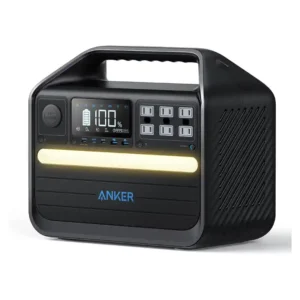
The Anker 555 PowerHouse returns 900Wh of its 1,024Wh rating and 936Wh through DC. Output measures 110 volts with audible inverter noise; fans read 60dB, there is no transfer function, and charging runs at 200W through an external brick.
Anker builds some of the best machines in this category; its SOLIX S2000 returns 95% of rated capacity and loses 0.08% an hour on standby, both the best figures we have measured anywhere. This is not one of them. The 555 PowerHouse collects five separate problems that current machines have solved: an output measuring 110 volts, below the accepted band and hard on any motor; no automatic transfer function at all, so a blackout takes connected equipment down; 200 watts of wall charging through an external brick, more than five hours from empty; 60-decibel fans with an audible whine from the inverter on top of them; and a 200-watt solar input capped at 28 volts, which excludes most rigid panels outright. What survives is real but narrow: 87.8% conversion through the sockets, 91.4% through DC, and a 145-watt car socket that makes it a decent twelve-volt camp battery. Anker's own SOLIX C1000 replaced this machine and fixes all five of those for similar money.
Battery safety and chemistry (LiFePO4, 3,000 cycles)
8
Real-world efficiency and output (87.8% AC, 91.4% DC, but 110V output)
6
UPS and EPS switchover
2
Port selection and distribution (100W USB-C, 145W 12V)
6.5
Solar charging and MPPT (200W, 28V ceiling)
2.5
AC recharge speed (200W via external brick)
2
Noise and thermal management (60dB plus inverter whine)
3.5
Portability and build quality (29 lbs)
7
Expandability and ecosystem (no expansion support)
4
Smart app and interface
3
PROS:
Conversion of 87.8% through AC and 91.4% through DC, both above the class line.
Standby drain of 1% an hour, with nothing measurable on the DC side.
A 145W car socket that carries a compressor fridge on the more efficient DC path.
Cells rated to 3,000 cycles under a five-year warranty with 24-hour support response.
Twenty-nine pounds, reasonable for 1,024Wh, with pass-through charging supported.
An internal design simple enough to have few failure points.
CONS:
Output measured 110 volts, below the accepted band and hard on motors.
No UPS mode fitted, so equipment loses power during a blackout.
Wall charging of 200W through an external brick, over five hours from empty.
Sixty decibels of fan noise plus an audible whine from the inverter itself.
A 28-volt solar ceiling that excludes most rigid panels, at 200W total.
A 1,000W inverter with only 1,500W surge, and no app or expansion path.
Anker Power Station Comparisons
Find out how Anker and Anker SOLIX models compare to competing brands across tested capacity, output, charging, efficiency, ratings, and features.