
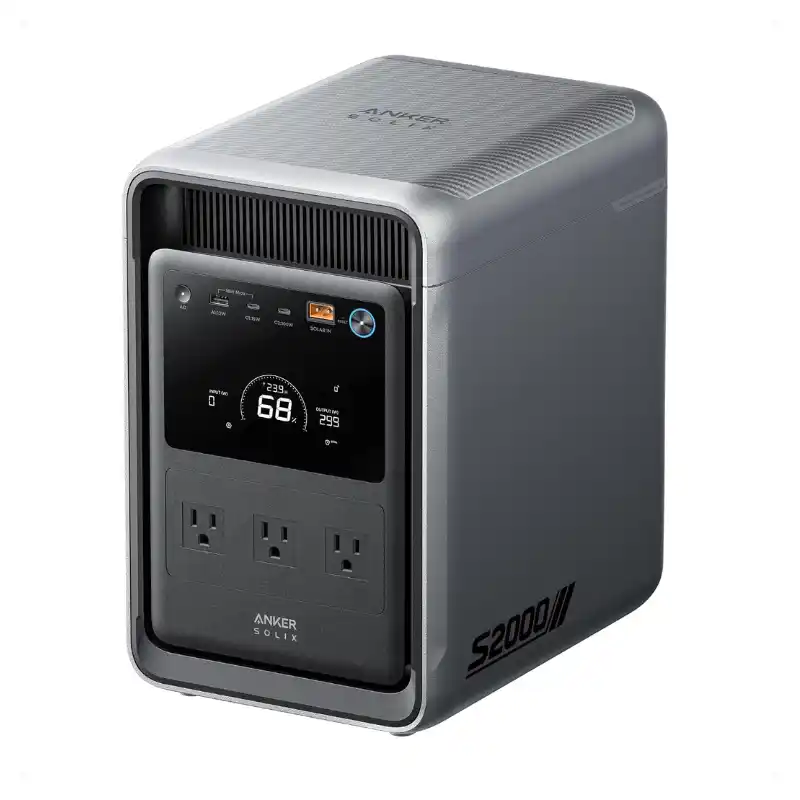
Anker SOLIX S2000 Review

The Anker SOLIX S2000 delivers 1,920Wh of its 2,009Wh rating (a 95% conversion rate, unmatched in this data) and loses just 0.08% of its charge per hour while idle. It crosses over in 9.6ms with a self-arming inverter, weighs 35 pounds, and sits in the mid-range price tier at exceptional value.
My Quick Verdict
Two measurements here are not merely the best in this dataset but are ahead of second place by a distance that makes the comparison look broken.
It converts 95% of its rated capacity into usable energy. The next best result at any capacity is 92%, and most of this field lands between 84 and 89.
And it loses 0.08% of its charge per hour on standby. The previous record in this data was 0.41%, which is five times as much. Switch it on, walk away, and a year later it would still be showing almost the same figure.
Then you reach the inverter at 1,500 watts and the solar input at 400. Both are the smallest figures at this capacity by a wide margin.
Best for: Households wanting standby power for modest loads and P or medical use, particularly when the machine sits unused for long periods.
Not for: heating appliances, heavy tools, or anyone recharging primarily from panels.
Key Stats
| Badge | Stats |
|---|---|
| Battery chemistry and longevity | LiFePO4 | 4,000 cycles |
| Continuous AC power output | 1,500W AC | 3,000W peak |
| Energy storage capacity | 2,009Wh | 1,920Wh usable |
| Rapid AC wall recharge | 1,600W input | 1,800W dual |
| Uninterrupted emergency backup | 9.6ms UPS | Self-arming |
| Maximum solar input and MPPT | 400W solar | Lowest at this size |
| Ultra-fast USB-C power delivery | 100W USB-C PD |
| Low-noise operational level | 53dB | Moderate under load |
| Standby retention | 0.08% per hour | Best measured |
| Conversion efficiency | 95% | Best measured |
Introduction
Every power station in this category quietly charges you a tax twice. Once, when it converts battery power into household power and loses roughly a seventh of it as heat, and again while it sits waiting, shedding a percent or two an hour until the night you need it.
The S2000 pays less of both than anything else measured here, and not by a small margin. 95% survive the conversion, and standby costs 0.08% per hour.
The chemistry is lithium iron phosphate, with a 4,000-cycle claim and a five-year warranty. Cycled daily, landing somewhere around eleven years before the 80% mark.
What It Can Actually Run
The inverter has a 1,500W continuous rating and 3,000W peak. That is the smallest sustained rating at this capacity, and it is the specification that decides who should not buy this machine.
Nominal storage is 2,009Wh. Metered at the outlets, it produced 1,920 Wh. Everything below is built on 1,920Wh.
- Refrigerator at 150W: nearly thirteen hours.
- CPAP at 40W with humidifier off: forty-eight hours, four full nights.
- Starlink dish at 50W: better than thirty-eight hours.
- Laptop at 70W: around twenty-seven refills.
The waveform came in at 119 volts and 0.90% distortion (less than half of what this field typically produces) and was clean enough for medical gear.
Charging and Smart Features
The wall input reaches 1,600W with stepped control, and both inputs together draw 1,800W.
Solar is the weak half of the specification. The ceiling is 400W at 11 to 60 volts and 12.5 amps, and the grading data shows that a complete solar refill falls outside the two-and-a-half-hour mark most rivals hit.
Handover clocked in at 9.6 milliseconds, and since the inverter comes up unprompted, an empty house is still covered.
Mid-range price tier and exceptional value tier. On usable energy per pound spent, nothing here comes close.
Charging Speed Benchmarks
Input performance for the Anker SOLIX S2000 against the 2,000Wh to 3,000Wh capacity class, using the twenty-six machines we hold input figures for. Mean wall charging in the bracket is 1,641W and mean solar is 1,123W. Each band is a tercile drawn inside this class, so the figures below rank the machine among comparable capacities only.
Wall charging is respectable. 1,600W is only 41W under the 1,641W class average, comfortably mid-table in the Average band, and dual input lifts the combined figure to 1,800W. A 2,009Wh pack therefore fills in around 1.3 hours from a socket. Set against a class that runs from 470W to 5,000W, that is an unremarkable but perfectly workable number, and it is the channel this unit is genuinely built around.
Solar is the hard limit on this machine. 400W is the lowest panel ceiling of any unit in the class, barely a third of the 1,123W class average, and it takes roughly 5.0 hours of unbroken sun to refill 2,009Wh. In real conditions, where cloud, panel angle and heat cost 20 to 30 percent of nameplate, that will not fit inside a single usable daylight window. Anyone planning to run this unit off-grid on panels alone should treat that as disqualifying rather than as a drawback, and buy it for grid-backed standby duty instead.
Planning to charge from panels rather than the grid? The Bluetti AC300 + B300K accepts 2,400W of solar, six times the S2000's ceiling, alongside 3,000W from mains. Panels bring 2,764Wh back in a little over an hour rather than five, and the input takes a 150-volt series string rather than a couple of foldables. For genuine off-grid use at this capacity, it is the machine that makes solar the primary input rather than a slow top-up.
Real Capacity: What You Actually Get
This is the section that justifies the unit, and the figures deserve to be stated plainly.
Against a claimed 2,009 Wh, the outlets returned 1,920 Wh. 95%. The strongest result recorded in this dataset is 92%, and the field average is closer to 86%.
In practical terms, this 2,009Wh unit hands you more spendable energy than several 2,048Wh rivals do, because less of the pack disappears on the way out.
The data carries no DC yield measurement, which fits a machine that documents no high-output twelve-volt socket either.
Standby is the other outlier. Switched on and idle, the meter showed a 0.08% drop each hour. That is five times better than the next best figure here and effectively means the pack does not self-discharge on any timescale you would notice.
My takeaway: Work from 1,920Wh – a bigger spendable figure than any rival at this size manages, despite a smaller pack behind it. Charge it, arm it, and it will still be waiting for you next winter.
Power Output and Surge: What It Can Turn On
Here, the machine gives back everything it won on efficiency.
The 1,500-watt ceiling is precisely where resistive heating appliances start, so a heater takes all of it, and nothing else can run. Machines at this size offering 2,400 or 3,000 watts do not face that problem.
Three thousand watts of peak power is adequate for a refrigerator compressor, and “adequate” is the right word. There is less reserve here than elsewhere in this class.
The waveform is genuinely good, with 0.90% distortion and 1,350 mV of electrical noise, both of which are better than most in this field. And the port array is thin: one 100-watt USB-C output, and no documented high-output DC socket at all.
Real Appliance Runtimes
1,920 Wh converted to run time; based on the appliance list, this applies to every unit.
| Appliance | Power Draw | Runtime | What That Means |
|---|---|---|---|
| Full-size refrigerator | 150W | About 12.8 hours | The longest fridge runtime of any two-kilowatt-hour unit reviewed here. |
| CPAP machine (no humidifier) | 40W | About 48 hours | Two full days of continuous overnight use. |
| Starlink dish | 50W | About 38.4 hours | Two working days away from any grid. |
| Pellet grill or smoker | 100W | About 19.2 hours | Nineteen hours of smoke before it asks for anything. |
| Laptop (70W) | 70W | About 27 recharges | A single 100W port, so one machine at a time. |
Every line here beats units with larger nominal packs, and 95% conversion is the entire reason. It is the clearest illustration in this dataset of why rated capacity is the wrong number to shop on.
Recharging: Wall and Solar
From a Wall Outlet
Mains charging accepts 1,600W with the rate adjustable in stages, taking an empty pack to full in around eighty minutes.
Together, both sources reach 1,800W, which is modest for this capacity, where several rivals manage 2,400W or more. It is enough, but the wall is doing most of the work.
From Solar Panels
Four hundred watts is the lowest solar ceiling among units at this capacity, and by a considerable margin.
Input runs 11 to 60 volts at 12.5 amps, which is a narrow current allowance on top of a low wattage limit. Foldable panels work; a serious array does not.
The consequence is stated plainly in the grading data: this unit cannot achieve a full solar recharge within the two-and-a-half-hour window that most of its rivals meet. On a sunny day alone, refilling two kilowatt-hours with that input takes most of a clear day.
You may leave the array plugged in permanently, and the output will continue during charging. Treat the panels as a top-up, though, not as the way you refill it.
Blackout Backup: The Part I Care About Most
Backup is executed properly, which, given the standby figure,e makes this an unusually convincing emergency machine.
At 9.6 milliseconds, the handover falls under eleven, which is the mark at which a machine stops being a battery with a relay attached.
Nobody has to arm it or even be at home. The inverter handles that part unprompted.
And leaving it armed costs 0.08% per hour, which is so close to nothing that the usual trade-off between readiness and self-discharge simply does not apply here.
Why this matters to me: most units force a choice between leaving the inverter armed and watching the pack drain, or switching it off and protecting nothing. This is the only machine in the dataset where that choice disappears entirely.
Noise and Living With It
Fifty-three decibels under load, which sits marginally above the line for rooms where anyone sleeps and is unremarkable everywhere else.
Weight is the surprise. Thirty-five pounds, 15.8 kilograms, for two kilowatt-hours of storage. That is the lightest unit at this capacity in the entire dataset, twelve pounds under the next lightest and thirty-two under the heaviest.
The smaller inverter accounts for much of it, and the result is a two-kilowatt-hour machine one person can genuinely move.
Connectivity includes Wi-Fi and Bluetooth, and the phone line is covered by the five-year warranty.
Where It Falls Short
Three limitations, and together they define a narrow but real use case.
1. A 1,500-Watt Inverter
The smallest sustained rating at this capacity. Run a heater or a portable air conditioner, and there is nothing spare for a fridge or lights.
For a household running modest loads, this is irrelevant. For anyone expecting to cover a kitchen circuit during an outage, it is disqualifying, and no amount of stored capacity compensates.
2. Four Hundred Watts of Solar
The lowest input ceiling at this capacity, on a narrow 12.5-amp current allowance, and the grading data indicate that a full solar recharge cannot be completed within the usual two-and-a-half-hour window.
Anyone planning multi-day off-grid use where panels have to keep pace with consumption should look elsewhere.
3. No Expansion and a Thin Port Array
The power station has no expansion battery; 2,009 W is the hard limit.
With a single 100-watt USB-C output and no documented DC socket, it will not be suitable for a central camp or vehicle installation.
How It Compares
The natural comparisons are the Anker SOLIX C2000 Gen 2, its own stablemate, and the Pecron E2400LFP, the other exceptional-value unit at this capacity.
| Feature | Anker SOLIX S2000 | Anker SOLIX C2000 Gen 2 | Pecron E2400LFP |
|---|---|---|---|
| Price tier | Mid-range | Upper mid-range | Mid-range |
| Value tier | Exceptional | Exceptional | Exceptional |
| Rated capacity | 2,009Wh | 2,048Wh | 2,048Wh |
| Usable through AC | 1,920Wh (95%) | 1,760Wh (85%) | 1,700Wh (83%) |
| Idle drain per hour | 0.08% | 0.41% | 1.0% |
| Sustained output | 1,500W | 2,400W | 2,400W |
| Solar input | 400W | 800W | 800W |
| UPS switchover | 9.6ms | 7.2ms | 9.8ms |
| Self-arming inverter | Yes | Yes | Yes |
| Expansion battery | No | Yes | Yes |
| Weight | 35 lbs | 41 lbs | 45 lbs |
Against Anker’s own C2000 Gen 2, the exchange is unusually clean. The S2000 delivers 160 Wh more usable energy from a smaller pack, holds its charge 5 times better, weighs 6 pounds less, and costs a price tier less. The C2000 answers with 900 more watts of inverter, twice the solar input, and an expansion port.
That is a straight trade between efficiency and capability, and which side wins depends entirely on your load list. Favouring loads and long storage decisively favours the S2000.
The price-match LFP is a closer match in price, and it also arms itself. It runs a much larger inverter and takes an expansion battery, but it converts 12 points worse and drains 12 times faster on standby.
Who Should Buy It, and Who Should Skip It
Buy It If
- The unit will sit charged for months and must be full when you finally reach for it.
- Your loads are refrigerators, lighting, networking, and medical equipment rather than heating appliances.
- You want two kilowatt-hours in a package one person can carry.
- Automatic protection matters, and you do not want to think about arming anything.
Skip It If
- A space heater, air conditioner, or heavy tool is on your list. The 1,500W inverter cannot share.
- Solar is your main recharge route. Four hundred watts will not keep pace.
- You expect to add capacity later.
- You need a high-output DC port for vehicle or camp equipment.
The Bottom Line
The S2000 is the most efficient power station in this dataset by a significant margin, and efficiency is the specification buyers most consistently overlook. 95% conversion and 0.08% hourly standby mean it delivers more usable energy than rivals with larger packs, and it still has it months later.
Pair that with a self-arming inverter, 4,000 cycles, and 35 pounds, and as an emergency machine, it is close to ideal.
The catch is the inverter and the panels. Fifteen hundred watts and 400 watts of solar draw a hard line around what this unit can do. Stay inside that line, and nothing here is better value. Cross it, and it fails immediately.


There are no reviews yet.