
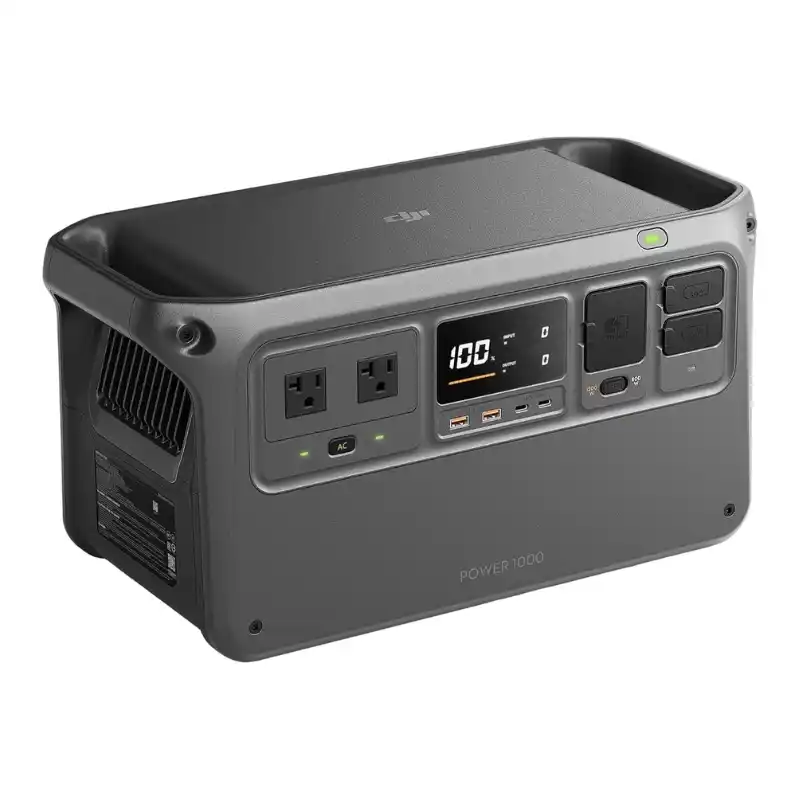
DJI Power 1000 Review

The DJI Power 1000 pairs 1,024Wh with a 2,200W inverter and 4,400W surge, in a 28-pound case carrying a 140W USB-C port and a 320W fast-charge output. Cells are rated for 3,500 cycles, and it sits in the entry-price tier with exceptional value per watt-hour.
My Quick Verdict
DJI came to the power station industry from drones, and the design shows it everywhere. A 140-watt USB-C port, a 320-watt fast-charge output for its own batteries, 28 pounds on the scale, and a 2,200-watt inverter in a case that size.
It is a field production unit that happens to serve as a home backup, rather than the other way around.
The giveaway specification is the solar window: 11 to 30 volts. Every other unit reviewed here accepts 60 volts or more. Thirty is the narrowest ceiling in the dataset, and it rules out most rigid panels entirely.
The other problem is conversion. At 80% through the outlet,s it is the weakest AC figure I have recorded.
Best for: Remote Work and DIY Tools, particularly camera, drone,ne and production work where USB-C throughput matters more than watt-hours.
Not for: solar-led setups. The 30-volt ceiling is a hard wall that no adapter gets around.
Key Stats
| Badge | Stat |
| Battery Chemistry and Longevity | LiFePO4 | 3,500 Cycles |
| Continuous AC Power Output | 2,200W AC | 4,400W Peak |
| Energy Storage Capacity | 1,024Wh | 820Wh Usable |
| Rapid AC Wall Recharge | 1,200W Input | Two-speed |
| Uninterrupted Emergency Backup | 13.3ms UPS | Manual Arm |
| Maximum Solar Input and MPPT | 575W Solar | 11–30V Only |
| Ultra-fast USB-C Power Delivery | 140W USB-C PD |
| Low-noise Operational Level | 52dB | Moderate Under Load |
| Modular Capacity Expansion | Expandable | Extra Battery Port |
| High-output DC | 320W SDC Fast-charge Port |
Introduction
Most power stations are designed by battery companies, and it shows in what they optimise. Watt-hours on the box, solar input on the side, a car socket as an afterthought.
This one was designed by a drone manufacturer, and the priorities are completely different. What DJI built is a unit that charges camera gear absurdly fast, weighs little enough to lift into a vehicle with one hand, and carries an inverter far larger than its storage would suggest.
Its cells are lithium iron phosphate, rated for 3,500 cycles and backed by a five-year warranty. At a cycle-a-day rate, that is a decade of service before capacity eases to 80%.
What It Can Actually Run
The inverter can deliver 2,200W continuously and peak at 4,400W. For a kilowatt-hour unit, those are large numbers, placing it in the Heavy-Duty Household Class despite modest storage.
Nominal capacity is 1,024Wh. Metered at the socket, it produced 820 Wh, an 80% return, the lowest AC conversion figure in this entire review set. The numbers below work from 820Wh.
- Domestic refrigerator at 150W: 5.5 hours.
- CPAP at 40W, humidifier off: a little over twenty hours.
- Starlink dish at 50W: roughly 16.5 hours.
- Laptop at 70W: about twelve refills, and unusually quick ones off the 140W port.
Measured output was 121 volts. Electrical noise on the inverter was 1,475 mV, cleaner than most units here, though harmonic distortion itself was never measured.
Charging and Smart Features
Mains input reaches 1,200W but offers only two speeds rather than the finer stages several rivals provide.
Solar is the weak point. Up to 575W, but across an 11-30 volt band at 20 amps, and the higher figures require dual external MPPT controllers rather than the built-in one.
Crossover was timed at 13.3 milliseconds with no self-arming mode. The array can stay plugged in, and loads keep running during a charge, though the wall and the sun will not work together. Entry-price tier, exceptional-value tier. On cost per rated watt-hour, it is among the cheapest here, though the weak conversion narrows that lead considerably.
Charging Speed Benchmarks
Where the DJI Power 1000 lands on recharging within the 1,000Wh to 1,999Wh capacity class, based on all 30 units in our charging database. Mean wall input there is 1,085W and mean solar input is 641W. Each rating is scored inside the class, never against the database as a whole.
Wall charging of 1,200W clears the 1,085W class average and sits mid-table in the Average band, since High begins at 1,300W. A 1,024Wh pack therefore comes back in around 0.9 hours from a socket. Against a bracket running from 200W to 2,400W, that is a solid rather than notable figure, and it is exactly what you would expect from an entry-tier machine that puts its budget into ports and weight instead.
Solar accepts 575W, a shade under the 641W class average and taking an Average rating in a field that peaks at 1,400W. Panels fill the pack in roughly 1.8 hours of strong light, twice the wall socket time. For a 28-pound machine intended to travel, that is workable rather than generous: a single 400W folding array will not saturate the input, but you will not gain much from a second one either.
Need to refill before a storm arrives? The Bluetti AC240 accepts 2,400W from mains, the highest wall input recorded in this bracket, and fills a larger 1,536Wh pack in about 0.6 hours. It weighs 72 pounds against 28 here, so this is a fixture rather than a travelling machine, and the trade is portability for recovery speed.
Real Capacity: What You Actually Get
Rated capacity is a claim about cells. Delivered capacity is a measurement, and on this unit, the two are further apart than on any other unit reviewed.
820 Wh were drawn from the AC sockets, down from a claimed 1,024 Wh. That is 80%, and every other unit on this site clears 82%.
The DC path fares far better at 886Wh, or 86.5%. A six-point spread and a clear signal about which port to use.
Standby loss is near 2.1% per hour with the inverter live, just over the 2% line. On the DC side, it falls to 0.8%.
My takeaway: 820 Wh through the sockets is a poor return for a kilowatt-hour pack. Run what you can on DC and USB-C, where this unit is genuinely strong, and the shortfall matters much less.
Power Output and Surge: What It Can Turn On
The two output figures answer different questions, and DJI has been unusually generous in both cases.
Twenty-two hundred watts sustained is above what most kilowatt-hour units offer, and it clears the threshold where heating appliances become viable.
Forty-four hundred watts of peak is double the sustained rating, which is ample for any compressor or hand tool you would reasonably connect.
The port array is where this unit sets itself apart. A 140-watt USB-C output charges a laptop at full speed without a mains brick, and the 320-watt SDC port refills drone and camera batteries much faster than a standard socket would. Neither is common at this price.
Real Appliance Runtimes
Converting 820Wh into hours, against the appliance draws used consistently across this site.
| Appliance | Power Draw | Runtime | What That Means |
| Full-size refrigerator | 150W | About 5.5 hours | Shorter than most kilowatt-hour units manage, owing to the 80% conversion. |
| CPAP machine (no humidifier) | 40W | About 20.5 hours | One night comfortably, a second only just. |
| Starlink dish | 50W | About 16.4 hours | A working shift with some of the evening left. |
| Pellet grill or smoker | 100W | About 8.2 hours | Sufficient for a slow cook, without much spare. |
| Laptop (70W) | 70W | About 12 recharges | And faster than rivals, since the port delivers 140W. |
These are the shortest runtimes of any kilowatt-hour unit reviewed here, and the cause is conversion, not capacity. The pack is the same size as its rivals’; fewer of them reach the outlets.
Recharging: Wall and Solar
From a Wall Outlet
The mains input accepts up to 1,200W, filling an empty pack in around an hour.
Control is coarser than elsewhere, offering two speeds rather than the four stages some rivals offer. Fast or slow, nothing in between.
Dual charging is also absent, so mains and solar cannot run together. On a dull morning when you want the wall to make up for what the panels are missing, you have to pick one.
From Solar Panels
This specification defines what the DJI Power 1000 can and cannot be.
Panel input runs from 11 to 30 volts. Thirty volts is the lowest ceiling in the dataset, roughly half of the most restrictive rivals’ ceilings.
In practice, that excludes most rigid panels, which typically operate above 30 volts, and it excludes wiring anything in series. You are limited to low-voltage foldable panels wired in parallel.
The rated 575W is achievable only by running dual external MPPT controllers rather than the internal one, which adds hardware and cost to reach a figure other units hit natively.
Panels can stay connected all day, and the unit powers loads while charging, but as the hub of a solar setup,p this is the wrong machine.
Blackout Backup: The Part I Care About Most
Backup behaviour is adequate and unremarkable, which is fair given that backup is clearly not what this unit was built for.
The crossover measured 13.3 milliseconds, well within the safety threshold, though short of the sub-nine figures posted by the best units
Nothing here arms itself. Somebody flips the inverter on beforehand and leaves it on, paying 2.1% an hour for the privilege.
For a refrigerator or lighting, this is entirely serviceable. For a desktop or a network drive left unattended, it is not.
Why this matters to me: buying this unit for blackout protection means paying for a 140W USB-C port and a drone-charging output you will never use, and then accepting middling backup performance. The strengths and the use case do not line up.
Noise and Living With It
Fifty-two decibels under load. Marginally past the line I draw for rooms with sleepers in them, and quieter than most of what it competes against.
Twenty-eight pounds, 13 kilograms. That is genuinely light for a kilowatt-hour carrying a 2,200-watt inverter, and it is one of the unit’s real advantages. Single-handed carrying is realistic.
One caveat on connectivity. The bench data lists no app support, while the manufacturer’s own materials describe smartphone control through the DJI ecosystem. That contradiction remains unresolved in the available sources, so confirm it directly before buying if remote monitoring matters to you.
Where It Falls Short
There are three genuine limitations, and the first will decide the purchase for many people.
1. The Solar Ceiling Is 30 Volts
Every other unit reviewed on this site accepts at least 60 volts, and several reach 95. This one stops at 30.
That excludes most rigid panels outright and makes series wiring impossible. You are limited to low-voltage foldables in parallel, and reaching the rated 575W requires adding external MPPT controllers.
No accessory raises this ceiling. If solar is part of your plan, this unit removes itself from consideration.
2. The Weakest AC Conversion Recorded Here
80% through the sockets means a 1,024 Wh unit behaves like an 820 Wh one. Rivals from the same pack size deliver 880Wh or 890Wh.
The DC path at 86.5% partially mitigates the penalty, so users running 12-volt and USB-C loads avoid most of it. Anyone relying on the AC outlets does not.
3. No Dual Charging, and Only Two Charging Speeds
Mains and solar cannot feed the unit simultaneously, a limitation that most rivals at this price do not have.
Wall charging also offers just two rates. Neither is fatal, but together they suggest a charging system designed with less care than the output side.
How It Compares
The natural comparisons are the Anker SOLIX C1000, which matches it on price and capacity, and the Pecron E1000LFP, the other unit here with a serious DC output.
| Feature | DJI Power 1000 | Anker SOLIX C1000 | Pecron E1000LFP |
| Price Tier | Entry | Entry | Entry |
| Value Tier | Exceptional | Exceptional | Exceptional |
| Rated Capacity | 1,024Wh | 1,056Wh | 1,024Wh |
| Usable Through AC | 820Wh (80%) | 910Wh (86.1%) | 880Wh (85%) |
| Sustained Output | 2,200W | 1,800W | 1,800W |
| Surge Output | 4,400W | 2,600W | 2,000W |
| USB-C Port | 140W | 100W | 100W |
| Solar Voltage Ceiling | 30V | 60V | 60V |
| Weight | 28 lbs | 28 lbs | 29 lbs |
| Fan Noise | 52dB | 59dB | 53dB |
Against the Anker SOLIX C1000, the DJI wins on inverter size, surge headroom, USB-C throughput, and quiet operation. It loses badly on conversion, delivering 90 Wh less than a similar pack, and its solar ceiling is half that of Anker’s.
For a production crew charging batteries and laptops from a vehicle, the DJI is clearly the better tool. For a household unit that will spend its life on AC loads, the Anker delivers more of what you paid for.
The Pecron E1000LFP is the choice if DC output is the point. It returns 90% through DC, compared to the DJI’s 86.5%; it carries a 300W XT60 and accepts twice the solar voltage. What it cannot match is the 140W USB-C port or the 4,400W surge.
Who Should Buy It, and Who Should Skip It
Buy It If
- You charge cameras, drones, or laptops in the field and want the fastest USB-C throughput here.
- You need a large inverter in a package light enough to lift alone.
- Your loads run mostly on DC and USB-C rather than the AC outlets.
- You already own DJI equipment that the SDC port is designed to charge.
Skip It If
- Solar matters. The 30-volt ceiling is the hardest limitation in this review set.
- Your loads are AC, where only 80% of the pack reaches you.
- You want to top up the wall and panels at the same time.
- You need dependable unattended backup for a computer.
The Bottom Line
The DJI Power 1000 is a very good field production unit and a mediocre power station, and separating those two judgments is the whole task of reviewing it.
The 140-watt USB-C port, the 320-watt fast-charge output, the 28 pounds, and the 4,400-watt surge ceiling are all genuinely excellent, and none of them is what a home backup buyer is shopping for.
Meanwhile, the two specifications that matter most to that buyer, AC conversion and solar input, are the weakest here. Buy it for what it was designed to do, and it is impressive. Buy it as a general-purpose unit, and you will pay for capabilities you never use while missing the one you need.


There are no reviews yet.