

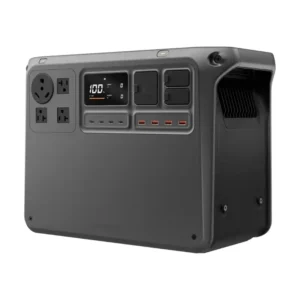
The DJI Power 2000 stores 22,048 Wh behind a 33,000 Wh inverter with a 6,000 W surge, and transfers to the battery with no measurable gal. Solar input reaches 1,800W over a 43-amp path, the most current any unit here accepts, and dual charging takes 2,300W. Upper mid-range price tier, exceptional value.
★★★★★
More details +
Only one unit reviewed here before this had a transfer time of zero, and it was a premium-tier fixture from a solar company that surrendered nearly everything else to achieve it. This one matches that figure while carrying a 3,000-watt inverter, 1,800 watts of solar input arriving over a 43-amp path (the largest current allowance recorded anywhere here), and an exceptional value tier rating. It also returns 86% at the sockets, better than several rivals costing more, and its 140-watt USB-C and 300-watt fast-charge ports are inherited from DJI's own equipment ecosystem. Two measurements spoil it. The fans hit 62 decibels, tied for the loudest reading ever recorded on this site, which decides where the unit can live before anything else gets a say. And only 75% of the pack reaches you through the twelve-volt path, eleven points below its own AC figure and tied for the worst DC result here, which undercuts precisely the vehicle and camp builds that a solar input this large would otherwise suit. One loose end worth chasing before you buy: the zero transfer sits alongside a grading entry recording no self-arming capability, and the sources do not reconcile it.
PROS:
- Transfer to battery with no measurable gap, matching a unit two value tiers above it.
- Solar input of 1,800W with a 43-amp low-voltage path, the largest current allowance recorded here.
- A 3,000W sustained and 6,000W peak inverter, among the largest at this capacity.
- Conversion of 86% at the sockets, above the class line and better than several pricier rivals.
- A 140W USB-C port and a 300W SDC fast-charge output for camera and drone batteries.
- Exceptional value tier despite the inverter size and solar ceiling.
CONS:
- Fans at 62dB, tied for the loudest measurement recorded on this site.
- Only 75% of the pack reaches you through DC, eleven points below its own AC figure.
- Wall charging offers just two speeds, with no gentle overnight setting.
- The zero transfer time sits alongside a grading entry that records no self-arming, which remains unresolved.
- Electrical noise exceeds 2,000 mV at the high end of the field.
- Cells rated for 3,000 cycles, while the best rivals at this capacity reach 4,000.
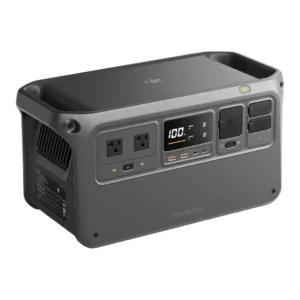
The DJI Power 1000 pairs 1,024Wh with a 2,200W inverter and 4,400W surge, in a 28-pound case carrying a 140W USB-C port and a 320W fast-charge output. Cells are rated for 3,500 cycles, and it sits in the entry-price tier with exceptional value per watt-hour.
★★★★★
More details +
A drone company built this, and every design decision follows from that: a 140-watt USB-C port, a 320-watt fast-charge output for camera and drone batteries, 28 pounds on the scale, and a 2,200-watt inverter with 4,400 watts of surge crammed into a kilowatt-hour case. As a field production unit, it is genuinely excellent,t and nothing here competes with it. As a power state, it has two hard-to-forgive problems. Conversion came in at 80% through the sockets, the weakest AC figure across this entire review set, so a 1,024Wh pack behaves like an 820Wh one while rivals from the same nominal capacity hand back 880Wh or more. And the solar input runs from 11 to 30 volts; the narrowest window in the dataset, which excludes most rigid panels, makes series wiring impossible and requires external MPPT controllers to reach its rated figure. The DC path at 86.5% partly rescues the first problem. Nothing rescues the second. Buy it to charge cameras from a truck, not to build a solar setup or to sit in a cupboard waiting for a storm.
PROS:
- A 140W USB-C port and a 320W fast-charge output, both well beyond what rivals at this price provide.
- A 2,200W sustained and 4,400W peak inverter, larger than anything else at this capacity.
- Twenty-eight pounds despite the oversized inverter, making it a realistic one-handed carry.
- Cells rated to 3,500 cycles under five years of cover, with expansion support.
- Inverter electrical noise measured at 1,475 mV, cleaner than most units here.
- Fans at 52dB, quieter than most of their direct competition.
CONS:
- Solar input stops at 30 volts, the narrowest window in the dataset, ruling out most rigid panels and any series wiring.
- Conversion of 80% through the sockets is the weakest AC figure recorded across this review set.
- Mains and solar cannot charge simultaneously, so there is no way to supplement panels on a dull day.
- Wall charging offers two fixed speeds, whereas rivals offer four selectable stages.
- Reaching the rated 575W of solar requires external MPPT controllers rather than the built-in one.
- Sources conflict on app support, so confirm remote monitoring directly before buying.
Deal
The DJI Power 2000 stores 22,048 Wh behind a 33,000 Wh inverter with a 6,000 W surge, and transfers to the battery with no measurable gal. Solar input reaches 1,800W over a 43-amp path, the most current any unit here accepts, and dual charging takes 2,300W. Upper mid-range price tier, exceptional value.
★★★★★