
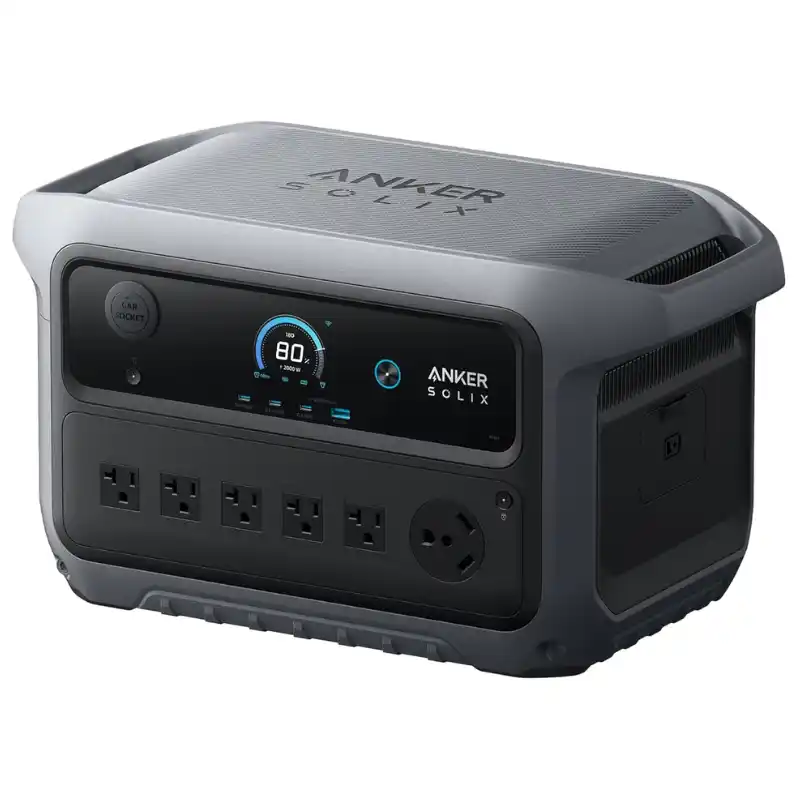
Anker SOLIX C2000 Gen 2 Review

The Anker SOLIX C2000 Gen 2 stores 2,048Wh behind a 2,400W inverter, crosses over in 7.2ms with a self-arming inverter, and loses only 0.41% of its charge per hour idle, both the best figures in this dataset. Cells rate at 4,000 cycles and sit in the upper-mid-range price tier at exceptional value.
My Quick Verdict
Two measurements on this unit are the best in the entire dataset, across all brands and capacities.
It crosses over in 7.2 milliseconds, faster than anything else recorded here. And it loses 0.41% of its charge per hour on standby, which is the lowest idle drain I have measured anywhere.
Those are precisely the two numbers that determine whether a power station works as an automatic backup: how quickly it picks up the load and whether it is still full when the moment arrives. This unit leads on both, arms itself, and sits in the exceptional value tier while doing it.
One specification spoils the sweep. Solar cannot stay connected around the clock, a genuine constraint for off-grid use and one that is unique among power stations of this size.
Best for: Emergency Home Resilience and Medical or CPAP Backup, especially where the unit is stored charged and expected to act on its own.
Not for: permanent off-grid installations that require panels to be wired in continuously.
Key Stats
| Badge | Stat |
| Battery chemistry and longevity | LiFePO4 | 4,000 cycles |
| Continuous AC power output | 2,400W AC | 4,500W peak |
| Energy storage capacity | 2,048Wh | 1,760Wh usable |
| Rapid AC wall recharge | 1,800W input | 2,600W dual |
| Uninterrupted emergency backup | 7.2ms UPS | Fastest measured |
| Maximum solar input and MPPT | 800W solar | 11–60V MPPT |
| Ultra-fast USB-C power delivery | Dual 140W USB-C PD |
| Low-noise operational level | 44dB | Whisper quiet |
| Standby retention | 0.41% per hour | Lowest measured |
| Modular capacity expansion | Expandable | Extra battery port |
Introduction
Backup power fails in two ways, and manufacturers advertise their defence against only one of them.
The advertised failure is the crossover: the grid drops, and the unit takes too long to pick up the load, so your equipment restarts anyway. The unadvertised failure is quieter. The unit sat in a cupboard for four months, slowly emptying itself, and on the night it was needed,d there was nothing in it.
The C2000 Gen 2 posts the best figure in this dataset against both. The pack is lithium iron phosphate, good for 4,000 cycles and covered for five years. Cycled once a day, the 80% threshold is roughly eleven years away.
What It Can Actually Run
The inverter has a 2,400W continuous rating and 4,500W peak. That clears the threshold where heating appliances are located, leaving room for something to run beside them.
Rated storage is 2,048 Wh, and metering the sockets produced 1,760 Wh, an 85% return. The DC route did even better at 1,875 Wh, or 91%. Figures below use 1,760Wh.
- Refrigerator at 150W: nearly twelve hours.
- CPAP at 40W with humidifier off: around forty-four hours, four nights.
- Starlink dish at 50W: better than thirty-five hours.
- Laptop at 70W: about twenty-five refills, across two 140W ports simultaneously.
Output measured 122 volts with 0.60% distortion, the second-cleanest waveform in this dataset, and well within safe limits for medical equipment.
Charging and Smart Features
Wall charging reaches 1,800W with stepped rate control, and mains plus panels together take 2,600W with solar prioritised.
Eight hundred watts of panel input arrives over two voltage bands: a low one of 11 to 28 volts, limited to 8 amps, and a higher one of 28 to 60 volts, good for 17. Foldables suit the first; rigid panels suit the second.
Crossover measured 7.2 milliseconds, the fastest recorded here, and the inverter arms itself, so no one needs to be present.
Upper mid-range price tier and exceptional value tier. That pairing in this capacity is unusual and the unit’s strongest argument.
Charging Speed Benchmarks
Where the Anker SOLIX C2000 Gen 2 lands on wall and panel recharging against every unit in the 2,000Wh to 3,000Wh capacity class we hold charging data for. Twenty-six machines sit in that bracket, averaging 1,641W on AC and 1,123W on solar. Each rating below is worked out within this class only, never against the database as a whole.
Wall charging is the strong half of this machine's input story. At 1,800W it beats the 1,641W class average and stops at the very edge of the Average band, a single watt below where High begins. Inputs across this bracket stretch from 470W to 5,000W, leaving the C2000 Gen 2 in the faster half without ever threatening the leaders. On a 2,048Wh pack that is around 1.1 hours to full in ideal conditions, quick enough that a storm warning at breakfast leaves you fully charged before lunch.
Panels are the weak half. The 800W solar ceiling is nearly 300W under the 1,123W class average and earns a Low rating, with only six of the twenty-six units in this bracket accepting less. Refilling 2,048Wh at 800W takes about 2.6 hours in flawless sun, and because panel ratings are laboratory figures, the real number in cloud or off-axis light will be longer again. The Gen 2 also cannot leave panels wired around the clock, so a permanently installed array is doubly ruled out.
Building a fixed solar array instead? The Bluetti AC300 + B300K is the quickest charger at this capacity on both channels: 3,000W from the wall and 2,400W of solar, which is three times the panel input of the C2000 Gen 2. Even on a bigger 2,764Wh stack that is under an hour on mains and roughly 1.2 hours on panels, and the array can stay wired permanently. For an off-grid installation rather than a portable backup, it removes both of the limits above.
Real Capacity: What You Actually Get
Both output paths on this unit are strong, and the split between them runs the sensible way round.
The sockets returned 1,760 Wh out of a claimed 2,048 Wh, or 85%, which clears the class line without fuss.
The twelve-volt route produced 1,875 Wh, a 91% return, and a six-point advantage. Anything capable of running on DC should.
Standby is the outstanding figure. With the inverter awake and nothing connected, it sheds 0.41% per hour, the lowest reading in this dataset, and on the DC side, the meter recorded nothing measurable at all. Left armed and untouched, this pack would still hold most of its charge after a month.
My takeaway: 1,760 Wh via AC, 1,875 Wh via DC. But the number that defines this unit is 0.41% per hour, because it means you can leave the inverter armed permanently and still find it full.
Power Output and Surge: What It Can Turn On
Sustained and peak output answer different questions, and both are competent here rather than exceptional.
Two thousand four hundred watts, held continuously, covers the remaining appliance with headroom left, which is the practical threshold at this capacity. It is 600 watts short of the largest inverters in this size class, and that gap only appears if you intend to run several heavy loads at once.
Forty-five hundred watts of peak power handles any domestic compressor or hand tool without difficulty.
Waveform quality is the quiet strength. A distortion of 0.60% is well below half the field average, and only one unit reviewed here produces a cleaner output. For a CPAP motor or a workstation, that matters more than the missing 600 watts.
Real Appliance Runtimes
1,760Wh translated into hours, against the appliance loads used consistently throughout this site.
| Appliance | Power Draw | Runtime | What That Means |
| Full-size refrigerator | 150W | About 11.7 hours | Most of the day, and considerably more once compressor cycling is counted. |
| CPAP machine (no humidifier) | 40W | About 44 hours | Four nights without touching a charger. |
| Starlink dish | 50W | About 35.2 hours | Thirty-five hours before the dish wanted power again. |
| Pellet grill or smoker | 100W | About 17.6 hours | Two long cooks between refills. |
| Laptop (70W) | 70W | About 25 recharges | Two 140W ports, so a pair of machines at full speed. |
Almost twelve hours on a refrigerator moves this out of outage territory and into day-long autonomy, which is the point at which capacity stops being the limiting factor and recharging becomes the question.
Recharging: Wall and Solar
From a wall outlet,
The mains input accepts 1,800W with staged rate control, refilling the pack from flat in a little over an hour.
Combining mains and panels lifts that to 2,600W with solar served first, which is among the highest dual-charging ceilings at this capacity and genuinely useful when a warning arrives with limited notice.
From Solar Panel
The solar implementation is merely good rather than excellent, and it contains one real flaw.
Input reaches 800W across two voltage ranges: 11 to 28 volts at 8 amps, and 28 to 60 volts at 17 amps. That split covers small foldables and rigid panels alike, which is more thoughtful than a single band.
Under a clear sky, an empty pack recovers in roughly 2.5 hours.
The problem is that panels cannot remain connected around the clock. Every other unit at this capacity permits it, and it is the standard arrangement for anyone running a vehicle or cabin setup where the array is wired in permanently. Here, disconnection becomes part of the routine.
Blackout Backup: The Part I Care About Most
This section is the reason to buy the unit, and there is nothing to qualify.
The crossover measured 7.2 milliseconds, the fastest figure recorded across every unit reviewed on this site. Nothing with a processor in it is going to notice a gap that short.
The inverter arms itself, which matters more than the raw speed. Most units in this dataset cannot, meaning they protect nothing when a house is empty.
And leaving it armed costs 0.41% per hour, so, unlike several rivals, there is no penalty for keeping it ready.
Why this matters to me: the three things automatic backup actually needs are a fast crossover, an inverter that arms itself, and standby loss low enough that leaving it armed is practical. This unit posts the best figure in the dataset on two of the three and satisfies the third outright.
Noise and Living With It
Forty-four decibels under load, quiet enough for a room with a sleeper in it and impressive given the inverter behind it.
In practice, it is a low background presence rather than a mechanical noise you track. Running it overnight beside a bed is realistic in a way it is not for most of this dataset.
Weight is 41 pounds (19 kilograms), which, for two kilowatt-hours, is genuinely light and better than most rivals at this capacity manage. Two hands, but not a struggle.
Wi-Fi and Bluetooth are both available, and a real telephone line sits behind the five-year cover.
Where It Falls Short
There are three limitations, and only the first one changes who should buy this.
1. Solar Cannot Stay Connected Continuously
This is the one lag specification in which the unit lags behind every rival in terms of capacity. Panels have to be disconnected rather than left wired in permanently.
For someone who charges foldables occasionally, it is a minor annoyance. For a vehicle build or a cabin with a fixed array, it is a structural problem because a permanent connection is the whole point of a fixed array.
2. Eight Hundred Watts of Solar Is Mid-Field
Rivals at this capacity accept 1,000W or 1,200W. The two-range voltage arrangement here is thoughtful, but the ceiling is ordinary.
Combined with the connection limitation, solar is the weakest aspect of an otherwise outstanding unit.
3. A 2,400W Inverter Where Others Offer 3,000W
Sufficient for a heating appliance plus a second load, and short of what the largest inverters at this size provide.
Only relevant if you plan to run multiple heavy loads simultaneously, which most households do not do during an outage.
How It Compares
Its two natural rivals are the EcoFlow Delta 3 Max Plus, which is in the same price tier, and the AFERIY P280, the cheapest option at this capacity.
| Feature | Anker SOLIX C2000 Gen 2 | EcoFlow Delta 3 Max Plus | AFERIY P280 |
| Price tier | Upper mid-range | Upper mid-range | Mid-range |
| Value tier | Exceptional | Good | Exceptional |
| Usable through AC | 1,760Wh (85%) | 1,740Wh (84%) | 1,880Wh (91%) |
| Usable through DC | 1,875Wh (91%) | 1,830Wh (89%) | 1,831Wh (89%) |
| UPS switchover | 7.2ms | 7.9ms | 8ms |
| Self-arming inverter | Yes | Yes | No |
| Idle drain per hour | 0.41% | 0.9% | 0.66% |
| Sustained output | 2,400W | 3,000W | 2,800W |
| Solar input | 800W | 1,000W | 1,200W |
| Solar connected 24/7 | No | Yes | Yes |
| Fan noise | 44dB | 42dB | 57dB |
| Battery cycles | 4,000 | 3,500 | 4,000 |
Against the Delta 3 Max Plus, this is remarkably close, and the C2000 wins the exchange on value. It crosses over marginally faster, holds charge nearly twice as well, lasts 500 more cycles, weighs seven pounds less, and sits an entire value tier better.
The Delta 3 Max Plus answers with a 3,000W inverter, half the power distortion, 200W more solar, and the ability to leave panels connected. For a household running heating loads or a permanent array, those matter. For most buyers, the value gap is not justified.
The AFERIY P280 is the interesting outsider, delivering 120 Wh more usable energy at a lower price point. But it cannot arm its own inverter, and its fans run 13 dB louder, which rules it out of those jobs entirely.
Who Should Buy It, and Who Should Skip It
Buy It If
- Automatic blackout protection is the main job, and nobody will be home to arm anything.
- The unit will be stored charged for long stretches between uses.
- You want two kilowatt-hours in the lightest package available at this capacity.
- You run sensitive electronics and want a clean waveform without paying top-tier prices.
Skip It If
- Your solar array is permanently wired. This unit will not accept that.
- You need more than 800W of panel input.
- Several heavy loads will run simultaneously, making a 3,000W inverter better suited.
- Maximum usable energy per pound of purchase is the only test.
The Bottom Line
The C2000 Gen 2 posts the two best numbers in this entire dataset, and they happen to be the two that determine whether backup power actually works: 7.2 milliseconds to catch the load and 0.41% per hour while it waits for the chance.
Add a self-arming inverter, 4,000 cycles, 44 decibels, and 41 pounds, and it does almost everything the more expensive flagships do while sitting in the exceptional value tier.
The solar limitation is real, and it disqualifies one specific use case. If your panels live permanently on a roof, buy something else. For every other job at this capacity, this is the unit I would choose.


There are no reviews yet.