
Bluetti AC300 + B300K Review

The Bluetti AC300 pairs an inverter head containing no battery with a B300K module, delivering 2,620Wh behind a 3,000W inverter. Cells are rated at 6,000 cycles, fans run at 44dB, and up to four modules can be added over time.
My Quick Verdict
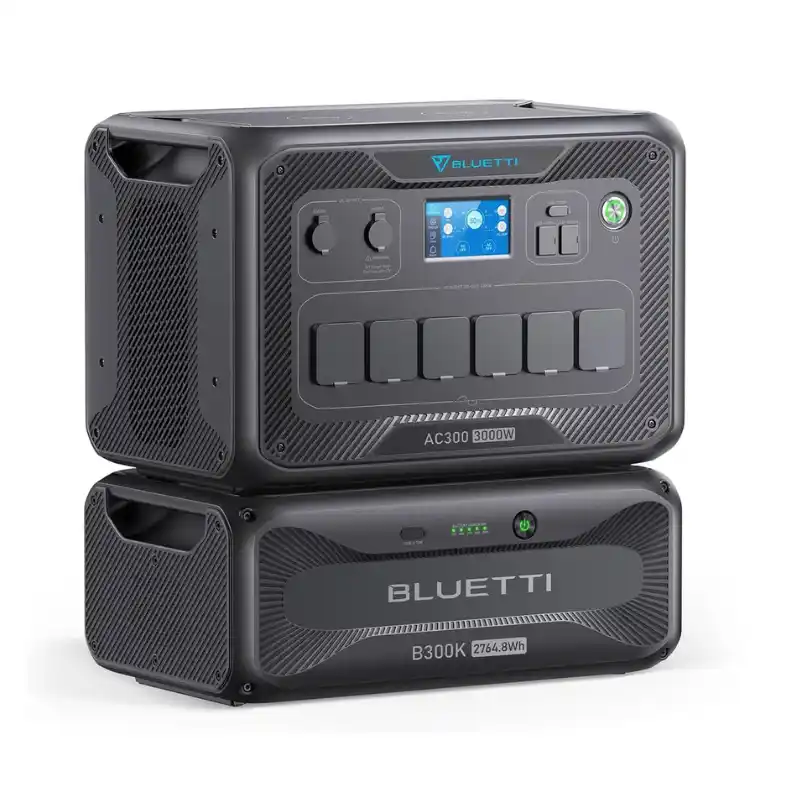
Every other machine reviewed on this site is one object. This is two: an inverter head with no cells inside it, and a battery module that plugs in underneath.
That architecture is the whole point. The head is bought once, and the capacity grows around it, up to four modules, without ever replacing the electronics.
The cells have a 6,000-cycle rating, the highest in this dataset, and the machine runs at 44 decibels with the cleanest electrical output of anything at this capacity.
Set against that, 2% of the pack disappears each hour the inverter sits awake, and the head and module together weigh 127 pounds.
Best for: Emergency Home Resilience as a permanent installation, and anyone who wants to buy capacity in stages rather than all at once.
Not for: portability of any kind, or leaving armed and unattended for weeks.
Key Stats
| Badge | Stats |
|---|---|
| Battery chemistry and longevity | LiFePO4 | 6,000 cycles |
| Continuous AC power output | 3,000W AC | 6,000W peak |
| Energy storage capacity | 2,764Wh | 2,620Wh usable |
| Modular architecture | Head unit + up to 4 batteries |
| Rapid AC wall recharge | 3,000W input | 5,400W dual |
| Uninterrupted emergency backup | 9.6ms UPS | Manual arm |
| Maximum solar input and MPPT | 2,400W solar | 150V ceiling |
| Inverter waveform quality | 0.70% THD | 990mv noise |
| Low-noise operational level | 44dB | Whisper quiet |
| Ultra-fast USB-C power delivery | 100W USB-C PD |
Introduction
Buying a power station usually means buying a fixed amount of energy and a fixed amount of electronics, welded together in one case. When your needs grow, you buy both again.
Bluetti separates them here. The AC300 head contains the inverter, charge controllers, display, and ports, but no cells whatsoever. It remains inert until a B300K module is attached beneath it; it can accept up to four.
Those modules have a 6,000-cycle rating, the highest in this dataset, which equates to roughly 16 years at 1 cycle per day.
What It Can Actually Run
The head sustains 3,000 watts and peaks at 6,000 watts, easily handling heavy household loads.
With one B300K attached, the pair is rated at 2,764 Wh, and the sockets returned 2,620Wh. Everything below is calculated from 2,620Wh.
- Refrigerator at 150W: better than seventeen hours.
- CPAP at 40W, humidifier off: sixty-five hours.
- Starlink dish at 50W: fifty-two hours.
- Laptop at 70W: around thirty-seven charges.
The waveform is the standout: 120 volts, 0.70% distortion, and 990 mV of electrical noise. All three are among the cleanest figures at this capacity.
Charging and Smart Features
Mains input reaches 3,000 watts, and mains plus panels together climb to 5,400 watts when solar is prioritised, one of the higher combined ceilings recorded here.
Solar draws 2,400 watts across a 12-150-volt range at 12 amps per channel, which permits a genuine series string.
The changeover took 9.6 milliseconds (brisk enough), but the inverter waits for manual intervention to be raised.
Premium price tier and good value tier. You are paying for the architecture, not for cheap watt-hours.
Charging Speed Benchmarks
How the Bluetti AC300 with a single B300K module compares on recharging speed with the rest of the 2,000Wh to 3,000Wh capacity class. The 26 units in that bracket average 1,641W of wall input and 1,123W of solar. All ratings below are set within the class, so they measure this machine against its own size peers only.
Almost nothing at this capacity charges faster from a socket. 3,000W is nearly double the 1,641W class average and well past the 1,800W High threshold, with combined AC and solar reaching 5,400W. Against the 2,764Wh the head and one module hold, that is roughly 0.9 hours to full. The headroom is the point rather than the speed: add a second, third or fourth B300K underneath and the charger still refills the stack in a sensible window, which a 1,800W input would not.
Solar matches the 2,400W class maximum, more than double the 1,123W class average and a clear High rating, with a 150-volt ceiling behind it for genuine series strings. A full pack from panels takes about 1.2 hours in strong light. The constraint is current rather than voltage: twelve amps per channel favours high-voltage strings over wide parallel banks, so plan the array around fewer panels wired in series rather than many wired side by side.
Nothing we have reviewed in this class charges faster. The Bluetti Apex 300 is the only unit in the database that beats it, drawing 5,000W from the wall against 3,000W here while matching the same 2,400W of solar, which fills a comparable 2,764Wh pack in around 0.6 hours. Short of that, the AC300 stack is the fastest charging machine at this capacity, and the modular architecture is the reason to stay with it.
Real Capacity: What You Actually Get
Delivery is respectable rather than exceptional, and the two paths diverge slightly.
The outlets delivered 2,620 Wh against a rated 2,764 Wh, which is 85% and squarely on the class line.
The twelve-volt route returned 2,361 Wh, or 83%, so the AC side is marginally more efficient than the twelve-volt side here.
Standby is the weak figure. Awake with nothing drawing, the pair sheds about 2% per hour, which sits right at the threshold I consider acceptable. Left armed for a fortnight,t it would be close to empty.
One inconsistency worth noting: the grading sheet lists 87% AC and 77% D, C, whereas bench testing recorded 85% and 83%. I have used the tested figures throughout.
My takeaway: 2,620Wh with one module attached, and that number roughly doubles or triples as you add more. But budget for the 2% hourly standby drain; this is not a machine to arm and forget for a month.
Power Output and Surge: What It Can Turn On
Three thousand watts continuous is a genuine whole-circuit rating, and 6,000 watts of surge leaves ample room for any domestic motor start.
What distinguishes this machine is the quality of that power rather than the quantity. A distortion of 0.70% is among the lowest recorded at this capacity, and electrical noise of 990 mV is roughly half of what most machines this size produce.
For a CPAP motor, a workstation, audio equipment, or anything with a switching supply, that combination genuinely matters, and very few machines at this size deliver it.
The port array is more ordinary: a single 100-watt USB-C output, alongside a 400-watt app-controlled DC port.
Real Appliance Runtimes
2,620 watt-hours with a single battery module, measured against this site’s fixed appliance list.
| Appliance | Power Draw | Runtime | What That Means |
|---|---|---|---|
| Full-size refrigerator | 150W | About 17.5 hours | Most of a day, and this figure scales with each module added. |
| CPAP machine (no humidifier) | 40W | About 65.5 hours | Sixty-five hours on the cleanest waveform at this capacity. |
| Starlink dish | 50W | About 52.4 hours | Two days of connection before it needs anything. |
| Pellet grill or smoker | 100W | About 26.2 hours | Twenty-six hours of smoking on one module. |
| Laptop (70W) | 70W | About 37 recharges | One port, taken sequentially. |
Read these as a starting point rather than a ceiling. Every figure here increases by B300 K for each BB300 K added, which is the difference between this machine and a sealed unit of the same capacity.
Recharging: Wall and Solar
From a Wall Outlet
Three thousand watts from a socket can refill a single-module system in about an hour, which is quick for its capacity.
Combining mains and panels lifts the ceiling to 5,400 watts, one of the higher combined figures recorded on this site, and that headroom matters increasingly as modules are added and the pack grows.
The rate is adjustable in steps, so an unhurried overnight charge is available when time is not the constraint.
From Solar Panels
Panels feed in at 2,400 watts across a 12 to 150-volt range, split into two channels at 1,200 watts each and 12 amps apiece.
A ceiling of 150 volts lets a string carry four or five rigid panels (the arrangement any permanent array prefers) since the same power arrives at lower current, through thinner cable, with less wasted heating.
Twelve amps per channel is modest, so the design plainly favours voltage over current. Wire high, and it works well; wire a low-voltage parallel bank, and you will hit the current limit before the wattage limit.
Panels need never come off, and the system keeps powering things while it fills.
Blackout Backup: The Part I Care About Most
The handover is quick, the inverter is passive, and the standby drain makes that combination more awkward here than on most machines.
At 9.6 milliseconds, it clears the eleven-millisecond bar easily, and no processor would notice the changeover.
Nothing here self-arms. The inverter comes up only when a person raises it and stays up only when left alone.
At 2% an hour, that is genuinely expensive. A week armed and untouched costs most of a single module’s charge, so on a system designed to be installed and left alone, this specification is most at odds with its own purpose.
Why this matters to me: a permanently installed system that must be armed by hand and then bleeds 2% per hour is asking you to choose between readiness and charge. Machines are a price tier below; solve this properly, and it is the one place the architecture does not save it.
Noise and Living With It
Forty-four decibels under load, which is quiet for a 3,000-watt inverter and comfortably beneath the threshold for a room where anyone sleeps.
That figure matters more here than on most machines, because a modular system is meant to be installed in a permanent location; often a utility room sharing a wall with living space.
The weight is the counterweight, and it is substantial. One hundred and twenty-seven pounds for the head and one module together, 57 kilograms, and every additional B300K adds more.
It does at least separate into two liftable pieces rather than one immovable object, which is a genuine practical advantage over a sealed machine of similar mass. It speaks Wi-Fi and Bluetooth, and Bluetti keeps a phone line open for warranty matters.
Where It Falls Short
Three limitations, and the first is the one that sits most awkwardly against the machine’s purpose.
1. Two Percent Standby Drain
Right at the threshold I treat as acceptable, and awkward on a system designed to be installed and forgotten.
Armed and untouched for a fortnight, a single-module system would be close to flat. Combined with an inverter that will not wake itself, that forces a choice between a machine that is ready and one that is charged.
2. One Hundred and Twenty-Seven Pounds
The head and one module together, with every additional battery adding more. This is an installation, not equipment.
The mitigation is real, though: it splits into two liftable components rather than one dead weight, making it considerably easier to get into a basement or up a step than a sealed machine of the same mass.
3. Premium Price for Good Value
Per watt-hour, this sits in the good-value tier, where several machines at this capacity reach exceptional levels.
What the premium buys is a modular architecture, a 6,000-cycle rating, and clean output. If you ever run only one module, you are paying for expansion you will never use.
How It Compares
The natural comparisons are the Anker SOLIX F3000 and the Pecron E3600LFP, both sealed units with a similar capacity.
| Feature | Bluetti AC300 + B300K | Anker SOLIX F3000 | Pecron E3600LFP |
|---|---|---|---|
| Price tier | Premium | Upper mid-range | Upper mid-range |
| Value tier | Good | Exceptional | Exceptional |
| Rated capacity | 2,764Wh | 3,072Wh | 3,072Wh |
| Usable through AC | 2,620Wh (85%) | 2,760Wh (89%) | 2,760Wh (89%) |
| Architecture | Head + up to 4 modules | Sealed | Sealed |
| Battery cycles | 6,000 | 4,000 | 3,500 |
| Distortion (THD) | 0.70% | 1.40% | 1.20% |
| Electrical noise | 990mv | Over 2,000mv | 1,750mv |
| Idle drain per hour | 2.0% | 0.66% | 1.16% |
| Fan noise | 44dB | 53dB | 52dB |
| Weight | 127 lbs | 91 lbs | 79 lbs |
Both sealed rivals convert four points better, weigh far less, and hold their charge two to three times longer on standby. In a straight one-on-one comparison, they win.
What neither can do is grow. Adding capacity to a sealed machine means buying another complete machine, electronics included. Here, it means buying a battery.
The AC300 also runs nine decibels quieter, with half the electrical noise and 2,000 more cycles, which, for a permanent installation beside a living space, are exactly the right things to be better at. Buy a sealed unit if the capacity you want today is the capacity you want forever. Buy this if it is not.
Who Should Buy It, and Who Should Skip It
Buy It If
- You want to buy capacity in stages rather than committing to a final figure now.
- The system will be installed permanently, ideally near the living space where 44dB matters.
- You run sensitive equipment and want the cleanest output available at this capacity.
- Long cell life is a priority, with 6,000 cycles being the joint-best recorded here.
Skip It If
- The capacity you want today is the capacity you will always want.
- It has to be left armed and unattended for weeks at a time.
- Cost per watt-hour is your deciding metric.
- Anything about the installation requires moving it afterwards.
The Bottom Line
The architecture is the argument. Separating the electronics from the cells means the expensive half of the system is bought once, and capacity is added in modules as budget and needs allow.
Around that sit genuinely strong figures: the joint highest cycle rating in this data, the cleanest output at this capacity, 44 decibels, and combined charging of 5,400 watts.
The 2% hourly standby drain is the discordant note because it runs counter to the permanent, set-and-forget installation the whole design points to. Plan to keep it on a charger, or accept that it needs to be checked.


There are no reviews yet.