
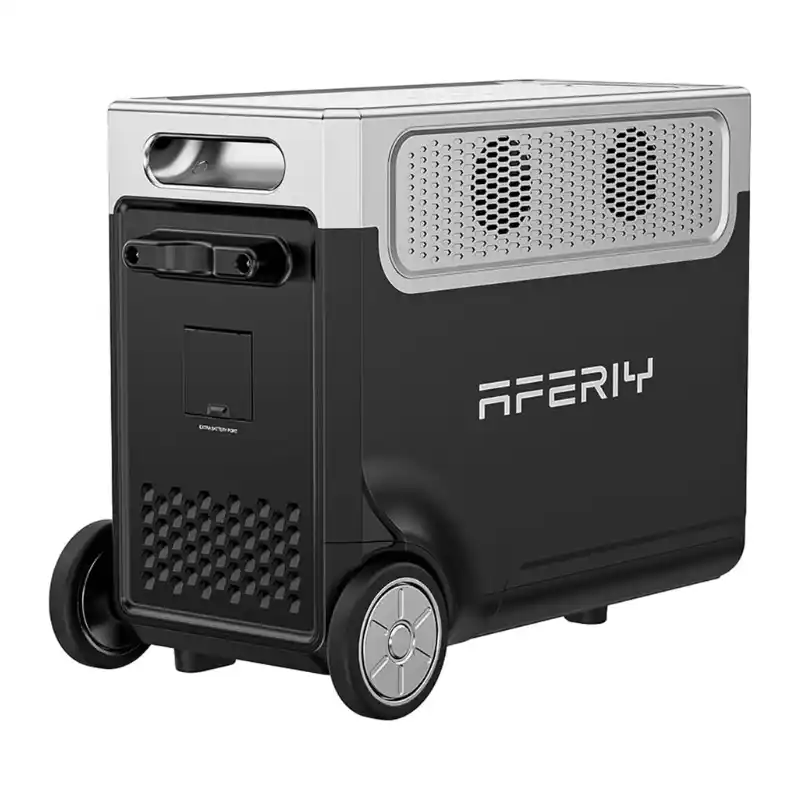
AFERIY P310 Review

The AFERIY P310 delivers 3,630Wh of its 3,840Wh rating, a 94% conversion, beaten by only one machine we have measured. Behind it is a 3,600W inverter, 2,000W of solar accepted up to 160 volts, and seven years of coverage on 4,000-cycle cells.
My Quick Verdict
Two figures here would top most buying decisions on their own. 94% of the rated pack reaches you as usable energy, a figure that only one machine in this entire dataset exceeds. And it carries a seven-year warranty, longer than anything else measured for this site.
It does both at an exceptional value tier and holds nearly four kilowatt-hours.
Then you switch it on. Sixty-three decibels is the highest fan reading we have seen in our tested power stations.
And the wall input tops out at 1,500 watts, which on a 3,840Wh pack means the better part of three hours from empty.
Best for: Solar-powered installations in outbuildings and workshops where nobody has to listen to it.
Not for: any indoor space where people are present, or for storm preparation with short notice.
Key Stats
| Badge | Stats |
|---|---|
| Battery chemistry and longevity | LiFePO4 | 4,000 cycles |
| Warranty coverage | 7 years | Longest measured |
| Continuous AC power output | 3,600W AC | 5,500W peak |
| Energy storage capacity | 3,840Wh | 3,630Wh usable |
| Rapid AC wall recharge | 1,500W input | Five-stage |
| Uninterrupted emergency backup | 10.1ms UPS | Manual arm |
| Maximum solar input and MPPT | 2,000W solar | 160V, 20A |
| Ultra-fast USB-C power delivery | 100W USB-C PD |
| Low-noise operational level | 63dB | Loudest measured |
| High-output DC | 350W XT60 |
Introduction
Conversion efficiency is the quietest thing you pay for and the hardest to see. A pack rated at 3,840 Wh that hands back 84% leaves 614 Wh behind as heat, which is the equivalent of a whole small power station’s worth of energy you bought and will never use.
This one gives back 94%, a figure bettered by a single machine across the whole set. On a pack this size, that difference is worth several hours of refrigerator time against a typical rival.
Behind it are lithium iron phosphate cells rated for 4,000 cycles and covered by a seven-year warranty. Five years is the class standard here, and several units manage three.
What It Can Actually Run
The inverter has a 3,600-watt continuous rating, with 5,500 watts available in a burst. The continuous figure is at the top of its class; the surge headroom is more modest than that offered by most machines of this size.
The label reads 3,840 Wh, and the sockets returned 3,630 Wh. Every figure below is calculated based on 3,630 Wh.
- Refrigerator at 150W: better than twenty-four hours.
- CPAP at 40W, humidifier off: over ninety hours.
- Starlink dish at 50W: seventy-two hours.
- Laptop at 70W: around fifty-one charges.
Output measured 119 volts with 1.50% distortion, both acceptable, though electrical noise exceeded 2,000 mV, the noisier end of this field.
Charging and Smart Features
The main input is limited to 1,500 watts across five selectable stages. The rate control is the finest offered by any machine reviewed here; the ceiling behind it is not.
The array can deliver 2,000 watts, accepting input from 11 to 160 volts at 20 amps. That voltage ceiling is among the highest recorded, and 20 amps is a generous current allowance to pair with it.
Handover measured 10.1 milliseconds, quick enough for any processor, though the inverter must be armed manually.
Dual charging behaves unusually: it exceeds 2,500 watts only when the pack’s state of charge is below 70%. Upper mid-range price tier, exceptional value tier.
Charging Speed Benchmarks
Input figures for the AFERIY P310 set against the Over 3,000Wh capacity class, a bracket of 16 machines whose mains charging averages 2,802W and whose solar averages 2,681W. Low, Average and High are calculated inside this class alone, so they rank the machine among comparable capacities rather than site-wide.
Wall charging is the weakest figure on this machine and the lowest recorded anywhere in the class. 1,500W is barely half the 2,802W class average, a clear Low rating, and against a 3,840Wh pack it works out at roughly 2.6 hours from empty. Five-stage rate control is genuinely the finest adjustment of any machine we have measured, which helps overnight, but it does not change the ceiling. Combined charging only exceeds 2,500W below about 70 percent state of charge, so the last third fills slowly.
Panels are where the design compensates. 2,000W is under the 2,681W class average earning an Average rating where the bracket ceiling is 6,400W, and it refills the pack in about 1.9 hours of strong light, comfortably quicker than the wall socket. The window is the well-judged part: 11 to 160 volts at 20 amps means a single foldable panel and a five-panel rigid series string both work on the same input without a second channel or an adapter.
Need mains charging that matches the pack size? The EcoFlow Delta Pro 3 takes 4,000W from a socket and 7,000W from both inputs together, which fills a larger 4,096Wh pack in around 1.0 hour against 2.6 here. Solar rises to 2,600W across two tracked paths. It costs considerably more per watt-hour, so this is the swap only if recovery speed is what the installation actually turns on.
Real Capacity: What You Actually Get
This is the section that carries the machine.
Put a meter on the outlets and measure 3,630 Wh against a claimed 3,840 Wh. That is 94%, and a single machine, across every capacity here, does better.
The twelve-volt path returned 3,596Wh, or 93%, which is within a point. Both routes are excellent, so you can organise loads around convenience rather than efficiency.
Standby costs around 1.0% an hour with the inverter awake, falling to 0.1% on DC. Solid figures, though not among the very best available.
My takeaway: Build every calculation on 3,630 Wh, an unusually large share of what the label promises. From an identical pack, a machine converting at 85% would give you roughly 350 watt-hours less, most of two hours of refrigerator time.
Power Output and Surge: What It Can Turn On
The continuous rating of 3,600 watts sits at the upper limit of the Heavy-Duty Household Class and comfortably handles multiple heavy loads at once.
Surge is where the specification is less generous. At 5,500 watts, the headroom above continuous is smaller than on most machines at this capacity, several of which offer 7,200 watts. It remains well beyond what a domestic compressor start demands, so this is a note rather than a warning.
Three hundred and fifty watts through the XT60 is a port worth having, especially when running a compressor fridge alongside a heater with no inverter involved.
USB-C is a single 100-watt port, thin for a machine of this capability, and electrical noise above 2,000 mV calls into question the reliability of sensitive equipment.
Real Appliance Runtimes
3,630Wh expressed as time, against the unchanging appliance set used in every review here.
| Appliance | Power Draw | Runtime | What That Means |
|---|---|---|---|
| Full-size refrigerator | 150W | About 24.2 hours | A full day and night on the fridge, before cycling extends it. |
| CPAP machine (no humidifier) | 40W | About 90.8 hours | Ninety hours of overnight use between charges. |
| Starlink dish | 50W | About 72.6 hours | Seventy-two hours of dish uptime. |
| Pellet grill or smoker | 100W | About 36.3 hours | Several long cooks on one charge. |
| Laptop (70W) | 70W | About 51 recharges | Fifty-one of them, taken one after another. |
These are among the longest runtimes recorded on this site, and 94% conversion is doing a meaningful part of the work. The constraint here is not what the machine holds but how slowly you can put it back.
Recharging: Wall and Solar
From a Wall Outlet
Fifteen hundred watts into a 3,840 Wh pack is the weakest charging-to-capacity ratio among any machine reviewed here.
From empty, that is close to three hours, whereas rivals at this capacity manage under an hour. If your scenario is a weather warning arriving with limited notice, this machine will not be full when it matters.
The five selectable rates offer the finest control anywhere in this data, a real benefit over years of cycling and no help at all against the clock.
Dual charging exceeds 2,500 watts, but only while the pack is under 70% charged. Above that threshold, it tapers, so the last third refills slowly regardless of what you have plugged in.
From Solar Panels
Given how slow the wall input is, the solar implementation is not a bonus here. It is the primary way this machine is meant to be refilled.
Panels feed in at 2,000 watts anywhere between 11 and 160 volts at 20 amps. That upper ceiling is among the highest measured,d and it permits five or six rigid panels in a single series string.
Twenty amps alongside it is generous, so a parallel bank delivers what it generates rather than being clipped.
The wide 11-volt floor means small foldables also work without a separate low-voltage channel, which several machines at this size require.
The array can remain permanently connected, and the unit runs loads throughout a charge.
Blackout Backup: The Part I Care About Most.
The backup here is competent hardware,e left half-configured, which by now is the most familiar shape of failure in this whole category.
At 10.1 milliseconds, the handover is brisk, brushing the edge of the excellent band and far inside the safety limit.
The inverter will not start on its own, so the machine must be switched on in advance and left running.
At 1.0%per hour, the standby cost is reasonable, though a week unattended still takes up most of a fifth of the pack.
Why this matters to me: the handover speed is genuinely good, but it only applies to a house with someone in it. On a machine this expensive to refill, being caught empty and unarmed is a worse outcome than on most.
Noise and Living With It
Sixty-three decibels under load. That is the highest fan reading of any machine measured for this site, at any capacity, from any brand.
In practical terms, it is a sustained conversational volume. Bedrooms, tents, RVs, offices, and any room where people are talking are all excluded outright if the conversation is audible through a closed door.
For a machine likely to live in a workshop or an outbuilding beside a solar array, that may not matter at all. It is worth being clear that the decision is made for you.
Weight is 88 pounds (40 kilograms), a two-person lift. And AFERIY runs no telephone support, so a seven-year warranty is administered entirely through email and web forms.
Where It Falls Short
Three limitations, and the first two decide where this machine can live and how it gets used.
1. Sixty-Three Decibels
The loudest reading in this entire dataset, and not by a narrow margin over the machines below it.
This is not a preference or a matter of light sleeping. It removes every indoor room where people spend time and will determine the purchase for most buyers before any other specification is considered.
2. Fifteen Hundred Watts of Wall Charging
On a 3,840Wh pack that is close to three hours from empty, and the worst charging-to-capacity ratio recorded here.
It also means solar is not optional. A machine this large, refilled slowly from a socket, depends on panels to be practical, and anyone without an array should understand that before buying.
Dual charging helps only below 70% state of charge, so the final third is slow, no matter what.
3. No Telephone Support, and Modest Surge Headroom
The longest warranty in this dataset has no phone line associated with it. Over seven years, that is a meaningful difference in how a fault gets resolved.
A surge of 5,500 watts is also below what most machines at this capacity offer, though still ample for domestic loads.
How It Compares
The natural comparisons are the Anker SOLIX F3000 and the Pecron E3600LFP, the two machines immediately below it in capacity.
| Feature | AFERIY P310 | Anker SOLIX F3000 | Pecron E3600LFP |
|---|---|---|---|
| Price tier | Upper mid-range | Upper mid-range | Upper mid-range |
| Value tier | Exceptional | Exceptional | Exceptional |
| Rated capacity | 3,840Wh | 3,072Wh | 3,072Wh |
| Usable through AC | 3,630Wh (94%) | 2,760Wh (89%) | 2,760Wh (89%) |
| Warranty | 7 years | 5 years | 5 years |
| Battery cycles | 4,000 | 4,000 | 3,500 |
| Wall charging | 1,500W | 3,840W | 3,600W |
| Solar input | 2,000W to 160V | 2,400W to 165V | 2,400W to 150V |
| Fan noise | 63dB | 53dB | 52dB |
| Phone support | No | Yes | Yes |
| Weight | 88 lbs | 91 lbs | 79 lbs |
On what you get and how long you keep it, the AFERIY leads clearly: 870 more usable watt-hours than either rival, five points better conversion, and two extra years of warranty.
On how you live with it, it loses just as clearly. Both rivals charge from the wall more than twice as fast, run ten decibels quieter, and have a telephone number behind the warranty.
So the split is unusually clean. Beside a large array in an outbuilding, where refilling happens in the sun, and nobody has to listen to it, the P310 delivers more energy per pound spent than anything at this size. Anywhere else, both rivals are the better machine.
Who Should Buy It, and Who Should Skip It
Buy It If
- You want the most usable energy per pound spent, nearly 4 kilowatt-hours.
- Solar is your primary recharge route, which the slow wall input effectively requires.
- Warranty length matters, and seven years is worth administering by email.
- The machine lives in an outbuilding, workshop, or vehicle bay.
Skip It If
- It will be anywhere near people. Sixty-three decibels settle that.
- You need it full quickly when a warning arrives.
- The house must be protected while empty.
- You want a telephone number to call over seven years of ownership.
The Bottom Line
On the two questions that matter over a decade of ownership (how much of the pack reaches you and how long the maker stands behind it), the P310 leads everything in this size and does so at an exceptional value tier.
On the two questions that define daily life with a machine (where it can live and how fast you can refill it), it is the worst performer in its class.
Those are not competing opinions. They are two accurate descriptions of the same machine, and which one governs depends entirely on whether it will sit beside an array in an outbuilding or anywhere a person might be sitting.


There are no reviews yet.