AFERIY power stations tested. Seven-year warranties, 91 to 94 percent measured conversion, and the noise and support trade-offs that come with them.
AFERIY holds the longest warranty in our entire database at seven years on both machines, against a market standard of five.
It also converts exceptionally well, returning 91% and 94% of rated capacity at the outlets, and prices at $0.31 to $0.32 per watt-hour, which is among the best value anywhere.
The costs are specific: no telephone support on either machine, and the P310 is the loudest unit in our database at 63dB.
Editor's Choice
AFERIY Power Stations reviewed below link to their full review, where you will find measured runtimes, the ten-category score breakdown, and complete specifications. This page is for choosing between them.
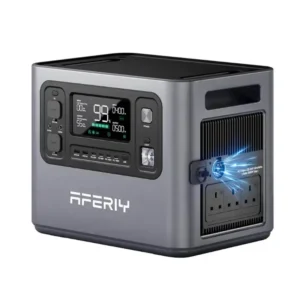
The AFERIY P280 delivers 1,880 Wh of its 2,048 Wh rated capacity to the sockets, a 91% conversion rate that is the best at this size. It runs a 2,800 W inverter with a 6,000 W surge, accepts 1,200 W of solar power across dual ports, and carries a seven-year warranty on 4,000-cycle cells.
Two numbers here are unmatched anywhere in this dataset: 91% conversion at the sockets, which is 120 to 140 watt-hours more usable energy than its closest rivals squeeze from identical nominal capacity, and a seven-year warranty where five is the class standard and several units manage three. Those cover how much you get and how long you keep it, and no other unit leads on both; while this one sits a price tier below the rivals it beats. Around them are a 2,800-watt inverter, 1,200 watts of solar across two independent ports, five-stage charging finer than anything else reviewed here, and 4,000-cycle cells. Then the firmware lets it down. The 8-millisecond crossover is genuinely quick and entirely conditional, because the inverter will not arm itself or guard a house unless someone is in it to switch it on. And at 57 decibels, the fans decide where it lives before you do. Put it in a garage, a workshop, or a vehicle,e and nothing at this capacity gives you more for the money. Ask it to sit in a cupboard and look after the house alone, and it can do so
Battery safety and chemistry (LiFePO4, 4,000 cycles)
10
Real-world efficiency and output (91% AC, 89% DC, 0.66% idle)
9.5
UPS and EPS switchover (8ms, no self-arming)
7.5
Port selection and distribution (dual 140W USB-C, 340W XT60)
9.5
Solar charging and MPPT (1,200W across dual ports)
9.5
AC recharge speed (1,800W, five-stage)
9.5
Noise and thermal management (57dB)
6
Portability and build quality (47 lbs)
7.5
Expandability and ecosystem (expansion supported)
9
Smart app and interface (Wi-Fi and Bluetooth)
7.5
PROS:
Conversion of 91% through the sockets, the best AC result recorded at this capacity.
A seven-year warranty, two years longer than anything else reviewed on this site.
Solar input of 1,200W across two independent 600W ports at 20 amps each.
A 2,800W sustained and 6,000W peak inverter, among the largest at this capacity.
Five-stage mains charging, the finest rate control of any unit reviewed here.
Cells rated to 4,000 cycles with standby loss of 0.66%pern hour, and dual 140W USB-C ports.
CONS:
The inverter cannot arm itself, so an 8ms crossover only helps when somebody switches it on.
Fans at 57dB, loud enough to exclude bedrooms, tents, and quiet offices.
AFERIY operates no telephone support, despite the longest warranty here.
The measured output of 117 volts sits at the bottom edge of the acceptable band.
Published weight figures are inconsistent between imperial and metric.
The 55-volt solar ceiling is marginally lower than the 60 volts most rivals allow.
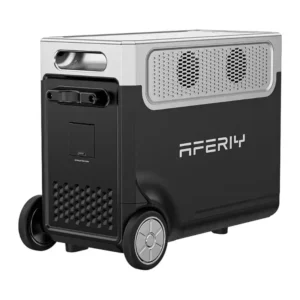
The AFERIY P310 delivers 3,630Wh of its 3,840Wh rating, a 94% conversion, beaten by only one machine we have measured. Behind it is a 3,600W inverter, 2,000W of solar accepted up to 160 volts, and seven years of coverage on 4,000-cycle cells.
Two numbers make a strong case for this machine, and two more take it apart. It converts 94% of its rated capacity into usable energy, beaten by exactly one unit across this entire dataset, and it carries a seven-year warranty, while five is the class standard and several units offer three; both at an exceptional value tier, for nearly four kilowatt-hours. Then the fans, at 63 decibels (nothing else measured at this site runs louder), eliminate every indoor space people actually occupy. And the wall input stops at 1,500 watts, the poorest charging-to-capacity ratio here, meaning close to three hours from empty and a machine that genuinely depends on its panels rather than merely benefiting from them. The solar side is well judged for that: 2,000 watts to 160 volts at 20 amps, with a low enough floor that foldables work too. Put it in an outbuilding beside a large array where nobody has to hear it, and it delivers more energy per pound spent than anything at this size. Bring it indoors,s and it is unusable.
Battery safety and chemistry (LiFePO4, 4,000 cycles)
10
Real-world efficiency and output (94% AC, 93% DC, 1.0% idle)
9.5
UPS and EPS switchover (10.1ms, no self-arming)
7
Port selection and distribution (100W USB-C, 350W XT60)
8.5
Solar charging and MPPT (2,000W, 11–160V at 20A)
9.5
AC recharge speed (1,500W into 3,840Wh, five-stage)
6
Noise and thermal management (63dB)
4
Portability and build quality (88 lbs)
4
Expandability and ecosystem (expansion support)
9
Smart app and interface (Wi-Fi and Bluetooth)
7.5
PROS:
Conversion of 94%, beaten by only one machine across this entire dataset.
A seven-year warranty, longer than anything else measured for this site.
Solar to 160 volts at 20 amps, with an 11-volt floor so foldables work without a separate channel.
Cells rated to 4,000 cycles and 3,630Wh of usable energy at an exceptional value tier.
Five-stage charge control is the finest rate adjustment offered by any machine here.
A 350W XT60 output and a 3,600W inverter at the top of its class.
CONS:
Sixty-three decibels is the loudest fan reading recorded anywhere in this data.
Wall charging at 1,500W into a 3,840Wh pack takes close to three hours to fully charge from empty.
AFERIY operates no telephone support behind that seven-year cover.
Dual charging exceeds 2,500W only below 70% state of charge, so the last third refills slowly.
The inverter will not arm itself, so an empty house is unprotected.
A surge of 5,500W is below the 7,200W most machines at this capacity provide.
Strengths and Weaknesses
Assessed across all our AFERIY-reviewed power stations rather than on any single model.
What this brand does well
Where it falls short
Seven-year warranty on both machines, the longest term we have recorded from any brand.
No telephone support on either machine. Every warranty claim across those seven years is handled by email or web form.
Conversion of 91% and 94%, among the strongest figures in our database.
The P310 reads 63dB, the loudest machine we have measured anywhere. The P280 is not far behind at 57dB.
Excellent value at $0.31 and $0.32 per watt-hour, comfortably beating most household names.
Only two machines in the range, both above 2,000Wh. No compact or camping option exists.
Both machines have working transfer functions at 8.0 and 10.1ms, comfortably inside the reliable band.
The P310's surge is 5,500W on a 3,600W inverter, a 1.5x margin that is tighter than most machines at that capacity.
Five selectable charging rates on the P280, the finest control we have recorded.
Neither machine is split-phase, so anything on a two-pole breaker is out of reach.
LiFePO4 rated at 4,000 cycles on both, and expansion support on both.
Brand recognition is low, which affects resale value even where the machine measures better than a rival.
Which Model Is Right for You?
Camping and Tailgating
The P280 at 47 pounds is the more portable of the two, with 2,800W continuous and 6,000 W surge, which covers an RV air conditioner comfortably. At 57 dB, it belongs outside the sleeping area rather than beside it.
The AFERIY P280 delivers 1,880 Wh of its 2,048 Wh rated capacity to the sockets, a 91% conversion rate that is the best at this size. It runs a 2,800 W inverter with a 6,000 W surge, accepts 1,200 W of solar power across dual ports, and carries a seven-year warranty on 4,000-cycle cells.
The P310 is the stronger choice on paper: 3,840Wh, 94% conversion, and a 10.1ms handover at $0.31 per watt-hour, which is genuinely excellent value at that capacity. The reservation is noisy. At 63 dB, it is the loudest machine we have tested, so plan on a garage or outbuilding rather than a utility room next to a bedroom.
The AFERIY P310 delivers 3,630Wh of its 3,840Wh rating, a 94% conversion, beaten by only one machine we have measured. Behind it is a 3,600W inverter, 2,000W of solar accepted up to 160 volts, and seven years of coverage on 4,000-cycle cells.
On 4,000-cycle cells, seven years of coverage is generous and unmatched in our data. If you expect to keep the machine for a decade, that is worth real money. Weigh it against the absence of telephone support. A shorter warranty you can invoke by phone is sometimes worth more than a longer one handled entirely by email.
What Sets This Brand Apart
AFERIY’s clearest advantage is conversion efficiency. Both machines return more than 90% of rated capacity at the outlets, where the field average sits closer to 85%. From a 3,840Wh pack, 94% delivers roughly 345 watt-hours more than 85% would.
Charging control is the second. The P280 offers five selectable charging stages, more than any other machine in our database, which lets you charge gently overnight to keep the cells cool or take everything the socket will give when a storm is coming.
Editors Brand Comparisons Summary (How This Brand Compares to Rivals)
Against
How they differ on our measurements
Choose this brand when
AFERIY vs Pecron
Both compete on measured value. Pecron is quieter at 53.9dB average against AFERIY's 60dB, and offers telephone support. AFERIY converts better and warrants for seven years against Pecron's inconsistent two to five.
Warranty length is your priority, and the machine lives where noise does not matter.
AFERIY vs Anker
Anker is quieter, has telephone support, and covers more capacities. AFERIY converts better, costs less per watt-hour, and warrants two years longer.
You want maximum efficiency and cover per pound spent, and can accept email-only support.
The Bottom Line
AFERIY measures better than its brand recognition implies. Conversion above 90% on both machines, seven-year warranties, 4,000-cycle cells, and prices around $0.31 per watt-hour make it one of the strongest value propositions we test.
What you accept in return is noise and email-only support. If the machine lives in a garage rather than beside a bedroom, that is a straightforward trade.
Frequently Asked Questions
Is AFERIY a good brand?
On measured data, better than its recognition suggests. Both machines convert above 90%, both use LiFePO4 rated for 4,000 cycles, and both carry seven-year warranties, the longest in our database. The two real drawbacks are noise, with the P310 at 63dB being the loudest machine we have measured, and the complete absence of telephone support.
How long is the AFERIY warranty?
Seven years on both the P280 and P310, which is the longest term of any brand in our database and two years beyond the power station's warranty standard of five. Note that we were only able to contact support via email and web form. There is no telephone line behind that cover.
Which AFERIY should I buy?
The P280 if you want portability and the finest charging control we have recorded. The P310 if you want capacity and the best conversion figure, at 94%. Both are priced at around $0.31 to $0.32 per watt-hour, so the choice is capacity and noise rather than value.
Are AFERIY power stations loud?
Yes, and this is the brand's clearest weakness. The P310 reads 63dB, the highest reading of any machine in our entire database, and the P280 reads 57dB. Neither belongs in a room where someone sleeps. A garage, workshop, or outbuilding suits them well.