
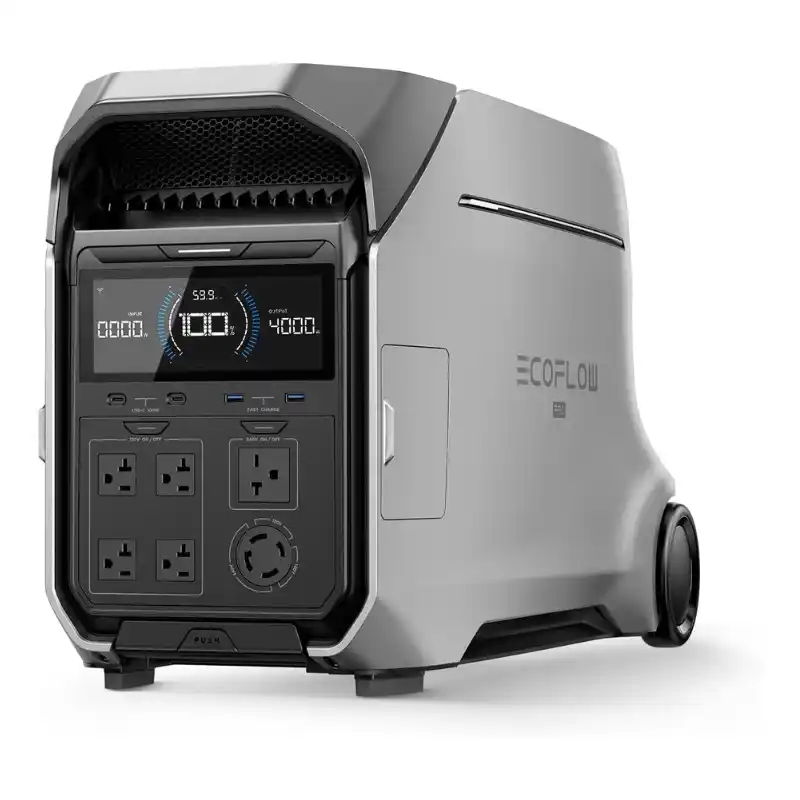
EcoFlow Delta Pro 3 Review

The EcoFlow Delta Pro 3 delivers 3,810Wh of its 4,096Wh rating through a 4,000W split-phase inverter that produces both 120V and 240V. It arms itself, hands over in 9.7ms, accepts 2,600W of solar power, and recharges at 7,000W from both inputs combined.
My Quick Verdict
Every unit reviewed on this site so far has been something you plug appliances into. This is the first that is wired into a house.
It produces 120 and 240 volts on split-phase, sustains 4,000 watts, and draws 4,000 watts from a wall socket. That combination puts it in the Industrial and Whole-Home Reserve Class, and it is the first machine here to reach that class.
It also converts 93% of its rated capacity, arms its own inverter, and hands over in 9.7 milliseconds.
What it asks is 113 pounds of floor space and a premium price tier, and it fits a USB-C port that would look ordinary on a machine costing a quarter as much.
Best for: Whole-circuit Emergency Home Resilience, transfer-switch installations, and anyone running 240-volt equipment off-grid.
Not for: portable use in any sense, or for buyers optimising for cost per watt-hour.
Key Stats
| Badge | Stats |
|---|---|
| Battery chemistry and longevity | LiFePO4 | 4,000 cycles |
| Continuous AC power output | 4,000W AC | 8,000W peak |
| Split-phase output | 120V and 240V |
| Energy storage capacity | 4,096Wh | 3,810Wh usable |
| Rapid AC wall recharge | 4,000W input | 7,000W dual |
| Uninterrupted emergency backup | 9.7ms UPS | Self-arming |
| Maximum solar input and MPPT | 2,600W solar | 150V ceiling |
| Ultra-fast USB-C power delivery | 100W USB-C PD |
| Low-noise operational level | 53dB | Moderate under load |
| Modular capacity expansion | Expandable | Extra battery port |
Introduction
There is a point where a power station stops being an appliance you carry to the problem and becomes infrastructure the problem is wired into. The Delta Pro 3 sits on the far side of that line.
The specification that puts it there is split-phase output. Most machines in this category produce 120 volts and nothing else, which is sufficient for sockets and lighting. This one produces 120 and 240, which covers well pumps, electric ranges, and anything else on a two-pole breaker.
Lithium iron phosphate cells sit behind the panel, warranted for five years with a 4,000-cycle claim; about eleven years at one full cycle per day.
What It Can Actually Run
Four thousand watts held continuously, eight thousand available in a burst. That sustained figure is more than double what most of the machines reviewed here manage and is enough to carry several heavy circuits at once.
The label reads 4,096Wh. A meter on the outlets returned 3,810 Wh, a -93% change, second only to one unit in the entire dataset. Every calculation below rests on 3,810Wh.
- Domestic refrigerator at 150W: better than twenty-five hours.
- CPAP at 40W with humidifier off: around ninety-five hours, which is four nights and most of a fifth.
- Starlink dish at 50W: over seventy-six hours.
- Laptop at 70W: fifty-four charges, though only one port to do them through.
The waveform measured 120 volts with 1.60% distortion, within limits, though not among the cleaner readings recorded here.
Charging and Smart Features:
Mains charging is extraordinary at 4,000 watts, filling the pack from empty in an hour despite its size. Combine wall and panels, and the ceiling rises to 7,000 watts.
Panels arrive in two configurations: 1,000 watts at 11 to 60 volts and 20 amps, and 1,600 watts at 30 to 150 volts and 15 amps, for a total of 2,600 watts. The high-voltage path allows a real series string.
Handover clocked in at 9.7 milliseconds, and the inverter raises itself, so an empty house stays covered.
Premium price tier, good value tier. You are not buying cheap watt-hours here; you are buying capability that the cheaper machines cannot reach.
Charging Speed Benchmarks
Where the EcoFlow DELTA Pro 3 sits on recharging within the Over 3,000Wh capacity class, drawn from the 16 machines in our charging database. Mean mains input in that bracket is 2,802W and mean solar input is 2,681W. All bands are calculated inside the class, so a Low solar rating here still represents more panel wattage than a High rating two classes down.
Mains charging of 4,000W beats the 2,802W class average comfortably and passes the 3,600W threshold into a High rating, bringing a 4,096Wh pack from empty in about 1.0 hour. Combined with panels the figure reaches 7,000W. On a machine wired to a transfer switch that speed is the point rather than a convenience, because a four-kilowatt-hour pack recovering slowly is a pack that never catches up across a multi-day outage. Class inputs run from 1,500W to 6,000W.
Solar accepts 2,600W over two independently tracked paths, one of which reaches 150 volts. That is a shade under the 2,681W class average and records as Average, well below the 6,400W class ceiling. Panels alone fill the pack in roughly 1.6 hours. Dual tracking is worth more than the headline figure on a permanent installation, since a roof string and a ground array at different angles are optimised separately instead of dragging each other down to the weaker one.
Running a large permanent array? The Pecron F5000LFP takes 6,400W of solar at 180 volts, nearly two and a half times the DELTA Pro 3, with 25 amps on each channel so voltage and current are both generous. It refills 5,120Wh from panels in around 0.8 hours. The trade is real: mains input falls to 3,600W and its harmonic distortion sits well above the working limit, so sensitive electronics should stay off its AC side.
Real Capacity: What You Actually Get
Conversion at this scale matters more than it does lower down the range, because the absolute quantities involved are larger.
The outlets returned 3,810 Wh against a claimed 4,096 Wh. 93%, and only one machine anywhere in this data returns more.
The 12-volt path produced 3,660 Wh, or 89%. Four points behind, so on this unit,t the AC outlets are the efficient route rather than the wasteful one.
Idling with the inverter live costs about 0.91% an hour, dropping to 0.25% on DC. For a machine this large, holding a charge for well over months of standby is what makes it a credible installed backup.
My takeaway: Plan on 3,810Wh. At 93%, the pack gives up very little on its way to the sockets. That efficiency compounds at this scale: the seven per cent lost here would amount to a small power station elsewhere.
Power Output and Surge: What It Can Turn On
The output section on this unit needs a different frame from the rest of the reviews on this site, because the question is no longer which appliances it can run.
Four thousand watts of sustained power covers a refrigerator, a freezer, a well pump, lighting, and networking simultaneously, with headroom to spare. Eight thousand watts of surge means no motor in a domestic property will be troubled by it.
Split-phase 240-volt output is the feature that sets it apart from everything reviewed before. Well pumps, electric ranges, workshop equipment, and anything else on a two-pole breaker become viable, and it is designed to be tied into a transfer switch rather than run through extension leads.
By comparison, the port array is disappointing for the price. One 100-watt USB-C output, where machines at a third of the price now fit two at 140 watts. The 400-watt app-controlled DC port is more useful.
Real Appliance Runtimes
Three thousand eight hundred and ten watt-hours, set against the appliance list this site holds constant.
| Appliance | Power Draw | Runtime | What That Means |
|---|---|---|---|
| Full-size refrigerator | 150W | About 25.4 hours | A full day and night on the fridge alone, before the compressor cycles it. |
| CPAP machine (no humidifier) | 40W | About 95 hours | The best part of a working week is overnight use. |
| Starlink dish | 50W | About 76 hours | Three days of connection with no grid behind it. |
| Pellet grill or smoker | 100W | About 38 hours | Several cooking sessions between charges. |
| Laptop (70W) | 70W | About 54 recharges | Fifty-four of them, taken one after another. |
These figures change the planning question entirely. Below two kilowatt-hours, you plan to cover an outage. At four, with 93% conversion, you plan around how you will put energy back in, because capacity is no longer the constraint.
Recharging: Wall and Solar
From a Wall Outlet
Four thousand watts from a wall socket is the largest mains input figure among everything reviewed on this site, and it refills a four-kilowatt-hour pack in about an hour.
For a machine of this size, that specification is what makes it practical. A unit this large charging at 1,500 watts would take most of a day, and the gap between a storm warning and the storm is rarely that long.
Bring both sources in at once, and the total climbs to 7,000 watts, near the top of the site’s recorded values.
From Solar Panels
Panel input totals 2,600 watts across two independent paths, and the split is deliberate.
One channel handles 1,000 watts from 11 to 60 volts at 20 amps; the domain of foldables and modest parallel banks. The other runs 30 to 150 volts at 15 amps for the remaining 1,600, and that is where a proper series string belongs.
That 150-volt path is what makes a permanent installation sensible: four or five rigid panels in series, lower current for the same power, thinner cable over a long run.
Because the two paths are tracked separately, a shaded array and a sunlit one do not drag each other down.
The array need never be unplugged, and output continues uninterrupted while the pack refills.
Blackout Backup: The Part I Care About Most
For a machine intended to be installed rather than carried, backup behaviour is the specification that determines whether the installation was worthwhile
Handover measured 9.7 milliseconds, under the eleven-millisecond mark where genuine protection begins. Nothing with a processor will register the transition.
The inverter arms itself, which matters more here than on any smaller unit. A machine wired into a transfer switch that needed somebody to press a button first would be close to pointless.
Losing 0.91% per hour while armed means permanent readiness costs almost nothing to count.
Why this matters to me: wired into a panel, a power station is only as good as its willingness to act unsupervised. This one hands over fast, wakes on its own, and holds its charge while it waits; the full set.
Noise and Living With It
Fifty-three decibels under load, sitting a little above the threshold for rooms with sleepers and unremarkable for a garage, basement, or plant room.
For a 4,000-watt inverter,r that is a reasonable result, though machines at half the output run seven decibels quieter.
Weight is the defining physical fact: 113 pounds, 55 kilograms. This is not so much a two-person life as a two-person job with a plan. Site it once and leave it.
Wi-Fi and Bluetooth are both present, EcoFlow’s well-developed app is running, and there is a number to ring.
Where It Falls Short
Nothing here disqualifies the unit for its intended job. Three things are worth weighing anyway.
1. One Hundred and Thirteen Pounds
This settles the portability question permanently. Moving it requires two people and forethought, and it is designed to be installed rather than relocated.
For a transfer-switch installation, that is the correct answer. Anyone imagining occasional camping use should look several capacity classes down.
2. A 100-Watt USB-C Port at This Price
One port at 100 watts, on a machine in the premium price tier, where units costing a fraction of it fit two ports at 140 watts.
It will charge a laptop slowly, one machine at a time. For a unit otherwise this comprehensive, it reads as an oversight rather than a compromise.
3. Good Value Rather Than Exceptional
Per watt-hour,r this sits in the good-value tier, where several machines at lower capacities reach exceptional.
The premium buys split-phase output, 4,000-watt charging, and a self-arming inverter, none of which the cheaper units offer. But if your loads are all 120 volts and you will never wire it in, you are paying for capability you cannot use.
How It Compares
The nearest comparisons are the Anker SOLIX F3000 and the Pecron F3000, both of which are immediately below it in capacity.
| Feature | EcoFlow DELTA Pro 3 | Anker SOLIX F3000 | Pecron F3000 |
|---|---|---|---|
| Price tier | Premium | Upper mid-range | Upper mid-range |
| Value tier | Good | Exceptional | Exceptional |
| Rated capacity | 4,096Wh | 3,072Wh | 3,072Wh |
| Usable through AC | 3,810Wh (93%) | 2,760Wh (89%) | 2,750Wh (89%) |
| Sustained output | 4,000W | 3,600W | 3,000W |
| Split-phase 240V | Yes | No | No |
| Self-arming inverter | Yes | No | No |
| UPS switchover | 9.7ms | 9.8ms | 8.6ms |
| Wall charging | 4,000W | 3,840W | 1,800W |
| Solar input | 2,600W | 2,400W | 1,600W |
| Weight | 113 lbs | 91 lbs | 63 lbs |
The Anker F3000 is the closest thing to a rival, matching this unit in charging speed and coming within 200 watts on solar. Two things stop it short: no 240-volt output and an inverter that waits to be switched on.
Those two gaps decide the comparison for anyone planning a wired installation. For a household running only 120-volt loads through sockets, the Anker delivers most of the capability at a better value tier.
The Pecron F3000 is a different proposition entirely: the cheapest energy in this whole dataset, in a body fifty pounds lighter, with wall charging less than half as fast. It is the value pick at three kilowatt-hours and has no substitute for a split-phase system.
Who Should Buy It, and Who Should Skip It
Buy It If
- You need a 240-volt output for a well pump, a range, or workshop equipment.
- The unit will be tied into a transfer switch or a subpanel.
- You want whole-circuit backup that operates on its own, even when nobody is home.
- You are building a permanent array and want a 150-volt series path.
Skip It If
- Every load in your house is 120 volts and always will be.
- The machine needs to move. At 113 pounds, it does not.
- Cost per watt-hour is your metric; lower units reach a better value tier.
- You need serious USB-C throughput for work equipment.
The Bottom Line
This is the first machine reviewed on this site to stop competing with power stations and start competing with home backup systems. Split-phase output, 4,000 watts sustained, 4,000 watts of charging, and an inverter that acts without being asked.
It is also the first time that honest advice has been given: most buyers do not need it. If your loads are sockets and lights, several units at half the price do that job well.
But if a two-pole breaker is anywhere in your plan, nothing below this point in the range is a candidate at all, and the Delta Pro 3 executes the role properly.


There are no reviews yet.