
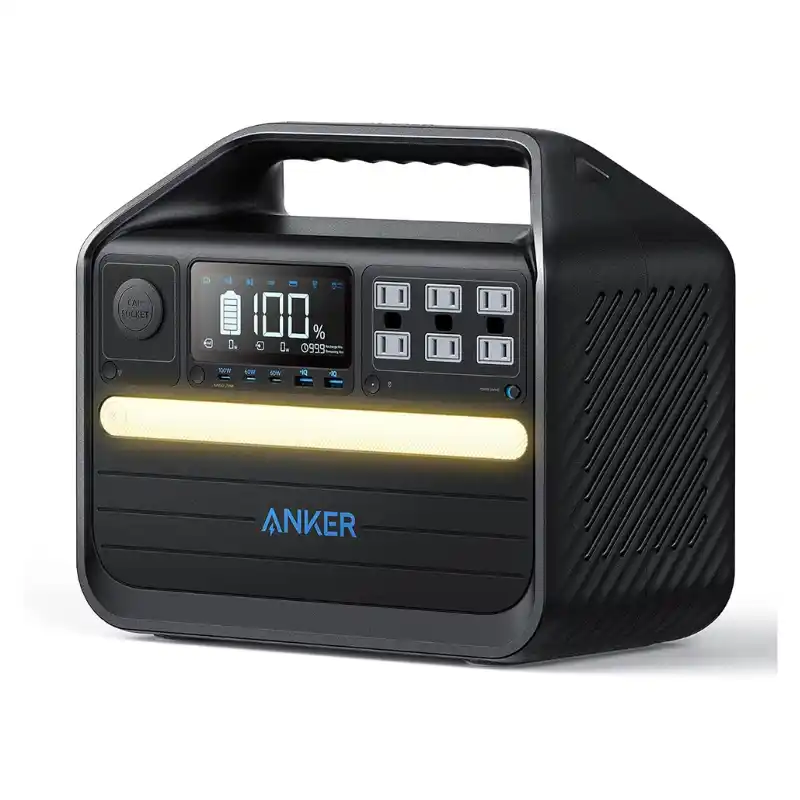
Anker 555 PowerHouse Review

The Anker 555 PowerHouse returns 900Wh of its 1,024Wh rating and 936Wh through DC. Output measures 110 volts with audible inverter noise; fans read 60dB, there is no transfer function, and charging runs at 200W through an external brick.
My Quick Verdict
Most machines that score badly on this site have one or two problems. This one has five, and they are not minor.
Its output measures 110 volts, which is below the accepted range. Its fans read 60 decibels. Its inverter produces an audible whine. It has no transfer function at all. And it charges at 200 watts through an external brick.
It converts well, and it delivers 91% through DC, which is the only reason this review is not shorter.
Best for: Twelve-volt camp loads on a machine bought at a steep discount, where nothing else about it matters.
Not for: backup, indoor use, motors, laptops on AC, or anyone comparing against current alternatives.
Key Stats
| Badge | Stats |
|---|---|
| Battery chemistry and longevity | LiFePO4 | 3,000 cycles |
| Continuous AC power output | 1,000W AC | 1,500W peak |
| Energy storage capacity | 1,024Wh | 900Wh usable |
| DC conversion efficiency | 91.4% through DC |
| Measured output voltage | 110V | Below the safe band |
| Emergency backup switchover | No UPS mode fitted |
| AC wall recharge | 200W via external brick |
| Maximum solar input and MPPT | 200W solar | 11–28V, 10A |
| Low-noise operational level | 60dB | Audible inverter whine |
Introduction
Anker builds some of the best machines in this category. The SOLIX S2000 returns 95% of its rated capacity and loses 0.08% per hour on standby, both the best figures we have measured.
The 555 PowerHouse is from an earlier generation, and placing the two side by side shows how far the brand has come.
This machine solves five problems that current machines have: undervoltage output, no transfer function, a 200-watt charging brick, 60-decibel fans, and an inverter that whines on its own.
Its pack is lithium iron phosphate, with a claimed 3,000 cycles and a 5-year warranty, the sole contemporary item on the sheet.
What It Can Actually Run
One thousand watts sustained, with only 1,500 in a burst. That 500-watt margin is among the tightest we have recorded, and it rules out heating appliances entirely.
From a 1,024 Wh label, the outlets produced 900 Wh. At 87.8%, that is a strong return. Everything below uses 900Wh.
- Refrigerator at 150W: six hours, though see the voltage caveat.
- CPAP without humidification at 40W: twenty-two and a half hours.
- Starlink dish at 50W: eighteen hours.
- A 45W twelve-volt camp fridge on DC: close to twenty-one hours, using the better 936Wh route.
The line read 110 volts, within the accepted band, alongside electrical noise above 2,000 mV and a whine audible from the inverter.
Charging and Smart Features
Wall input is 200 watts from an external charging brick at a single, fixed rate. From empty, that is more than five hours.
Panels contribute 200 watts and accept input from 11 to 28 volts at 10 amps. That 28-volt ceiling is among the narrowest we have measured and excludes most rigid panels.
Together, both inputs reach 300 watts, which changes little.
There is no UPS mode and no app. Upper mid-range price tier, luxury value tier.
Charging Speed Benchmarks
Grid and array charging on the Anker 555 PowerHouse, benchmarked against the 1,000Wh to 1,999Wh capacity class, using all 30 machines in our charging database. Mains input there averages 1,085W and solar averages 641W, with the rating bands set inside the bracket alone.
This machine sets the floor of the class on both channels. 200W through an external brick is the slowest mains input recorded in the bracket, a sixth of the 1,085W class average, and it needs roughly 5.1 hours to fill 1,024Wh. The brick is the deeper problem: it is the strongest single predictor of a slow machine in our whole dataset, and it is a component that can be lost or left behind, which turns a slow charge into no charge at all.
Panels match it exactly at 200W, again the class minimum and under a third of the 641W class average, rating Low where the bracket high is 1,400W. That is about 5.1 hours of unbroken sun, identical to the socket, and neither route completes inside a comfortable window. A 200W panel saturates this input on its own, so there is no array worth building here and no benefit to buying beyond a single folding panel.
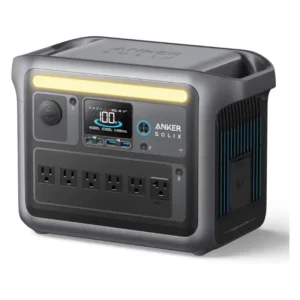
Want the current machine from the same brand? The Anker SOLIX C1000 charges internally at 1,350W with no brick to carry, nearly seven times this machine, and takes 600W of solar. A 1,056Wh pack comes back in about 0.8 hours on AC or 1.8 hours on panels, and it sits in the entry price tier with an expansion path this one does not offer.
Real Capacity: What You Actually Get
The conversion figures are the one genuinely strong part of this machine, and the DC side is the better of the two.
A meter on the sockets measured 900 Wh against a claimed 1,024 Wh. 87.8% sits above the class line.
The twelve-volt route returned 936 Wh (91.4%), nearly 4 points better. That is a strong figure, and it points to where this machine is actually useful.
Retention is decent as well; a percent an hour, armed, and on twelve volts, is nothing the meter could register.
Run twelve-volt equipment through the 145-watt car socket,et and you get most of the pack. Run AC loads, and you get less, at the wrong voltage.
My takeaway: Take 900 Wh from the outlets; 12 volts returns 936 Wh. The twelve-volt path is both more efficient and free of the voltage problem, which is the only way to use this machine well.
Power Output and Surge: What It Can Turn On
The inverter is the weakest at this capacity in two separate ways.
One thousand watts sustained is the lowest we have recorded at 1kWh, and 1,500 watts of surge gives only a 1.5x margin, among the tightest in our database. A refrigerator compressor demanding 1,200 watts at startup leaves very little room.
Then the voltage. At 10 volts under nominal conditions, a motor draws more current for the same output, heats up as a result, and ages faster. Resistive loads and switching supplies are unaffected.
Beyond the fans, the sheet logs a whine from the inverter itself. That means there are two sources of sound, and turning the load down quiets only one of them.
The 145-watt car socket is the only output worth using, and it comes close to 150 watts, enough to run a compressor fridge.
Real Appliance Runtimes
AC lines are based on 900 Wh; anything on 12 volts uses the more accurate 936 Wh measurement.
Two of these five loads avoid the inverter completely. On this particular machine, that is not a footnote; it is the recommended way to use it.
Recharging: Wall and Solar
From a Wall Outlet
At 200 W, a 1,024 Wh pack takes more than 5 hours to charge from empty, and it charges via an external brick rather than a built-in charger.
The brick travels separately, needs to be stored, and eventually wears out; without it, the machine cannot take mains power at all.
There is no adjustable rate, so slow is the only speed.
Dual charging boosts the combined charging rate to 300 watts, which shortens the wait to around 3.5 hours on a bright day, though it is still slow by current standards.
From Solar Panels
The solar input is the most restrictive we have measured at this capacity.
Two hundred watts between 11 and 28 volts at 10 amps. Every one of those three numbers is low.
The 28-volt ceiling is the binding constraint. Most rigid panels operate above 28 volts and will not work here, leaving you with low-voltage foldables wired in parallel.
Two hundred watts pushing a kilowatt-hour occupies most of a bright day, and the sheet notes plainly that panels alone miss the standard refill window.
The array can stay permanently connected, and pass-through charging is supported, both of which this implementation allows.
Blackout Backup: The Part I Care About Most
There is no automatic transfer function on this machine.
The grading entry records the UPS mode as not applicable. Whatever sits in the sockets goes dark at the precise moment the mains does.
That is the fifth of the five failures, and in some ways the most consequential, because blackout backup is why most people at this capacity are shopping.
Losing 1% per hour, it holds its charge until you want it. It simply will not respond on its own.
Why this matters to me: a machine with no transfer function, an undervoltage output, and a five-hour charger is not a backup system by any definition. Treat it as a camp battery with a good DC socket and nothing more.
Noise and Living With It
Sixty decibels under load, among the louder readings recorded here and beyond what any occupied indoor room will tolerate.
Worse, the grading sheet records audible noise from the inverter itself in addition to the fans. Very few machines in our database have both, and it means the sound does not fall away when the load drops.
Twenty-nine pounds, 13.1 kilograms, fair enough for a kilowatt-hour.
There is no app of any kind and no expansion port. Five years of coverage with a same-day response promise is the best thing here that isn’t a measurement.
Where It Falls Short
Five separate limitations, each of which would cost the machine points.
1. Output Measured 110 Volts
Under the band, this category is treated as safe. Motors compensate by drawing more current, run hotter as a result, and fail sooner over repeated cycles.
A refrigerator run on this machine through successive outages is having a harder life than one fed by a rival.
2. No UPS Mode
Nothing here catches the load; connected gear stops with the mains.
For a 1kWh machine sold in a category defined by backup, that specification determines everything else.
3. Two Hundred Watts Through an External Brick
Over five hours from flat, one speed only, and dependent on a component that lives outside the machine.
Current machines at this capacity charge internally at 1,200-1,440 watts and refill in about an hour.
4. Sixty Decibels Plus an Audible Inverter Whine
Two sources of noise rather than one. The fans exclude all occupied indoor rooms, and the inverter whine persists even at light load.
5. A 28-Volt Solar Ceiling and a 1,500W Surge
Most rigid panels will not work at all, and the grading data records that solar cannot refill the pack in the usual window.
The 1,500-watt surge on a 1,000-watt inverter is also among the tightest margins we have measured.
How It Compares
The most instructive comparison is between Anker’s current machine of a similar size and the strongest all-rounder at this capacity.
Anker’s own SOLIX C1000 is the machine that replaced this one, and the gap is enormous: nearly double the inverter, correct output voltage, a working transfer function, more than six times the wall charging, three times the solar, and an app.
There is no specification for which the 555 leads its own successor, except for DC conversion at two points.
The Bluetti Elite 100 V2 makes the point even harder, adding a self-arming inverter and 51-decibel fans at a lower price point. If either is available, this machine has no case at all.
Who Should Buy It, and Who Should Skip It
Buy It If
- It is heavily discounted, and you understand exactly what it cannot do.
- Your loads run on 12 volts, and 91.4% of them, along with a 145-watt socket, are genuinely useful.
- The machine lives in a vehicle or a workshop where no one hears the noise.
- Your existing panels are low-voltage foldables that fit under 28 volts.
Skip It If
- A refrigerator, freezer, or pump will run on it regularly.
- Blackout protection is any part of your reason for buying.
- You want it full in less than five hours.
- Anker’s own SOLIX C1000 is available and fixes all of these problems.
The Bottom Line
This machine converts well, and its twelve-volt side is genuinely strong. Those are the two honest things to say about it.
Everything else has been superseded. An undervoltage output, no transfer function, a 200-watt brick, 60-decibel fans with an inverter whine on top, and a solar input that excludes most panels.
Anker’s own current machine at this capacity fixes all five for a similar price. This one is worth considering only at a steep discount for twelve-volt work in a space where nobody has to hear it.


There are no reviews yet.