
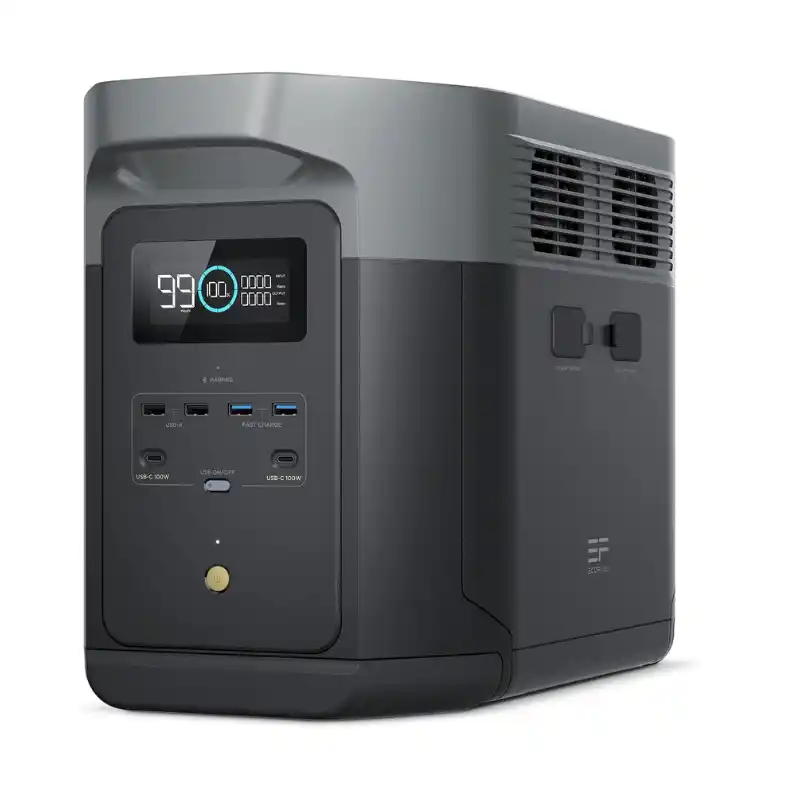
EcoFlow Delta 2 Max Review

The EcoFlow Delta 2 Max carries 2,048Wh behind a 2,400W inverter, runs at 46dB, and sheds only 0.8% of its charge per hour on standby. Distortion measures 0.90%, dual charging reaches 2,600W, and it weighs 51 pounds. Upper mid-range price tier, good value.
My Quick Verdict
The smaller Delta 2 reviewed on this site is the loudest unit in the entire dataset at 62 decibels, which excludes it from every room where anyone sleeps.
Scaling that design up to two kilowatt-hours solved the problem completely. The Delta 2 Max runs at 46 decibels, 16 decibels quieter than its sibling, and it does so behind a larger inverter.
It also holds a charge better than almost anything here, at 0.8% an hour, and produces one of the cleanest waveforms at this capacity.
What EcoFlow did not change is the crossover. At 17.5 milliseconds, it is the second slowest at this capacity, and the inverter still will not wake on its own.
Best for: Emergency Home Resilience in occupied homes, and Medical or CPAP Backup where quiet operation and clean output both matter.
Not for: protecting computers or network drives, particularly in an empty house.
Key Stats
| Badge | Stats |
|---|---|
| Battery chemistry and longevity | LiFePO4 | 3,000 cycles |
| Continuous AC power output | 2,400W AC | 4,400W peak |
| Energy storage capacity | 2,048Wh | 1,790Wh usable |
| Rapid AC wall recharge | 1,800W input | 2,600W dual |
| Uninterrupted emergency backup | 17.5ms UPS | Manual arm |
| Maximum solar input and MPPT | 1,000W solar | Dual 500W ports |
| Ultra-fast USB-C power delivery | Two 100W USB-C ports |
| Low-noise operational level | 46dB | Whisper quiet |
| Inverter waveform quality | 0.90% THD |
| Modular capacity expansion | Expandable | Extra battery port |
Introduction
Manufacturers rarely fix things quietly between siblings in the same generation, which makes this unit interesting to place beside its smaller relative.
The kilowatt-hour Delta 2 is the noisiest machine in this data, and the fans alone rule it out of bedrooms, tents,s and home offices. The two-kilowatt-hour version runs sixteen decibels quieter while carrying a bigger inverter, which is the opposite of what usually happens when a design scales up.
It also improved conversion and waveform quality. The cells remain lithium iron phosphate-rated at 3,000 cycles under five years of coverage, which is roughly eight years of daily use.
What It Can Actually Run
The inverter sustains 2,400W with a 4,400W peak, so a heating appliance runs with something alongside it.
Rated storage is 2,048Wh. Metered at the sockets, it returned 1,790 Wh, an 87% result. Figures below use 1,790Wh.
- Refrigerator at 150W: just under twelve hours.
- CPAP at 40W, no humidifier: nearly forty-five hours.
- Starlink dish at 50W: about thirty-six hours.
- Laptop at 70W: about twenty-five complete charges, split over a pair of ports.
Output measured 120 volts with 0.90% distortion, which is less than half the class average and among the best waveform figures at this capacity.
Charging and Smart Features
Wall input peaks at 1,800W with stepped rate control, and mains plus panels together reach 2,600W, one of the highest combined ceilings here.
Solar arrives as two independent 500W ports, rated for 11 to 60 volts at 15 amps each, totalling 1,000W.
Handover took 17.5 milliseconds, and the inverter needs to be armed manually. The array can remain attached, and the unit can power loads while charging.
Upper mid-range price tier; good value.
Charging Speed Benchmarks
Recharge speeds for the EcoFlow DELTA 2 Max compared with the full 2,000Wh to 3,000Wh capacity class, a bracket of twenty-six machines averaging 1,641W on mains and 1,123W on panels. Every rating is scored inside this bracket, so a Low figure here still represents a substantial charger by the standards of a smaller class.
At 1,800W the DELTA 2 Max charges faster than the 1,641W class average and closes out the Average band, with combined AC and solar reaching 2,600W among the highest dual figures at this size. Filling 2,048Wh at the mains rate alone takes about 1.1 hours as a best case. Given the class spans 470W to 5,000W, the honest reading is that EcoFlow put this unit comfortably in the upper half without chasing the fast-charging leaders.
Solar caps at 1,000W over a pair of separately tracked 500W inputs, a shade below the 1,123W class average and rates Average in a bracket whose ceiling is 2,400W. Expect roughly 2.0 hours from empty in good conditions. Independent tracking on each port is the practical advantage: a shaded array and a sunlit one are optimised separately instead of averaging each other down, which matters more on a fixed roof installation than the raw ceiling does.
Running a bigger array than 1,000W? The Jackery Explorer 2000 Plus accepts 1,400W of solar at 24 amps, 40 percent more than the DELTA 2 Max and generous on current rather than just voltage, which is what usually stops a large array delivering its rating. It reaches a full 2,042Wh pack from panels in about 1.5 hours. Wall charging is slower at 1,500W, so take this route when daytime solar is doing most of the work.
Real Capacity: What You Actually Get
Conversion improved noticeably over the smaller unit in this line, though the twelve-volt path went the other way.
The outlets delivered 1,790 Wh against a 2,048 Wh label; 87%. That is four points better than the kilowatt-hour Delta 2 manages and above the class line.
The DC route returned 1,676 Wh (an 81% return) and was six points behind the AC route. Running twelve-volt gear on a twelve-volt machine costs you energy rather than saving it.
Idle behaviour is a genuine strength. Awake with nothing attached, the pack sheds 0.8% per hour, which ranks near the top of this dataset and makes leaving the inverter armed a realistic habit.
My takeaway: Plan for 1,790 Wh and draw power from the AC outlets rather than the 12-volt side. The DC path is six points weaker here, which reverses the usual advice.
Power Output and Surge: What It Can Turn On
Sustained and peak ratings are conventional and sufficient. 2,400W covers a heating appliance with headroom, and 4,400W of peak handles compressor starts without approaching its limit.
The genuine achievement is what the unit sounds like while doing it. Forty-six decibels behind a 2,400-watt inverter is quiet by any standard at this capacity, and sixteen decibels better than the smaller unit in the same family.
Waveform quality is strong too, with 0.90% distortion and 1,535 mV of electrical noise. The distortion figure, in particular, is less than half of what much of this field produces, which matters for a CPAP motor or a workstation.
The car socket is rated 139 watts, ordinary for the class and short of the 150-watt mark.
Real Appliance Runtimes
Turning 1,790 Wh into running time, as measured on the appliance list this site applies throughout.
| Appliance | Power Draw | Runtime | What That Means |
|---|---|---|---|
| Full-size refrigerator | 150W | About 11.9 hours | A night and a good part of the following day. |
| CPAP machine (no humidifier) | 40W | About 44.8 hours | Four nights, quietly enough to sleep beside. |
| Starlink dish | 50W | About 35.8 hours | Thirty-six hours of connection off-grid. |
| Pellet grill or smoker | 100W | About 17.9 hours | An overnight cook with hours in reserve. |
| Laptop (70W) | 70W | About 25 recharges | Two 100W ports working together. |
The CPAP line is where this unit distinguishes itself. Four nights of runtime is common at this capacity; four nights at 46 decibels and 0.90% distortion is not.
Recharging: Wall and Solar
From a Wall Outlet
The main charger accepts 1,800W, with the rate adjustable in stages, so an empty pack fills in a little over an hour.
Bring both sources together, and the ceiling rises to 2,600W. Few machines this size go higher, and it counts for a lot when the forecast turns with only an hour to spare.
That combined ceiling is well clear of what either source can manage on its own, and it is a real step up from the smaller Delta 2, which cannot run both inputs at once.
From Solar Panels
Panel capacity totals 1,000W, split across two separate 500W inputs running 11 to 60 volts at 15 amps each.
Two ports rather than one have a practical benefit worth stating plainly: each is tracked independently, so an array in full sun and an array partly shaded do not average each other down.
The 60-volt ceiling is conventional, so long series strings stay out of reach, and 15 amps per port is adequate rather than generous.
In good condition, the pack recovers from empty in roughly two and a half hours, and the panels do not need to be unplugged afterwards.
Blackout Backup: The Part I Care About Most
This is the specification EcoFlow left untouched between the smaller unit and this one, and it shows.
Handover measured 17.5 milliseconds. That clears the 20-millisecond safety threshold with little to spare, and it is the second-slowest figure at this capacity.
At that speed, the result depends on what is plugged in. Some computer supplies bridge the gap,p and some restart, and you discover which during an outage rather than before one.
There is no self-arming mode either. What partly redeems it is how little the unit loses while armed. At 0.8% an hour,ur you can simply leave it running, an option that units bleeding two or three times faster do not really offer.
Why this matters to me: the low standby loss almost rescues the slow crossover, because you can afford to leave this one armed indefinitely. What it cannot rescue is the seventeen and a half milliseconds itself, and that is what keeps this unit away from anything with a processor.
Noise and Living With It
Forty-six decibels under load. Set against the 62 decibels of the smaller unit in the same family, that is a transformation rather than an improvement.
It sits well below the threshold for a room with a sleeper and for a machine expected to run a CPAP overnight, which is arguably its most important specification.
Fifty-one pounds, 23 kilograms, puts it in the middle of the pack for two kilowatt-hours; some way above the lightest machines here, and well under the heaviest.
The app runs over Wi-Fi and Bluetooth and is backed by EcoFlow’s mature software and a telephone support line.
Where It Falls Short
There are three limitations, and the first is the one EcoFlow chose not to address.
1. Seventeen and a Half Milliseconds
The second-slowest handover at this capacity, and inside the safety line by a margin thin enough to make the outcome equipment-dependent.
Paired with a manually armed inverter, this unit cannot be relied upon for automatic protection. A handful of machines at this size manage the handover in half that time and arm themselves without being asked.
2. The DC Path Is Six Points Weaker
81% through twelve volts versus 87% through the AC outlets. On most units here, the relationship runs the other way.
It removes the usual efficiency argument for moving loads onto DC, and it makes this a poor choice as the hub of a vehicle build.
3. An Ordinary Car Socket and a Shorter Cycle Rating
The pack is good for 3,000 cycles, compared to 4,000 on the best machines of this size. Stretched over ten years, that gap is real.
The 139-watt car socket is unremarkable and falls short of the 150 watts needed to power demanding twelve-volt accessories.
How It Compares
The natural comparisons are its own successor, the EcoFlow Delta 3 Max Plus, and the Anker SOLIX C2000 Gen 2, the strongest all-rounder at this capacity.
| Feature | EcoFlow Delta 2 Max | EcoFlow Delta 3 Max Plus | Anker SOLIX C2000 Gen 2 |
|---|---|---|---|
| Price tier | Upper mid-range | Upper mid-range | Upper mid-range |
| Value tier | Good | Good | Exceptional |
| Usable through AC | 1,790Wh (87%) | 1,740Wh (84%) | 1,760Wh (85%) |
| UPS switchover | 17.5ms | 7.9ms | 7.2ms |
| Self-arming inverter | No | Yes | Yes |
| Idle drain per hour | 0.8% | 0.9% | 0.41% |
| Distortion (THD) | 0.90% | 0.30% | 0.60% |
| Sustained output | 2,400W | 3,000W | 2,400W |
| Fan noise | 46dB | 42dB | 44dB |
| Battery cycles | 3,000 | 3,500 | 4,000 |
| Weight | 51 lbs | 48 lbs | 41 lbs |
Against its own successor, the picture is clear. The Delta 3 Max Plus crosses over in under half the time, wakes itself, runs a larger inverter, produces a third the distortion, and weighs less, all at the same price tier. The Delta 2 Max returns three points more usable energy, and that is the extent of its advantage.
Anyone choosing between them today should pay the same money for the newer unit unless the older one is discounted substantially.
The Anker SOLIX C2000 Gen 2 makes the case harder still, sitting a value tier better while crossing over in 7.2 milliseconds, arming itself, carrying a thousand more cycles, and weighing ten pounds less. What the EcoFlow offers is a higher combined charging ceiling and three conversion points.
Who Should Buy It, and Who Should Skip It
Buy It If
- The unit will run overnight in a room where someone is sleeping.
- You need clean output for a CPAP machine or sensitive electronics.
- It will be stored charged, and you want it still full months later.
- You want the fastest combined top-up from mains and panels together.
Skip It If
- A computer or network drive is what you are protecting.
- The house will be empty when the power goes out.
- Your loads are twelve-volt, where this unit gives back six points less.
- You can buy its successor for the same price tier, which you generally can.
The Bottom Line
Scaling the Delta 2 up to two kilowatt-hours fixed the flaw that defined it. Sixteen decibels quieter, better conversion, cleaner output, and dual charging that the smaller unit lacks entirely.
What survived the redesign is the crossover, and at 17.5 milliseconds on a manually armed inverter,r it keeps this machine out of the one job buyers most often want a power station for.
As a quiet, efficient, long-lasting battery for an occupied home, it is very good. As an automatic backup, it is not, and EcoFlow’s own successor fixed exactly that for the same money.


There are no reviews yet.