
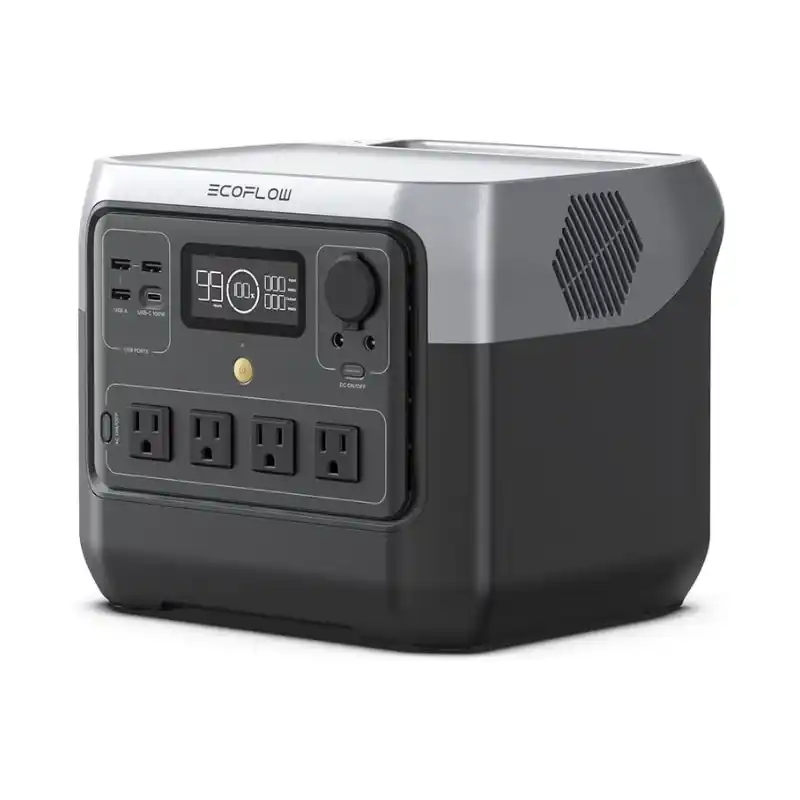
EcoFlow River 2 Pro Review

The EcoFlow River 2 Pro charges from a wall socket at 940W and refills in under an hour, weighs 17 pounds for 768Wh, and has Wi-Fi and Bluetooth apps. Its fans read 60 dB, and the switchover measures 30ms.
My Quick Verdict
940 watts of wall charging into a 768 Wh pack refills this power station in under an hour. Nothing else at this capacity comes close, and most of its rivals charge through a brick at a fifth the rate.
It weighs 17 pounds and delivers 45.2 watt-hours per pound, the highest energy density of any machine under 1,000 Wh we have measured.
Then the noise. Then there is the racket: 60 decibels of fan plus a whine from the inverter, on hardware whose buyers mostly take it camping.
Its switchover time is 30 milliseconds, tying for the slowest reading in our entire database.
Best for: Car camping and weekend trips where fast recharging matters and the machine sits outside the tent.
Not for: sleeping beside, any backup, or running heating appliances.
Key Stats
Introduction
Machines at this size normally charge slowly. Most of the 500 to 800 Wh units we have measured draw between 90 and 200 watts through an external brick, which means four to six hours from empty.
This one draws 940 watts through an internal charger and refills in under an hour. That is a genuine generational difference rather than an incremental improvement, and it is the reason to consider the machine at all.
It is also the most energy-dense unit per kilowatt-hour we have weighed: 768 Wh in 17 pounds.
Its pack claims 3,000 lithium iron phosphate cycles, with a five-year warranty, and both figures are good for this class.
What It Can Actually Run
Eight hundred watts sustained with 1,600 in a burst. That covers a refrigerator, a television, and devices, but not a heating appliance of any kind.
From a 768 Wh label, the outlets yielded 620 Wh. 80% lands under the 85% mark this class is meant to clear. Everything below uses 620Wh.
- Refrigerator at 150W: just over four hours.
- CPAP at 40W with the humidifier off: 15.5 hours.
- Starlink dish at 50W: 12.5 hours.
- A 45W, 12-volt camp fridge on DC: roughly 15 hours using the better 683Wh route.
Output measured a correct 120 volts, though electrical noise exceeded 2,000 mV, and the inverter produced an audible whine of its own.
Charging and Smart Features
Wall input reaches 940 watts through an internal charger, with adjustable speed. From empty, that is around fifty minutes.
The panel side accepts 220 watts from 11 volts to 5 volts, at 13 amps, with nothing to unhook afterwards.
There is no dual charging here; the socket and the panels never operate simultaneously.
The switchover measured 30 milliseconds. Upper mid-range price tier, premium value tier.
Charging Speed Benchmarks
How quickly the EcoFlow River 2 Pro refills from both sources, against the 28 machines our database holds in the 300Wh to 999Wh capacity class. Mains input across that group averages 279W and solar averages 192W. Bands are terciles drawn inside this class, so High begins just above 200W here and would mean something entirely different a class up.
Wall charging is close to the ceiling of this bracket. 940W is more than triple the 279W class average and within ten watts of the 950W class maximum, refilling a 768Wh pack in about 0.8 hours. On a machine this size that changes how it gets used: a full recharge fits inside a lunch stop rather than an overnight, which is the practical argument for the River 2 Pro over cheaper 200W rivals that need most of a day.
Panels do not keep pace. 220W clears the 192W class average and just passes the 198W mark for a High rating, but the 600W class ceiling is nearly three times that, and refilling the pack from the array takes roughly 3.5 hours. That is a fourfold gap between the two channels, the widest split on any unit we have covered at this size, so treat solar as a slow top-up and plan on the socket for anything time-critical.
Want an array that fills it as quickly as the wall? The Pecron E600LFP accepts 400W of solar, nearly double the River 2 Pro and the highest panel ceiling we have reviewed in this class, bringing a 614Wh pack back in about 1.5 hours of good sun. Mains charging drops to 270W, so this is the machine for daylight rather than deadlines, and its 3,500-cycle cells outlast the River 2 Pro's by a wide margin.
Real Capacity: What You Actually Get
The two paths diverge by eight points, and, unusually, the twelve-volt side is much stronger.
A meter on the sockets measured 620 Wh, compared with a claimed 768 Wh. At 80% it misses the class bar, and no machine this size that we otherwise rate highly does worse.
The DC route returned 683Wh, or 88%, which is a genuinely good result. That 63Wh gap is worth an extra hour and a half on a camp fridge.
Standby follows the same split, and it is stark. The inverter loses 2.4% per hour when armed, which is above my acceptable threshold, whereas the DC side loses 0.13%.
Left armed for a week,ek this machine would shed roughly 40% of its charge. Left on DC, it would barely move.
My takeaway: Reckon on 620 Wh at the outlets or 683 Wh at 12 volts, and kill the inverter between uses. Bleeding 2.4% per hour is a real cost for a pack of this size.
Power Output and Surge: What It Can Turn On
Eight hundred watts continuous is modest and appropriate for the capacity. It runs a refrigerator, a television, lighting, and devices, but it will not run a kettle, a heater, or a hair dryer.
A domestic fridge compressor waking up fits within the 1,600-watt burst, which is the demand that counts at this size.
The bi-directional 100-watt USB-C port is a genuine feature. It charges a laptop at full rate and can also charge the power station itself from a compatible source, a feature few machines of this size offer.
Output quality is mixed. A correct 120 volts is good, but electrical noise above 2,000mv and an audible inverter whine both sit at the untidy end of this field.
Real Appliance Runtimes
AC lines are based on 620 Wh; the 12-volt line uses the more accurate 683 Wh measurement.
The camp fridge line shows why the DC path matters here. Put that fridge on 12 volts instead of the inverter, and you gain 90 minutes while sidestepping the 2.4% hourly bleed altogether.
Recharging: Wall and Solar
From a wall outlet
940 watts from an internal charger is the standout specification on this machine.
From empty, it refills in around fifty minutes. For comparison, the Bluetti EB70, with a similar capacity, draws 200 watts through an external brick and takes more than 3.5 hours.
The rate steps down as you wish, so an overnight trickle is available, and the cells thank you for it.
The one gap is dual charging, which is not supported. Mains and panels cannot feed the machine simultaneously, so the socket cannot compensate for what a cloudy morning fails to deliver.
From Solar Panels
The panel input draws 220 watts at 11-50 volts and 13 amps.
Slim against 768Wh, and the grading sheet confirms panels alone will not finish the job inside the standard window.
The wide 11-volt floor means a single foldable panel engages immediately, which suits the camping use this machine is built for.
Fifty volts at the ceiling allows two rigid panels in series, though the 220-watt limit means there is little point going further.
Panels may remain bolted on indefinitely, and output continues throughout a charge.
Blackout Backup: The Part I Care About Most
The switchover measured 30 milliseconds, the joint-slowest reading in our entire database.
This category draws its safety line at 20 milliseconds. Under that mark, plugged-in gear usually survives a mains failure intact. This is half again beyond that line.
Expect a PC, a router, or a NAS to reboot at that pace rather than continuing. Nothing marginal about it.
The 2.4% hourly standby drain compounds it. Even used deliberately, keeping this machine armed and ready is expensive on a pack this size.
Why this matters to me: at 30 milliseconds this is not a backup machine, and at 2.4% an hour it is not a machine you leave waiting either. Treat the fast charging as its purpose and the inverter as something you switch on when needed.
Noise and Living With It
Sixty decibels under load, which is among the louder readings in our database and unusually loud for a machine this small.
Beyond the fans, the sheet logs a whine from the inverter, so two things are making sound,nd and one of them continues even when the draw is small.
Awkward on hardware bought largely for camping, since canvas absorbs nothing. Sixty decibels an arm’s length from your ear is a genuine problem.
Weight is the compensation, and it is genuine: 17 pounds (7.8 kilograms), holding 768 Wh. At 45.2 watt-hours per pound, it is the most energy-dense machine under a kilowatt-hour we have weighed.
Where It Falls Short
There are four limitations, and the first two determine where the machine can be used.
1. Sixty Decibels With an Audible Inverter Whine
Loud enough to exclude every occupied indoor space, and unusually loud for a 768Wh machine.
For a unit this portable, sold into camping and van use, that is a real practical limitation. A tent offers no sound insulation at all.
2. A 30-Millisecond Switchover
The joint slowest figure recorded anywhere in our database, and half again past the safety threshold.
Work on the basis that anything plugged in reboots. This is not backup hardware.
3. 80% AC Conversion and 2.4% Standby Drain
Five points under the class bar on AC means 148 watt-hours of the label never make it out.
And at 2.4% an hour with the inverter armed, a week of waiting costs roughly 40% of the charge. Use the DC path where you can, and switch the inverter off when you cannot.
4. No Dual Charging, and 220 Watts of Solar
The two inputs are exclusive, and 220 watts from the panel is not enough to fill the pack in a normal window.
For a machine this good at wall charging, that is an odd asymmetry, but it does mean the socket is clearly the intended route.
How It Compares
Two comparisons at a similar capacity, one from the same brand and one from a rival.
Compared to the Bluetti EB70, this machine charges nearly five times as fast, converts more efficiently via DC, lasts 1,000 more cycles, and outputs a proper 120 volts. The EB70 answers with 48-decibel fans, which is a serious selling point for a camping machine.
EcoFlow’s own older River Pro is the clearer comparison. This machine converts 7 points better with AC, charges 280 watts faster, and uses lithium iron phosphate cells rated for 3,000 cycles, compared to the River Pro’s 800 NMC cycles.
So within EcoFlow’s own range, this is the obvious choice. Against the EB7,0, it comes down to whether you would rather charge fast or sleep near it.
Who Should Buy It, and Who Should Skip It
Buy It If
- Fast recharging is your priority, and you want it in something you can carry with one hand.
- The machine will sit outside a tent or in a vehicle rather than beside you.
- Twelve-volt gear dominates your setup, where the turning turns 88% and barelleaksss.
- You want a machine under 20 pounds with a real app and 3,000-cycle cells.
Skip It If
- You will sleep near it. Sixty decibels plus an inverter whine rules that out.
- Catching a mains failure figures anywhere in your thinking.
- A heater or kettle is on your load list.
- The machine will sit charged and armed for long periods.
The Bottom Line
This machine is built around one specification, and it is a good one. 940 watts of internal charging in a 17-pound unit is a combination nothing else at this capacity offers.
What it asks in return is that you accept 60 decibels, an inverter whine, a 30-millisecond switchover, and 2.4% hourly drain when armed.
For a weekend camper who charges fast, uses the DC side, and leaves the machine outside the tent, that trade works. For anyone wanting quiet or backup, it does not.


There are no reviews yet.