
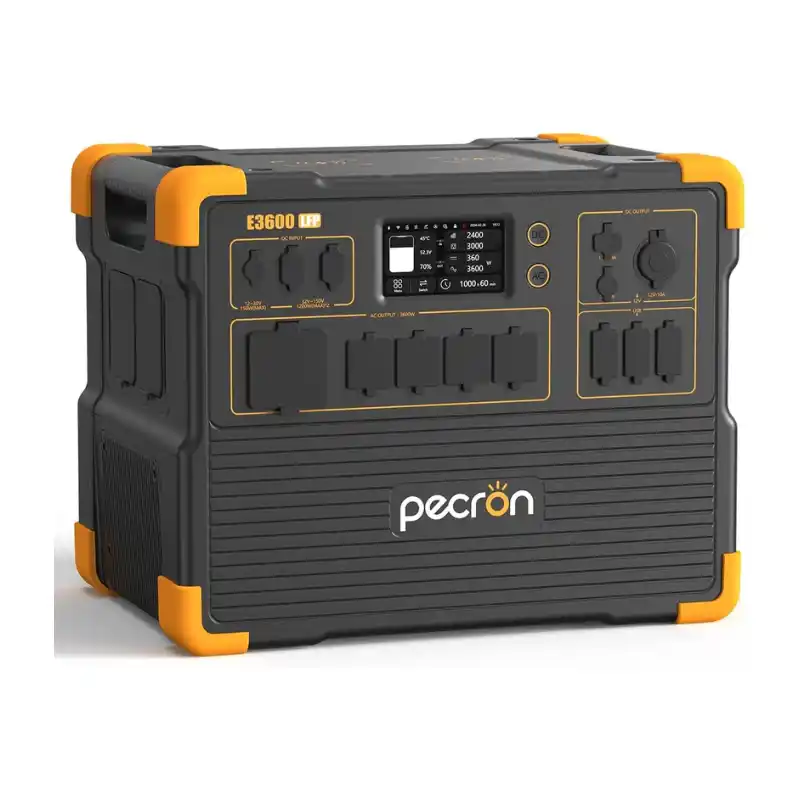
Pecron E3600LFP Review

The Pecron E3600LFP delivers 2,760Wh of its 3,072Wh rating, powered by a 3,600W inverter with 7,200W of surge capacity. It draws 3,600W from a wall socket and 2,400W from solar across two channels, reaching 150 volts, at an exceptional value tier.
My Quick Verdict
Pecron sells two machines at three kilowatt-hours, and comparing them is the most instructive thing about either.
The cheaper one delivers identical capacity and conversion, then bottlenecks on charging: 1,800 watts from the wall, 1,600 from panels, and a solar input blind to anything below 25 volts.
This one takes 3,600 watts from a socket, 2,400 from panels across two channels, and reaches 150 volts on the upper path. Twice the charging, in every direction.
You pay for it in mass. Seventy-nine pounds against sixty-three, which is the difference between a determined one-person shift and a two-person job.
Best for: Off-grid installations with a serious array, and Emergency Home Resilience where the unit is refilled in a hurry.
Not for: protecting an empty house, or hauling it any distance.
Key Stats
| Badge | Stats |
|---|---|
| Battery chemistry and longevity | LiFePO4 | 3,500 cycles |
| Continuous AC power output | 3,600W AC | 7,200W peak |
| Energy storage capacity | 3,072Wh | 2,760Wh usable |
| Rapid AC wall recharge | 3,600W input | Four-stage |
| Uninterrupted emergency backup | 9ms UPS | Manual arm |
| Maximum solar input and MPPT | 2,400W solar | 150V upper path |
| Ultra-fast USB-C power delivery | 100W USB-C PD |
| Low-noise operational level | 52dB | Moderate under load |
| High-output DC | 400W XT60 |
| Modular capacity expansion | Expandable | Extra battery port |
Introduction
Two machines from the same maker, the same capacity, the same cells, and the same conversion figures. On a spec sheet,t they look like colour choices.
The difference is entirely in how quickly energy returns. Where one draws 1,800 watts from a socket, this draws 3,600. On a pack this size, that separates a two-hour refill from a fifty-minute one.
That matters most in exactly the situation you bought the thing for: a warning arrives, the machine is half empty, and you have whatever time the forecast gives you. Cell chemistry is lithium iron phosphate; 3,500 cycles claimed; warranted for five years.
What It Can Actually Run
Three thousand six hundred watts held steady, 7,200 available in a burst. That is at the top of the Heavy-Duty Household Class, and it eliminates the need to choose between appliances.
Rated at 3,072 Wh, the outlets delivered 2,760 Wh 89%, a strong figure at this scale. All the arithmetic below is based on 2,760 Wh.
- Refrigerator at 150W: eighteen hours and a bit.
- CPAP at 40W, humidifier off: sixty-nine hours.
- Starlink dish at 50W: fifty-five hours.
- Laptop at 70W: thirty-nine charges, taken in sequence.
Voltage read 121, distortion 1.20%, electrical noise 1,750mv. Each figure is sound without being notable.
Charging and Smart Features
The main input is the headline: 3,600 watts across four selectable stages, filling three kilowatt-hours in well under an hour.
Panels arrive by two routes. A 150-watt channel handles 12 to 32 volts for small foldables, and the main channel handles 1,200 watts at 32 to 150 volts, for a total of 400 watts when both are running.
The handover clocked in at 9 milliseconds (brisk by any measure), but only after somebody had raised the inverter and left it up.
Upper mid-range price tier, exceptional value tier.
Charging Speed Benchmarks
Recharging performance for the Pecron E3600LFP across the Over 3,000Wh capacity class, covering the 16 largest machines we hold data on. The bracket averages 2,802W from a wall socket and 2,681W from solar. Ratings below are within-class terciles, so they compare this unit to its own size peers and nothing smaller.
Four-stage mains charging peaks at 3,600W, ahead of the 2,802W class average and resting exactly on the High threshold, so it records as Average by a single watt. That fills 3,072Wh in roughly 0.9 hours. The comparison that matters is internal: Pecron's cheaper three-kilowatt-hour machine accepts half this, and doubling the charger is most of what the extra outlay buys. Class inputs stretch from 1,500W to 6,000W.
Solar takes 2,400W over two channels with a 150-volt main path, marginally under the 2,681W class average and an Average rating against a 6,400W ceiling. A full array refill runs to about 1.3 hours. The dedicated low-voltage channel is the practical addition, because it engages from 12 volts and lets a single foldable panel work alongside a proper series string, where the cheaper sibling ignores anything under 25 volts entirely.
Want the array to do the heavy lifting? The Pecron F5000LFP accepts 6,400W of solar, more than two and a half times this machine, at 180 volts and 25 amps per channel. It brings 5,120Wh back from the array in roughly 0.8 hours, faster than its own mains charging. Be aware its harmonic distortion measures 3.50%, well outside the working limit, so medical and sensitive equipment should not run from its outlets.
Real Capacity: What You Actually Get
Both paths sit close together here, which makes planning simple.
Metered at the sockets, the machine delivered 2,760 Wh against a 3,072 Wh label. 89%, matching units that cost considerably more.
The twelve-volt route came in a shade lower at 2,719Wh, or 88%. A single point apart, so unlike several machines reviewed here, there is no efficiency argument pushing you towards one port or the other.
Standby costs about 1.16% an hour with the inverter awake and 0.33% on DC. Middling figures: not a slow bleed, not the best available either.
My takeaway: 2,760 Wh,h whichever socket you use. Plug in wherever is convenient, because on this machine the choice of path costs you almost nothing.
Power Output and Surge: What It Can Turn On
A 3,600-watt continuous rating is a genuine whole-circuit figure at this capacity, and it changes the character of an outage.
A refrigerator, a freezer, a space heater, and lighting can run together without the machine approaching its ceiling. Seven thousand two hundred watts of surge means nothing domestic will trip it on startup.
The 400-watt XT60 output is the other useful port. It carries a compressor fridge and a heater simultaneously, with the inverter entirely out of circuit, which is the arrangement anyone building into a vehicle wants.
USB-C is the weak link at a single 100-watt port, a shortfall that is now recurring across machines of this size and price.
Real Appliance Runtimes
What 2,760Wh buys in hours, using the standard loads applied throughout this site.
| Appliance | Power Draw | Runtime | What That Means |
|---|---|---|---|
| Full-size refrigerator | 150W | About 18.4 hours | A day's worth before cycling is even factored in. |
| CPAP machine (no humidifier) | 40W | About 69 hours | Three nights and most of a fourth. |
| Starlink dish | 50W | About 55 hours | Fifty-five hours of satellite uptime. |
| Pellet grill or smoker | 100W | About 27.6 hours | Enough for several separate cooks. |
| Laptop (70W) | 70W | About 39 recharges | One port, so one machine at a time. |
These are indistinguishable from the cheaper Pecron at the same capacity, which is the point. What separates the two machines is not what they hold but how fast they take it back on.
Recharging: Wall and Solar
From a Wall Outlet
Three thousand six hundred watts is twice what the cheaper machine in this range accepts, and it takes a flat pack to fill in around fifty minutes.
The four selectable rates are genuinely useful over years of ownership. Drop to the slowest overnight, and treat the cells gently; take everything the socket offers when the weather is coming.
Together, both inputs reach the same 3,600-watt ceiling, so the panels displace mains draw rather than add to it.
From Solar Panels
The two-channel arrangement here is worth understanding because it addresses one of the most annoying limitations of Pecron’s cheaper three-kilowatt-hour machine.
That unit ignores anything producing under 25 volts, which makes a single small foldable panel invisible to it. This one adds a dedicated low-voltage channel: 150 watts at 12- 32 volts, specifically for small panels.
The main channel then runs at 32 to 150 volts, up to 1,200 watts, which is where a proper series string of rigid panels belongs. Run both, and the total reaches 2,400 watts.
A 150-volt ceiling permits four or five panels in series, keeping current low and cable losses down across a long run.
Leave the panels attached indefinitely; output carries on uninterrupted while the pack fills.
Blackout Backup: The Part I Care About Most
The handover is genuinely quick, and the inverter is passive, a combination that has defined most of this category.
At nine milliseconds, the handover clears the eleven-millisecond bar by a wide margin, and no workstation or network drive would register the mains going.
But the inverter waits to be switched on. Someone has to arm it in advance and leave it armed.
At 1.16% an hour,r that is affordable rather than free. A week left running unattended costs roughly a fifth of the pack, which is a habit to manage rather than a fault to work around.
Why this matters to me: nine milliseconds is fast enough to protect anything in the house, and it protects nothing at all if the machine was sitting with its inverter off when the storm came through.
Noise and Living With It
Fifty-two decibels under load, which is a shade above what a room with a sleeper will tolerate and unremarkable anywhere else.
Given the size of the inverter behind it, that is a decent showing, and several lower-output machines are noisier.
Weight is 79 pounds (36 kilograms). Sixteen pounds heavier than the cheaper Pecron at identical capacity, and firmly a two-person lift on stairs.
Wi-Fi and Bluetooth are both available, and Pecron answers the phone during the five-year term.
Where It Falls Short
Three things to weigh, and the first is what the extra money actually costs you.
1. Seventy-Nine Pounds
Sixteen more than the cheaper machine at the same capacity, and enough to make this a two-person lift rather than an awkward solo one.
That is the physical cost of the larger inverter and the faster-charging hardware. For an installation, it is irrelevant; for anything that gets loaded into a vehicle,e it is not.
2. A Manually Armed Inverter
Nine milliseconds are wasted on an empty house because the inverter won’t start on its own.
A standby drain of 1.16% per hour makes leaving it armed workable, though a fortnight unattended would cost around 40% of the pack.
3. Three Thousand Five Hundred Cycles and One USB-C Port
Both rivals, in this capacity, offer 4,000 cycles, which, over a decade of daily use, is a measurable difference.
A single 100-watt USB-C port is also thin for a machine at this price, where units costing a fraction now fit two at 140 watts.
How It Compares
The obvious comparison is between Pecron’s own cheaper machine at the same capacity and the Anker SOLIX F3000 as the outside rival.
| Feature | Pecron E3600LFP | Pecron F3000 | Anker SOLIX F3000 |
|---|---|---|---|
| Price tier | Upper mid-range | Upper mid-range | Upper mid-range |
| Value tier | Exceptional | Exceptional | Exceptional |
| Rated capacity | 3,072Wh | 3,072Wh | 3,072Wh |
| Usable through AC | 2,760Wh (89%) | 2,750Wh (89%) | 2,760Wh (89%) |
| Sustained output | 3,600W | 3,000W | 3,600W |
| Wall charging | 3,600W | 1,800W | 3,840W |
| Solar input | 2,400W to 150V | 1,600W to 120V | 2,400W to 165V |
| Low-voltage solar channel | Yes, from 12V | No, 25V floor | Yes, from 11V |
| UPS switchover | 9ms | 8.6ms | 9.8ms |
| Battery cycles | 3,500 | 3,500 | 4,000 |
| Weight | 79 lbs | 63 lbs | 91 lbs |
Against Pecron’s own cheaper machine, the question is whether doubled charging speed and a low-voltage solar channel are worth sixteen extra pounds. For a fixed installation, comfortably, yes. For anything portable, the lighter unit is the better buy.
The Anker F3000 sits between the two in weight and edges out the other on solar voltage and cycle life, at the cost of another twelve pounds.
All three convert identically, and none will arm their own inverter, so the decision here is genuinely about mass and charging rather than about capability. That is an unusually clean choice in this category.
Who Should Buy It, and Who Should Skip It
Buy It If
- You need to get three kilowatt-hours back into the pack in under an hour.
- Your solar mixes small foldables with a rigid series string, which the two channels handle separately.
- The machine will be installed rather than carried.
- You want a 3,600W inverter without moving up to the next price tier.
Skip It If
- You will move it regularly. The cheaper Pecron does the same job, but is sixteen pounds lighter.
- The house must be covered while empty.
- Maximum cycle life matters, where rivals offer 4,000.
- You need serious USB-C throughput.
The Bottom Line
This is the clearest illustration in the whole dataset of what money buys within a single brand. Same capacity, same cells, same conversion, and twice the charging in every direction.
For a machine that lives on an array or gets topped up under time pressure, that difference is the whole point of the purchase.
For one that gets carried, it is sixteen pounds you did not need to pay for. Both Pecrons are honest value; they are built for different rooms.


There are no reviews yet.