
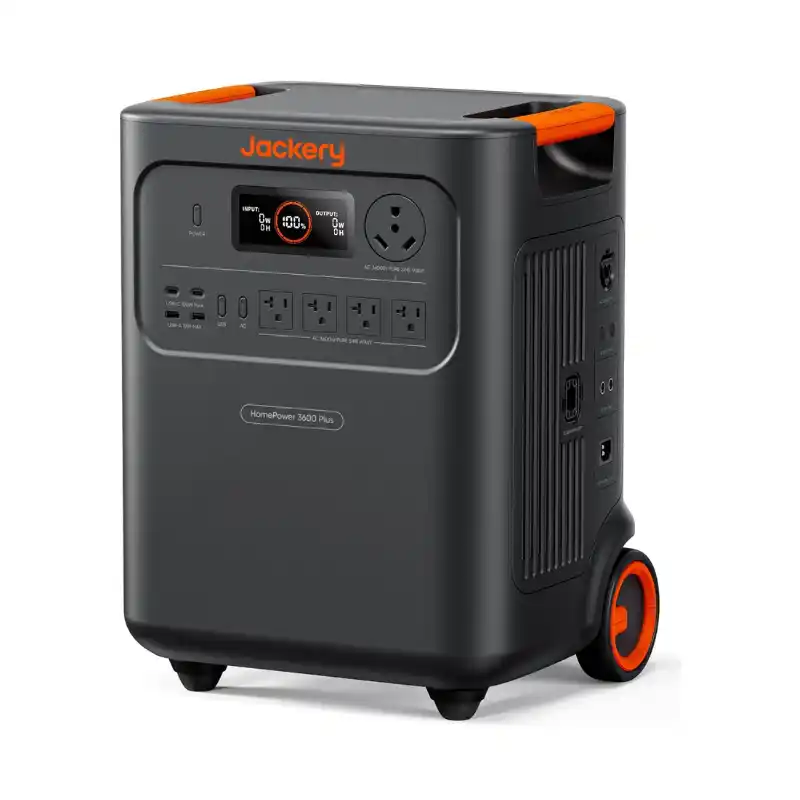
Jackery HomePower 3600 Plus Review

The Jackery HomePower 3600 Plus delivers 3,210Wh of its 3,584Wh rating, is powered by a 3,600W inverter, and weighs 77 pounds, while rivals at this capacity weigh over 130 pounds. Cells are rated for 6,000 cycles, and standby drain is less than 1% per hour.
My Quick Verdict
At 77 pounds, this holds more energy per pound than anything else reviewed above 3.5 kilowatt-hours. Its nearest rivals in this capacity weigh 132 and 136 pounds.
Its cells are rated for 6,000 cycles (matched but unbeaten here), and it holds 51 decibels while shedding less than 1 percent of charge per hour on standby.
Then you look at the ports. There is no high-output DC socket at all. Not an undersized one, not an unmeasured one; the specification reads zero watts.
Solar is capped at 1,000 watts too, which, on a pack this size,e cannot complete a recharge in the window every rival manages.
Best for: Emergency Home Resilience, where the machine must be carried or repositioned, and for long-term standby storage.
Not for: twelve-volt loads of any kind, vehicle builds, or solar-led recharging.
Key Stats
| Badge | Stats |
|---|---|
| Battery chemistry and longevity | LiFePO4 | 6,000 cycles |
| Continuous AC power output | 3,600W AC | 7,200W peak |
| Energy storage capacity | 3,584Wh | 3,210Wh usable |
| Weight for capacity | 77 lbs | Lightest above 3.5kWh |
| AC wall recharge | 1,700W input | 2,700W dual |
| Uninterrupted emergency backup | 9ms UPS | Manual arm |
| Maximum solar input and MPPT | 1,000W solar | Dual 500W ports |
| Ultra-fast USB-C power delivery | 100W USB-C PD |
| High-output DC | None fitted |
| Low-noise operational level | 51dB | Quiet under load |
Introduction
Machines at this capacity are usually installed rather than owned in any portable sense. The two closest rivals weigh over 130 pounds each and go where they are put.
This one weighs 77. That is the same as a mid-range two-kilowatt-hour unit, carrying nearly twice the energy, and it changes what the machine can be: something that moves between a garage, a vehicle,e and a house rather than something that occupies a plant room.
Cells are lithium iron phosphate, claiming 6,000 cycles with a five-year warranty; a figure matched but not beaten anywhere in this data, and about sixteen years at one cycle per day.
What It Can Actually Run
Three thousand six hundred watts continuous, with 7,200 in a burst, on 120 volts only. That sits at the ceiling of the Heavy-Duty Household Class, ample for a home’s essential circuits, but no help at all to a two-pole breaker.
From a 3,584 Wh label, the outlets surrendered 3,210 Wh. That 89% is a good showing for a pack this size. Everything below uses 3,210Wh.
- Refrigerator at 150W: better than twenty-one hours.
- CPAP at 40W with the humidifier off: eighty hours.
- Starlink dish at 50W: sixty-four hours.
- Laptop at 70W: around forty-five charges.
The waveform measured 120 volts with 1.20% distortion, though electrical noise exceeded 2,000 mV, placing it at the noisier end of this field.
Charging and Smart Features
Mains input reaches 1,700 watts, and mains plus panels together reach 2,700 watts. On a 3,584Wh pack that is over two hours from empty.
Solar delivers 1,000 watts across two 500-watt ports, each running at 12 to 60 volts and 12 amps.
The grading data show that this machine cannot complete a full solar recharge within the two-and-a-half-hour benchmark that most of its rivals meet, which follows directly from its 1,000-watt ceiling.
The changeover came in at 9 milliseconds (properly fast), provided a person has already raised the inverter. Premium price tier, good value tier.
Charging Speed Benchmarks
Recharge speeds for the Jackery HomePower 3600 Plus measured against every machine in the Over 3,000Wh capacity class our charging database covers. Sixteen units sit in that bracket, with mean inputs of 2,802W from the wall and 2,681W from panels. Bands are set inside the class, not across the database.
Mains input of 1,700W falls below the 1,800W threshold that separates Low from Average in this bracket, so it takes a Low rating and comes in at roughly 60 percent of the 2,802W class average. Filling 3,584Wh at that rate needs about 2.1 hours, though panels contributing at the same time lift the ceiling to 2,700W. That combined figure is the one to plan around, because on its own the charger is closer to what a two-kilowatt-hour machine carries than to what this capacity warrants.
Panels cap at 1,000W across two tracked ports, which is the lowest solar ceiling in the class, well under the 2,681W class average, and a Low rating against a 6,400W bracket high. A full array refill runs to roughly 3.6 hours in flawless conditions, and real conditions cost 20 to 30 percent of nameplate, which pushes it past a single usable daylight window. For a machine light enough to take to a site, that is the specification that keeps it tethered to a socket.
Want charging that matches three and a half kilowatt-hours? The Bluetti AC500 + B300S accepts 5,000W from mains and 3,000W from panels, roughly three times both figures here, bringing a module back to full in about 0.6 hours on AC or 1.0 hour on solar. It weighs 149 pounds against 77, so you trade portability for a system that recovers quickly and grows a module at a time.
Real Capacity: What You Actually Get
Conversion on the AC side is strong, and the DC side does not exist to be measured.
The outlets returned 3,210 Wh against a claimed 3,584 Wh. 89% is a good result at this capacity, and better than either of the heavier rivals it competes with.
The bench data shows no DC yield at all, which follows logically: there is no twelve-volt outlet for the energy to leave through.
Standby is a genuine strength. Awake with nothing drawing, it sheds about 0.83% per hour, under 1%, and among the better retention figures at this size.
My takeaway: 3,210Wh through the outlets, and only through the outlets. There is no DC path on this machine, so every load runs through the inverter whether it needs to or not.
Power Output and Surge: What It Can Turn On
The inverter is capable and conventional. At 3,600 watts, held steady, you can have the fridge, freezer, heating, and lights all running at once, while 7,200 watts of burst power absorbs the startup surge of any household motor.
It produces 120 volts only. Machines at this capacity increasingly offer split-phase, and anything on a two-pole breaker is outside this one’s scope.
The port array is where the design becomes unusual. One USB-C port rated at 100 watts, and beyond that, nothing on the twelve-volt side whatsoever.
Every other machine at this capacity fits at least a car socket, and most fit an XT60 rated for 300-440 watts. On this machine, a compressor fridge, a diesel heater,r or any vehicle accessory must pass through the inverter and then its own power supply, paying the conversion cost twice for nothing.
Real Appliance Runtimes
3,210 Wh converted to hours against the appliance set; this site remains constant across every review.
| Appliance | Power Draw | Runtime | What That Means |
|---|---|---|---|
| Full-size refrigerator | 150W | About 21.4 hours | A day on the fridge, extending further as the compressor rests. |
| CPAP machine (no humidifier) | 40W | About 80.3 hours | Eighty hours of overnight use. |
| Starlink dish | 50W | About 64.2 hours | Sixty-four hours of connection with no mains. |
| Pellet grill or smoker | 100W | About 32.1 hours | Thirty-two hours on the smoker. |
| Laptop (70W) | 70W | About 45 recharges | Through the single 100W port. |
There is no DC line in this table, and that is not an oversight. On every other machine at this capacity, a twelve-volt fridge would appear here with a longer figure than the inverter can deliver. This one has nowhere to plug it in.
Recharging: Wall and Solar
From a Wall Outlet
Seventeen hundred watts into a 3,584 Wh pack means a little over two hours from empty, which is slow for that capacity.
Feed it from the socket and the sun at once, and the ceiling rises to 2,700 watts, which cuts that time appreciably in decent weather.
Charging steps down through several rates, so an overnight trickle is there when the clock is not against you. For a machine light enough to be carried to a socket, the slow charging is less limiting than it would be on an installed system.
From Solar Panels
One thousand watts is the weakest solar ceiling among machines at this capacity, and it has a stated consequence.
Input arrives through two 500-watt ports, each accepting 12 to 60 volts at 12 amps. Two independently tracked channels are the right arrangement, so a shaded array and a sunlit one will not average each other down.
The grading sheet is blunt about the consequence: panels alone will not fill this pack inside the two-and-a-half-hour benchmark its rivals hit. Pushing 3,584Wh through a 1,000-watt door occupies most of a bright day.
The 60-volt ceiling also rules out a long series string, so a large array needs parallel wiring and heavier cable.
The array can remain permanently attached, and output continues throughout a charge.
Blackout Backup: The Part I Care About Most
The handover is one of the better figures in this capacity, and the inverter behind it is passive, a familiar shape by now.
At nine milliseconds,s it clears the eleven-millisecond bar with room to spare, and no processor would notice the swap.
It waits to be raised by hand, and stays up only as long as it is left alone.
At 0.83% an hour, that is an affordable habit (among the cheapest of any manually armed machine at this size), which makes the missing automation more frustrating than damaging.
Why this matters to me: nine milliseconds and sub-one-percent standby are very nearly the full set. The one thing missing is the firmware deciding to switch itself on, and that is what stands between this machine and genuine unattended backup.
Noise and Living With It
Fifty-one decibels under load, which sits exactly on the line for rooms where anyone sleeps and is quiet by the standards of this capacity.
Both heavier rivals at this size run three or four decibels louder, and for a machine that might be carried into a living space, that difference is worth having.
The weight is the headline. Seventy-seven pounds, 35 kilograms, holding 3,584Wh. Nothing else reviewed here comes close to three and a half kilowatt-hours, and the two nearest competitors are roughly fifty-five pounds heavier.
Wi-Fi and Bluetooth are both available, and Jackery keeps a phone line open throughout the warranty period.
Where It Falls Short
Two limitations are structural, and one is a matter of degree.
1. There Is No High-Output DC Socket
Not undersized, not unmeasured. The specification reads zero watts, and no twelve-volt yield figure exists because there is no port to measure it through.
Every rival at this capacity fits at least a car socket, and most fit an XT60 between 300 and 440 watts. A compressor fridge, a diesel heater,r or any vehicle accessory must run through the inverter here, converting to household power and back again for no purpose.
For a machine light enough to take into a vehicle, this is the strangest omission on the page.
2. One Thousand Watts of Solar
The lowest ceiling at this capacity, and the grading data state plainly, is that a full solar recharge falls outside the window rivals meet.
Combined with 1,700-watt mains charging, both recharge routes are slow. This is a machine you plan to refill overnight rather than between outages.
3. No Split Phase, and a Manually Armed Inverter
Output is 120 volts only, so two-pole circuits are outside its scope in a capacity class where several rivals offer 240 volts.
And a 9-millisecond handover only protects a house with someone in it if the inverter is armed first.
How It Compares
The natural comparisons are the two Anker machines at a similar capacity, both far heavier.
| Feature | Jackery HomePower 3600 Plus | Anker SOLIX F3800 | Anker SOLIX F3800 Plus |
|---|---|---|---|
| Price tier | Premium | Premium | Premium |
| Value tier | Good | Good | Premium |
| Rated capacity | 3,584Wh | 3,840Wh | 3,840Wh |
| Usable through AC | 3,210Wh (89%) | 3,310Wh (86%) | 3,270Wh (85%) |
| High-output DC | None | 142W socket | 141W socket |
| Sustained output | 3,600W, 120V only | 6,000W split phase | 6,000W split phase |
| Wall charging | 1,700W | 1,800W | 6,000W |
| Solar input | 1,000W | 2,400W | 3,200W |
| Battery cycles | 6,000 | 3,000 | 3,000 |
| Idle drain per hour | 0.83% | 1.9% | 1.6% |
| Fan noise | 51dB | 55dB | 54dB |
| Weight | 77 lbs | 132 lbs | 136 lbs |
Against both Ankers, this machine converts better, holds its charge twice as well, runs more quietly, doubles the cycle rating, and weighs fifty-five pounds less. On everything related to the battery and how it behaves, it wins comfortably.
On everything to do with what you can connect and how fast you refill it, it loses. Neither Anker is missing a DC socket; both draw more than twice as much solar power and produce 240 volts.
So the split is clean. If the machine needs to be carried, stored, charged for months, and used for household loads, this is the better buy by a wide margin. If it is going on a transfer switch or into a vehicle build, it is the wrong shape entirely.
Who Should Buy It, and Who Should Skip It
Buy It If
- The machine has to be moved, and 130-pound rivals are out of the question.
- It will be stored charged for long periods between uses.
- Long cell life matters, with 6,000 cycles being the joint-best recorded here.
- Your loads are household AC, and quiet operation is worth having.
Skip It If
- Anything in your plan runs on twelve volts. There is no socket for it.
- Solar is your main recharge route.
- You need 240 volts for a two-pole circuit.
- The house must be protected while empty.
The Bottom Line
Judged as a battery, this is the best machine at its capacity. Six thousand cycles, 89% conversion, under one percent standby drain, 51 decibels, and fifty-five pounds lighter than anything it competes with.
Judged as a system, it has a hole. No high-output DC socket at all, on a machine light enough to be exactly the sort of thing you would take to a vehicle or a campsite where DC loads live.
Buy it for household backup that needs to be carried; it is excellent. Buy it expecting to run 12-volt equipment, only to find nowhere to plug it in.


There are no reviews yet.