
Jackery Power Station Reviews

Jackery power stations tested and compared. Measured conversion, switchover times, and surge ratings, plus how Jackery compares to Anker and EcoFlow.

Every Jackery machine we have tested sits above 2,000Wh, making it the most narrowly focused brand we cover. There are no compact or camping options in our data at all.

Within that focus, the execution is consistent: five-year warranty on all four, an app on all four, a working transfer function on all four, and conversion averaging 88.2%, the strongest of any brand we test.

Best for: home backup and high-output work. Weakest for: anyone wanting a portable machine and value shoppers.

Editor's Choice

Each Jackery model below links to its full review, where you will find measured runtimes, the complete ten-category score breakdown, full specifications, and our verdict. This page is for choosing between them; the reviews are for understanding any one of them properly.

Add to compare
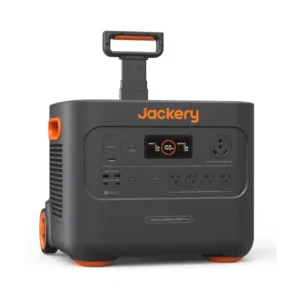
The Jackery Explorer 2000 Plus delivers 1,780Wh of its 2,042Wh rating, powered by a 3,000W inverter with a 6,000W surge. Solar input reaches 1,400W at 24 amps, the second-highest at this capacity, and electrical noise measures a clean 750 mV. Upper mid-range price tier, good value.
★★★★★
More details +
One number here needs reading twice. Jackery advertises 4,000 charge cycles, which looks identical to the 4,000-cycle ratings on rival units at this capacity; except this one is measured to 70% of original capacity, whereas the rest of the field measures to 80%. Letting a pack fall a further ten points before declaring it worn out is a materially easier test, so the headline figure is not interchangeable with a competitor's; however, the shelf tags invite you to compare them. Set that aside, and there is a strong machine underneath: 1,400 watts of solar accepted at 24 amps, the second-highest input at this size and unusually generous on current, which is what actually stops most large arrays from s working; a 3,000-watt inverter with 6,000 of surge; 1,780Wh delivered from 2,042Wh; and electrical noise of 750mv, among the cleanest measured anywhere in this data. Against it: 61.5 pounds, combined charging capped at 1,800 watts, only two wall speeds, and an inverter that will not wake on its own. Buy it for the panels and the inverter, not for the cycle count.
Battery safety and chemistry (LiFePO4, 4,000 cycles)
7.5
Real-world efficiency and output (87% AC, 89% DC, 750mv noise)
9
UPS and EPS switchover (12.8ms, no self-arming)
6.5
Port selection and distribution (two 100W USB-C, 155W 12V)
8
Solar charging and MPPT (1,400W at 24A)
9.5
AC recharge speed (1,500W mains, 1,800W dual, two speeds)
8
Noise and thermal management (53dB)
7
Portability and build quality (61.5 lbs)
5.5
Expandability and ecosystem (expansion support)
9
Smart app and interface (Wi-Fi and Bluetooth)
8.5
PROS:
  • Solar input of 1,400W at 24 amps, second highest at this capacity and generous on current.
  • A 3,000W sustained and 6,000W peak inverter, among the largest at this size.
  • An electrical noise level of 750 mV is among the cleanest readings in this dataset.
  • Conversion of 87% at the sockets and 89% through DC, both above the class line.
  • A 155W car socket, one of the few here to clear the 150-watt mark.
  • Wi-Fi and Bluetooth support, with phone assistance, backed by a five-year warranty.
CONS:
  • The 4,000-cycle rating is measured at 70% capacity, not the 80% every rival here uses.
  • Combined charging caps at 1,800W, well behind the 2,400W and 2,600W units.
  • Wall charging offers only two speeds, with no gentle overnight setting.
  • Sixty-one and a half pounds, a two-person lift, and heavy for the capacity.
  • The inverter cannot arm itself, so a 12.8ms handover only helps an occupied house.
  • Idle drain of 1.15% an hour costs a third of the pack over a fortnight left armed.
Add to compare
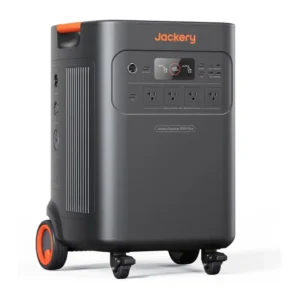
The Jackery Explorer 5000 Plus delivers 4,380Wh of its 5,040Wh rating, backed by a 7,200W split-phase inverter with 14,400W of surge, the largest peak rating measured here. Solar accepts 4,000W across a path reaching 450 volts.
★★★★★
More details +
Fourteen thousand four hundred watts of peak output is the largest surge figure across all machines measured at this site, and it means the question of whether lesser inverters (whether a well pump or a big compressor) will actually start never arises here. Behind it sit 7,200 watts continuous on split-phase, 1.10% distortion, 700 mV of electrical noise, and 49 decibels, which, for an inverter this size, is genuinely good engineering. The solar side matches that ambition with a 135- to 450-volt channel that takes 4,000 watts, the range a rooftop string array actually produces. Then the input side falls apart. Main charging stops at 1,800 watts into a 5,040Wh pack, close to three hours from empty and the worst ratio at this size; pass-through is absent, so those three hours are also downtime; and the inverter will not arm itself, so an empty house is uncovered regardless of whether the 0ms or the 15.5ms switchover figure applies. Fill it from a large array, and it is formidable. Ask it to ride out a storm for a week on a wall socket, and it cannot keep up.
Battery safety and chemistry (LiFePO4, 4,000 cycles)
9.5
Real-world efficiency and output (86% AC, 82% DC, 1.10% THD)
8.5
UPS and EPS switchover (0ms / 15.5ms, no self-arming)
7
Port selection and distribution (100W USB-C, 172W car socket)
7.5
Solar charging and MPPT (4,000W across dual paths, 450V ceiling)
10
AC recharge speed (1,800W, no pass-through)
4.5
Noise and thermal management (49dB)
8.5
Portability and build quality (132 lbs)
2.5
Expandability and ecosystem (expansion and split-phase pairing)
9.5
Smart app and interface (Wi-Fi and Bluetooth)
8.5
PROS:
  • A 14,400W peak rating, the largest surge figure measured anywhere in this dataset.
  • A 7,200W split-phase inverter matching the largest sustained output here.
  • Solar to 450 volts, the range a rooftop string array actually produces.
  • Distortion of 1.10% and 700 mV of electrical noise, both clean at this scale.
  • Forty-nine decibels behind a 7,200W inverter, quieter than several smaller machines.
  • Cells rated to 4,000 cycles, and a 172W car socket that clears the 150-watt mark.
CONS:
  • Wall charging at 1,800W into a 5,040 Wh pack is the worst ratio at this size.
  • No pass-through charging, so refilling and using the machine are mutually exclusive.
  • The inverter will not arm itself, so an empty house is unprotected.
  • Switchover data records two different figures, 0ms and 15.5ms, without explanation.
  • One hundred and thirty-two pounds in a single body, and a premium value tier.
  • Two charging speeds only, with no gentle overnight rate available.
Add to compare
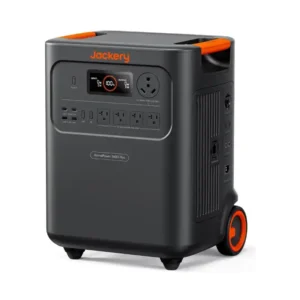
The Jackery HomePower 3600 Plus delivers 3,210Wh of its 3,584Wh rating, is powered by a 3,600W inverter, and weighs 77 pounds, while rivals at this capacity weigh over 130 pounds. Cells are rated for 6,000 cycles, and standby drain is less than 1% per hour.
★★★★★
More details +
Machines holding three and a half kilowatt-hours are typically installed and left in place; the two closest rivals here weigh 132 and 136 pounds. This one weighs 77, the same as a mid-range two-kilowatt-hour unit that carries nearly twice the energy, and that alone makes it a different proposition. The battery specifications back this up: 6,000 cycles, jointly highest in this dataset; 89% conversion, better than either heavier rival; 0.83% hourly standby drain, so it holds a charge through months of storage; 51 decibels; and a 9-millisecond handover. Then you look at the ports and find no high-output DC socket at all (not undersized, not unmeasured, simply absent), whereas every rival has at least a car socket, and most have an XT60 between 300 and 440 watts. On a machine light enough to be carried into a vehicle or a campsite, where twelve-volt loads actually live, that is a genuinely strange omission. Solar caps at 1,000 watts, too low to refill the pack in the window its rivals manage. Buy it as a portable household battery, and it is the best at this size. Ask it to feed anything on twelve volts,s and it cannot.
Battery safety and chemistry (LiFePO4, 6,000 cycles)
10
Real-world efficiency and output (89% AC, 0.83% idle, no DC path)
8.5
UPS and EPS switchover (9ms, no self-arming)
7.5
Port selection and distribution (100W USB-C, no DC socket)
4
Solar charging and MPPT (1,000W, cannot complete a recharge in window)
5.5
AC recharge speed (1,700W mains, 2,700W dual)
7
Noise and thermal management (51dB)
8
Portability and build quality (77 lbs at 3,584Wh)
6
Expandability and ecosystem (expansion support)
9
Smart app and interface (Wi-Fi and Bluetooth)
8.5
PROS:
  • Seventy-seven pounds, holding 3,584 Wh, lighter than anything else reviewed above three and a half kilowatt-hours.
  • Cells rated at 6,000 cycles, the joint highest figure recorded in this dataset.
  • Standby drain of 0.83% an hour, so it holds a charge through months of storage.
  • Conversion of 89% at the sockets, better than either heavier rival at this capacity.
  • A 9ms handover, among the quicker figures at this capacity.
  • Fifty-one decibels and dual independently tracked solar ports.
CONS:
  • No high-output DC socket at all, so every load must run through the inverter.
  • Solar capped at 1,000W, too low to complete a recharge in the window rivals meet.
  • Main charging at 1,700 W means over two hours from empty.
  • The inverter will not arm itself, so an empty house is unprotected.
  • Output is 120 volts only, with no split-phase option for two-pole circuits.
  • Electrical noise above 2,000mv sits at the noisier end of this field.
Add to compare
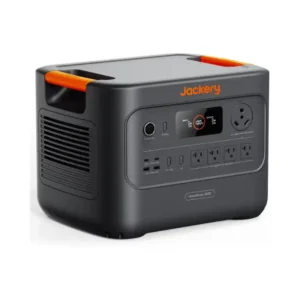
The Jackery SG HomePower 3000 delivers 2,820 Wh of its 3,072 Wh rating, with a 91% conversion efficiency, powered by a 3,600W inverter. At 59 pounds, it is among the lightest machines in this capacity, with 4,000-cycle cells and a standby drain of less than 1 percent per hour.
★★★★★
More details +
Past about eighty pounds, a power station stops being something you reposition and becomes something you install, which is why fifty-nine pounds holding 3,072Wh is the specification that defines this machine; roughly what a good two-kilowatt-hour unit weighs, with half again the energy. It backs that with a 91% conversion, among the stronger figures in this data, so it gives you more usable energy than several rivals with larger packs on paper, and 0.83% hourly standby means it is still nearly full whenever you get to it. A 3,600-watt inverter, a 169-watt car socket that clears a threshold most machines here miss, and 52 decibels round out a genuinely good battery. The system around it is closed and slow. There is no expansion support at all; wall charging stops at 1,800 watts, solar stops at 1,000, and cannot refill the pack in the window rivals manage, and running both together does not lift the ceiling. Buy it because you need to carry three kilowatt-hours. For a machine that stays put, both rivals at this capacity do more for a lower price tier.
Battery safety and chemistry (LiFePO4, 4,000 cycles)
9.5
Real-world efficiency and output (91% AC, 89% DC, 0.83% idle)
9.5
UPS and EPS switchover (13.3ms, no self-arming)
6.5
Port selection and distribution (100W USB-C, 169W car socket)
8
Solar charging and MPPT (1,000W at 24A, cannot refill in window)
6
AC recharge speed (1,800W, no gain from dual charging)
6.5
Noise and thermal management (52dB)
7.5
Portability and build quality (59 lbs at 3,072Wh)
8
Expandability and ecosystem (no expansion support)
4
Smart app and interface (Wi-Fi and Bluetooth)
8.5
PROS:
  • Fifty-nine pounds holding 3,072Wh, among the lightest machines at this capacity.
  • A 91% conversion rate at the sockets is one of the strongest figures in this data.
  • Standby drain of 0.83% an hour, so it holds a charge through months of storage.
  • A 3,600W inverter with 7,200W of surge, at the top of its class.
  • A 169W car socket, exceeding the 150-watt limit, is missing from most of the sockets in this data.
  • Fifty-two decibels and a 24-amp solar current allowance, both better than several rivals.
CONS:
  • No expansion battery support, so the capacity is permanently fixed.
  • Wall charging at 1,800 W, close to two hours from empty.
  • Running solar alongside mains does not raise the charging ceiling above 1,800W.
  • Solar caps at 1,000W and cannot complete a recharge in the window rivals meet.
  • The inverter will not arm itself, leaving an empty house unprotected.
  • Electrical noise above 2,000mv sits at the higher end of this field.

Strengths and Weaknesses

Assessed across all our Jackery-reviewed power stations rather than on any single model.

What this brand does well Where it falls short
The strongest conversion of any brand we test, averaging 88.2%, with the SG HomePower 3000 returning 91%. No machine under 2,000Wh in our tested range. Camping, backpacking and light portable use are not served at all.
Complete consistency: five-year warranty, Bluetooth app, telephone support and a working transfer function on every model. Value is mid-pack at a $0.49 median, well behind Pecron at $0.36 and Anker at $0.41.
The largest surge rating in our database: 14,400W on the Explorer 5000 Plus, which removes motor inrush as a consideration entirely. Cycle ratings are quoted to 70% capacity rather than the 80% used by every other brand, so the numbers are not directly comparable.
The SG HomePower 3000 delivers 52.1 watt-hours per pound, among the best density we have measured at that capacity. The Explorer 5000 Plus has no pass-through charging, so every recovery period is time the system is unavailable.
Quiet for the capacity, averaging 51.2dB across the range with nothing above 53dB. Only one split-phase machine, and it is the most expensive in the range at $0.69 per watt-hour.
The HomePower 3600 Plus is rated at 6,000 cycles, the joint highest figure in our database. Handover times cluster at 9 to 13.3ms, which is reliable but not class-leading.

Which Model Is Right for You?

Camping and Tailgating

Jackery does not compete in this space in our tested range. The smallest machine we have measured is 2,042Wh at 61.5 pounds. For portable machines under 20 pounds, look at brands that make them.

Overlanding and RVing

The Explorer 2000 Plus is the practical choice: 2,042Wh with 3,000W continuous and 6,000W of surge, expandable, at 61.5 pounds. That surge figure matters for RV air conditioning, where compressor startup can demand 2,800 to 3,500 watts.

Add to compare
A studio product photo of the Jackery Explorer 2000 Plus portable power station with its telescoping handle extended, showing its dark gray body, bright orange accents, integrated wheels, and comprehensive front-facing output panel against a white background.
Deal
The Jackery Explorer 2000 Plus delivers 1,780Wh of its 2,042Wh rating, powered by a 3,000W inverter with a 6,000W surge. Solar input reaches 1,400W at 24 amps, the second-highest at this capacity, and electrical noise measures a clean 750 mV. Upper mid-range price tier, good value.
★★★★★

Emergency Home Backup

The SG HomePower 3000 is the pick, and it is the best-judged machine in the range: 3,072Wh, 91% measured conversion, 3,600W continuous and 59 pounds at $0.42 per watt-hour.

Add to compare
A studio product photo of the Jackery HomePower 3000 portable power station on a white background, showing its dark gray chassis, bright orange handle accents, front LCD display, multiple AC and USB outputs, dedicated 30A RV outlet, side cooling vents, and integrated transport wheel.
Deal
The Jackery SG HomePower 3000 delivers 2,820 Wh of its 3,072 Wh rating, with a 91% conversion efficiency, powered by a 3,600W inverter. At 59 pounds, it is among the lightest machines in this capacity, with 4,000-cycle cells and a standby drain of less than 1 percent per hour.
★★★★★

The HomePower 3600 Plus adds capacity and a faster 9ms handover along with 6,000-cycle cells, at $0.45 per watt-hour and 77 pounds.

Add to compare
A studio product photo of the Jackery HomePower 3600 Plus portable power station on a white background, showing its dark gray chassis, bright orange carry handles and wheel accents, front LCD display, side charging ports, USB outputs, AC outlets, and integrated transport wheels.
Deal
The Jackery HomePower 3600 Plus delivers 3,210Wh of its 3,584Wh rating, is powered by a 3,600W inverter, and weighs 77 pounds, while rivals at this capacity weigh over 130 pounds. Cells are rated for 6,000 cycles, and standby drain is less than 1% per hour.
★★★★★

Whole-house and Split-Phase

The Explorer 5000 Plus is the only split-phase Jackery: 5,040Wh, 7,200W across 120V and 240V, and 14,400W of surge, the largest peak we have recorded.

Add to compare
A studio product photo of the heavy-duty Jackery Explorer 5000 Plus portable power station on a white background, showing its grey-and-black suitcase-style body with an orange pull-rod telescoping handle extended vertically, a front color LCD screen, and integrated double transport wheels.
Deal
The Jackery Explorer 5000 Plus delivers 4,380Wh of its 5,040Wh rating, backed by a 7,200W split-phase inverter with 14,400W of surge, the largest peak rating measured here. Solar accepts 4,000W across a path reaching 450 volts.
★★★★★

It hands over with no measurable gap, which puts it in a small group of machines that genuinely behave like a UPS.

Two caveats: at $0.69 per watt-hour, it is the most expensive energy in the range, and it has no pass-through charging, so it cannot supply loads while refilling.

Technology and Ecosystem

Conversion Efficiency

Jackery averages 88.2% at the outlets across four machines, the strongest brand figure in our database. The SG HomePower 3000 returns 91%.

From a 3,000Wh pack, 91% delivers roughly 150 watt-hours more than 86% for the same nominal capacity, which is about an hour of extra refrigeration.

Cycle Rating Methodology

This is worth understanding before comparing Jackery to other brands. Jackery quotes cycle life to 70% of original capacity, while every other brand in our data quotes to 80%.

A 4,000-cycle Jackery rating and a 4,000-cycle rating elsewhere are therefore not measuring the same thing. The Jackery figure is measured to a lower endpoint, which makes it look more generous than a like-for-like comparison would.

Surge Headroom

The Explorer 5000 Plus doubles its continuous rating to 14,400W of surge, the highest peak figure in our entire database.

For well pumps, table saws, and air compressors, that headroom means motor inrush stops being a specification you have to check.

Editors Brand Comparisons Summary (How This Brand Compares to Rivals)

How Jackery measures against the brands it competes with at the same capacities, based on our tested figures.

Against How they differ on our measurements Choose this brand when
Jackery vs Anker Both are consistent brands with strong conversion (88.2% against 88%) and five-year warranties. Anker is cheaper at a $0.41 median against $0.49, covers 1,000Wh capacities Jackery does not, and has two split-phase machines to Jackery's one. You want the highest surge rating available, or the best conversion at 3,000Wh.
Jackery vs EcoFlow EcoFlow charges faster, covers far more capacity bands, and offers instantaneous self-arming transfer on its flagship. Jackery converts better on average and runs quieter across its range. You are shopping at 2,000Wh or above and want quiet, efficient machines with no weak models in the range.

The Bottom Line

Jackery is a narrow range executed consistently. Every machine is above 2,000Wh, every one has a five-year warranty, an app,p and a working transfer function, and conversion is the strongest we measure at any brand.

Buy the SG HomePower 3000 for home backup, the Explorer 2000 Plus for RV use, or the Explorer 5000 Plus if you need split-phase and the largest surge rating available. Just be aware you are paying above the market median per watt-hour for that consistency.

Frequently Asked Questions

It depends on what you are comparing. Jackery averages a median cost of $ 0.49 per watt-hour, which is more than Anker at $0.41 and considerably more than Pecron at $0.36. What you get for it is the strongest conversion of any brand at 88.2%, complete consistency across the range, and the highest surge rating we have measured.

Not in our tested range. Every Jackery we have measured is above 2,000Wh and 59 pounds, so the brand does not serve camping or backpacking use. For portable machines, other brands cover that ground.

Ratings run from 4,000 to 6,000 cycles, but there is an important caveat: Jackery quotes cycle life to 70% of original capacity, while every other brand quotes to 80%. That means a 4,000-cycle Jackery rating and a 4,000-cycle rating from another brand are not measuring the same endpoint. Adjust your comparison accordingly.

The SG HomePower 3000: 3,072Wh, 91% measured conversion, 3,600W continuous, and 59 pounds at $0.42 per watt-hour. If you need split-phase for a well pump or an electric range, the Explorer 5000 Plus is the only option in the range.

Only the Explorer 5000 Plus, which delivers split-phase 120V and 240V output and can be wired into a transfer switch by a qualified electrician. The other three machines are 120V only, which covers sockets, lighting, and ordinary appliances but not anything on a two-pole breaker.

Power Station Geek
Logo
Compare items
  • Total (0)
Compare
0