
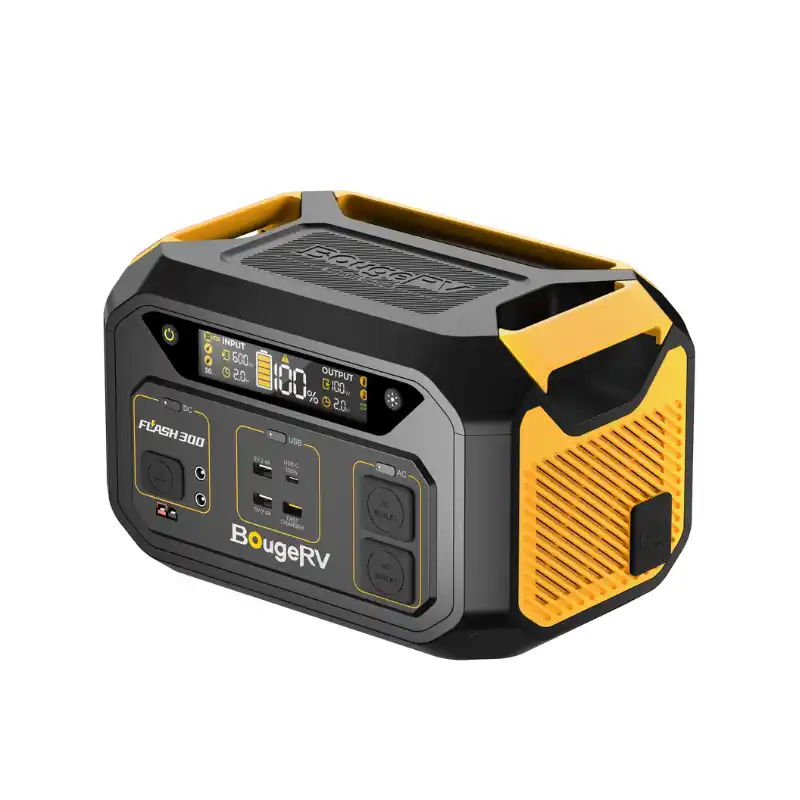
BougeRV Flash 300 Review

The BougeRV Flash 300 accepts 600W of solar on a 286Wh pack and charges from the wall at 600W, filling in under half an hour. Behind it sit NMC cells rated for 700 cycles, and with a shutoff, there is no way to switch them off.
My Quick Verdict
Six hundred watts of solar input on a 286Wh battery is a ratio that nothing else in our database approaches. The panel input is more than twice the size of the pack it fills.
It also charges from the wall at 600 watts, which fills the machine in under half an hour.
Everything after that runs against it. NMC cells rated for 700 cycles, an auto shutoff that cannot be disabled, 58 decibels, 110-volt output and an eighteen-month warranty.
Its cost per watt-hour also tops everything we have tested, and not by a narrow margin.
Best for: Rapid panel refills on brief outings, with someone watching it and a replacement expected inside two years.
Not for: overnight loads, long-term ownership, quiet spaces, or value shopping.
Key Stats
Introduction
Solar input is normally sized to the battery behind it. A 286Wh machine typically accepts 60 to 160 watts because more than that would fill the pack faster than the sun can reliably provide.
Here the figure is 600 watts, spanning 12 to 45 volts at 25 amps. The panel input is more than twice the battery’s capacity, a ratio that nothing else in our database comes close to.
In practice, that means a full refill from panels in well under an hour of decent sun, and it is genuinely the machine’s reason for existing.
The cells behind it are NMC-rated for 700 cycles, which is roughly two years at one charge per day.
What It Can Actually Run
Six hundred watts sustained with 1,200 in a burst. That is generous for 286 Wh and comfortably covers a television, lighting, and devices.
From a 286Wh label, the outlets yielded 240Wh, an 83% return that sits two points under the bar. Everything below uses 240Wh.
- Television at 150W: an hour and a half.
- CPAP without humidification at 40W: six hours, assuming the shutoff holds off.
- Starlink dish at 50W: four and three-quarter hours.
- Laptop at 70W: about 3.5 charges at full rate.
The line read 110 volts, within the accepted band, with noise above 2,000 mV and a hum coming from the inverter.
Charging and Smart Features
Wall input reaches 600 watts via an internal charger, filling the pack in about 29 minutes.
Panels deliver 600 watts at 12 to 45 volts and 25 amps, a limit more than double what the cells can handle.
Dual charging is not supported, which is a small loss given that each input supports up to 600 watts.
There is no UPS mode and no app. Mid-range price tier, luxury value tier.
Charging Speed Benchmarks
Charging speed for the BougeRV Flash 300, set against the 24 machines our charging database holds in the Under 300Wh capacity class. Wall input across that group averages 131W and solar averages 97W. Bands are terciles drawn inside this class, so High here begins just above 100W, a threshold that would be a rounding error two classes up.
Nothing in this class charges faster. 600W sets the class maximum and is more than four times the 131W class average, which fills a 286Wh pack in roughly 0.5 hours. Expressed as the charge ratio in our guide, that is 2.1 watts of input per watt-hour of storage, the highest figure anywhere in our data. Most of this bracket sits between 50W and 100W and takes three to five hours, so the Flash 300 is doing something categorically different from its neighbours.
Panels match it exactly. 600W is again the class maximum and over six times the 97W class average, refilling the pack in about 0.5 hours of strong sun, identical to the wall socket. For context, that solar ceiling is higher than any machine in the 300Wh to 999Wh class accepts. The caution is what sits behind it: 700-cycle NMC cells with no way to shut them off, so charging this quickly, this often, works through a short cell life faster than the speed alone suggests.
Nothing in this class charges faster, but the cells are the catch. The Bluetti EB3A gives up about a third of the wall speed at 430W and drops solar to 160W, still filling a 268Wh pack in roughly 0.6 hours from a socket. What you get for that is lithium iron phosphate rather than 700-cycle NMC, so the pack survives being charged at full rate day after day. If this machine will be cycled hard, that trade is worth making.
Real Capacity: What You Actually Get
Both paths land close together, a couple of points below where machines at this capacity should.
A meter on the sockets recorded 240 Wh, compared with a claimed 286 Wh. Eighty-three per cent sits two points below the class line.
Twelve volts yielded 248 Wh (85%), just reaching it. The gap is small enough not to dictate your setup.
Both readings come with the shutoff live, so the machine decides when a discharge finishes if the draw thins out.
Standby loss went unrecorded on both routes, since the shutoff renders such a measurement close to meaningless.
My takeaway: Plan on 240 Wh at the outlets or 248 Wh at 12 volts, and expect the machine to call time on itself if the draw falls away. Keep an eye on it with light loads.
Power Output and Surge: What It Can Turn On
Six hundred watts continuous is generous for 286Wh and lets the machine attempt loads its capacity cannot sustain for long. At full output, the pack lasts about twenty-four minutes.
A television, lighting, a router, a laptop and devices all run comfortably, and 1,200 watts of surge covers small motors.
That bi-directional USB-C outlet earns its place: a laptop’s full 100 watts out, and the machine is refillable from a compatible supply.
The voltage works against it. Ten volts under nominal makes every motor pull harder and warm up doing it.
Past 2,000 mV of noise, plus a humming inverter, puts the power quality among the messier readings here.
Real Appliance Runtimes
Main figures rest on 240Wh, the DC line on 248Wh, and each assumes the shutoff stays quiet.
Read every low-draw line with the shutoff in mind. Hardware that switches itself off at low draw does not achieve these figures while you sleep, whatever the sums promise.
Recharging: Wall and Solar
From a Wall Outlet
Six hundred watts through an internal charger fills a 286Wh pack in around twenty-nine minutes, which is among the fastest charging-to-capacity ratios we have measured.
The charger sits inside the machine rather than in the cable, so nothing travels separately, rare at this size, where bricks are the norm.
There is no adjustable rate, so fast is the only speed.
Dual charging is not supported, though with both routes reaching 600 watts individually that matters less than it usually would.
From Solar Panels
This is the machine’s defining specification and the reason to consider it at all.
Six hundred watts, taken anywhere from 12 volts to 45, at a full 25 amps. For a 286Wh pack, that ratio is unmatched anywhere in our database; the input exceeds twice the battery’s capacity.
The 25-amp current allowance is also generous, matching machines ten times this capacity, so a parallel bank delivers everything it generates.
Forty-five volts at the ceiling allows a small series pair of rigid panels, which most compact machines cannot accept.
Sunshine alone finishes a charge within the standard window, which, at this ratio, hardly needs confirming. The array can stay permanently connected,d and pass-through charging is supported.
Blackout Backup: The Part I Care About Most
There is no automatic transfer function, which is standard at this capacity.
What counts for more is the shutoff, logged in the grading data as present and permanent.
Machines with this feature turn themselves off when the draw falls below a threshold, assuming nothing is connected. A breathing machine between cycles, a fridge resting its compressor, a camera pack nearly topped up, any of these can set it off.
On a machine otherwise well suited to unattended solar charging, that is an awkward pairing: it will refill itself brilliantly and may not be running when you return.
Why this matters to me: a permanent shutoff beats a missing handover for sheer nuisance, since it lets you down on an ordinary night rather than only in an emergency. Test any low-draw load before depending on it.
Noise and Living With It
Fifty-eight decibels under load, which is loud for a machine this small and beyond what an occupied indoor room will tolerate.
Beyond the fans, the sheet logs the inverter humming on its own account, two noises, not one.
That combination is awkward on a compact machine sold for camping, where canvas absorbs nothing.
Fourteen point two pounds (6.4 kilograms) is substantial for this much storage, and the rapid-charging hardware plus its cooling explain why. There is no app, and the warranty runs eighteen months.
Where It Falls Short
Four limitations, and the first two would each be enough on their own.
1. The Most Expensive Energy in Our Database
Per watt-hour, this is the priciest machine we have tested, and by a clear margin over second place.
What that buys is 240 usable watt-hours, NMC cells rated for 700 cycles, and an eighteen-month warranty.
2. Seven Hundred NMC Cycles and an Auto Shutoff
Roughly two years at one charge a day, whereas LiFePO4 rivals at this capacity offer 2,000 cycles and five and a half years.
And the auto shutoff cannot be turned off, so low-draw loads may stop unattended. For a CPAP or an overnight camera, a charge is a failure mode.
3. Fifty-Eight Decibels With an Inverter Whine
Too loud for canvas or a bedroom, on hardware light enough to suggest both.
Two sources of noise rather than one, and the whine persists at light load.
4. Output at 110 Volts, No App
Under the band, which asks more of every motor than it should.
Wireless is absent too, so nothing can be checked or improved.
How It Compares
Two comparisons at a similar capacity, both cheaper and both longer-lived.
On charging, this machine leads decisively: nearly four times the solar charging of the EB3A and nine times that of the Energiser, plus the fastest wall input of the three.
On everything about ownership, it trails. Both rivals use LiFePO4 cells rated for nearly three times as many cycles, both deliver the correct 120-volt output, both are quieter, and neither has an auto shutoff.
The Bluetti EB3A is the better machine overall, despite having less capacity. If refilling speed is genuinely your priority and the machine is supervised, the BougeRV has a case, but it is a narrow one.
Who Should Buy It, and Who Should Skip It
Buy It If
- Solar refill speed is your priority, and you have 600-watt panels.
- The machine is supervised, and your loads are high enough to avoid triggering the shutoff.
- You will replace it within a couple of years anyway.
- It lives outdoors or in a vehicle where 58 decibels don’t reach anyone.
Skip It If
- Cost per watt-hour matters. Nothing in our database costs more.
- Anything runs on it overnight or unattended.
- You intend to keep it for more than about two years of regular use.
- The Bluetti EB3A is available and is better by nearly every measure, except for solar.
The Bottom Line
One specification here is genuinely exceptional. Six hundred watts of solar on a 286Wh pack means this machine refills from the sun faster, relative to its size, than anything else we have tested.
Everything about owning it works the other way: 700 NMC cycles, an auto shutoff you cannot turn off, 58 decibels, 110-volt output, eighteen months of cover and the highest price per watt-hour in our data.
If you need a small machine that refills in minutes and you will watch it work, then that solar input is real. On any other basis, its rivals are better and cheaper.


There are no reviews yet.