

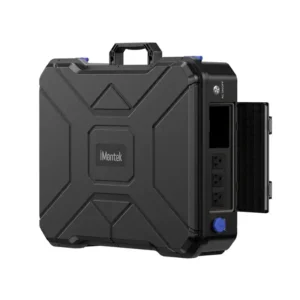
The Montek X1200 answers one question better than anything at its size: will it start the tool? A 7,000W surge ceiling swallows motor inrush that trips lesser inverters, 1,280Wh returns a class-leading 92% at the outlets, and solar accepts panels up to 150 volts.
★★★★★
More details +
Everything about this unit points to one moment: the instant a motor tries to start and the inverter either holds or quits. A 7,000W ceiling, roughly double what anything else at this capacity offers, is the whole reason it exists. Independent testing pulled 1,190Wh from the rated 1,280Wh, a 92% result that is the best I have seen in this size range and means it out-delivers some larger units. The 9.6ms switchover and auto-on inverter make it a credible home backup too. But 57dB fans put it well past comfortable bedside use; 2,500 cycles are short of the 4,000 its rivals carry; and there is no phone support if something goes wrong. Buy it for a garage, a workshop, or a truck bed, where the surge and the 150-volt solar input earn their keep. For a bedroom, the Bluetti AC240 is the better answer.
PROS:
- Best-in-class 92% efficiency, so it delivers more usable energy than its rated capacity suggests.
- A 7,000W surge rating, roughly double most units this size, for high-inrush motor loads.
- Solar input to 150 volts, so you can wire a real array of cheap third-party panels.
- Fast 9.6ms switchover with an auto-on inverter for unattended backup.
- It takes an expansion battery, so the system can grow.
- A 2,000W continuous rating puts it in the Heavy-Duty Household Class, so it runs space heaters and portable AC.
CONS:
- Fan noise of 57dB rules out bedroom and tent use for most people.
- Cells rated for 2,500 cycles, fewer than the 3,500 to 4,000 of competing units.
- No phone customer support from the brand.
- Inverter distortion was not measured, which is important for sensitive medical equipment.
- At 37 pounds, it is heavy for its capacity and requires a firm two-handed carry.
- The USB-C port maxes at 100W, behind the 140W ports on newer rivals.
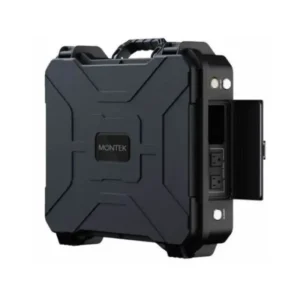
The Montek X1000 delivers 910Wh of its 1,010Wh rating, a 90% return, with a 260W twelve-volt output and 89% DC efficiency. It uses NMC cells rated for 2,000 cycles and has no automatic transfer function.
★★★★★
More details +
Excellent Conversion, Obsolete Chemistry
Ninety percent of this machine's rated capacity reaches the outlets, and 89% reaches the twelve-volt socket, which are among the strongest conversion figures we have recorded at any capacity. The DC side is fed by a 260-watt output, nearly double what most machines this size can provide. For a camp fridge, a diesel heater, or vehicle accessories, that combination is genuinely well matched, and 25 pounds makes it a one-handed carry. Then the chemistry: NMC cells rated for 2,000 cycles, one of only five NMC machines left in our database, backed by a two-year warranty. At one cycle a day, that runs out past year five,e where LiFePO4 rivals at this capacity reach eleven. Around it sit a 1,000-watt inverter that excludes heating appliances entirely, 210 watts of wall charging that takes close to five hours, 59-decibel fans, no app at all, and no automatic transfer function. Montek's own X1200 offers the same efficiency and fixes nearly all of those issues, which makes the smaller machine hard to recommend at anything but a steep discount. PROS:
- Conversion of 90% at the outlets, among the strongest figures we have recorded at any capacity.
- A 260W twelve-volt output with 89% DC efficiency, well suited to camp and vehicle loads.
- Standby drain of 1% an hour, so it holds a charge through long storage.
- An internal charger rather than an external brick, with dual charging at 560W.
- Solar to 70 volts with a 12-volt floor, and the array can stay permanently connected.
- Twenty-five pounds for 1,010Wh, a genuine one-handed carry, with a silent inverter.
CONS:
- NMC cells rated for 2,000 cycles, roughly five years of daily use, compared with 111for LiFePO4 rivals.
- No UPS mode fitted, so connected equipment loses power during a blackout.
- A 1,000W inverter, the lowest at this capacity, which excludes heating appliances.
- Wall charging at 210W, about 5 hours from empty at a single fixed rate.
- No app of any kind and no expansion path.
- Fifty-nine decibels and a two-year warranty, both at the weak end of this class.