
Oupes Power Station Reviews

Oupes power stations tested and compared. Which models deliver genuine value, which repeat the brand’s recurring flaws, and how Oupes compares to rivals.

Oupes splits cleanly in two. The Mega series delivers strong value at $0.33 and $0.36 per watt-hour with working transfer functions and apps. The numbered series does not.

Across the 600, 1100, and 1800, the same four gaps repeat every time: no transfer function, no app, charging through an external brick, and a solar input capped around 30 volts.

Best for: the Mega 2 and Mega 3 specifically. Weakest for: everything else in the range.

Editor's Choice

Each Oupes power station model below links to its full review, where you will find measured runtimes, the complete ten-category score breakdown, full specifications, and our verdict. This page is for choosing between them; the reviews are for understanding any one of them properly.

Add to compare
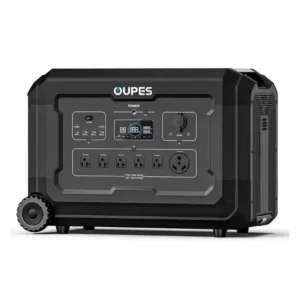
The Oupes Mega 3 holds 3,072Wh behind a 3,600W inverter, delivers 2,620Wh at the outlets, and accepts 2,100W of solar to 150 volts. A six-year warranty backs 3,500-cycle cells, and it sits in the upper mid-range price tier at exceptional value.
★★★★★
More details +
Most specifications in this category are matters of degree; a slower charger costs you time; a louder fan costs you a room. Switchover speed has a practical threshold of 20 milliseconds: below it, connected equipment generally rides through a grid failure; above it, it depends on your particular power supply. Across forty machines measured for this site, this is the only one to land on the wrong side of it, at 20.1 milliseconds, and it cannot arm its own inverter either. Two further limitations compound it: the array cannot stay permanently connected, which almost everything else here allows, and the machine cannot receive firmware updates at all across six years of warranty coverage. That warranty is genuinely a year better than the class standard, the value tier is honest, the 2,100-watt solar range is flexible, and the standby drain under 1% is good. But two direct rivals at identical capacity and the same price convert four points better, switch over in less than half the time, take a permanent array,y and get firmware support. There is no configuration in which this is the one to buy.
Battery safety and chemistry (LiFePO4, 3,500 cycles)
9
Real-world efficiency and output (85% AC, 82% DC, distortion unmeasured)
7.5
UPS and EPS switchover (20.1ms, above threshold, no self-arming)
4
Port selection and distribution (100W USB-C, 400W DC)
8
Solar charging and MPPT (2,100W to 150V, cannot stay connected)
7
AC recharge speed (1,800W mains, 3,900W combined)
7.5
Noise and thermal management (61dB)
4.5
Portability and build quality (81 lbs)
4.5
Expandability and ecosystem (expansion support)
9
Smart app and interface
5
PROS:
  • A six-year warranty, a year beyond the class standard.
  • Solar of 2,100W across a wide 12 to 150 volt range, suiting foldables and rigid strings alike.
  • Combined charging of 3,900W, more than double the mains input alone.
  • Standby drain of 0.9% an hour, so it holds a charge through long storage.
  • A 400W app-controlled DC port and expansion support at an exceptional value tier.
  • A 3,600W inverter with 6,000W of surge, properly sized for the capacity.
CONS:
  • A 20.1ms switchover, the only reading above the twenty-millisecond threshold in this dataset.
  • Panels cannot remain connected around the clock, so the array must be disconnected between sessions.
  • No firmware update capability across six years of warranty coverage.
  • Sixty-one decibels, beyond what any occupied indoor room will tolerate.
  • No harmonic distortion figure exists in the bench data
  • Eighty-one pounds and 1,800W mains charging, both behind the better machines at this size.
Add to compare
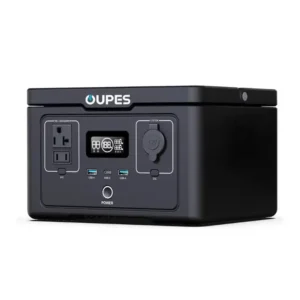
The Oupes 600 delivers 470Wh of its 595Wh rating, is powered by a 600W inverter, weighs 14.9 pounds, and charges at 97W via an external brick. Output measures 110 volts, and there is no transfer function or app.
★★★★★
More details +
Tested Oupes, and the Same Four Gaps
We have tested several Oupes power stations, and all share the same list: mains charging through an external brick, no automatic transfer function, no app of any kind, and a solar input capped around 30 volts that excludes most rigid panels. The smallest of them repeats every one, then adds an output measuring 110 volts and conversion of 78% through the sockets, seven points below where machines this size should land. Charging runs at 97 watts, more than six hours from empty, though dual charging at least lifts the combined figure to 160. What it genuinely offers is weight: 14.9 pounds is the lightest of any machine at this capacity we have put on a scale, a real one-handed carry-over distance, and the 160-watt, twelve-volt socket clears the threshold most compact machines miss. The Pecron E600LFP, at almost identical capacity, converts 13 points better, carries double the inverter, takes more than 3 times the solar, and costs less per watt-hour.
Battery safety and chemistry (LiFePO4, 2,000 cycles)
5.5
Real-world efficiency and output (78% AC, 84% DC, 110V output)
4.5
UPS and EPS switchover
2.5
Port selection and distribution (60W USB-C, 160W DC)
6
Solar charging and MPPT (115W, 30V ceiling)
2.5
AC recharge speed (97W via brick, 160W dual)
2.5
Noise and thermal management (51dB with inverter whine)
6.5
Portability and build quality (14.9 lbs at 595Wh)
8.5
Expandability and ecosystem (no expansion support)
4
App, display and telemetry
3
PROS:
  • Fourteen point nine pounds, the lightest machine at this capacity we have weighed.
  • Dual charging supported at 160W, which its own rivals at this capacity lack.
  • Returns 84% through DC, six points better than the AC path.
  • A 160W twelve-volt socket that clears the 150-watt threshold.
  • A bi-directional 60W USB-C port and an exceptional value tier.
  • LiFePO4 chemistry with a 24-hour customer service response commitment.
CONS:
  • Wall charging of 97W through an external brick, over six hours from empty.
  • Only 78% through AC, seven points below the class line.
  • Output measured 110 volts, below the accepted band and hard on motors.
  • Solar capped at 115W with a 30-volt ceiling that excludes most rigid panels.
  • No UPS mode, no app, and no expansion path.
  • Fifty-one decibels with an audible inverter whine, and 2,000-cycle cells.
Add to compare
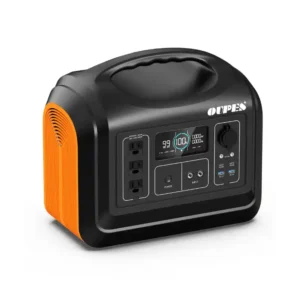
The Oupes 1800 delivers 1,320Wh of its 1,488Wh rating, backed by an 1,800W inverter with 4,000W of surge power. Wall charging runs at 375W through an external brick; there is no app or transfer function, and output measures 110 volts.
★★★★★
More details +
Divide the pack by the charger, and this machine takes nearly four hours to recover (375 watts through an external brick into a 1,488Wh pack), the worst charging-to-capacity ratio recorded anywhere on this site, at any capacity. Its own inverter can empty that pack in about forty-five minutes. The solar side offers no relief either: 415 watts across a 12- to 30-volt window, a ceiling narrow enough to exclude most rigid panels outright, leaving you with low-voltage foldables and a slow refill. Add no automatic transfer function at all, so a blackout takes connected equipment down; a 110-volt output that makes motors run hot; a 60-watt USB-C port; no app; and no expansion path. What the machine does well is convert, at 88.7% through the sockets, which is above the class line and better than several pricier rivals, and it holds its charge at 1% an hour. Those are genuine strengths attached to a design that are replaced by what it spends or reacts when it matters.
Battery safety and chemistry (LiFePO4, 2,500 cycles)
6
Real-world efficiency and output (88.7% AC, 81.3% DC, 110V output)
6
UPS and EPS switchover
2
Port selection and distribution (60W USB-C, 135W DC)
4.5
Solar charging and MPPT (415W, 30V ceiling)
3
AC recharge speed (375W via external brick)
2
Noise and thermal management (56dB, silent inverter)
6
Portability and build quality (40 lbs)
7
Expandability and ecosystem (no expansion support)
4
App, display and telemetry
3
PROS:
  • Conversion of 88.7% at the outlets, above the class line and better than several pricier machines.
  • Standby drain of 1% an hour, with nothing measurable on the DC side.
  • An 1,800W inverter with 4,000W of surge capacity, properly sized for the load.
  • The inverter itself runs silently, so the fans are the only noise source.
  • Cells rated to 2,500 cycles, with pass-through charging and a permanently connectable array.
  • Forty pounds, reasonable for the capacity.
CONS:
  • Wall charging of 375W through an external brick, the worst ratio measured anywhere here.
  • No UPS mode fitted, so connected equipment loses power during a blackout.
  • A 30-volt solar ceiling that excludes most rigid panels entirely.
  • Output measured 110 volts, below the accepted band and hard on motors.
  • A 60W USB-C port, no app of any kind, and no expansion path.
  • Luxury value tier, with a two-year warranty against a five-year standard.
Add to compare
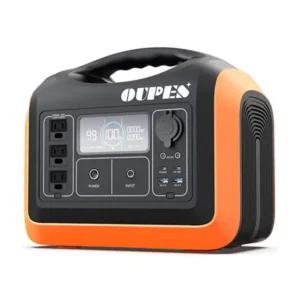
The Oupes 1100 delivers 810 Wh of its 992 Wh rating through a 1,100 W inverter. Main power comes in at 180W via a separate brick; panels stop at 161W and 30 volts, and neither a handover function nor connectivity is fitted.
★★★★★
More details +
By the third machine from a manufacturer, a repeated flaw stops being a coincidence. Across the Oupes 600, this 1100, and the Oupes 1800, the same list appears every time: no automatic transfer function, mains charging through an external brick, no app of any kind, and a solar input that stops around 30 volts, thereby excluding most rigid panels. This is the middle machine of that group, and it adds a 110-volt output that falls below the accepted band and is harder on any motor, plus it has the weakest conversion of the three at 81.6% through the sockets and 80% through DC. Charging runs at 180 watts and takes more than five hours from empty, with no dual charging to shorten it. What works is genuine but modest: a 1,100-watt inverter with a comfortable 2x surge margin, 52 decibels, and 24 pounds. The Bluetti Elite 100 V, at almost the same capacity, charges nearly seven times faster, hands over in 8.7 milliseconds while arming itself, and outputs the correct voltage.
Battery safety and chemistry (LiFePO4, 2,000 cycles)
5.5
Real-world inverter efficiency (81.6% AC, 80% DC, 110V output)
4
UPS and EPS switchover (no UPS mode fitted)
2.5
Port selection and power distribution (60W USB-C, 135W DC)
4.5
Solar charging and MPPT performance (161W, 30V ceiling)
2.5
AC recharge speed (180W via external brick)
2
Noise and thermal management (52dB)
7
Portability and build quality (24 lbs)
7.5
Expandability and ecosystem (no expansion support)
4
Smart app and interface
3
PROS:
  • An 1,100W inverter with 2,200W of surge has a comfortable 2x margin for compressor starts.
  • Fifty-two decibels under load, quieter than several machines at this capacity.
  • Twenty-four pounds for 992Wh, a manageable one-handed carry.
  • The array can stay permanently connected, with pass-through charging supported.
  • LiFePO4 chemistry with a 24-hour customer service response commitment.
  • Priced in the premium value tier rather than the luxury one.
CONS:
  • Wall charging at 180W via an external brick, taking over five hours from empty.
  • No UPS mode is fitted, so the equipment loses power during a blackout.
  • Solar capped at 161W with a 30-volt ceiling that excludes most rigid panels.
  • Output measured 110 volts, below the accepted band and hard on motors.
  • Conversion of 81.6% through AC and 80% through DC, both below the class line.
  • A 60W USB-C port, no app, no expansion path, and no dual charging.

Strengths and Weaknesses

Assessed across all our Oupes-reviewed power stations rather than on any single model.

What this brand does well Where it falls short
The Mega series is genuinely good value. The Mega 2 at $0.33 and Mega 3 at $0.36 per watt-hour undercut most rivals at those capacities. The numbered series repeats four gaps on every model: no transfer function, no app, external brick charging, and a solar ceiling around 30 volts.
Six-year warranty on the Mega 3, one of the longest terms we have recorded. Two-year warranty on the 600 and 1800, which is the shortest pairing in the range.
LiFePO4 throughout, rated 2,000 to 3,500 cycles. The loudest brand we tested, averaging 56.8 dB, with the Mega 3 at 61dB. No Oupes reads below 51dB.
The Oupes 600 at 14.9 pounds is the lightest machine at its capacity we have weighed. Conversion averages 83.9%, the weakest of the six largest brands.
Expansion support on both Mega machines. The Oupes 1800 at $0.94 per watt-hour is among the most expensive energy in our database, and it has no transfer function.
Both Mega machines carry Bluetooth apps. Telephone support is missing on two of five machines, and the Mega 3's 20.1ms handover is the slowest measurable figure in our database.

Which Model Is Right for You?

Camping and Tailgating

The Oupes 600 is the only sensible option, and its case rests entirely on weight. At 14.9 pounds for 595 Wh,h it is the lightest machine at that capacity we have put on a scale.

Add to compare
A studio product photo of the compact OUPES 600 portable power station on a white background, displaying its solid black rectangular body, front LCD screen showing battery levels, dual AC outlets, and various USB and DC ports.
Deal
3 months ago

Oupes 600 Review

The Oupes 600 delivers 470Wh of its 595Wh rating, is powered by a 600W inverter, weighs 14.9 pounds, and charges at 97W via an external brick. Output measures 110 volts, and there is no transfer function or app.
★★★★★

Everything else about it is ordinary: 78% conversion, 110V output, 97W charging through a brick, no app, and a two-year warranty. Buy it because it is light, not because it is good.

Overlanding and RVing

Neither the 1100 nor the 1800 is competitive. The 1800 costs $0.94 per watt-hour, which is near the top of our whole database, and has no transfer function.

If you want an Oupes for vehicle use, the Mega 2 at 48 pounds is the better machine despite the weight, and costs a third as much per watt-hour.

Add to compare
OUPES Mega 2 Review
Deal
2 months ago

OUPES Mega 2 Review

Emergency Home Backup

The Mega 2 is the pick: 2,048Wh, 2,500W continuous, 5,000W surge and a 17.7ms handover at $0.33 per watt-hour.

Add to compare
OUPES Mega 2 Review
Deal
2 months ago

OUPES Mega 2 Review

The Mega 3 offers more capacity and a six-year warranty, but its 20.1ms handover is the slowest measurable figure in our entire database, which puts it right at the edge of the safety threshold.

Add to compare
A studio product photo of the rugged OUPES Mega 3 portable power station on a white background, featuring a dark charcoal gray body, integrated transport wheels, a central digital display, and multiple front-facing AC, DC, and USB outputs.
Deal
3 months ago

Oupes Mega 3 Review

The Oupes Mega 3 holds 3,072Wh behind a 3,600W inverter, delivers 2,620Wh at the outlets, and accepts 2,100W of solar to 150 volts. A six-year warranty backs 3,500-cycle cells, and it sits in the upper mid-range price tier at exceptional value.
★★★★★

None of the numbered series can be used for backup, since none has a transfer function.

Larger Installations

The Mega 3 at 3,072Wh and 3,600W continuous is the largest Oupes we have tested, with expansion support and a six-year warranty at $0.36 per watt-hour.

Add to compare
A studio product photo of the rugged OUPES Mega 3 portable power station on a white background, featuring a dark charcoal gray body, integrated transport wheels, a central digital display, and multiple front-facing AC, DC, and USB outputs.
Deal
3 months ago

Oupes Mega 3 Review

The Oupes Mega 3 holds 3,072Wh behind a 3,600W inverter, delivers 2,620Wh at the outlets, and accepts 2,100W of solar to 150 volts. A six-year warranty backs 3,500-cycle cells, and it sits in the upper mid-range price tier at exceptional value.
★★★★★

It is not split-phase, so anything on a two-pole breaker remains out of reach. At 61 dB, it is also the loudest machine in the range, which suits a garage rather than a utility room.

Technology and Ecosystem

The Recurring Gaps

Across Oupes power stations, we tested spanning 595Wh to 3,072Wh, three share the same four omissions: no automatic transfer function, no app, mains charging through an external brick, and a solar input capped around 30 volts that excludes most rigid panels.

That consistency across capacities indicates a brand decision rather than a size constraint, and it is the single most useful thing to know before shopping the range.

The Mega Series Difference

The Mega 2 and Mega 3 correct most of it. Both have transfer functions, Bluetooth apps, expansion support, and internal charging, and both are priced well at $0.33 and $0.36 per watt-hour.

They remain loud at 59 and 61dB, and the Mega 3’s handover at 20.1ms sits exactly on the safety threshold rather than inside it.

Solar Limitations

Every Oupes we have tested caps its solar voltage at or near 30 volts. Most rigid panels operate above that, which restricts you to low-voltage foldables wired in parallel.

Check the voltage window against panels you already own before buying any machine in this range.

Editors Brand Comparisons Summary (How This Brand Compares to Rivals)

How Oupes measures against the brands competing at the same price points, on our tested figures.

Against How they differ on our measurements Choose this brand when
Oupes vs Pecron Both compete on value, and Pecron wins on nearly every measure: better conversion (87.9% against 83.9%), quieter fans (53.9 dB against 56.8 dB), and a lower median cost per watt-hour. Only for the Mega 2 specifically, where $0.33 per watt-hour with a 2,500W inverter is genuinely competitive.
Oupes vs Bluetti Bluetti converts better, runs considerably quieter, and offers far more model choice. Oupes undercuts it substantially on the Mega series. You want maximum capacity per pound spent, and the machine lives somewhere noise does not matter.

The Bottom Line

Oupes is two brands under one badge. The Mega series delivers real value with the features a backup machine needs, and the numbered series repeats the same four gaps at every capacity.

Buy the Mega 2 for value or the Mega 3 for capacity and warranty length. Treat the 600 as a lightweight camping battery and skip the 1100 and 1800 entirely.

Frequently Asked Questions

It depends entirely on the model, more so than any other brand we test. The Mega 2 and Mega 3 are genuinely good value, with working transfer functions and apps. The 600, 1100, and 1800 all lack a transfer function, an app, internal charging, and a usable solar voltage range. Those four gaps repeat on every numbered model.

The Mega 2 at $0.33 per watt-hour: 2,048Wh, 2,500W continuous, 5,000W surge, expansion support, and a Bluetooth app. The Mega 3 is the larger option at $0.36, though its 20.1ms handover is the slowest measurable figure in our database.

Fan design appears to be where the cost savings land. Across five machines, the brand averages 56.8dB, the loudest of the six largest brands we test, and nothing in the range reads below 51dB. If the machine will live in an occupied room, this is the specification to check first.

Yes, but with an important limit. Every Oupes we have tested caps its solar voltage at or near 30 volts, which excludes most rigid panels. You are restricted to low-voltage foldables wired in parallel. Check your panels' operating voltage before buying.

Only the Mega 2 and Mega 3, which are the sole models with a transfer function. The 600, 1100, and 1800 cannot catch a power cut at all. Even then, the Mega 3's 20.1ms handover sits at the edge of the reliable range, so a desktop or network drive may still restart.

Power Station Geek
Logo
Compare items
  • Total (0)
Compare
0