
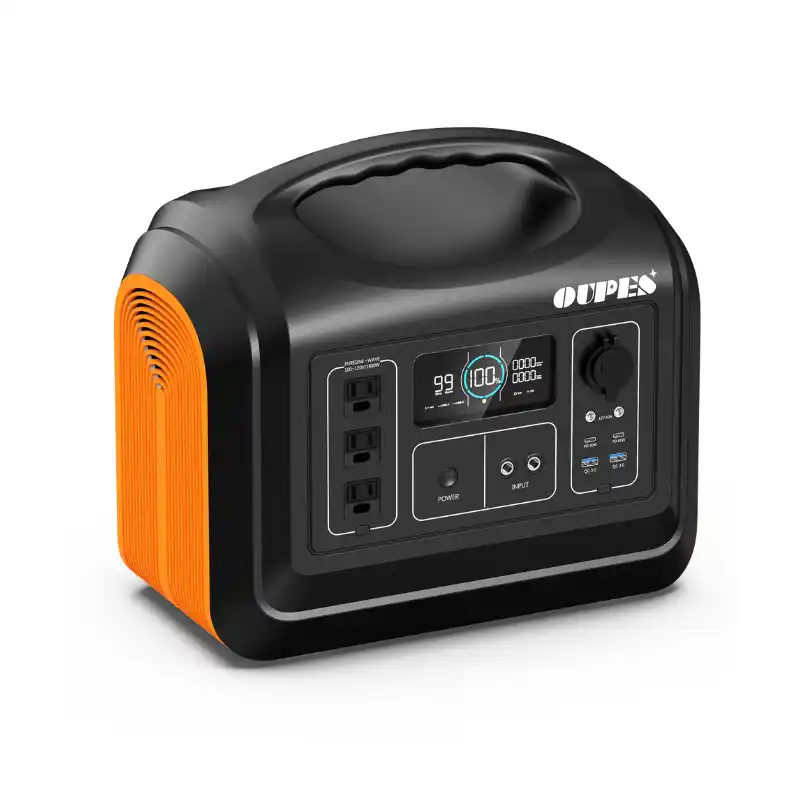
Oupes 1800 Review

The Oupes 1800 delivers 1,320Wh of its 1,488Wh rating, backed by an 1,800W inverter with 4,000W of surge power. Wall charging runs at 375W through an external brick; there is no app or transfer function, and output measures 110 volts.
My Quick Verdict
Run this power station at its rated output and the pack empties in about forty-five minutes. Refill it from a wall socket, and you wait nearly four hours.
Three hundred and seventy-five watts through an external brick is the slowest charging arrangement measured anywhere for this site, into any capacity.
It also has no automatic transfer function at all, no app, no expansion path, a 60-watt USB-C port, and a 110-volt output that sits below the accepted band.
It converts well (88.7% at the sockets is a genuinely strong figure), and that is the only sentence in this review that reads as praise.
Best for: Planned off-grid use where the machine is charged overnight beforehand and nothing motor-dependent relies on it.
Not for: backup, monitoring, twelve-volt builds, or any situation where recharging speed matters.
Key Stats
Introduction
There is a simple test that exposes an unbalanced design: divide the pack by the charger and see how long recovery takes.
On this machine, that arithmetic gives you nearly four hours, from a 375-watt external brick into a 1,488Wh pack. It is the slowest charging arrangement I have measured on this site, at any capacity, by a clear margin.
Behind it sits an 1,800-watt inverter that can empty the same pack in roughly forty-five minutes.
Chemistry is lithium iron phosphate, with 2,500 cycles claimed and a two-year warranty.
What It Can Actually Run
Eighteen hundred watts sustained with 4,000 in a burst, which handles a heating appliance or a refrigerator with lighting beside it.
Rated at 1,488 Wh, the power station delivered 1,320 Wh through its AC outlets. That is not the strongest result for the machine.
All runtime calculations below are based on 1,320Wh of usable AC energy.
- Refrigerator at 150W: eight and three-quarter hours.
- CPAP at 40W without humidification: thirty-three hours.
- Starlink dish at 50W: over twenty-six hours.
- Laptop at 70W: about nineteen charges, though slowly through a 60-watt port.
Output measured 110 volts, below the accepted working band, with electrical noise above 2,000 mV, though no audible noise from the inverter itself.
Charging and Smart Features
Wall input is 375 watts, delivered through an external charging brick rather than an internal charger, at a single fixed rate.
Solar takes 415 watts between 12 and 30 volts. That 30-volt ceiling is among the narrowest measured and rules out most rigid panels.
Dual charging is supported and lifts the ceiling to 415 watts, which barely improves on solar alone.
There is no UPS mode and no app. Premium price tier, luxury value tier.
Charging Speed Benchmarks
Where the Oupes 1800 sits on recharging against the 1,000Wh to 1,999Wh capacity class, drawn from the 30 machines in our charging database. The bracket returns a 1,085W mean on the wall and 641W on panels. Ratings are internal to the class, so they rank this unit among similar capacities only.
Wall charging runs at 375W through an external brick, roughly a third of the 1,085W class average and a clear Low rating, which puts 1,488Wh at about 4.0 hours from empty. There is no rate adjustment and no internal charger, so the figure is fixed. This is the class where internal charging became standard rather than exceptional, and a brick-fed 375W input on a pack approaching 1.5kWh is the specification that dates the machine most.
Panels accept 415W, marginally faster than the socket but still under two thirds of the 641W class average and rates Low where the bracket peaks at 1,400W. A full array refill takes roughly 3.6 hours in ideal light, and longer once cloud and panel angle take their usual share. Neither input will return this machine to full inside a working morning, so plan recharging around overnight or a full day rather than around a gap between uses.
Need a machine that recovers quickly? The EcoFlow Delta 3 Plus charges internally at 1,500W and takes 1,000W of solar, four times and more than twice the Oupes 1800 respectively, with both inputs able to run together. A 1,024Wh pack is back to full inside an hour on either channel, which is the difference between a machine you can cycle daily and one you charge overnight.
Real Capacity: What You Actually Get
This is the one section where the machine performs well.
A meter on the sockets recorded 1,320 Wh, compared with a claimed 1,488 Wh. That 88.7% sits above the class bar and ahead of machines that cost several times as much.
The twelve-volt route returned 1,211Wh, or 81.3%, seven points behind. The AC path is the efficient one here, so there is no need to route loads onto DC.
Charge retention is sound as well; a percent-per-hour charge, nothing detectable at twelve volts.
The trouble is what surrounds those figures. A machine that converts well and takes four hours to refill is efficient in its use of energy it cannot quickly replace.
My takeaway: 1,320 Wh is the working figure, and it comes from a genuinely good conversion. Plan on nearly four hours to put it back, and charge overnight rather than between uses.
Power Output and Surge: What It Can Turn On
The inverter ratings are reasonable for the capacity. At 1,800 watts, it powers a heater or a fridge with lamps beside it, while 4,000 watts in a burst handles compressor startup.
The problem is the voltage at which those watts arrive. At 10 volts under nominal conditions, motors compensate by drawing more current, which heats them up and causes them to age sooner. Heating elements, lamps, and switching supplies notice nothing.
The port array is thin. A 60-watt USB-C output is half of what most machines at this capacity provide, and it will charge a laptop slowly, if at all, at full rate.
Its 12-volt outlet caps at 135 watts, just under the 150 watts that separates a working socket from a token one.
One positive: the inverter itself produces no audible noise, so the fans are the only source of noise.
Real Appliance Runtimes
1,320Wh translated into running hours, on the appliance set applied to every machine here.
These runtimes are perfectly decent. The question this machine cannot answer well is what happens after they run out.
Recharging: Wall and Solar
From a Wall Outlet
Three hundred and seventy-five watts into a 1,488 Wh pack is the worst charging-to-capacity ratio measured anywhere on this site.
From empty, that is close to four hours. Comparable machines routinely accept 1,200 watts and are full again in seventy minutes.
The power comes via a brick that lives outside the machine, so there is an extra object to transport and eventually replace, and misplacing it removes mains charging altogether.
There is no rate adjustment, and dual charging raises the combined ceiling to only 415 watts, which is barely more than solar delivers on its own.
From Solar Panels
The solar arrangement is as constrained as the mains one, and in a more specific way.
Input reaches 415 W at 1- 30 V. That 30-volt ceiling is among the narrowest recorded for this site.
Most rigid panels produce above 30 volts, so this machine will not accept them. You are limited to low-voltage foldables wired in parallel, and the 415-watt total means even those cannot refill the pack quickly.
Reaching the rated figure also requires dual inputs rather than a single connection.
Two things the panel side does permit: leaving the array wired in indefinitely, and running loads while it charges.
Blackout Backup: The Part I Care About Most
There is no automatic transfer function on this machine.
Its grading row indicates that the UPS mode is not applicable. Anything in the sockets goes dark with the mains, no differently from a household circuit.
That places the Oupes 1800 alongside four other machines in this database with the same gap, and the same conclusion applies: this is a battery, not a backup system.
Losing a percent an hour means it waits well and stays charged. What it will never do is act without you.
Why this matters to me: an 1,800-watt inverter with no transfer function is a large extension lead with a battery attached. If a blackout is why you are shopping, this machine cannot help.
Noise and Living With It
Fifty-six decibels under load, past what any occupied indoor room will tolerate and unremarkable in a garage or outbuilding.
The sheet marks the inverter as silent, leaving the fans as the only source of noise; an improvement over several machines at this price where both are audible.
Forty pounds, 18 kilograms; fair enough for the amount of energy inside.
There is no app of any kind and no expansion port. The warranty runs for two years and is backed by a 24-hour customer service response commitment.
Where It Falls Short
Five limitations, and the first two compound each other badly.
1. Three Hundred and Seventy-Five Watts Through a Brick
The worst charging-to-capacity ratio recorded anywhere for this site, at close to four hours from empty.
It is delivered by an external charger rather than a built-in one, so the machine cannot take mains power at all without a separate component that can be lost or damaged.
2. No UPS Mode
No automatic transfer function of any kind, so a blackout takes connected equipment down.
Combined with the slow charger, that means the machine neither reacts to an outage nor recovers quickly from one.
3. A 30-Volt Solar Ceiling
Among the narrowest windows measured for this site. Most rigid panels operate above 30 volts and will not work here at all.
You are confined to low-voltage foldables, and 415 watts total means even those refill the pack slowly.
4. Output Measured 110 Volts
Below the accepted working band. Motors draw extra current to compensate and run hotter, which shortens their life over repeated cycles.
Resistive loads and switching supplies remain unaffected, keeping the machine usable for some purposes.
5. A 60-Watt USB-C Port, No App, No Expansion
At 60 watts, the port offers half of what this class typically provides, and plenty of laptops will not draw at their full rate from it.
No wireless of any sort means nothing to watch or update, and with no module port, the 1,488Wh figure is fixed for good.
How It Compares
Two comparisons at a similar capacity show what the money could buy instead.
The Lemi Power 1500 matches this machine’s usable capacity almost exactly and beats it on charging speed, output voltage, USB-C, app connectivity, and transfer functionality. Its own 30-millisecond switchover is poor, and it is still better than none.
The Montek X1200 holds less capacity and outclasses both: 92% conversion, a 9.6-millisecond self-arming transfer, 1,200 watts of solar to 150 volts, and 1,200 watts of internal charging.
There is no measure on which the Oupes leads either machine except AC conversion, where it beats the Lemi by three points.
Who Should Buy It, and Who Should Skip It
Buy It If
- It is heavily discounted, and you understand exactly what it cannot do.
- The machine gets charged overnight before planned use, never between uses.
- Your loads are resistive or electronic, with no motor depending on it.
- You already own low-voltage foldable panels that are suitable for a 30-volt ceiling.
Skip It If
- Blackout protection is any part of your reason for buying.
- You need it fully charged in less than four hours.
- You own or plan to buy rigid solar panels.
- You want an app, an expansion path, or a USB-C port that properly charges a laptop.
The Bottom Line
The Oupes 1800 converts its battery well, holds a charge well, and runs a properly sized inverter. Those three things are real, and they are the whole list.
Everything governing how energy gets in or how the machine behaves during an outage is either the worst measured here or absent entirely. A 375-watt external brick, a 30-volt solar ceiling, and no transfer function at all.
Two machines at this capacity do more for less, and one of them does considerably more. There is no scenario in which this is the right purchase at anything other than a steep discount.


There are no reviews yet.