
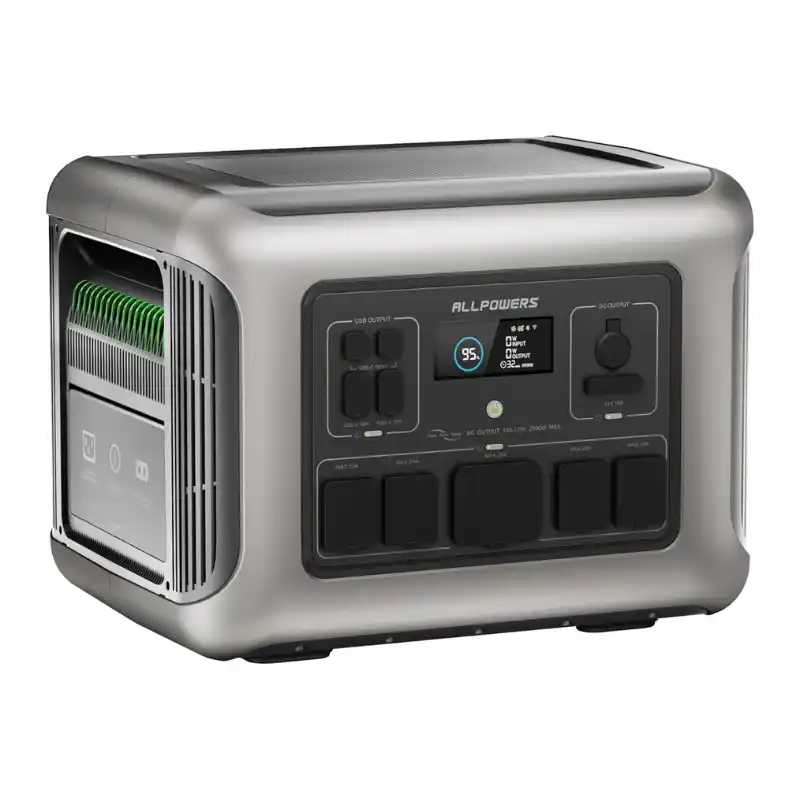
AllPowers R2500 Review

The AllPowers R2500 pairs 2,016Wh with a 2,500W inverter and accepts solar between 12 and 150 volts, a ceiling few units reach. It delivers 1,720 Wh to the outlets and takes an expansion battery. Upper mid-range price tier, exceptional value per watt-hour.
My Quick Verdict
Across every power station we have reviewed, the output voltage has fallen between 117 and 122. American mains voltage is 120 V, and the accepted operating range for household equipment is 117 to 123 V.
This one measured 112 volts. It is the only machine reviewed here to fall outside that band, and it is not marginal.
Undervoltage is not a cosmetic fault. Motors compensate by drawing more current, which makes them run hotter and shortens their life; this is precisely the kind of problem that shows up months later as a failed compressor rather than immediately as a tripped breaker.
Which is a shame, because the solar implementation here is one of the best at this capacity, and the inverter is the largest.
Best for: Off-grid and workshop use with resistive loads and a large array, where undervoltage is least critical.
Not for: refrigerators, freezers, pumps, or any other motor you intend to keep for years.
Key Stats
| Badge | Stats |
|---|---|
| Battery chemistry and longevity | LiFePO4 | 3,500 cycles |
| Continuous AC power output | 2,500W AC | 4,000W peak |
| Energy storage capacity | 2,016Wh | 1,720Wh usable |
| Rapid AC wall recharge | 1,500W input | Three-stage |
| Uninterrupted emergency backup | 11ms UPS | Manual arm |
| Maximum solar input and MPPT | 1,000W solar | 12–150V ceiling |
| Ultra-fast USB-C power delivery | Two 100W USB-C ports |
| Low-noise operational level | 57dB | Loud under load |
| Measured output voltage | 112V | Below the safe band |
| Modular capacity expansion | Expandable | Extra battery port |
Introduction
Output voltage is a specification nobody checks because, on almost every unit, it is fine. The grading standard used across this site allows 117 to 123 volts, which brackets the 120 volts delivered by American sockets, and twenty-two machines have now cleared it.
The R2500 measured 112 volts, roughly 7% low.
Resistive loads, such as heaters and incandescent lighting, run at reduced power, and nothing is harmed. Motors behave differently: they draw extra current to make up the shortfall, which raises operating temperature and shortens service life. The consequences accumulate rather than announce themselves.
The pack is lithium iron phosphate, with 3,500 cycles claimed and 5 years covered.
What It Can Actually Run
The inverter sustains 2,500W with a 4,000W peak, and that sustained rating is the highest at this capacity.
Nominal storage is 2,016Wh. The outlets returned 1,720Wh, an 85% result. Figures below use 1,720Wh.
- Refrigerator at 150W: about 11.5 hours, though see the voltage caveat above.
- CPAP at 40W, humidifier off: roughly forty-three hours of use.
- Starlink dish at 50W: roughly thirty-four hours.
- Laptop at 70W: about twenty-four refills across two ports.
Distortion was left unmeasured, while electrical noise came back above 2,000mv, the noisy end of this field.
Charging and Smart Features
Wall input reaches 1,500W across three selectable stages, and both sources together take 2,000W.
The panels are where it excels: a kilowatt taken in across a 12- to 150-volt window at 13 amps. That ceiling is among the highest in this data and permits a real series string.
The crossover measured 11 milliseconds, which is quick, but the inverter must be armed by hand.
Upper mid-range price tier and exceptional value tier.
Charging Speed Benchmarks
Wall and panel charging for the AllPowers R2500, measured against every unit in the 2,000Wh to 3,000Wh capacity class our charging database covers. Twenty-six machines sit in that group, with mean inputs of 1,641W from the wall and 1,123W from panels. Bands are terciles drawn inside the class, so a rating here describes the machine among comparable capacities and nothing else.
Three-stage wall charging reaches 1,500W, which is 141W short of the 1,641W class average and keeps the R2500 in the lower half of the Average band, with 2,000W available when panels feed it at the same time. Filling 2,016Wh from a socket alone takes roughly 1.3 hours. Inputs across this bracket run from 470W to 5,000W, so the gap to the leaders is wide, but three selectable rates is better control than most machines in the same price region offer.
Panels accept 1,000W, marginally below the 1,123W class mean and rating Average where the bracket ceiling is 2,400W. That is about 2.0 hours of clear sun to refill the pack. The specification worth buying this machine for is the voltage window rather than the wattage: solar is accepted from 12 volts all the way to 150, which covers a single foldable panel and a five-panel series string on the same input, and very few units at this capacity span that range.
Need the grid side to move faster? The Bluetti AC200L accepts 2,400W from a socket, 60 percent more than the R2500, refilling 2,048Wh in about 0.9 hours rather than 1.3. It raises solar to 1,200W on a comparable 145-volt window, so the array flexibility survives the swap and only the panel count changes.
Real Capacity: What You Actually Get
Delivery is respectable on both paths, and the two sit unusually close together.
Metered output reached 1,720 Wh against a 2,016 Wh label; 85%, over the line but not by enough to remark on.
The 12-volt route returned 1,735 Wh, or 86%. A single point of difference, so the choice of port makes almost no practical difference to how much energy you get.
Standby is the weaker figure. Awake with nothing attached,d it sheds roughly 2.16% an hour, which is above the 2% line and means a fortnight left armed would empty most of the pack. On DC, the loss falls to 0.1%.
My takeaway: 1,720Wh either way, so plug it in wherever is convenient. But do not leave the inverter armed for weeks at 2.16% an hour, because it will not be there when you need it.
Power Output and Surge: What It Can Turn On
The sustained rating is the highest at this capacity, and on its own, that would be a selling point.
2,500W can power a heating appliance with a genuine room to spare, and 4,000W of peak power handles compressor starts without difficulty.
The problem is the voltage at which those watts arrive. At 112 volts, a motor rated for 120 volts draws more current to produce the same mechanical work, and the extra current dissipates as heat in the windings.
For a workshop running heaters, lights, and hand tools, this is largely academic. For a refrigerator or freezer expected to run for years off this unit during outages, it is the specification I would weigh above all others on the page.
Distortion was never measured, which leaves a second question unanswered for anyone considering medical equipment.
Real Appliance Runtimes
1,720 Wh translated into running hours using the standard appliance loads applied throughout this site.
| Appliance | Power Draw | Runtime | What That Means |
|---|---|---|---|
| Full-size refrigerator | 150W | About 11.5 hours | Adequate on paper, though the low output voltage is the concern here, not the duration. |
| CPAP machine (no humidifier) | 40W | About 43 hours | Four nights, with distortion unmeasured. |
| Starlink dish | 50W | About 34.4 hours | An electronic load, so the low voltage does not touch it. |
| Pellet grill or smoker | 100W | About 17.2 hours | Seventeen hours of smoke; only the igniter is a motor. |
| Laptop (70W) | 70W | About 24 recharges | Over USB-C, so the inverter voltage is irrelevant. |
Worth noting which of these loads care about the voltage reading. Electronics with switching supplies handle a wide input range and will not notice. Anything with a compressor or a motor will.
Recharging: Wall and Solar
From a Wall Outlet
The mains socket delivers 1,500W into the unit, filling it in roughly ninety minutes.
Three rates beat a plain fast-or-slow toggle, without reaching the four- and five-position systems found elsewhere.
Use both sources at once,e and the total reaches 2,000W, which is ordinary for this size.
From Solar Panels
This is where the R2500 is genuinely strong, and it deserves to be said clearly given the rest of this review.
Panel input accepts 1,000W at 12 to 150 volts, 13 amps. That upper ceiling is among the highest recorded in this data and puts real array design within reach.
At 150 volts, you can wire four or five rigid panels into a single series string, which lowers the current for the same power, reduces losses over a long cable run, and allows for thinner cable. Units capped at 60 volts force everything into parallel, and the cabling costs follow.
Thirteen amps is a modest current allowance, so the design intent is clearly high voltage rather than high current.
The array can remain wired in permanently, and the machine keeps supplying loads throughout a charge.
Blackout Backup: The Part I Care About Most
The hardware is capable, and the firmware leaves it half-finished, a pattern that has recurred across this dataset.
The crossover measured 11 milliseconds, right at the boundary of what I would call excellent and comfortably inside the safety threshold. A computer or a router will ride through it.
The inverter, though, stays down until somebody raises it, and it has to be left up afterwards.
At 2.16% an hour, that is an expensive habit. Leaving it armed for a week costs more than a third of the pack, which makes this unit poorly suited to the standby role it would otherwise suit.
Why this matters to me: eleven milliseconds is fast enough to protect a desktop, and a 2.16% hourly drain means you cannot afford to leave it ready to do so. The two specifications work against each other, and together they are worse than either one alone.
Noise and Living With It
Fifty-seven decibels under load, among the louder readings here and clearly past what a room with a sleeper can absorb.
In a workshop or a garage, it disappears into the background. In a tent or a bedroom,m it does not.
Sixty-three pounds, 25.8 kilograms. Substantial for what it stores, and realistically a job for two people.
One further gap: AllPower offers no telephone support. Anything that goes wrong is handled by email or an online form, and over five years of ownership, that is not a trivial distinction.
Where It Falls Short
One flaw here is unusual enough to lead with. Three others are more familiar.
1. Output Measured 112 Volts
The ALLPOWERS R2500 is the only power station we have tested that falls outside the 117 to 122-volt operating range, at roughly 7% below its nominal voltage.
Resistive loads tolerate this without harm. Motors do not: they compensate by drawing additional current, which raises winding temperature and shortens life. A refrigerator running on this unit during repeated outages is being treated worse than it would be on a rival’s unit.
This is the specification I would weigh most heavily, and it is why I would not recommend the unit for appliance backup.
2. Standby Drain of 2.16% an Hour
Above the 2% line, and awkward given the crossover is fast enough to be useful. A week left armed costs over a third of the pack.
When paired with an inverter that will not self-arm, the unit is effectively unsuitable for unattended standby, regardless of how quickly it hands over.
3. Sixty-Three Pounds, Fifty-Seven Decibels, No Phone Line
Heavy enough for two people, loud enough to exclude quiet rooms, and backed by a five-year warranty with no telephone support behind it.
No one decides the purchase alone. Together, they describe a machine for a workshop rather than a house.
4. No Distortion Reading Exists
Nobody appears to have measured harmonic distortion on this machine, and the electrical noise reading exceeded 2,000 mV. Anyone considering medical equipment now has two open questions rather than one.
How It Compares
The natural comparisons are the Bluetti AC200L, the other high-voltage solar unit at this capacity, and the Pecron E2400LFP, the value benchmark.
| Feature | AllPowers R2500 | Bluetti AC200L | Pecron E2400LFP |
|---|---|---|---|
| Price tier | Upper mid-range | Upper mid-range | Mid-range |
| Value tier | Exceptional | Exceptional | Exceptional |
| Measured output voltage | 112V | 120V | 119V |
| Usable through AC | 1,720Wh (85%) | 1,830Wh (89%) | 1,700Wh (83%) |
| Sustained output | 2,500W | 2,400W | 2,400W |
| Solar voltage ceiling | 150V | 145V | 95V |
| UPS switchover | 11ms | 13.8ms | 9.8ms |
| Self-arming inverter | No | No | Yes |
| Idle drain per hour | 2.16% | 0.5% | 1.0% |
| Fan noise | 57dB | 48dB | 54dB |
| Phone support | No | Yes | Yes |
The Bluetti AC200L is the direct comparison because it targets the same buyer: someone wiring a fixed array who wants a high-voltage ceiling. It gives up five volts of solar headroom and answers with correct output voltage, four points more conversion, nine fewer decibels, a quarter of the standby drain, and a support line to call.
Based on that evidence, the AC200L is simply the better machine for almost anyone, and the R2500’s 150-volt ceiling is not enough of an edge to overcome the rest.
The Pecron E2400LFP is priced in a lower tier and includes its own inverter, whereas the R2500 does not. Its solar ceiling is much lower at 95 volts, so for array building, the AllPowers still has an argument. For everything else, it does not.
Who Should Buy It, and Who Should Skip It
Buy It If
- You are wiring a series array and want a 150-volt ceiling.
- Your loads are resistive: heating, lighting, electronics on switching supplies.
- The unit lives in a workshop or garage and gets recharged where it stands.
- You want the largest inverter available at this capacity.
Skip It If
- A refrigerator, freezer,r or pump will run on it regularly. The 112-volt output is the reason.
- You want to leave it armed and ready between outages.
- Medical equipment is on your list, with distortion unmeasured.
- You want a telephone number behind the warranty.
The Bottom Line
There is a good machine underneath this one. A 150-volt solar ceiling, the largest inverter at this capacity, near-parity between its AC and DC paths, and exceptional value per watt-hour.
But a measured output of 112 volts is not a detail to file among the cons. It is 7% below what motors are designed to receive, and the damage it does is cumulative and invisible until something fails.
For resistive loads in a workshop, the unit is capable and cheap. For the refrigerator that most people buy a power station to protect, the Bluetti AC200L is in the same tier, offers nearly the same solar ceiling, and delivers the correct voltage.


There are no reviews yet.