
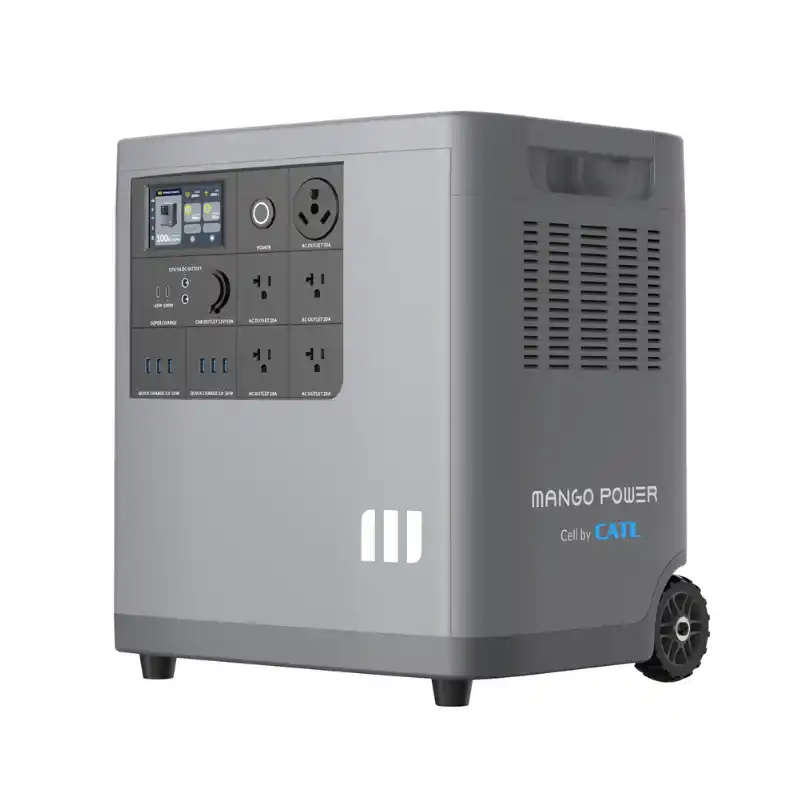
Mango Power E Review

The Mango Power E has a 33,532 Wh battery and delivers 33,010 Wh to the outlets via a 3,000W inverter. Cells are rated at 4,000 cycles, the handover measures 8.5ms, and solar accepts 2,000W, but only from 60 volts upward.
My Quick Verdict
Solar inputs are normally described by their ceiling. This one is defined by its floor.
The panel input on the Mango Power E ranges from 60 to 150 volts. Not 11 to 150, or 12 to 150, as almost everything else in this class does. Sixty is where it starts, and anything producing less is not recognised.
That single number rules out every foldable panel on the market and any small parallel arrangement. This machine will accept only a properly wired series of rigid panels.
The rest of it is respectable (4,000 cycles, an 8.5-millisecond handover, standby drain under one percent) wrapped in a hundred pounds and sixty decibels.
Best for: Permanent rigid-panel setups and household backup in outbuildings where nobody has to hear it.
Not for: foldable panels, portable use, or anywhere quiet.
Key Stats
| Badge | Stats |
|---|---|
| Battery chemistry and longevity | LiFePO4 | 4,000 cycles |
| Continuous AC power output | 3,000W AC | 4,800W peak |
| Energy storage capacity | 3,532Wh | 3,010Wh usable |
| AC wall recharge | 3,000W input | Single speed |
| Uninterrupted emergency backup | 8.5ms UPS | Manual arm |
| Maximum solar input and MPPT | 2,000W solar | 60V minimum |
| Ultra-fast USB-C power delivery | 100W USB-C PD |
| Low-noise operational level | 60dB | Loud under load |
| Standby retention | 0.7% per hour |
| Modular capacity expansion | Expandable | Extra battery port |
Introduction
Every solar specification in this dataset is written the same way: a wattage, a voltage range, a current limit. Buyers read the wattage, occasionally check the upper voltage, and never think about the lower one because it is always low enough not to matter.
On this machine, it matters more than anything else on the sheet. The input accepts 60 to 150 volts, and a panel producing 40 volts on a bright afternoon will not register.
Foldable panels typically produce somewhere between 18 and 40 volts. None of them will work here. Its pack claims 4,000 lithium iron phosphate cycles with a five-year warranty, putting eleven years of daily service within reach.
What It Can Actually Run
Three thousand watts sustained, 4,800 in a burst, on 120 volts. The continuous figure is solid for the capacity; the surge headroom is narrower than most machines at this size offer.
Rated at 3,532 Whh, the sockets returned 3,010 Whh. 85%, sitting exactly on the class line. All calculations below use 3,010Wh.
- Refrigerator at 150W: about twenty hours.
- CPAP at 40W with the humidifier off: seventy-five hours.
- Starlink dish at 50W: sixty hours.
- Laptop at 70W: around forty-three charges.
The output measured 119 volts with 1.50% distortion, and the electrical noise reached 2,000 mV, which is at the upper end of the range for this field.
Charging and Smart Features
Mains charging reaches 3,000 watts, which is qfast for its capacity, though it runs at a single, fixed rate with no adjustable stages.
The panel input handles 2,000 watts at 20 amps, with a voltage range of 60 to 150 volts. Generous at the top; the trouble is where it begins.
The changeover clocked 8.5 milliseconds, quick for a machine this size, achievable only once a person has raised the inverter.
One curiosity worth knowing: combining mains and panel caps at around 1,800 watts, which is lower than the wall input alone can handle. Premium price tier, exceptional value tier.
Charging Speed Benchmarks
Charging benchmarks for the Mango Power E against the Over 3,000Wh capacity class, covering the 16 largest machines in our charging database. The bracket returns a 2,802W mean on mains and 2,681W on panels. As elsewhere on the site, Low, Average and High are worked out inside the class rather than across it.
Wall charging of 3,000W clears the 2,802W class average and sits in the upper half of the Average band, refilling 3,532Wh in about 1.2 hours. Two things qualify it. The rate is fixed at a single speed, so there is no gentle overnight profile, and combining mains with solar produces a lower ceiling than the wall socket manages alone, which is behaviour we have not recorded on any other machine. Treat mains and panels as alternatives here rather than as inputs that stack.
The headline 2,000W is below the 2,681W class average and rates Average against a 6,400W ceiling, filling the pack in roughly 1.8 hours. The figure that decides whether you can use it at all is the floor, not the ceiling: this input recognises nothing under 60 volts, and foldable panels typically produce between 18 and 40. Two rigid panels in series are the minimum to register anything, and three or four are needed to work through a cloudy afternoon. Check that before buying panels, not after.
Want an input that works with the panels you already own? The Pecron E3600LFP adds a dedicated low-voltage channel that engages from 12 volts alongside a 150-volt main path, so a single foldable and a full series string both work, and it accepts 2,400W of solar with 3,600W from mains across four selectable stages. Three kilowatt-hours refill in about 0.9 hours on AC or 1.3 hours on panels.
Real Capacity: What You Actually Get
Conversion is even here, with both paths landing close together.
Metered at the outlets, 3,010 Wh emerged from a claimed 3,532 Wh, an 85% match, which clears the threshold without distinction.
The twelve-volt route returned 2,977Wh, or 84%, a single point behind. There is nothing to gain by routing loads one way rather than the other.
Retention is where it does well: about 0.7% per hour is lost while the inverter idles, or 0.16% on the twelve-volt path. Charged and left armed, this machine holds its state well.
My takeaway: 3,010 Wh, regardless of which port you use. And with a 0.7% hourly drain, arming it and leaving it is affordable in a way it is not on several machines at this capacity.
Power Output and Surge: What It Can Turn On
The inverter is competent rather than commanding. Three thousand watts can power a refrigerator, heating, and lighting simultaneously without difficulty.
The surge is 4,800 watts, enough for any domestic compressor start, but narrower than the 7,200-watt headroom several rivals at this size provide. If you plan to start two motors within a second of each other, that margin is worth noting.
At 1.50%, the distortion passes, while 2,000 mV of electrical noise places it among the less tidy outputs measured here.
Sockets are sparse. One USB-C at 100 watts, and a car outlet rated at 133, under the 150-watt line where twelve-volt ports start earning their keep.
Real Appliance Runtimes
What 3,010Wh delivers as running time, using the loads applied throughout this site.
| Appliance | Power Draw | Runtime | What That Means |
|---|---|---|---|
| Full-size refrigerator | 150W | About 20.1 hours | Twenty hours on the fridge before cycling extends it. |
| CPAP machine (no humidifier) | 40W | About 75.3 hours | Seventy-five hours of overnight running. |
| Starlink dish | 50W | About 60.2 hours | Sixty hours of connection with no mains. |
| Pellet grill or smoker | 100W | About 30.1 hours | Thirty hours on the smoker. |
| Laptop (70W) | 70W | About 43 recharges | Through a single 100W port. |
Solid figures for the capacity, though the pack is larger than most at this size, and the 85% conversion means it does not pull as far ahead as the rating suggests.
Recharging: Wall and Solar
From a Wall Outlet
Three thousand watts from a socket refills the pack in a little over an hour, which is genuinely quick at this capacity.
What is missing is control. Charging runs at one fixed rate, with none of the selectable stages that several rivals offer, so there is no gentle overnight setting.
The combined figure is stranger still. Running mains and panels together caps around 1,800 watts, which is less than the wall input alone. On every other machine reviewed here, adding solar raises the ceiling rather than lowering it. If you are in a hurry, disconnect the panels.
From Solar Panels
This section defines the machine and should be read carefully before purchase.
The input accepts 2,000 watts at 60 to 150 volts, 20 amps. That upper ceiling is generous, and the current allowance is decent.
The 60-volt floor is the issue. Most machines in this dataset start at 11 or 12 volts, which means a single foldable panel works straight out of the bag. Here, nothing under 60 volts is recognised at all.
Foldable panels generally sit between 18 and 40 volts. To reach 60, you need at least two rigid panels wired in series, and realistically three or four to operate comfortably above the floor across a cloudy day.
For a fixed array,y that choice is defensible. For anyone assuming a portable panel would plug in, it is a trap with no warning attached. The array can stay bolted in place, and output continues throughout a charge.
Blackout Backup: The Part I Care About Most
The handover is one of the better figures at this capacity, and the automation behind it is, as usual, absent.
Eight and a half milliseconds is well under the eleven-millisecond mark that separates real protection from a battery-with-a-relay setup. Nothing with a processor would register the changeover.
Nothing comes up unprompted; the inverter waits for a hand and stays up only while undisturbed.
Losing only 0.7% per hour keeps that habit inexpensive, and among the machines here that need to be armed by hand, this is one of the cheaper ones to leave running.
Why this matters to me: eight and a half milliseconds and sub-one-percent standby are nearly the complete set for automatic backup. The only missing piece is the firmware raising the inverter itself, and it is the piece that decides whether an empty house is covered.
Noise and Living With It
Sixty decibels under load, which is among the louder readings in this dataset and excludes any indoor space where people spend time.
In a plant room, outbuilding,g or detached garage,ge it will not matter. In a house, it will be audible through a closed door.
The weight is 100 pounds (45 kilograms) in one body. It requires a two-person lift and a machine that goes where it is put and stays there.
Both Wi-Fi and Bluetooth are supported, and Mango answers calls during the warranty period.
Where It Falls Short
There are three limitations, and the first will catch buyers out more than any specification on this page.
1. The Solar Input Starts at 60 Volts
Almost every machine in this dataset accepts panels rated at 11 or 12 volts or higher. This one recognises nothing below 60.
Foldable panels sit between 18 and 40 volts, so none of them will work. You need two rigid panels in series to reach the floor and three or four to operate comfortably above it in imperfect conditions.
For a permanent, defensible array. For anyone expecting to unfold a panel beside the machine on a camping trip, it is a wasted purchase, and nothing about the headline 2,000-watt figure warns you.
2. Combined Charging Is Slower Than Mains Alone
Wall input reaches 3,000 watts. Walls and panels together cap around 1,800.
Every other machine reviewed here treats solar as additive. Here, it appears to displace the main’s capacity rather than supplement it, so the fastest route to a full pack is the socket by itself.
3. Sixty Decibels, One Hundred Pounds, One Charging Speed
The noise excludes indoor rooms, the weight makes it a permanent installation, and the single fixed charging rate removes the gentle overnight option that several rivals offer.
Individually, none is fatal. Together,r they describe a machine for an outbuilding.
How It Compares
The natural comparisons are the Jackery SG HomePower 3000 and the Pecron E3600LFP, both at a similar capacity.
| Feature | Mango Power E | Jackery SG HomePower 3000 | Pecron E3600LFP |
|---|---|---|---|
| Price tier | Premium | Premium | Upper mid-range |
| Value tier | Exceptional | Good | Exceptional |
| Rated capacity | 3,532Wh | 3,072Wh | 3,072Wh |
| Usable through AC | 3,010Wh (85%) | 2,820Wh (91%) | 2,760Wh (89%) |
| Solar voltage range | 60 to 150V | 12 to 60V | 12 to 150V |
| Solar input | 2,000W | 1,000W | 2,400W |
| Wall charging | 3,000W, single speed | 1,800W | 3,600W, four-stage |
| UPS switchover | 8.5ms | 13.3ms | 9ms |
| Idle drain per hour | 0.7% | 0.83% | 1.16% |
| Fan noise | 60dB | 52dB | 52dB |
| Weight | 100 lbs | 59 lbs | 79 lbs |
The Pecron E3600LFP is the clearest comparison because it accepts the same 150-volt ceiling and adds a 12-volt low-voltage channel. It also charges faster from the wall, with four selectable rates; weighs 21 pounds less; runs 8 decibels quieter; and sits in a lower price tier.
On specification alone, the Pecron wins comfortably. What the Mango offers is 460 more watt-hours of rated capacity and a slightly faster handover.
The Jackery SG HomePower 3000 converts six points better and weighs forty-one pounds less, but stops at 60 volts on solar, has no expansion path, and charges from the wall at only 1,800 watts.
Who Should Buy It, and Who Should Skip It
Buy It If
- Your array is rigid panels wired in series, comfortably above 60 volts.
- The machine will be installed in an outbuilding or plant room and left there.
- You want the pack held at charge for months, where 0.7% an hour is genuinely low.
- A fast handover matters, and you accept arming it by hand.
Skip It If
- You own or plan to buy foldable panels. They will not work.
- The machine will run anywhere within earshot of people.
- You need to move it, or you want a gentle overnight charging rate.
- You expect solar and mains together to fill it faster than mains alone.
The Bottom Line
There is a decent machine here: 4,000 cycles, a quick handover, low standby drain, and honest value per watt-hour.
But two specifications behave unlike anything else in this dataset, and both work against the buyer. A solar input that ignores every foldable panel made, and combined charging is slower than the wall socket by itself.
Wired to a proper rigid array in a building where nobody has to listen to it, none of that matters, and the machine does its job. Bought based on the headline figures without reading the voltage range, it will disappoint on the first sunny afternoon.


There are no reviews yet.