
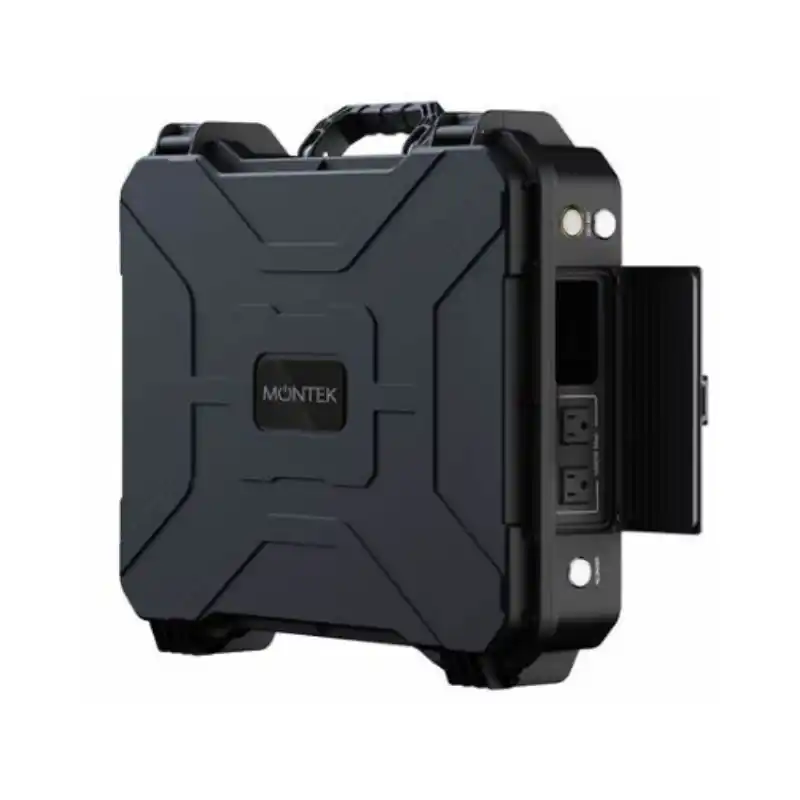
Montek X1000 Review

The Montek X1000 delivers 910Wh of its 1,010Wh rating, a 90% return, with a 260W twelve-volt output and 89% DC efficiency. It uses NMC cells rated for 2,000 cycles and has no automatic transfer function.
My Quick Verdict
90% of this machine’s rated capacity is delivered through the outlets, which is among the highest conversion figures we have recorded at any capacity.
Its 12-volt output is rated at 260 watts, nearly double what most machines of this size fit, and it returns 89% through that path as well.
Those two figures make it genuinely useful for vehicle and camp builds where twelve-volt equipment does the work.
It is also one of the few machines we have reviewed that still uses NMC cells, rated for 2,000 cycles, with no transfer function and no app at all.
Best for: Camp and vehicle setups running twelve-volt equipment, where efficiency matters more than longevity.
Not for: backup of any kind, long-term ownership, or anyone who wants remote monitoring.
Key Stats
Introduction
Conversion efficiency is the quiet advantage nobody advertises, and this machine has it. 90% of the rated pack reaches the outlets, where the field average sits closer to 85.
That figure is matched on the 12-volt side at 89% and paired with a 260-watt DC socket, nearly double what a typical car outlet of this size provides.
For a camp fridge, a diesel heater, or vehicle accessories, that combination is genuinely well-suited.
The chemistry is where the machine dates itself. These are NMC cells rated for 2,000 cycles, one of only five NMC machines left in our database.
What It Can Actually Run
One thousand watts sustained with 2,000 in a burst. Slim for a pack this size, and enough to exclude every heating appliance.
Rated at 1,010Wh, the sockets returned 910Wh, 90%. Everything below uses 910Wh.
- Refrigerator at 150W: just over six hours.
- CPAP at 40W with the humidifier off: nearly twenty-three hours.
- Starlink dish at 50W: eighteen hours.
- A 45W twelve-volt camp fridge fed on DC: around twenty hours, using the 902Wh path.
The output measured a correct 120 volts, with no audible noise from the inverter itself and electrical noise of 1,773 mVmv.
Charging and Smart Features
Wall input is 210 watts via an internal charger, which is slow, about 5 hours from empty.
The panel input handles 360 watts across a 12 to 70 volt band at 12 amps, with no need to unhook the array.
Running both inputs together reaches 560 watts, and that is this machine at its quickest.
There is no UPS mode and no app. Upper mid-range price tier, exceptional value tier.
Charging Speed Benchmarks
Wall and array charging on the Montek X1000, set against the 1,000Wh to 1,999Wh capacity class in our database, which holds 30 machines at a 1,085W mains mean and a 641W solar mean. Each band is a within-class tercile, so these ratings measure the unit against comparable capacities and nothing larger.
Mains charging of 210W is barely above the 200W class minimum and amounts to less than a fifth of the 1,085W class average, working out at roughly 4.8 hours to refill a 1,010Wh pack. The guide's charge ratio makes the point plainly: at 0.21 watts per watt-hour this is among the slowest arrangements relative to capacity that we have recorded. In a bracket where the quickest machine accepts 2,400W and finishes inside forty minutes, that gap is nearly twelvefold.
Panels are faster than the socket, which is unusual at this size. 360W is still well under the 641W class average which records Low in a bracket peaking at 1,400W, but it refills the pack in about 2.8 hours, roughly two hours quicker than mains. On a suitcase-style machine intended for a truck bed or a work site, that reversal is worth planning around: bring panels rather than assume a generator or a socket will be the faster route.
Want the bigger machine in the same family? The Montek X1200 shares the rugged case design but accepts 1,200W from mains and 1,200W of solar through a 150-volt window, filling a larger 1,280Wh pack in roughly 1.1 hours on either channel. It also runs LiFePO4 cells rather than NMC, so repeated fast charging costs far less over the life of the pack.
Real Capacity: What You Actually Get
This section justifies the machine.
Put a meter on the sockets, and 910 Wh comes out of a 1,010 Wh claim. Barely a handful of machines anywhere in this data beat 90%, and it means what the label promises is close to what you spend.
DC came back at 902Wh, 89%, one point down. With a single point between them, put things wherever suits you rather than chasing efficiency.
Retention is sound too, a percent per hour armed, half that through twelve volts.
For a machine at this price, those are figures that would grace something considerably more expensive.
My takeaway: 910 Wh via AC and 902 Wh via DC from a 1,010 Wh pack. Almost nothing is lost either way, which is the strongest argument this machine makes.
Power Output and Surge: What It Can Turn On
The inverter is the limitation. A thousand watts holds steady, trailing the typical 1,800 at this size by a wide margin, putting heaters, kettles, and dryers well beyond it.
Two thousand watts of surge covers a refrigerator compressor start, which is the load most household buyers care about.
The DC side is where the design is more generous. A 260-watt, twelve-volt output comfortably exceeds the 150-watt threshold and can run a compressor fridge with something beside it.
Combined with 89% DC efficiency, that makes this a better twelve-volt machine than several units costing considerably more.
Output quality is decent: correct 120 volts, no audible inverter whine, and 1,773mv of electrical noise.
Real Appliance Runtimes
AC lines below work from 910Wh; the twelve-volt line uses the 902Wh DC measurement.
Note how close the AC and DC figures are. On most machines, the two paths differ by five points or more; here they differ by one, so the choice of socket costs you almost nothing either way.
Recharging: Wall and Solar
From a Wall Outlet
Two hundred and ten watts into a 1,010Wh pack takes close to five hours from empty, which is slow by any current standard.
At least the charger lives inside the machine, so nothing separate travels with it or goes missing, unlike several units charging at comparable rates.
There is no adjustable rate, so that is the only speed available.
Dual charging is supported, raising the combined ceiling to 560 watts, more than double that of a single socket, and is the practical way to recharge this machine on a bright day.
From Solar Panels
The panel input draws 360 watts at 12- 70 volts and 12 amps.
The 70-volt ceiling is slightly above the 60 volts most machines at this capacity allow, which gives a little more room for a series pair of rigid panels.
Because it accepts from 12 volts, a folding panel registers straight off, so occasional solar needs no workaround.
Three hundred and sixty watts is slim, yet the sheet confirms that the panels alone can replenish it within the standard window, something many larger machines cannot do.
The array can stay permanently connected, and pass-through charging is supported.
Blackout Backup: The Part I Care About Most
There is no automatic transfer function on this machine.
Its grading row marks the UPS mode as not applicable, so whatever is in the sockets goes dark with the mains, no different from a wall circuit.
That places the X1000 alongside more than two dozen machines in our database with the same gap. The verdict does not change: storage, not protection.
Shedding just a percent per hour, it holds a charge well. Acting without you is the one thing it cannot do.
Why this matters to me: excellent conversion counts for nothing at the moment the grid drops. If catching an outage is the reason you are shopping, this machine cannot do it at any price.
Noise and Living With It
Fifty-nine decibels under load, which is among the louder readings recorded here and beyond what any occupied indoor room will tolerate.
No sound comes from the inverter, leaving the fans solely responsible, an improvement over several machines at this price
Twenty-five pounds, 11 kilograms, lean for a kilowatt-hour and genuinely liftable with one arm.
Nothing connects to a phone, no module port is fitted, and the cover runs two years with a same-day response promise.
Where It Falls Short
Four limitations, and the first two will shorten your ownership.
1. NMC Cells Rated for 2,000 Cycles
One of only five machines left in our database using older NMC chemistry rather than lithium iron phosphate.
Two thousand cycles at one a day runs out somewhere past year five, whereas current LiFePO4 machines at this capacity reach eleven.
Paired with a two-year warranty, that is the shortest expected working life of anything at this size.
2. No UPS Mode and No App
Nothing catches the load when mains fails; connected gear stops.
Neither wireless standard is present, which rules out checking it from elsewhere, changing the rate by phone, or receiving any update.
3. A 1,000-Watt Inverter and 210-Watt Charging
One thousand watts sustained is the lowest at this capacity and excludes heating appliances entirely.
And 210 watts from the wall takes close to five hours from empty, which makes this a machine you charge overnight rather than between uses.
4. Fifty-Nine Decibels
Too loud for anywhere people sleep, camp, or work quietly. A garage, workshop, or vehicle absorbs it without complaint.
How It Compares
Two comparisons at the same capacity: its own larger sibling and the strongest all-rounder in the class.
Montek’s own X1200 is the machine that shows what this design becomes when properly finished: twice the inverter, three and a half times the surge, nearly six times the wall charging, LiFePO4 cells, a self-arming inverter, and a larger DC output.
The X1000 matches it only on DC efficiency, and trails it everywhere else. If both are available, there is no argument for the smaller one.
The Bluetti Elite 100 V2 converts four points worse and beats this machine on chemistry, cycle life, inverter size, charging speed, noise, and having a transfer function at all.
Who Should Buy It, and Who Should Skip It
Buy It If
- Twelve-volt equipment is your main load and the 260-watt socket suits it.
- You want the most usable energy from a rated pack at this capacity.
- The machine lives in a vehicle, garage, or workshop where the noise reaches no one.
- It is heavily discounted, and you accept a shorter working life.
Skip It If
- You expect to own it for more than a few years. The chemistry decides that.
- Catching an outage is anywhere in your reasoning.
- A heater, kettle,e or hair dryer is on your load list.
- Montek’s own X1200 is available, which fixes nearly everything here.
The Bottom Line
There is a genuinely efficient machine inside this one. 90% through the outlets, 89% through DC, and a 260-watt, twelve-volt socket make it a better camp and vehicle battery than several units that cost more.
The chemistry undoes it. Two thousand NMC cycles under a two-year warranty is the shortest working life at this capacity, and no amount of conversion efficiency compensates for a pack that ages out in five years.
Add no transfer function, no app, and a 1,000-watt inverter, and the picture settles. Buy it at a discount for the twelve-volt work you plan to do soon. Montek’s own X1200 is the better machine by a wide margin.


There are no reviews yet.