
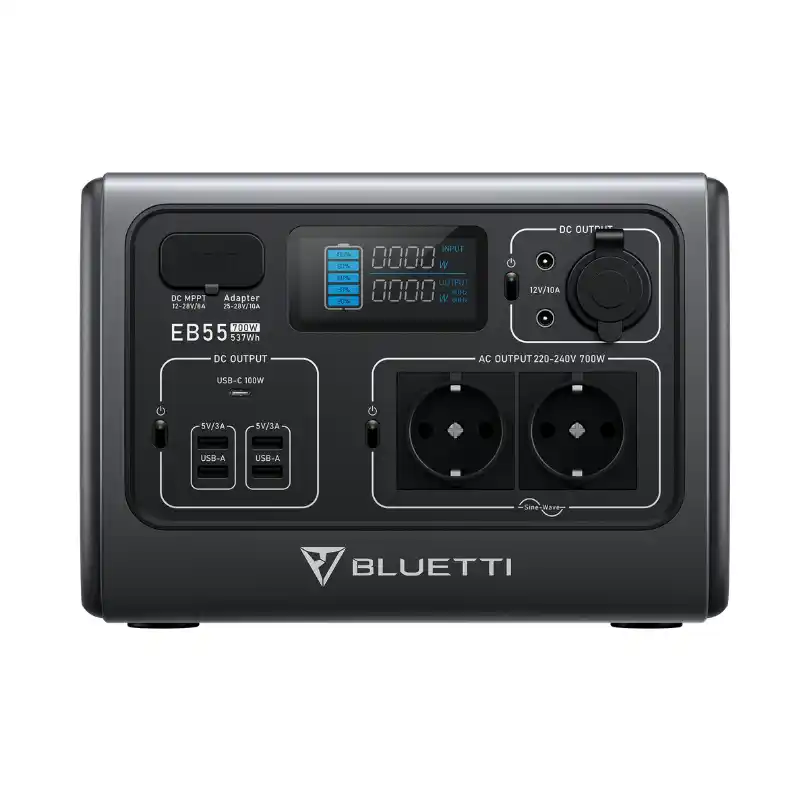
Bluetti EB55 Review

The Bluetti EB55 delivers 468Wh of its 537Wh rating, features a 700W inverter, runs at 48dB, and supports dual charging at 400W. Output measures 110 volts, charging runs through an external brick, and there is no app.
My Quick Verdict
This machine does the fundamentals well. It returns 87% through the sockets and 89% through DC, runs at 48 dB, and carries a 700-watt inverter, which is generous for a 537 Wh battery.
It also supports dual charging at 400 watts, which is the highest combined input of any compact machine we have tested.
What it costs is the problem. Per watt-hour, it sits among the most expensive machines we have reviewed.
The return on that outlay: a brick in the cable, nothing to connect to, nothing to catch a failure, and a line reading 110 volts.
Best for: Quiet camping where Bluetti’s support network matters and the machine is charged beforehand.
Not for: value shopping, backup, rigid solar panels, or anything with a motor.
Key Stats
Introduction
Judged purely by its performance, the EB55 is a decent compact machine. It converts well on both paths, runs quietly, and carries an inverter larger than most units at 5537 Wh
Judged by cost per watt-hour, it is the most expensive machine we have reviewed, ahead of split-phase home systems and modular installations several times its size.
That gap between capability and price is the whole review, because everything the machine does well, cheaper units at this capacity also do.
Its pack claims 2,000 lithium iron phosphate cycles against two years of cover.
What It Can Actually Run
Seven hundred watts sustained with 1,400 in a burst. Ample for a pack this size, handling a screen, lamps, networking gear, and chargers without strain.
Rated at 537 Wh, the sockets returned 468 Wh (87%), above the class line. Everything below uses 468Wh.
- Television at 150W: just over three hours.
- CPAP without humidification at 40W: close to twelve hours.
- Starlink dish at 50W: 9 and 1/3 hours.
- A 45W twelve-volt camp fridge on DC: past ten and a half hours, drawing on 478Wh.
The line read 110 volts, within the accepted band, with 1,961 mV of noise and an inverter hum.
Charging and Smart Features
Wall input is 200 watts through an external charging brick at a single fixed rate. From empty, that is around two and three-quarter hours.
The panel side handles 155 watts across 12 to 28 volts at 8 amps, and the sheet confirms sunshine alone completes a charge within the standard window.
Dual charging is supported at 400 watts combined, which is the highest figure of any compact machine we have measured.
There is no UPS mode and no app. Upper mid-range price tier, luxury value tier.
Charging Speed Benchmarks
How long the Bluetti EB55 takes to refill, set against the 300Wh to 999Wh capacity class, drawn from all 28 machines in our database rather than only the reviewed subset. The class averages 279W on mains and 192W on panels, with each band a tercile inside that group.
Wall charging of 200W arrives through an external brick and sits below the 279W class average, holding an Average rating on the boundary where High begins. That fills 537Wh in roughly 2.7 hours. The figure that improves the picture is dual charging at 400W: run panels alongside the brick and the effective input doubles, which is not something most machines in this price region offer. The brick itself remains a component to keep track of.
Solar accepts 155W, under the 192W class average and rating Average against a 600W bracket ceiling, which puts a panel-only refill at about 3.5 hours of strong light. On its own that is slow, and the sensible way to use this machine is to treat the two inputs as a pair rather than alternatives, since neither is quick enough alone to turn the EB55 around inside a working morning.
Want to lose the brick and halve the wait? The VigorPool Captain 700 charges internally at 600W, three times the EB55, and takes 240W of solar with dual charging supported. A larger 672Wh pack comes back in about 1.1 hours rather than 2.7, it runs at 47dB, and it accepts an expansion battery the EB55 has no equivalent for.
Real Capacity: What You Actually Get
Both paths clear the class line, which is more than most machines at this size manage.
A meter on the sockets recorded 468 Wh, compared with a claimed 537 Wh. 87% is a good return, better than that of several rivals at this capacity.
Twelve volts yielded 478, an 89% return, two points up. Two points apart is close enough to plug things in wherever suits.
Standby loss went unmeasured on both paths, so months on a shelf remain untested.
The conversion is genuinely the strongest thing here. It is also the one thing you are not paying a premium for, since cheaper machines at this capacity match it.
My takeaway: Plan on 468. What about the outlets? 478 Wh at 12 volts. Both figures are sound, and they yield a price per watt-hour that no other machine in our database asks for.
Power Output and Surge: What It Can Turn On
700 W continuous is generous for 537 Wh and gives this machine more headroom than most compact units.
Screens, lamps, networking kit, a laptop, and chargers all sit comfortably inside it. The 1,400-watt burst brushes what a household fridge demands when its compressor engages, making that load plausible rather than dependable.
The voltage undermines that. Ten volts under nominal makes every motor pull harder and heat up, which bites precisely on the borderline loads this inverter might otherwise manage.
Its USB-C outlet supplies a laptop’s full 100 watts, unlike the 60-watt ports several competitors fit.
Its 12-volt outlet is limited to 135 watts, under the 150-watt line, and the sheet logs the inverter humming alongside the fans.
Real Appliance Runtimes
Mains figures rest on 468Wh; the DC line uses the marginally better 478Wh.
Solid figures for capacity and a 48-decibel rating make them suitable for use in a tent. What they do not explain is why this machine costs what it does.
Recharging: Wall and Solar
From a Wall Outlet
Two hundred watts through an external brick fills the pack in around two and three-quarter hours, which the grading data still counts as fast charging by the three-hour standard.
The brick itself is the irritation. It packs apart from the machine, wants shelf space, and its loss ends mains charging outright.
There is no adjustable rate, so slow is the only speed.
Dual charging is the redeeming feature. Socket and sun together climb to 400 watts (no compact machine in this data combines them better), which appreciably shortens the wait in good weather.
From Solar Panels
The panel input draws 155 watts at 12-28 volts and 8 amps.
A 28-volt limit shuts out most rigid panels, so parallel foldables are what remain.
At 155 watts, the grading data indicates that a full solar recharge is achievable within the usual window, something several larger machines cannot manage.
The 12-volt floor means a single foldable engages immediately, suiting casual camp charging.
Panels may remain attached indefinitely, with output continuing during charging.
Blackout Backup: The Part I Care About Most
There is no automatic transfer function on this machine.
Its rating row indicates that UPS mode is not applicable, meaning the sockets are dead when the mains are off.
Normal at this size, since a handover is rare below 800Wh, and no particular fault of this unit.
Treat it as a campsite and desktop kit rather than protection, whatever the shelf label says.
Why this matters to me: at this capacity nobody should expect a transfer function, so the omission costs little. It is worth stating because a premium price can create expectations the specification does not support.
Noise and Living With It
Forty-eight decibels under load, which is quiet by any standard and among the better readings at this capacity.
For context, the EcoFlow River 2 Pro reads 60 decibels and the EcoFlow River Pro 58. Ten to twelve decibels is a substantial difference in a tent.
One qualification: the inverter hums on its own account, so airflow is not the sole culprit.
Sixteen and a half pounds, 7.4 kilograms, fair enough for what it holds. Nothing connects to a phone, and the cover lasts two years with a same-day response promise.
Where It Falls Short
Four limitations, and the first is the one that decides the purchase.
1. Among the Highest Prices Per Watt-Hour We Have Recorded
Only a handful of machines we have tested ask more per watt-hour, and none of them is this small, not the flagship split-phase systems, not the modular home installations.
The outlay secures 537 Wh, a brick in the cable, no connectivity, no handover, and a 110-volt line. Cheaper units this size equal or exceed it on conversion.
2. Output Measured 110 Volts
Under the band, which makes motors labour and warm across repeated starts.
That matters here because the 700-watt inverter is otherwise large enough to attempt a refrigerator.
3. A 200-Watt Charging Brick and a 28-Volt Solar Ceiling
Near two and three-quarter hours from flat, dependent on a part that lives outside the machine.
And 28 volts rules out most rigid panels, leaving small foldables as the only option
4. No UPS Mode, No App, 2,000 Cycles
Neither a handover nor any wireless, so nothing can be watched or improved.
And 2,000 cycles under two years of cover is the shortest pairing at this capacity.
How It Compares
Two comparisons at a similar capacity, both of which cost less.
Against the BigBlue CellPowa 500 at the same capacity, the EB55 wins on inverter size, solar input, dual charging, and USB-C. It loses on output voltage, whereas the BigBlue delivers 120 correctly.
The Pecron E600LFP is the harder comparison. More capacity, more than four points better conversion, correct voltage, 1,500 more cycles, nearly triple the solar and double the inverter, at a considerably lower price per watt-hour.
Bluetti’s support network and the 48-decibel reading are what you are paying for here. Whether those justify the premium is a judgment rather than a measurement, but the specification provides the basis for that judgment.
Who Should Buy It, and Who Should Skip It
Buy It If
- Quiet operation matters and the machine shares a space with you.
- Bluetti’s support network is worth a premium to you.
- Dual charging at 400 watts suits your travel needs.
- You want a 100-watt USB-C port on a compact machine.
Skip It If
- Cost per watt-hour carries meaningful weight in your decision.
- A refrigerator or anything with a motor is on the list.
- Your array is rigid panels, shut out by the 28-volt limit.
- The Pecron E600LFP is available, which does more for less.
The Bottom Line
The EB55 is a competent compact machine. Good conversion on both paths, quiet operation, a generous inverter for the capacity, and the best dual-charging figure in its class.
It also sits among the priciest machines per watt-hour we have tested, and the specification sheet does not explain why. The charging brick, the missing app, the 110-volt output, and the 2,000-cycle cells all belong to a cheaper machine.
Buy it if quiet matters and Bluetti’s support is worth paying for. On value, several machines at this capacity do more for considerably less.


There are no reviews yet.