
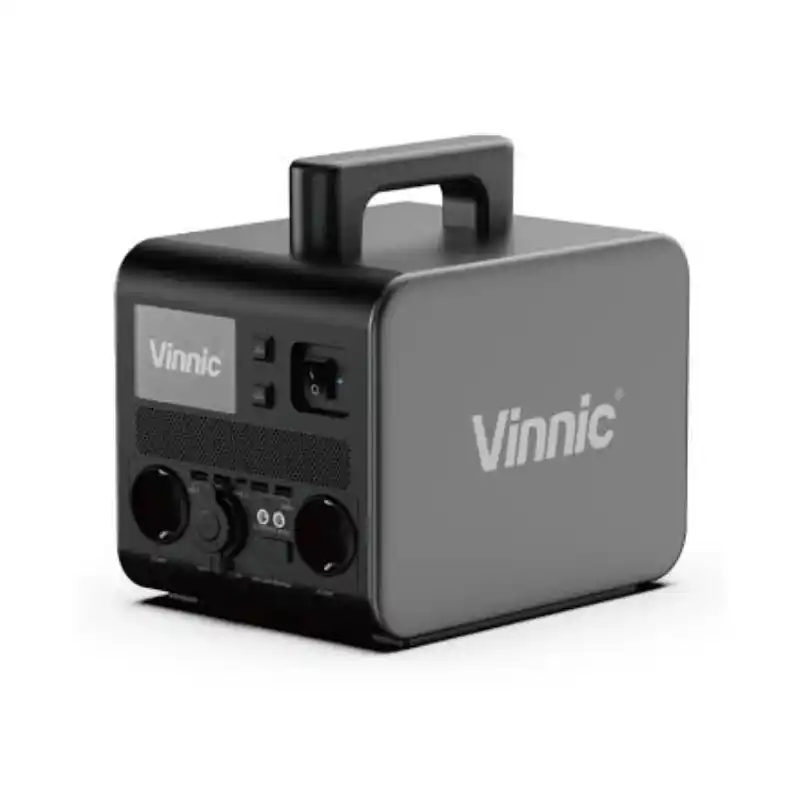
Vinnic PS700 Review

The Vinnic PS700 carries cells rated for 4,000 cycles, double that of any other compact machine we have tested, and is powered by a 700W inverter. It returns 430 Wh of its 512 Wh rating and charges at 200W via an external brick.
My Quick Verdict
Every other compact power station we have tested carries cells rated for 2,000 cycles or fewer. This one is rated for 4,000.
Cycled daily, that stretches to about eleven years, while rivals manage five and a half, and on hardware you might own for a decade, nothing else determines value so completely.
Alongside that sit a 700-watt inverter (ample for a pack this size) and USB-C at the full 100 watts a laptop wants.
The asking price is near the steepest per watt-hour we have logged, for hardware fed by a brick and delivering 110 volts.
Best for: Long-term ownership where cycle life matters more than the purchase price.
Not for: value shopping, fast charging, backup, or anything with a motor.
Key Stats
Introduction
Cycle life is the specification that determines how long a machine remains useful, and, in this regard, it is remarkably consistent: almost every compact unit we have tested is rated for 2,000 cycles or fewer.
The Vinnic PS700 is rated for 4,000. That is double the class norm and matches machines four and five times its capacity.
Drained and refilled daily, that is about 11 years before capacity slips to 80%, compared with 5.5 for the competition.
The cells are lithium iron phosphate, and a 700-watt inverter sits behind them, ample for this much storage.
What It Can Actually Run
Seven hundred watts sustained with 1,400 in a burst. Screens, lamps, networking kit, and chargers all fit; nothing that generates heat does.
Rated at 512 Wh, the sockets returned 430 Wh (83%), two points below the class line. Everything below uses 430Wh.
- Television at 150W: nearly three hours.
- CPAP without humidification at 40W: ten and a half hours.
- Starlink dish at 50W: 8.5 hours.
- A 45W twelve-volt camp fridge on DC: roughly 10 hours, drawing 454 Wh.
The line read 110 volts, within the accepted band, with noise measured at 1,790 mV.
Charging and Smart Features
Wall input is 200 watts through an external charging brick at a single fixed rate. From empty, that is around two and a half hours.
Solar takes 154 watts between 9 and 30 volts at 7 amps. That 9-volt floor is the lowest we have recorded, so almost any panel will engage it.
There is no dual charging here; wall and sun never work in concert.
There is no UPS mode and no app. Upper mid-range price tier, luxury value tier.
Charging Speed Benchmarks
Time to full for the Vinnic PS700, benchmarked against the 300Wh to 999Wh capacity class in our database, which holds 28 machines at a 279W mains mean and a 192W solar mean. Each band is a within-class tercile, so the figures rank this unit against similar capacities only.
Charging runs at 200W through an external brick, below the 279W class average and sitting exactly on the High boundary to record as Average. A 512Wh pack refills in about 2.6 hours. There is an argument for the slow rate on this particular machine: its cells are rated for 4,000 cycles, double any other compact unit we have tested, and a gentle charge is part of why a pack lasts that long. It is still slow against a class where the leader manages 950W.
Solar comes in at 154W, under the 192W class average and holding Average where the ceiling is 600W, taking roughly 3.3 hours of good light to fill the pack. That is broadly in line with the wall socket, so there is no fast route and no slow one. For a machine whose whole proposition is longevity rather than convenience, the charging figures are consistent with the design even if they are not competitive.
Want long cell life and quicker solar? The Pecron E600LFP pairs 3,500-cycle lithium iron phosphate with 400W of solar, more than two and a half times the Vinnic, filling a 614Wh pack from the array in around 1.5 hours. Mains charging rises to 270W and is internal rather than brick-fed, so the cable count drops as well.
Real Capacity: What You Actually Get
The twelve-volt path is the stronger of the two by nearly six points.
A meter on the sockets recorded 430 Wh, compared to a claimed 512 Wh. Two points shy of the standard this class is held to.
Twelve volts yielded 454 Wh (88.6%), well over that bar. Route what you can that way.
Standby loss is absent from our records on both paths, a conspicuous gap for a unit sold for its lifespan.
The conversion figures are ordinary. What is not ordinary is how many times you can repeat them before the pack degrades.
My takeaway: Plan on 430 Wh at the outlets, 454 Wh at 12 volts. Neither figure is remarkable; the number of times you can draw them is.
Power Output and Surge: What It Can Turn On
700 watts continuous is generous for a 512 W unit and gives the machine more headroom than most compact units, which typically top out at 500 watts.
Screens, lamps, networking gear, a laptop, and chargers all sit well within it. The 1,400-watt burst brushes what a household fridge needs when its compressor kicks in, which makes that load plausible rather than certain.
The voltage works against it. Ten volts under nominal makes every motor pull harder and warm up, biting hardest on the very loads this inverter might otherwise handle.
USB delivers a laptop’s full 100 watts, which many competitors of this size cannot match.
Electrical noise measured at 1,790 mV, which is mid-field for the category.
Real Appliance Runtimes
Main figures are based on 430 Wh; the DC line uses the higher 454 Wh.
Multiply any line here by 4,000, and you have the machine’s argument. Its rivals offer the same hours for half the charge.
Recharging: Wall and Solar
From a Wall Outlet
Two hundred watts through an external brick fills the pack in around two and a half hours, which is reasonable for the capacity if not quick.
That brick packs apart from the unit, needs somewhere to live, and its loss ends mains charging outright.
No rate control exists, so that’s the pace you get.
Nor can sunshine help, since the two inputs never combine.
From Solar Panels
The solar input holds a small record. Its 9-volt floor is the lowest we have measured on any machine, which means almost any panel, however small or shaded, will engage it.
The ceiling is 30 volts, which rules out most rigid panels and makes low-voltage foldables the practical route.
At 154 watts, the ceiling is slim, and the sheet notes panels alone fall short of the standard refill window. A 7-amp current allowance is fair for the class.
Panels may remain attached indefinitely, with output continuing during charging.
Blackout Backup: The Part I Care About Most
There is no automatic transfer function on this machine.
Its grading row marks the UPS mode as not applicable, so the sockets die alongside the mains.
That is standard at 512Wh, where almost nothing offers a transfer function, and it is not a fault of this machine specifically.
It does confirm this as camp and desk equipment, which the capacity already implied.
Why this matters to me: nobody buys 512Wh to guard a house, so the absent handover costs nothing. Cycle life is what this machine is selling, and that is a different kind of promise.
Noise and Living With It
No fan noise measurements exist in our data for this machine, which is a genuine gap for a compact unit likely to be used in a tent.
Fourteen point three pounds, 6.4 kilograms – lean for the capacity and easy to shift one-handed.
No connectivity at all, so nothing can be watched, altered,d or improved.
That last point sits awkwardly against a 4,000-cycle rating. A machine sold 11 years ago cannot tell you anything about its condition over that period.
Where It Falls Short
Four limitations, and the first is what you pay for the longevity.
1. Close to the Highest Price Per Watt-Hour in Our Database
A single unit in our testing costs more per watt-hour but stores more.
The 4,000-cycle rating is the justification, and over a decade the arithmetic can work. Over three or four years it does not.
2. Output Measured 110 Volts
Under the band, which makes motors labour and heat across repeated starts.
That is a particular irony on a machine designed to last eleven years; the appliances it feeds may not.
3. A 200-Watt Charging Brick and a 30-Volt Solar Ceiling
Two and a half hours or so from flat, via a part outside the machine, with nothing to speed it along.
And 30 volts excludes most rigid panels, so the excellent 9-volt floor only helps small foldables.
4. No App, No Transfer Function, No Idle Drain Data
Nothing can be monitored or updated throughout the machine’s intended long life.
Standby loss went unrecorded on both routes, the one figure that matters most for hardware kept on a shelf.
How It Compares
Two comparisons at almost identical capacity, both cheaper and both shorter-lived.
The Vinnic wins on the two specifications that describe how long and how hard the machine works: double the cycle life and 200 more watts of inverter. It also charges faster and absorbs more solar energy.
It loses on output voltage, where both rivals deliver higher voltage, and on dual charging, which both support but it does not.
The BigBlue CellPowa 500 is the value alternative, with correct 120-volt output, more usable capacity, dual charging, and a considerably lower price. The Vinnic’s case concerns only the decade after purchase.
Who Should Buy It, and Who Should Skip It
Buy It If
- You intend to keep the machine for the better part of a decade.
- Cycle life is the specification you shop on, at 4,000 against 2,000.
- You want a 700-watt inverter and a full 100-watt USB-C port at this size.
- Your panels are small foldables, which the 9-volt floor handles well.
Skip It If
- Cost per watt-hour matters. Only one machine in our data asks more.
- Anything with a motor will run on it, where 110 volts works against you.
- You want dual charging, which both rivals at this capacity offer.
- You will replace the machine within three or four years anyway.
The Bottom Line
The PS700 makes one argument, and it makes it clearly: 4,000 cycles, while the class offers 2,000, which is 11 years of daily use versus 5.5.
If you genuinely keep equipment that long, the price per watt-hour looks different by year eight.
If you do not, you are paying a premium for durability you will never claim, on a machine with a 110-volt output, a charging brick, and no way to monitor how long the pack will last.


There are no reviews yet.