
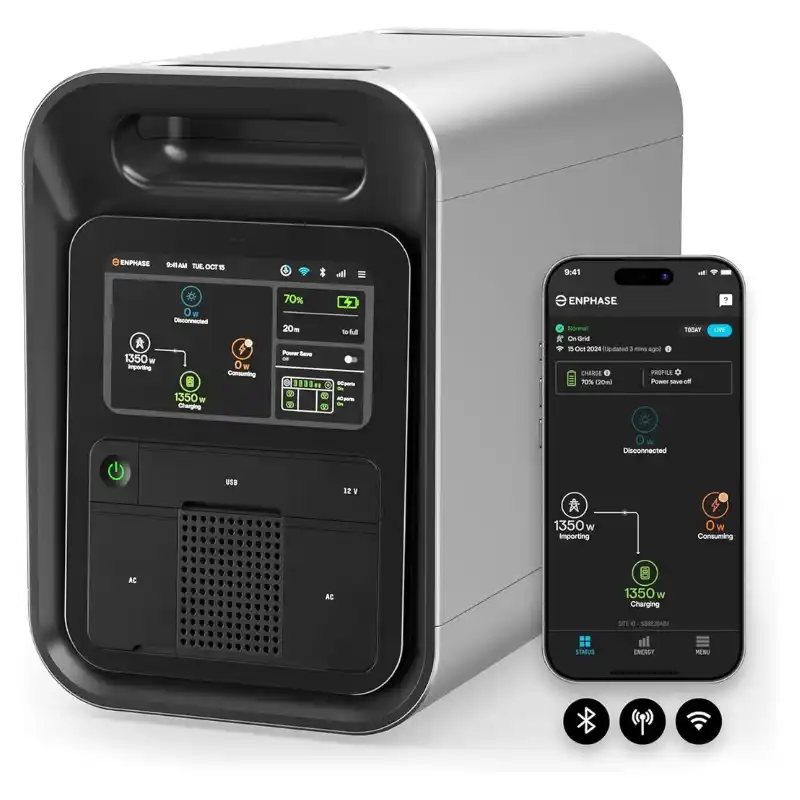
Enphase IQ PowerPack 1500 Review

The Enphase IQ PowerPack 1500 holds 1,532 Wh and runs a true zero-transfer inverter, so connected equipment never experiences a gap when the grid fails. Electrical noise measures 85 mV, about 20 times cleaner than the field, and the fans stay at 46dB. It sits in the premium price tier.
My Quick Verdict
Across every unit reviewed on this site, one number has never appeared before: zero milliseconds.
The IQ PowerPack does not switch over when the grid fails, because it never switched away from its own inverter in the first place. Your equipment runs continuously on battery power, and the mains simply keep the battery topped up. There is no gap to measure.
Its electrical noise reading is the other outlier, at 85 mV, while the rest of the field ranges from 700 to 2,000. That is roughly twenty times cleaner than typical.
Everything else about it is compromised, and it carries a luxury-tier price while delivering the worst DC yield in the dataset.
Best for: Emergency Home Resilience, where a computer, a network drive,e or medical equipment must not experience a gap of any length.
Not for: portable use of any kind, or solar-led setups. This is a fixture with a handle.
Key Stats
| Badge | Stat |
| Battery Chemistry and Longevity | LiFePO4 | 2,500 Cycles |
| Continuous AC Power Output | 1,500W AC | 3,000W Peak |
| Energy Storage Capacity | 1,532Wh | 1,310Wh Usable |
| Rapid AC Wall Recharge | 1,500W Input | Adjustable Speed |
| Uninterrupted Emergency Backup | 0ms Transfer | True Online UPS |
| Maximum Solar Input and MPPT | 440W Solar | 10A Hard Limit |
| Ultra-fast USB-C Power Delivery | 60W USB-C PD |
| Low-noise Operational Level | 46dB | Whisper Quiet |
| Inverter Electrical Noise | 85mV | Cleanest Measured |
| Modular Capacity Expansion | Not Supported |
Introduction
Almost every power station sold with backup capability is doing the same trick. The grid feeds your equipment directly; a relay monitors for failures, and when the voltage drops, it switches your load to the inverter. That flip takes time, and the argument in this category is about how little.
Enphase, a solar company rather than a battery brand, has built something structurally different. The inverter runs constantly, and your equipment is always drawing from it. The main does nothing but replenish the battery behind it.
There is no relay, no flip, and no gap. The measured transfer time is zero, not a rounding of a very small number, but the complete absence of the event.
Cell chemistry is lithium iron phosphate; 2,500 cycles claimed; 5 years covered. That is around seven years of daily cycling, and the shortest working life of any large unit reviewed here.
What It Can Actually Run
Sustained output is 1,500W with a 3,000W peak. Both figures are modest for a pack this size, and the sustained rating, in particular, is below what a 1,532Wh unit would normally deliver.
Put a meter on the sockets, and 1,310Wh comes back, or 85.5%. That figure drives every subsequent calculation.
- Refrigerator at 150W: approaching nine hours.
- CPAP at 40W with humidifier off: better than thirty hours.
- Starlink dish at 50W: around twenty-six hours.
- Laptop at 70W: about eighteen refills, though slowly, since the USB-C port delivers only 60W.
Voltage measured 121. Electrical noise on the output was 85 mV, a figure so far below the rest of the field that it belongs in a different category of equipment.
Charging and Smart Features
The main input reaches 1,500W with stepped rate control, filling the pack in about an hour.
Solar is severely limited. Just 440W across a 12 to 60 volt band, with an explicit instruction not to exceed 10 amps, and it cannot achieve a full recharge inside the two and a half hour benchmark other units meet.
Because the inverter runs continuously, there is no crossover to configure and no auto-on setting to miss. Loads run while charging, though mains and solar cannot feed it simultaneously.
Premium price tier, luxury value tier. This is the most expensive energy on the page by a wide margin, and the zero-transfer design is what you are paying for.
Charging Speed Benchmarks
Input figures for the Enphase IQ PowerPack 1500 against the 1,000Wh to 1,999Wh capacity class, benchmarked across the 30 machines in our charging database. Typical mains input there is 1,085W and typical solar is 641W. Every band is calculated within the class, not across the whole database.
Wall charging of 1,500W is nearly 40 percent above the 1,085W class average and comfortably past the 1,300W mark for a High rating, refilling 1,532Wh in about 1.0 hour. That is appropriate for a machine built by a solar company to behave like fixed equipment: it is meant to live plugged in, take over with no measurable gap, and be full again quickly after an outage rather than be carried anywhere.
The panel figure is the surprise. 440W is under 70 percent of the 641W class average and only just clears the Low threshold to record as Average, in a bracket whose highest figure is 1,400W. Refilling 1,532Wh at that rate takes roughly 3.5 hours of unbroken sun, the longest solar time of any High-rated mains charger here. On a machine from a solar manufacturer, the low ceiling reads as a deliberate choice to keep it grid-tied rather than as an oversight.
Want a machine sized for panels as well as the grid? The Pecron E1500LFP holds a comparable 1,536Wh and accepts 800W of solar to a 95-volt ceiling, nearly double the PowerPack and wide enough for a proper series string, while still charging at 1,400W from mains. The array fills it in about 1.9 hours instead of 3.5, and it sits several price tiers lower.
Real Capacity: What You Actually Get
The two output paths on this unit diverge more sharply than on any other, and unusually,y the AC side is the better one.
Through the outlets, it delivered 1,310 Wh of a claimed 1,532 Wh, or 85.5%. That is a solid, ordinary result.
On the twelve-volt side, it managed only 1,156 Wh, which is 75%. That is the lowest DC yield recorded in this dataset, and it is 10 points below its own AC figure.
The reason follows from the architecture. This machine was designed around a continuously running AC inverter, and the DC path is clearly secondary. Idling with the inverter live costs roughly 1% an hour, dropping to 0.66% on the twelve-volt side.
My takeaway: 1,310 Wh through the outlets and only 1,156 Wh through DC. This is the one unit reviewed here where running twelve-volt gear on twelve volts actively costs you energy rather than saving it.
Power Output and Surge: What It Can Turn On
The continuous rating of 1,500W is the number to check against your appliance list, because it is low for a pack of this size.
It sits exactly at the threshold for resistive heating appliances, meaning a 1,500W space heater would use the entire budget, with nothing left over. Units at similar capacity elsewhere carry 2,200W or 2,400W and can hold a second load alongside.
The 3,000W peak is sufficient for compressor starts and ordinary hand tools without difficulty.
The output genuinely excels in quality rather than quantity. An 85 mV electrical noise reading, against a field ranging from 700 mV to over 2,000 mV, indicates that the waveform reaching your equipment is exceptionally clean. For a network drive, a workstation, or medical equipment, that is worth more than surge headroom.
Real Appliance Runtimes
1,310 Wh expressed as running time, using the standard appliance loads applied across this site.
| Appliance | Power Draw | Runtime | What That Means |
| Full-size refrigerator | 150W | About 8.7 hours | Overnight without difficulty, and further as the compressor idles. |
| CPAP machine (no humidifier) | 40W | About 32.8 hours | Several nights running, and on the cleanest waveform anywhere in this set. |
| Starlink dish | 50W | About 26.2 hours | Over a full day of uptime off-grid. |
| Pellet grill or smoker | 100W | About 13.1 hours | More cooking time than most sessions require. |
| Laptop (70W) | 70W | About 18.7 recharges | Plenty of them, but slow ones, at 60W per port. |
Runtimes are strong because the pack is large. Note the laptop line: the count is high, but each charge takes longer than on any other unit here because the USB-C port delivers 60W, whereas rivals provide 100W or 140W.
Recharging: Wall and Solar
From a Wall Outlet
The mains input accepts 1,500W with adjustable stages, taking the pack from empty in roughly an hour.
That is quick for a unit of this capacity, and it matters more here than usual, because the solar path is too weak to be a serious recharge route.
Dual charging is not supported, so mains and panels cannot be combined.
From Solar Panels
This is the weakest solar implementation reviewed on this site, which is a genuinely odd thing to write about a product from a solar company.
Input is capped at 440W across a 12-60 V range, and the documentation includes an explicit warning not to exceed 10 A. That is a hard current limit stated in unusually blunt terms.
Ten amps and 440 watts together mean this unit cannot complete a full recharge within the two-and-a-half-hour window that most competitors meet, and it rules out any serious array.
Panels can remain connected throughout the day, and the unit runs loads while charging. But treat solar here as a trickle supplement, not as a recharge strategy.
Blackout Backup: The Part I Care About Most
This section is the reason the unit exists, and it is the only one on this site with no shortfall to report.
There is no transfer time because there is no transfer. The inverter runs continuously, and connected equipment draws from it at all times, with the mains serving only to keep the battery it’s connected to charged. When the grid fails, nothing about your equipment’s supply changes.
That architecture is what commercial installations call a true online or double-conversion UPS, and it is normally found in server rooms rather than in something with a carry handle.
There is also nothing to arm. Every other unit reviewed here requires someone to have switched the inverter on in advance. This one has no such state.
Why this matters to me: six of the ten units reviewed on this site cannot arm their own inverters, which means most of them provide no protection when a house is empty. This one removes the question entirely and is worth a great deal for a network drive or a workstation.
Noise and Living With It
The fans measure 46dB under load, which, for a unit of this size, is quiet and comfortably below the threshold for a room with a sleeper.
Given that a true online inverter runs continuously rather than only under load, that quietness is not a luxury. A unit humming permanently in a home office at 60 decibels would be unbearable, and this one is not.
Then there is the weight. Fifty-five pounds, 25 kilograms, for 1,532Wh. That is the poorest weight-to-capacity ratio among the mid-size units here and is firmly a two-handed lift.
App connectivity includes Wi-Fi and Bluetooth, with phone support covered under the warranty.
Where It Falls Short
The zero-transfer design costs a great deal elsewhere. Four areas in particular.
1. The Worst DC Yield Measured
75% through the twelve-volt path, ten points below its own AC figure and the lowest DC result anywhere in this dataset.
On every other unit reviewed here, moving a load onto DC saves energy. On this one, it wastes energy. Anyone planning a vehicle or camp setup around twelve-volt gear should look elsewhere entirely.
2. Solar That Cannot Recharge It
Four hundred and forty watts with a stated 10-amp ceiling is the weakest solar input here, and it cannot complete a recharge in the window competitors meet.
For a solar company, this is a strange limitation, and it removes off-grid self-sufficiency from the list of things this unit can do.
3. A 60W USB-C Port and No Expansion
Sixty watts is half of what most rivals provide and well under half of what the best provide. A modern laptop will charge, but slowly, and some will not charge at full rate at all.
There is also no support for expansion batteries, so 1,532 Wh is a hard limit for a unit in the premium tier.
4. Luxury Value Tier, Shortest Cycle Life Here
This is the most expensive stored energy on the page by a clear margin, and its cells offer 2,500 cycles, while rivals at a third of the price tier offer 3,500 or 4,000.
You are paying a substantial premium for one architectural advantage and accepting a shorter service life in exchange.
How It Compares
The closest comparisons are the Bluetti AC240, which has an identical rated capacity, and the Pecron E1500LFP, the cheapest route to this much stored energy.
| Feature | Enphase IQ PowerPack 1500 | Bluetti AC240 | Pecron E1500LFP |
| Price Tier | Premium | Upper mid-range | Entry |
| Value Tier | Luxury | Premium | Exceptional |
| Rated Capacity | 1,532Wh | 1,536Wh | 1,536Wh |
| Usable Through AC | 1,310Wh (85.5%) | 1,310Wh (87%) | 1,310Wh (85.2%) |
| Usable Through DC | 1,156Wh (75%) | 1,306Wh (85%) | 1,446Wh (94.1%) |
| Transfer Time | 0ms | 19.2ms | 18ms |
| Sustained Output | 1,500W | 2,400W | 2,200W |
| Electrical Noise | 85mV | 2,000mV+ | 2,000mV+ |
| Solar Input | 440W | About 1,000W | 800W |
| USB-C Port | 60W | 100W | 100W |
| Expansion Battery | No | Yes | Yes |
All three deliver an identical 1,310Wh through their AC outlets, which makes the rest of the comparison unusually clean. What separates them is what surrounds that number.
The Bluetti AC240 offers a larger inverter, more than twice the solar input, expansion support, and a lower price point. What it cannot give you is a gap-free supply, and its 19.2-millisecond transfer is among the slowest here.
The Pecron E1500LFP delivers the same AC energy at the entry-level price tier and returns 94.1% of that energy as DC, compared to this unit’s 75%. It is a better battery by a distance and a far worse UPS.
So the question is narrow and answerable: Is a genuinely gap-free supply worth two price tiers and a weaker unit in every other respect? For a workstation or medical equipment, plausibly yes. For a refrigerator, plainly not.
Who Should Buy It, and Who Should Skip It
Buy It If
- You are protecting a workstation, a network drive, or medical equipment that must not have any gaps in protection. in protection
- Waveform quality matters to you, where 85mv is in a different class from everything else here.
- The unit will be installed in one location and will never be moved.
- You want a backup system with nothing to arm and nothing to forget.
Skip It If
- Your loads are twelve-volt. This is the one unit that costs you energy rather than saves it.
- Solar is part of the plan. The 440W ceiling and 10-amp limit are too restrictive to matter.
- You need more than 1,500W of sustained power, or expect to add capacity later.
- The value per watt-hour is up to you.
The Bottom Line
The IQ PowerPack is the only unit reviewed on this site that is a true UPS rather than a battery with a fast relay, and that single architectural fact is what you are buying.
It removes the entire class of problems that have come up in six of the ten reviews here: an inverter that has to be armed in advance, and a transfer gap that may or may not be survivable by whatever you plugged in.
But it is a home appliance with a handle. Fifty-five pounds, a 60W USB-C port, the worst DC yield in the dataset, solar too weak to recharge it, and no expansion path, all at the luxury value tier. Buy it for one specific job, and it does that job better than anything else. Ask it to do anything else,e and it disappoints immediately.


There are no reviews yet.