
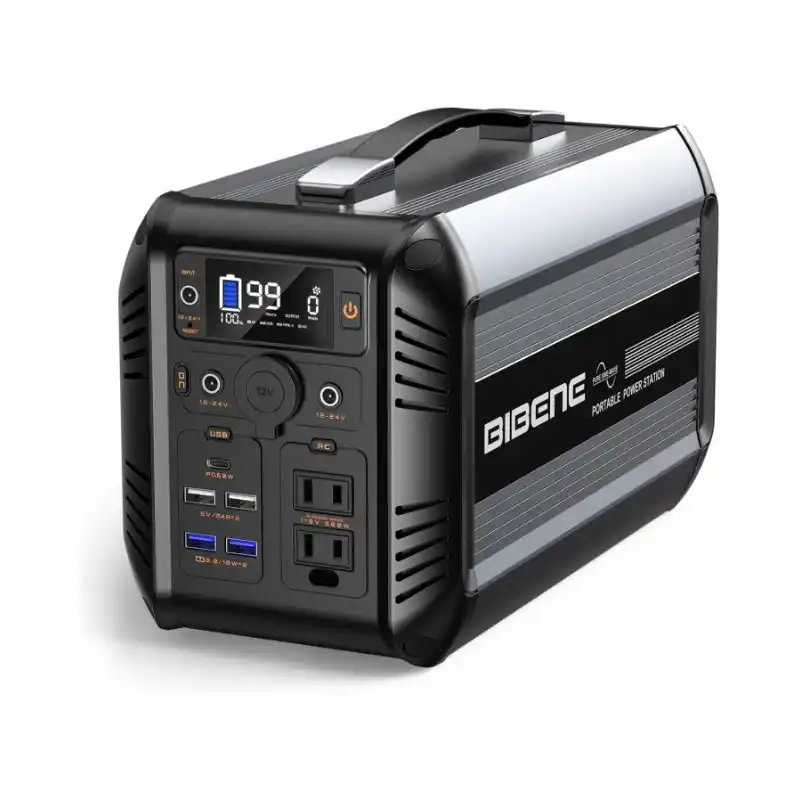
Bibene 614wh Review

The Bibene 614Wh returns just 451Wh via AC but 561Wh via DC, an 18-Wh gap. Solar caps at 94W across a 12- to 24-volt window, among the tightest measured, and charging runs at 94W through a brick.
My Quick Verdict
Through the AC sockets, this machine returns 73% of its rated capacity. Through the twelve-volt output, it returns 91%.
That eighteen-point spread is the second-widest amongst power stations we have reviewed, and it means plugging into the wrong socket costs you 110 watt-hours, nearly a fifth of the pack.
Nothing but one other machine has returned less through its sockets in this whole process.
Its solar input tops out at 94 watts across a 12- to 24-volt window, among the tightest ranges in the entire database.
Best for: Inexpensive camp setups where everything draws from the twelve-volt outlet.
Not for: AC-heavy use, solar charging, backup, or anything with a motor.
Key Stats
Introduction
Two numbers describe this machine, and they describe two different products.
Ask its AC sockets for energy, and 73% of the rated pack arrives, the joint-second-worst conversion figure we have measured. Ask the twelve-volt output and 91% arrives, which is genuinely good.
That eighteen-point spread is the second widest in our database, behind only the EcoFlow River Pro. At this size, the pack is worth 110 watt-hours, or nearly a fifth of everything you charged.
The pack claims 2,000 lithium iron phosphate cycles against two years of cover.
What It Can Actually Run
Five hundred watts sustained with 1,000 in a burst. That is the lowest AC rating among machines of this capacity, and it excludes refrigerator compressors and all heating appliances.
Rated at 614 Wh, the sockets returned just 451 W (73%). AC figures below use 451 Wh; DC figures use the much higher 561 Wh.
- Television at 150W through the inverter: three hours.
- CPAP at 40W with the humidifier off: eleven hours.
- Starlink dish at 50W: nine hours.
- A 45W twelve-volt camp fridge on DC: past twelve hours, drawing on 561Wh.
The line read 110 volts, within the accepted band, yet 1,096 mV of electrical noise ranks among the tidiest measured here.
Charging and Smart Features
Wall input is 94 watts through an external charging brick at a single fixed rate. From empty, that is more than six hours.
Solar takes 94 watts at 12-24 volts. Both the ceiling and the range are the narrowest in our database.
Dual charging is not supported, so mains and panels cannot run together.
There is no UPS mode and no app. Mid-range price tier, exceptional value tier.
Charging Speed Benchmarks
Refill times for the Bibene 614Wh within the 300Wh to 999Wh capacity class, measured against the 28 units our charging database holds. The bracket averages 279W of mains input and 192W of solar. Every band is internal to the class, so a Low rating reflects performance among machines of similar size only.
Both channels sit at 94W, and both take a Low rating. From a socket that is a third of the 279W class average and needs roughly 6.5 hours to fill 614Wh, the slowest socket refill on this page. The input arrives through a brick, so there is no rate control and no way to shorten it, and the class leader does the same job in under an hour at 950W.
Panels match the socket exactly at 94W against a 192W class average, which is again roughly 6.5 hours, so there is no faster route and no decision to make. The real limit is the 12 to 24 volt window, among the tightest we have measured: a single 100W rigid panel can exceed 24 volts at open circuit in cold bright conditions, which puts even a modest array outside what this input will accept.
Same capacity, a quarter of the wait. The Pecron E600LFP holds an identical 614Wh but charges internally at 270W and accepts 400W of solar, so a full refill takes about 2.3 hours on mains or 1.5 hours on panels instead of six and a half on either. Its 3,500-cycle cells and 91% return on both output paths widen the gap further.
Real Capacity: What You Actually Get
This section is the review.
A meter on the sockets measured 451 Wh, compared with a claimed 614 Wh. At 73%, about 163 watt-hours remain in the machine.
Twelve volts yielded 561 Wh (91%), a figure that would flatter a far more expensive unit.
That eighteen-point spread is the second widest we have measured. Three to five points is the usual separation between a machine’s two routes.
No standby loss was measured on either path, so months on a shelf remain untested.
My takeaway: Reckon on 451 Wht at the outlets, or 561 Wh at 12 volts. Use the twelve-volt output wherever you can; the difference is worth nearly a fifth of the pack.
Power Output and Surge: What It Can Turn On
Five hundred watts continuous is the lowest rating at this capacity and severely constrains the machine.
Screens, lamps, networking gear, a laptop, and chargers are all comfortable. A household fridge starting up can draw a 1,000-watt surge, so it may well trip the breaker.
The voltage compounds it. Ten volts under nominal makes every motor pull harder and heat up, which bites hardest on a machine already short of burst capacity.
The DC side is where the design works. A 91% return through the twelve-volt output makes camp fridges and vehicle accessories genuinely efficient here.
One genuine strength: an electrical noise level of 1,096 mV is among the cleanest readings in our database, better than machines costing several times as much.
The USB-C outlet manages 60 watts: full speed for phones and tablets, sluggish for a current laptop.
Real Appliance Runtimes
Main figures rest on 451Wh; the DC line uses the much-better 561Wh.
No refrigerator line appears here, and that is deliberate. With 500 watts continuous and 1,000 watts of surge on a 110-volt output, a domestic fridge is not a load I would rely on this machine to start.
Recharging: Wall and Solar
From a Wall Outlet
Charging a 614Wh pack at 94 watts takes more than 6 hours from empty, which is among the slowest charging arrangements in our database.
The power comes from a brick on the cable rather than from a charger inside, adding an object to pack and eventually replace.
There is no adjustable rate and no dual charging, so panels cannot shorten the wait.
For comparison, the Pecron E600LFP at identical capacity charges at 270 watts and fills in around two and a quarter hours.
From Solar Panels
The solar input is among the most restrictive we have measured, on both counts.
Ninety-four watts is among the lowest ceilings of any machine we have tested, and the 12- to 24-volt window is among the tightest; only two units accept a narrower range.
Twenty-four volts excludes essentially every rigid panel, leaving only small, low-voltage foldables, and at 94 watts, even those refill the pack over most of a day.
Unsurprisingly, the sheet notes panels alone will not finish a charge inside the standard window.
The array can stay permanently connected, and pass-through charging is supported, both of which this implementation allows.
Blackout Backup: The Part I Care About Most
There is no automatic transfer function on this machine.
The grading entry records the UPS mode as not applicable, so anything plugged into the outlets loses power the instant the grid does.
That is standard at this capacity and not a mark against the machine specifically. Almost nothing under 800Wh offers a transfer function.
It does mean this is camp and desk equipment rather than backup equipment, regardless of what the category name suggests.
Why this matters to me: at 614 Wh with a 500-watt inverter, nobody should treat this as backup. It is a battery for devices and twelve-volt loads, and it does that part adequately.
Noise and Living With It
There is no fan noise measurement in our data for this machine, which is a genuine gap. Noise decides more about a compact camping machine than most specifications.
What we do have is the electrical noise figure at 1,096 mV, which is clean and suggests a reasonable inverter design.
Sixteen point eight pounds (7.62 kilograms) is lean for the capacity and easily managed with one arm, the only measure win, which it clearly outdoes the Pecron.
Nothing connects to a phone, and the cover lasts two years with a same-day response promise.
Where It Falls Short
Four limitations, and the first two are structural.
1. 73% Through AC
Only one machine here converts worse through its outlets, and 163 watt-hours of the label stay locked inside.
91% at twelve volts is excellent by comparison, though it only helps with what you can put there, and a 60-watt USB-C port further limits that.
2. Ninety-Four Watts of Solar, Capped at 24 Volts
Among the smallest ceilings and tightest voltage windows in our entire database.
Essentially, no rigid panel will work. You are limited to small foldables, and even those take most of a day to refill the pack.
3. A 500-Watt Inverter at 110 Volts
No machine this size offers lower continuous output, and a fridge compressor may demand more than the 1,000-watt burst can provide.
The 110-volt reading also falls below the band, so motors labour more than they ought to.
4. A 94-Watt Charging Brick, No App, No Fan Noise Data
Over six hours from empty through a separate component, with no dual charging to help.
There is no Bluetooth or Wi-Fi either, and there is no fan noise measurement in our data, a real gap for a machine bought for camping.
How It Compares
The comparison at identical capacity is not close.
The Pecron E600LFP has identical capacity and beats this machine on nearly every measure: 18 points more AC conversion, more than double the inverter, four times the solar at four times the voltage ceiling, correct output voltage, and 1,500 more cycles.
The Pecron is cheaper per watt-hour and three pounds heavier, with mass being the sole column this machine takes.
The Oupes 600 is closer, matching on cycles, voltage, and USB-C while converting better through AC. Between those two, it is a narrow choice; against the Pecron, it is not a choice at all.
Who Should Buy It, and Who Should Skip It
Buy It If
- You will run 12-volt equipment through the DC output, which supplies % of the power; the cost is heavily discounted, and the loads are devices rather than appliances.
- Carrying it matters, and 16.8 pounds suits you.
- Clean inverter output matters for sensitive low-draw equipment.
Skip It If
- Your loads plug into the AC sockets, where only 73% of the power arrives.
- Solar charging is part of the plan. A 24-volt ceiling rules out nearly every panel.
- A fridge features in your plans, and 1,000 watts at 110 is not enough margin.
- The Pecron E600LFP is available at the same capacity.
The Bottom Line
There are two machines here. Fed through the DC outlet, it returns 91% and does honest work for the price.
Through the sockets, that falls to 73%, near the bottom of everything measured, behind an inverter managing 500 watts at 110.
Add the smallest solar ceiling and narrowest voltage window in our database, plus a 94-watt charging brick, and this becomes a machine for DC loads only. The Pecron, at identical capacity, does everything better.


There are no reviews yet.