
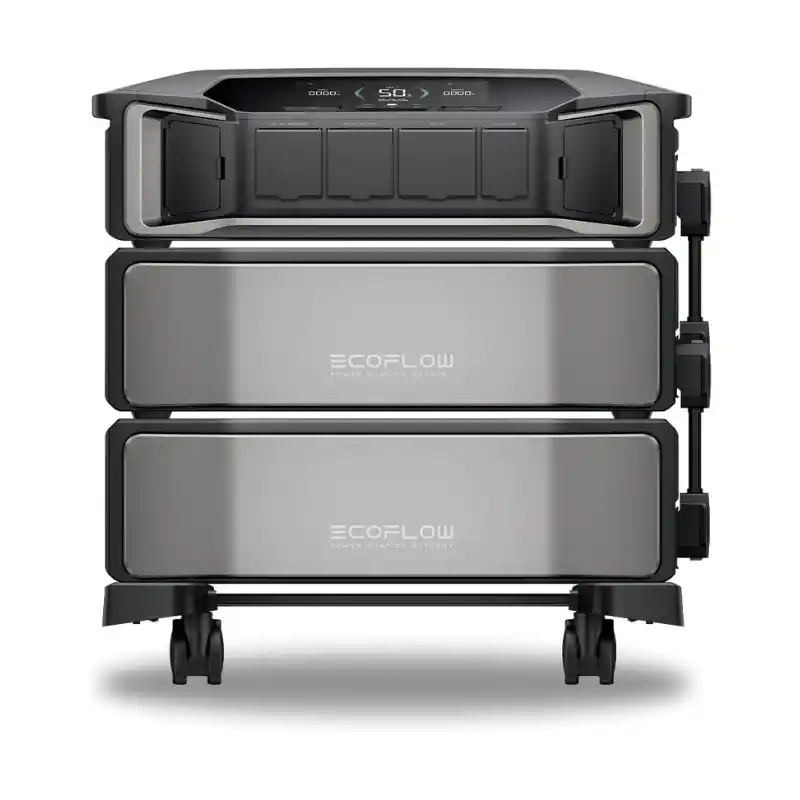
EcoFlow Delta Pro Ultra Review

The EcoFlow Delta Pro Ultra holds 6,144Wh behind a 7,200W split-phase inverter, delivers 5,620Wh at the outlets, and transfers to battery with no measurable gap while arming itself. Solar accepts 5,600W across a path reaching 450 volts.
My Quick Verdict
Two machines reviewed on this site have transferred to battery with no measurable gap. Only this one also raises its own inverter, which means it is the only unit here that protects an empty house with no gap at all.
It is the largest machine in the dataset at 6,144 Wh; it converts 91% of that and produces 7,200 watts on split-phase.
Its solar input accepts up to 450 volts, roughly three times the ceiling of anything else reviewed here, putting it in genuine rooftop-array territory.
It also weighs 188 pounds, costs more per watt-hour than almost anything at this size, and returns only 80% through DC.
Best for: Whole-home backup on a transfer switch, and permanent rooftop or ground-mount solar installations.
Not for: anyone weighing cost per watt-hour or twelve-volt loads.
Key Stats
| Badge | Stat |
|---|---|
| Battery chemistry and longevity | LiFePO4 | 3,500 cycles |
| Continuous AC power output | 7,200W AC | 10,000W peak |
| Split-phase output | 120V and 240V |
| Energy storage capacity | 6,144Wh | 5,620Wh usable |
| Rapid AC wall recharge | 7,200W input | 8,800W combined |
| Uninterrupted emergency backup | 0ms transfer | Self-arming |
| Maximum solar input and MPPT | 5,600W solar | 450V high path |
| Inverter waveform quality | 0.90% THD |
| Low-noise operational level | 42dB | Whisper quiet |
| Modular capacity expansion | Expandable | Extra battery port |
Introduction
Two things separate a genuine home backup system from a large battery with a fast relay. It must take over without a gap, and it must do so without anyone present to make it happen.
Put forty machines through this process, and precisely one manages both. Others transfer with no measurable delay but require manual arming; many arm themselves but take ten or fifteen milliseconds to switch over.
This one does neither of those things wrong. Its pack is lithium iron phosphate, claiming 3,500 cycles with a five-year warranty (roughly a decade of daily use), and the shortest life among the biggest machines in this data.
What It Can Actually Run
Seven thousand two hundred watts held continuously, 10,000 in a burst, on both 120 and 240 volts. That is the largest sustained output of any machine reviewed on this site.
The label reads 6,144 Wh, and the sockets returned 5,620 Wh (91%), which is a strong result at any capacity and remarkable at this one. All figures below use 5,620Wh.
- Refrigerator at 150W: better than thirty-seven hours.
- CPAP at 40W with the humidifier off: 140 hours, which is close to six nights.
- Starlink dish at 50W: 112 hours.
- Laptop at 70W: around eighty charges.
The waveform measured 0.90% distortion and 1,830 mV of electrical noise. The distortion figure is genuinely clean; the noise reading is mid-field.
Charging and Smart Features
Mains charging reaches 7,200 watts, and mains with panels together climb to 8,800 watts with solar prioritised, the highest combined figure recorded on this site.
The EcoFlow Delta Pro Ultra accepts solar input through two simultaneous paths: 1,600 watts at 30–150 volts (Low-PV) and 4,000 watts at 80–450 volts (High-PV), for a combined total maximum of 5,600 watts.
That 450-volt channel is unlike anything else in this dataset. It is string-inverter territory, the arrangement a permanent rooftop array actually uses.
Transfer is instantaneous, and the inverter arms itself. Flagship price tier, premium value tier.
Charging Speed Benchmarks
How the EcoFlow DELTA Pro Ultra compares on charging with the rest of the Over 3,000Wh capacity class, a group of 16 machines averaging 2,802W on mains and 2,681W on solar. Ratings are calculated within this bracket, so they place the unit among the largest machines on the site rather than against the whole database.
Our charging database records 1,800W of mains input for this machine, which is well under the 2,802W class average, lands at the bottom of the Average band, working out at roughly 3.4 hours to refill 6,144Wh. On a pack this large, recharging rather than capacity becomes the planning constraint. Note that EcoFlow publishes a much higher figure for the full stack, and until the two are reconciled the conservative number is the one to plan around. Class inputs reach 6,000W at the top.
Solar is where this machine has no real rival. 5,600W is more than double the 2,681W class average, a clear High rating, and it arrives through a path reaching 450 volts, roughly triple the ceiling of anything else here and the range a rooftop array genuinely operates at when it is wired for a string inverter. Panels fill the whole 6,144Wh pack in around 1.1 hours of strong light, a third of the time the recorded mains input needs.
Need mains charging that keeps pace? The Anker SOLIX F3800 Plus pulls 6,000W from a wall socket, the fastest grid charging we have recorded, and brings 3,840Wh back in about 0.6 hours with pass-through running throughout. Solar drops to 3,200W at 165 volts. For a property where the grid returns intermittently between outages rather than staying down for days, that balance is the more useful one.
Real Capacity: What You Actually Get
The two paths on this machine diverge by 11 points, and the gap runs counter to the direction most buyers expect.
Against a 6,144 Whh label, the outlets gave up 5,620 Whh. Ninety-one per cent at this scale means roughly 524 watt-hours lost, which is less than the entire capacity of a small power station.
The 12-volt route returned 4,936 Wh, or 80%. That is among the weaker DC figures in this dataset and is 11 points behind its own AC side.
Retention is first-rate: 0.58% an hour armed, 0.16% on the twelve-volt side. For hardware meant to sit installed and waiting for years, that is precisely the behaviour required.
My takeaway: Take 55,620 Wh from the sockets; at 12 volts, you get only 44,936 Wh. This is one of the few machines here where routing loads to 12 volts actively costs you energy; use the AC side.
Power Output and Surge: What It Can Turn On
The inverter is the largest reviewed on this site, and it changes themachine’ss purpose.
Seven thousand two hundred watts, continuous, at 120 and 240 volts, covers an entire property rather than selected circuits: a well pump, an electric range, heating, refrigeration, and a workshop, all simultaneously.
Ten thousand watts of surge puts motor inrush entirely out of consideration.
A distortion of 0.90% is clean enough for any sensitive equipment, and the 400-watt app-controlled DC port is useful, though the single 100-watt USB-C output is thin for a machine at this price.
Real Appliance Runtimes
5,620 Wh is set as the running time; on the appliance, this figure never varies.
| Appliance | Power Draw | Runtime | What That Means |
|---|---|---|---|
| Full-size refrigerator | 150W | About 37.5 hours | A day and a half on the fridge alone, before cycling extends it. |
| CPAP machine (no humidifier) | 40W | About 140 hours | Close to six nights uninterrupted. |
| Starlink dish | 50W | About 112 hours | Four and a half days of connection with no grid. |
| Pellet grill or smoker | 100W | About 56 hours | Fifty-six hours of cooking between charges. |
| Laptop (70W) | 70W | About 80 recharges | Eighty of them, through one port. |
At this scale, runtime is no longer the constraint, and recharging becomes the central question, which is why the 7,200-watt mains input and 5,600-watt solar ceiling matter more here than any figure in this table.
Recharging: Wall and Solar
From a Wall Outlet
Seven thousand two hundred watts from a wall connection is the highest mains input recorded on this site, and it refills a six-kilowatt-hour pack in well under an hour.
Combining mains and panels raises the ceiling to 8,800 watts, again the highest combined figure measured here.
For a system wired into a property and expected to cycle repeatedly across a multi-day event, that recovery speed is what makes the installation viable rather than merely large.
From Solar Panels
The solar implementation is the most capable in this dataset nd operates at two levels.
A lower channel takes 1,600 watts at 30 to 150 volts, covering a conventional series string of rigid panels.
The upper channel draws 4,000 watts at 80-450 volts. Four hundred and fifty volts is roughly three times the ceiling of anything else reviewed here, and it is the voltage range at which a proper rooftop array operates when wired to a string inverter.
In practical terms, it means the array on a house roof can feed this machine directly at high voltage and low current, using thin cable with minimal loss over a long run, rather than being rewired into low-voltage parallel banks to suit a portable battery.
Both channels track independently, panels may stay permanently connected, and loads run throughout a charge.
Blackout Backup: The Part I Care About Most
This is the section that separates the machine from everything else reviewed here.
The measured transfer time is zero. Not a sliver of a millisecond,d but nothing to measure, since connected equipment never experiences the changeover as an interruption at all.
And the inverter arms itself, which is the half that most machines get wrong. Two other units in this dataset transfer without a measurable gap; neither reliably raises its own inverter, so both protect only a house with somebody in it.
At that rate of loss, keeping it permanently armed costs almost nothing.
Why this matters to me: across forty machines, this is the only one that both transfers with no gap and wakes without being asked. For a property wired to a transfer switch, that combination is the entire product.
Noise and Living With It
Forty-two decibels under load, which is among the quietest readings recorded on this site and remarkable behind a 7,200-watt inverter.
Several machines that produce a third of this output run 10 decibels louder. For a system likely to be installed in a utility room adjoining a living space, that is a genuine engineering result rather than a footnote.
The weight is the constraint: 188 pounds (85 kilograms), the heaviest machine measured for this site. This is a delivery-and-installation exercise, not a purchase you carry indoors.
Wi-Fi and Bluetooth both work, running the most developed app software in this category, backed by a support line.
Where It Falls Short
Three things weigh against it, and none concern what the machine can do.
1. One Hundred and Eighty-Eight Pounds
The heaviest machine measured for this site is a single body. Getting it into position is a planned operation with more than one person and probably a trolley.
For a permanent installation, it is simply the cost of the capacity. It does mean the location needs to be decided before the order.
2. Premium Value Tier at a Flagship Price
Per watt-hour, this is expensive, sitting well above the machines at three to five kilowatt-hours that reach the exceptional tier.
What the money buys is the transfer behaviour, the 450-volt solar path, the 7,200-watt inverter, and the quiet. If you do not use those, the premium is real and unrecovered.
3. 80% Through DC, and 3,500 Cycles
The twelve-volt path is eleven points behind its own AC side and among the weaker DC results in this data, so vehicle-style loads are not a good fit.
Cell life of 3,500 cycles is also the shortest among the largest machines here, with 4,000 and 6,000 cycles appearing.
How It Compares
The natural comparisons are the Pecron F5000LFP and the EcoFlow Delta Pro 3, the two nearest machines in capability.
| Feature | EcoFlow Delta Pro Ultra | Pecron F5000LFP | EcoFlow Delta Pro 3 |
|---|---|---|---|
| Price tier | Flagship | Premium | Premium |
| Value tier | Premium | Exceptional | Good |
| Rated capacity | 6,144Wh | 5,120Wh | 4,096Wh |
| Usable through AC | 5,620Wh (91%) | 4,440Wh (86%) | 3,810Wh (93%) |
| Usable through DC | 4,936Wh (80%) | 4,653Wh (90%) | 3,660Wh (89%) |
| Sustained output | 7,200W split phase | 7,200W split phase | 4,000W split phase |
| Transfer time | 0ms, self-arming | 0ms, self-arming | 9.7ms, self-arming |
| Solar input | 5,600W to 450V | 6,400W to 180V | 2,600W to 150V |
| Wall charging | 7,200W | 3,600W | 4,000W |
| Distortion (THD) | 0.90% | 3.50% | 1.60% |
| Fan noise | 42dB | 58dB | 53dB |
| Weight | 188 lbs | 124 lbs | 113 lbs |
The Pecron F5000LFP is a value comparison, and it is a serious one: the same 7,200-watt split-phase output, the same instantaneous transfer with self-arming, more solar wattage, and an exceptional value tier compared to this machine’s premium. It weighs sixty-four pounds less.
What it gives up is waveform quality (by a wide margin, 3.50% distortion versus 0.90%) along with 16 decibels and 1,000 Wh of capacity.
The Delta Pro 3 converts two points better and costs a tier less, but delivers 4,000 watts rather than 7,200 and transfers in 9.7 milliseconds rather than instantly. For most households, that is enough; for a whole-property installation,n it is not.
Who Should Buy It, and Who Should Skip It
Buy It If
- You are wiring an entire property to a transfer switch and want it to operate unattended.
- You have a rooftop array operating at string-inverter voltages.
- Nothing you protect can tolerate any interruption at all.
- The system will be installed in or near the living space, where 42 decibels matter.
Skip It If
- Cost per watt-hour is up to you
- Your loads run on twelve volts, where this returns only 80%.
- Four thousand watts of output would cover you, which for most households it will.
- The installation site is difficult to reach with an 188-pound load.
The Bottom Line
This is the only machine among forty measured for this site that both transfers with no measurable gap and raises its own inverter. For a property wired to a transfer switch, that combination is not a feature but the entire specification.
Around it sit the largest inverter, the fastest charging, the highest solar voltage ceiling, and 42 decibels of noise, all of which are exactly what a permanent installation needs.
You pay a flagship price for premium-tier energy; it weighs 188 pounds, and the DC path is weak. None of that matters for the job it is built for, and all of it matters if you were buying it for anything else.


There are no reviews yet.