
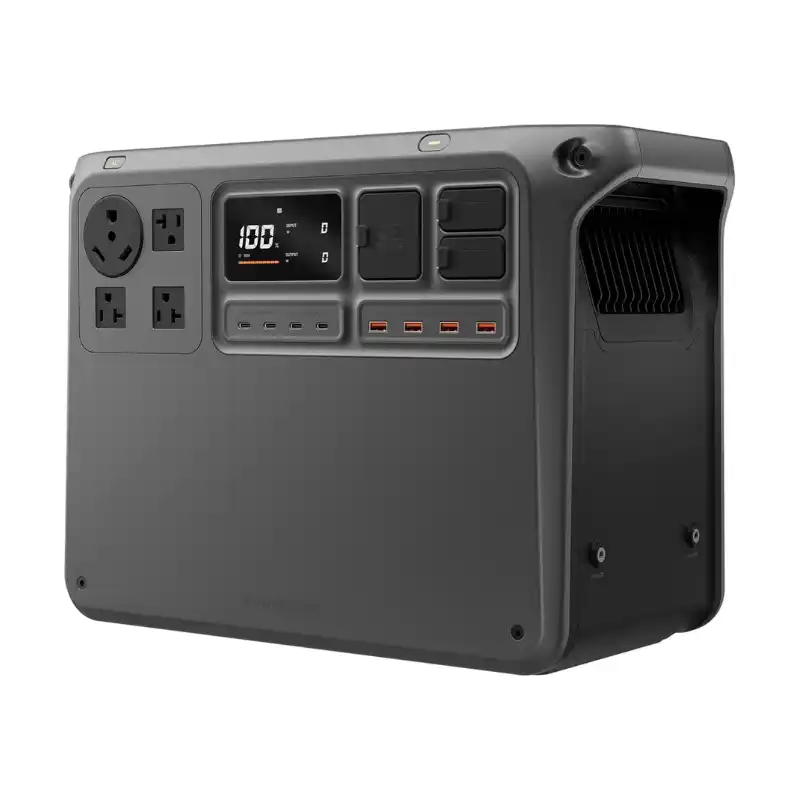
DJI Power 2000 Review

The DJI Power 2000 stores 22,048 Wh behind a 33,000 Wh inverter with a 6,000 W surge, and transfers to the battery with no measurable gal. Solar input reaches 1,800W over a 43-amp path, the most current any unit here accepts, and dual charging takes 2,300W. Upper mid-range price tier, exceptional value.
My Quick Verdict
Until now, only one unit reviewed on this site has posted a transfer time of zero, and it was a premium-tier fixture from a solar company that gave up almost everything portable to achieve it.
The DJI Power 2000 posts the same zero while sitting in the exceptional value tier, featuring a 3,000-watt inverter and a solar input that draws more current than any other unit measured here.
That combination should make it the obvious recommendation at this capacity. Two measurements stop it.
The fans reach 62 decibels, tying the loudest reading ever recorded here, and only 75% of the pack reaches you through the twelve-volt path.
Best for: Emergency Home Resilience and Remote Work where a gap-free supply matters and the unit lives somewhere noise does not carry.
Not for: bedrooms, tents, or anyone building around twelve-volt loads.
Key Stats
| Badge | Stat |
|---|---|
| Battery chemistry and longevity | LiFePO4 | 3,000 cycles |
| Continuous AC power output | 3,000W AC | 6,000W peak |
| Energy storage capacity | 2,048Wh | 1,770Wh usable |
| Rapid AC wall recharge | 1,800W input | 2,300W dual |
| Uninterrupted emergency backup | 0ms transfer | No measurable gap |
| Maximum solar input and MPPT | 1,800W solar | 43A, highest current |
| Ultra-fast USB-C power delivery | 140W USB-C PD |
| Low-noise operational level | 62dB | Loudest measured |
| Modular capacity expansion | Expandable | Extra battery port |
| High-output DC | 300W SDC fast-charge port |
Introduction
The smaller DJI unit reviewed on this site was clearly a field-production tool that happened to serve as a backup. Its solar window stopped at 30 volts, and its conversion was the weakest recorded anywhere.
This one corrects both faults so completely that it barely looks like the same product line. Solar climbs to 1,800 watts across a 43-amp low-voltage path, and conversion reaches 86% at the outlets.
It also transfers to the battery with no measurable delay. Lithium iron phosphate cells sit behind it, with a claimed 3,000 cycles and a five-year warranty. One cycle a day puts the 80% mark about eight years out.
What It Can Actually Run
The inverter sustains 3,000W with 6,000W of peak, which is a whole-circuit rating and among the largest at this capacity.
Rated storage is 2,048Wh. Metering the sockets recorded 1,770 Wh, an 86% return. Figures below use 1,770Wh.
- Refrigerator at 150W: nearly twelve hours.
- CPAP at 40W without humidifier: around forty-four hours.
- Starlink dish at 50W: better than thirty-five hours.
- Laptop at 70W: about twenty-five refills at full 140W speed.
Measured output was 119 volts. Harmonic distortion does not appear in the bench data, and electrical noise exceeds 2,000 mV, which is at the high end of the field.
Charging and Smart Features
Wall input draws 1,800W but offers only two speed settings, rather than the finer stages that several rivals provide. Mains and panels together reach 2,300W.
Solar is the standout section of the specification sheet. Up to 1,800W, arriving through an 11 to 45 volt path at 43 amps and an 11 to 60 volt path at 20 amps.
Transfer to battery measured 0 milliseconds, though the grading data shows no self-arming option, an unusual pairing worth confirming with DJI before relying on it.
Upper mid-range price tier, exceptional value tier. On a per-pound basis, very little here competes.
Charging Speed Benchmarks
Input speeds for the DJI Power 2000 against the 26 machines we hold charging data for in the 2,000Wh to 3,000Wh capacity class, where wall charging averages 1,641W and solar averages 1,123W. Low, Average and High are terciles calculated inside this class, which is why a High solar figure here would be an ordinary one on a 4kWh machine.
The socket side is unremarkable by design. 1,800W sits 159W over the 1,641W class mean and closes out the Average band, refilling 2,048Wh in about 1.1 hours on the fast setting. Class inputs span 470W to 5,000W. The limitation is granularity rather than speed: there are only two wall charging rates, so there is no gentle overnight profile the way five-stage and four-stage machines offer, and the choice is between full rate and one step down.
This is where the unit separates itself. 1,800W of solar is 60 percent past the 1,123W class mean, comfortably a High rating, and it arrives over a 43-amp path that is the largest current allowance recorded anywhere in our data. Panels fill the pack in roughly 1.1 hours, matching its own wall speed, which almost nothing at this size manages. High current rather than high voltage means wide parallel banks of low-voltage foldables work here, which is exactly the array most vehicle and camp builds actually own.
Want the wall socket to keep up with the panels? The Bluetti AC200L draws 2,400W from mains against 1,800W here, a third faster, and refills the same 2,048Wh of capacity in about 0.9 hours rather than 1.1. Its 1,200W solar ceiling is lower, so this is the trade rather than an upgrade: choose the AC200L when grid recharging before an outage matters more than daytime solar throughput.
Real Capacity: What You Actually Get
The two output paths on this unit diverge sharply, and the direction is wrong.
Through the sockets, it returned 1,770 Wh of a claimed 2,048 Wh, or 86%. That is a good result, above the class line and better than several units costing more.
Through the 12-volt side, it managed only 1,550 Wh. At 75%, that is eleven points below its own AC figure and ties the worst DC yield recorded anywhere in this dataset.
Standby is strong on AC at roughly 0.66% an hour, and noticeably weaker on DC at 1.25%.
My takeaway: 1,770Wh through the outlets is the number to plan around, and it is a good one. What you must not do is assume the DC path saves energy here. This unit costs you eleven points.
Power Output and Surge: What It Can Turn On
The inverter ratings are generous, and the port array is unusual, which together define what this unit is good at.
3,000W sustained covers heating appliances alongside other loads without shedding anything, and 6,000W peak leaves no domestic load capable of tripping it.
Two outputs come straight from DJI’s own equipment line: a USB-C port at 140 watts, enough to keep a laptop running at full speed without its charger, and a 300-watt SDC socket designed to refill camera and drone packs in a fraction of the usual time.
Electrical noise is the weak spot, exceeding 2,000 mV, whereas the best units at this capacity sit under 1,000 mV. For tools and appliances, that is immaterial. For sensitive audio or measurement equipment,t it is worth knowing.
Real Appliance Runtimes
1,770Wh converted into running hours, against the appliance loads applied consistently across this site.
| Appliance | Power Draw | Runtime | What That Means |
|---|---|---|---|
| Full-size refrigerator | 150W | About 11.8 hours | Half a day outright, extending well past that with compressor cycling. |
| CPAP machine (no humidifier) | 40W | About 44.3 hours | Four nights between charges. |
| Starlink dish | 50W | About 35.4 hours | A day and a half of satellite uptime. |
| Pellet grill or smoker | 100W | About 17.7 hours | Smoke a shoulder and still have hours in hand. |
| Laptop (70W) | 70W | About 25 recharges | Quick ones, since the port supplies 140W. |
Nothing here is unusual for two kilowatt-hours delivered at 86%. The reason to buy this unit is not its runtime but the way it behaves the instant the grid disappears.
Recharging: Wall and Solar
From a Wall Outlet
The mains input accepts 1,800W, filling the pack from flat in a little over an hour.
Control is coarse. Two-speed settings were the best at this capacity, giving four or five, so there is no gentle overnight rate to select.
Combining mains and panels lifts the total to 2,300W, which is respectable rather than class-leading.
From Solar Panels
Eighteen hundred watts is roughly double what most units at this capacity accept, and the way it arrives matters as much as the total.
Two distinct paths carry it: an 11-to-45-volt route rated at 43 amps, and an 11-to-60-volt route rated at 20 amps. Forty-three amps is the highest current recorded in this data, and current, rather than wattage, is usually what prevents a large low-voltage array from delivering everything it produces.
The 60-volt ceiling is ordinary rather than generous, so long series strings are still out. But for a large parallel array of standard panels, a few units here are better matched.
Panels may remain connected around the clock, and loads run during charging.
Blackout Backup: The Part I Care About Most
This is the section that justifies the unit, and it comes with one caveat worth taking seriously.
The measured transfer time is zero. Not a fraction of a millisecond, but no measurable gap at all, which is the same result the far more expensive Enphase unit produces through a continuously running inverter.
That puts equipment protection in a different category. Nothing plugged in should ever register the grid failing.
The caveat is that the grading data records no self-arming option, which sits oddly beside a zero transfer time. Those two facts are hard to reconcile, and the available sources do not resolve the conflict. If unattended protection is your reason for buying, confirm the behaviour directly with DJI before committing.
Why this matters to me: a genuine zero-gap transfer at this price tier would be the most significant finding in the dataset. The unresolved question about self-arming is the only thing keeping me from saying so without qualification.
Noise and Living With It
Sixty-two decibels under load, tying the highest figure ever recorded on this site.
That is a conversational volume sustained continuously, and it excludes bedrooms, tents, RVs, and quiet home offices without argument. In a garage, basement, or workshop, nobody will care.
At 48 pounds (21.7 kilograms), the mass is fair given the pack and the size of the inverter driving it. You will still want both hands, and it is something you place rather than something you carry.
Connectivity works over both Wi-Fi and Bluetooth, and DJI keeps a phone line open behind the five-year cover.
Where It Falls Short
Three things stand between this unit and a straightforward recommendation.
1. Sixty-Two Decibels
Tied for the loudest measurement in this dataset. This is not a marginal difference from the quiet units at this capacity, which run in the low forties.
It decides where the unit can live before any other specification gets a say, and for a unit otherwise capable,e it is the most costly flaw on the sheet.
2. Only 75% Through the DC Path
Eleven points below its own AC figure, and tied with the worst DC result recorded anywhere here.
On most units, moving a load to twelve volts saves energy. On this one,ne it wastes a substantial amount, which rules it out as the hub of a vehicle or camp setup built around DC gear.
3. Two Charging Speeds, and an Unresolved Self-Arming Question
Wall charging offers two rates where rivals offer four or five, so there is no gentle overnight option.
More importantly, the zero-millisecond transfer sits alongside a grading entry recording no self-arming capability. Those two things do not naturally coexist, and the available sources do not resolve the issue. Confirm before relying on unattended protection.
How It Compares
The closest comparisons are the Anker SOLIX C2000 Gen 2, the strongest all-round unit at this capacity, and the Enphase IQ PowerPack 1500, the only other zero-transfer unit reviewed here.
| Feature | DJI Power 2000 | Anker SOLIX C2000 Gen 2 | Enphase IQ PowerPack 1500 |
|---|---|---|---|
| Price tier | Upper mid-range | Upper mid-range | Premium |
| Value tier | Exceptional | Exceptional | Luxury |
| Rated capacity | 2,048Wh | 2,048Wh | 1,532Wh |
| Usable through AC | 1,770Wh (86%) | 1,760Wh (85%) | 1,310Wh (85.5%) |
| Usable through DC | 1,550Wh (75%) | 1,875Wh (91%) | 1,156Wh (75%) |
| Transfer time | 0ms | 7.2ms | 0ms |
| Sustained output | 3,000W | 2,400W | 1,500W |
| Solar input | 1,800W | 800W | 440W |
| Fan noise | 62dB | 44dB | 46dB |
| Battery cycles | 3,000 | 4,000 | 2,500 |
Against the Enphase, this is not close in value. Both transfer with no measurable gap, but the DJI carries 3x the capacity, 2x the inverter, 4x the solar input, and sits 2 value tiers higher. What Enphase offers in exchange is exceptionally clean output and a 46-decibel difference against 62.
Against the Anker SOLIX C2000 Gen 2, the argument is harder. The Anker converts better on DC by sixteen points, carries a thousand more cycles, and runs eighteen decibels quieter. Its 7.2-millisecond transfer is fast enough that nothing should notice it.
So the DJI wins when the loads are AC, the array is large, and the room isn’t one anyone sleeps in. The Anker wins in nearly every other category and is the safer recommendation for most households.
Who Should Buy It, and Who Should Skip It
Buy It If
- You want a gap-free transfer without paying the premium tier.
- You are building a large solar array and need the highest available input ceiling.
- You charge camera or drone batteries and want the SDC fast-charge port.
- The unit will be located in a garage, basement, or workshop.
Skip It If
- It has to run anywhere quiet. Sixty-two decibels rules that out entirely.
- Your loads are twelve-volt, where only 75% of the pack reaches you.
- You want the longest cycle life at this capacity.
- Unattended protection is critical, and you cannot confirm the self-arming behaviour first.
The Bottom Line
This is the second unit reviewed here to transfer with no measurable gap, and the first to do it at a sensible price with a serious inverter and the largest solar ceiling in the dataset.
On paper, that should end the argument at two kilowatt-hours. It does not, because 62 decibels is a genuine exclusion rather than an inconvenience, and a 75% DC path undermines exactly the vehicle and camp use cases the solar figure invites.
Put it in a workshop with a large array and AC loads, and very little competition. Ask it to sit quietly in a hallway, or to feed twelve-volt gear, and it is the wrong unit.


There are no reviews yet.